Quick wins for a faster PC:
Repair Windows errors before they cause bigger problemsFix Now →Fix the driver behind crashes, sound loss and screen glitchesFind Drivers →Clear out junk files and repair common Windows errorsFree Scan →AI growth is increasingly limited by access to electricity, not just by the supply of chips or software. Data centers need large, reliable power connections, and those connections can take longer to obtain than the buildings and servers they are intended to support. Grid-connection queues, permitting, transmission construction and shortages of transformers, gas turbines, advanced chips and other equipment can delay new capacity. They also force operators to choose locations, generation contracts and operating strategies that require substantial investment.
The result is a near-term constraint on how quickly AI computing can expand. It does not, however, prove one universal increase in the price of every AI service. Electricity prices, contracts, generation mixes, connection rules and project timing differ widely by region and facility.
As an Amazon Associate I earn from qualifying purchases.
Why electricity has become an AI growth constraint
Every AI workload ultimately runs on powered servers. Training and serving larger models require dense clusters of accelerated servers, which can draw far more electricity per rack than conventional enterprise computing. A developer can buy processors and design a facility, but that capacity is unusable until a utility or an on-site generation system can deliver sufficient power with the required reliability.
The Tool Desk
Outbyte Driver Updater FREEFix the driver behind crashes, sound loss and screen glitchesFind Drivers →Outbyte PC Repair FREERepair Windows errors before they cause bigger problemsFix Now →The International Energy Agency (IEA) reported in its 2026 update that global data-center electricity demand grew 17% in 2025, while global electricity demand overall grew 3%. AI-focused data-center demand increased faster than the data-center total. That is an observed growth comparison for 2025, not a forecast.
#1 Best Overall

- POWER AND CHARGE: This rack mount power strip provides an additional 8 NEMA 5-15 outlets (120V/15A) and features a 6ft (1,8m) long cord so you can plug your devices in while leaving the rack mobile
- 1U RACK DESIGN: Compatible with all 19" server racks 4 inches or deeper, this horizontal-mount power distribution unit fits many network racks and has an integrated power cord; ANSI/EIA RS-310-D standard
- EASY INSTALLATION: This IT-grade rackmount PDU features a rugged steel chassis, LED indicators for ground and surge protection, and lets you control the power state with power and reset switches
- PROTECTS YOUR EQUIPMENT: This rack mountable 8-outlet (120V) power strip features a built-in circuit breaker and reset switch, ensuring a dependable performance of your networking equipment
- THE IT PRO'S CHOICE: Designed and built for IT Professionals, this rack PDU is backed for 2-Years, including free lifetime 24/5 multi-lingual technical assistance
IEA described the emerging problem this way: “At the same time, AI deployment is increasingly coming up against a range of physical bottlenecks, limiting the rate at which data centres can expand in the near term.” The bottlenecks are both physical and administrative. A project may be ready to build but waiting for a connection study, planning approval, transmission work or a transformer that is not available on schedule.
Physical bottlenecks
- Grid capacity: A local substation or transmission line may not have spare capacity for a large new load.
- Long-lead equipment: Transformers, gas turbines and other electrical or generation equipment can have tight supply chains.
- High power density: Accelerated servers concentrate more load in a smaller space, increasing demands on electrical distribution and cooling systems.
- Fuel and generation limits: A region may have generation available in aggregate but lack deliverable power at the data center’s location and required times.
Administrative bottlenecks
Connection applications commonly require engineering studies, permits, land-use decisions and regulatory approvals. Transmission and generation projects can take years to plan and construct. The IEA’s 2025 analysis contrasts this with a data center that can become operational in roughly two to three years. If the building is finished before the power infrastructure, servers may sit idle or the operator may commission only part of the planned capacity.
What the demand figures actually show
Forecasts are scenario-based, so they should not be read as guaranteed consumption. In its 2025 Energy and AI analysis, the IEA’s base case projected global data-center electricity consumption at about 945 terawatt-hours (TWh) in 2030—approximately twice its estimated 2024 level. The same case projected electricity use from accelerated servers to grow about 30% annually through 2030, with those servers accounting for almost half of the net increase in data-center consumption.
IEA explicitly cautioned that “There is substantial uncertainty both about data centre consumption today and in the future.” Model adoption, utilization, hardware efficiency, software optimization, local connection limits and the pace of new construction can all move the outcome above or below a base case. The 945 TWh figure is therefore a planning scenario, not a promised total.
Rank #2

- Versatile and Space-Saving: This 1U Rack mount PDU features a compact design that allows for efficient use of space in standard 19-inch racks. 16 rear-facing plug outlets and three front-facing outlets provide ample connectivity for your devices
- Efficient USB Power: Featuring four USB ports, it enables simultaneous power supply to your favorite devices, ensuring convenience and productivity
- Built-in Circuit Breaker: The PDU is equipped with a built-in 12-Amp circuit breaker that protects against circuit overloads. This ensures reliable performance and helps prevent damage to your equipment
- Heavy-Duty Construction: The power distribution unit is designed with heavy-duty components and a sturdy metal housing for durability and long-lasting use
- Convenient Mounting: The PDU features mounting ears on the back panel for easy installation in a standard 19-inch rack
| Figure | What it means | Status and scope |
|---|---|---|
| 17% | Growth in global data-center electricity demand in 2025 | IEA 2026 observation |
| 3% | Growth in global electricity demand in 2025 | IEA 2026 comparison for all electricity demand |
| About 945 TWh by 2030 | Global data-center electricity consumption | IEA 2025 base-case projection; about double estimated 2024 consumption |
| About 30% per year through 2030 | Electricity consumption from accelerated servers | IEA 2025 base-case projection |
Why a completed data center can still be waiting for power
Data-center construction and energy-system construction run on different schedules. A facility developer can secure land, erect a building and install servers in two to three years, according to the IEA’s 2025 discussion. A utility connection may require a new substation, transmission reinforcement or generation plant, each with its own design, procurement, environmental review and construction sequence.
Equipment shortages compound the timing problem. The IEA’s 2026 update identifies tight supply chains for gas turbines, transformers, advanced chips and other IT components. A delay in any one of these can prevent a planned expansion from reaching its intended power level. Developers may respond by phasing the build, locating in a different market or arranging temporary generation, but each response changes cost and risk.
Connection queues and permitting
Grid operators must protect reliability for existing customers, so a request for a very large load is studied rather than connected automatically. Projects can wait in a queue while the operator determines what network upgrades are needed and who will pay for them. Planning and regulatory approvals can add further delay, even when the physical equipment is available.
Why location matters
Two sites with identical servers can face very different schedules and electricity costs. One may be near spare transmission capacity and a diversified generation fleet; another may require a new line, substation or gas supply. Local rules can also determine whether a project may use on-site generation, a non-firm connection or demand-response arrangements.
Rank #3

- 10 NEMA 5-15R Outlets with Long Power Cord: This rack mount power strip provides 10 NEMA 5-15 outlets (15A) and features a 6ft long cord to conveniently plug in devices, keeping the mounting more easily and flexible
- Universal 19-Inch Rack Compatibility: Compatible with all 19-inch server racks 4 inches or deeper, this horizontal-mount power distribution unit fits many network racks and has an integrated 6ft/1.8m power cord
- Fireproof Heavy-Duty Construction: This server rack mountable power distribution unit features whole housing fireproofed construction that will support long-life working performance
- Built-In Circuit Breaker Protection: This rack mountable 10-outlet (AC100-240V) power strip features a built-in circuit breaker and reset switch, ensuring dependable performance of your power equipment and safety for using power
- Industrial-Grade Materials and Design: Features industrial equipment pure copper wire material for high power capacity, industrial-grade metal housing, and cord retention tray for enhanced durability
How power constraints can raise AI costs
Power constraints increase the infrastructure and financing burden of AI expansion, but the available evidence does not establish a single global “power premium” for AI services. The cost experienced by an operator depends on location, connection charges, wholesale and retail electricity prices, contract terms, generation technology, utilization, financing and the timing of equipment purchases.
Direct project costs
- Network upgrades: New substations, transmission lines and protection equipment may be required before a large load can connect.
- Generation procurement: A developer may contract for renewable, gas, nuclear or other capacity, or build generation on site. Capital and fuel costs differ by technology and region.
- Backup and resilience: Batteries, backup generators, redundant feeds and controls add equipment and maintenance costs.
- Idle-capacity risk: If power arrives later than the building or servers, capital is tied up without producing computing revenue.
- Expedited equipment: Scarce transformers, turbines and electrical components can require earlier reservations, alternative designs or more expensive procurement.
Operating-cost effects
When electricity is scarce or expensive at a particular time, operators may shift workloads, curtail nonessential computation or pay for contracts that provide firmer supply. Those choices affect utilization and scheduling. They do not translate mechanically into a fixed price increase for an end user: providers can absorb costs, change capacity plans, improve efficiency or operate in another region.
Power constraints can nevertheless reduce supply growth. If capacity additions are delayed while demand for model training and inference continues, scarce accelerated-computing capacity may remain allocated to the highest-value workloads. The sources reviewed here do not quantify how that dynamic has changed consumer AI prices by geography or workload.
How the United States illustrates the scale of the issue
U.S. figures provide context, not a global rule. The U.S. Department of Energy (DOE) cited an Electric Power Research Institute estimate that data centers could account for up to 9% of U.S. electricity generation annually by 2030, compared with 4% of total U.S. load in 2023. DOE’s wording uses different denominators for those two figures, so they should not be treated as a perfectly like-for-like time series or as an observed current share.
Rank #4
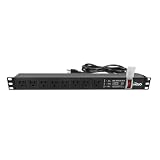
- Efficient Power Distribution: Delivers 12A (US Listed 12A) power through 8 NEMA 5-15R ports, ideal for server racks, network setups, and office environments
- Comprehensive Indicators: Monitors status with Power (yellow), Earth (green), and Lightning Protection (red) indicators, ensuring secure power for server rooms and warehouses
- Compact Design: Sleek 1U horizontal profile (19" x 1.7" x 1.7") maximizes rack space efficiency in IT cabinets
- Versatile Compatibility: 1 NEMA 5-15P input for seamless integration in diverse setups, providing flexibility for network installations
- Safety Assurance: UL listed for compliance, guaranteeing safety and quality in data centers and office spaces
The Energy Information Administration reported that total U.S. net electricity demand grew about 1.7% per year from 2020 to 2025, versus about 0.1% per year from 2005 to 2019. That is economy-wide demand context, not a data-center-only measurement. Local conditions still determine whether a particular U.S. project can connect on time.
Where the additional electricity may come from
There is no single power source or universal fix. In the IEA’s 2025 global base case, renewables meet nearly half of additional data-center demand over the next five years. Natural gas and coal also contribute, while nuclear becomes more important toward the end of the decade and beyond. The mix varies by region, grid design, fuel availability, policy and project economics.
| Approach | What it can provide | Trade-offs to examine |
|---|---|---|
| Grid-connected expansion | Access to an existing network and generation fleet | Connection queues, transmission upgrades, approval time and local reliability limits |
| Renewable procurement | Additional low-carbon generation through projects or contracts | Variable output, transmission needs, storage or firming requirements and project timing |
| Natural-gas generation | Dispatchable power that can support periods of high load | Fuel supply, emissions, permitting and exposure to fuel-price changes |
| Coal generation | Existing or new thermal capacity in some systems | Emissions, policy constraints, plant availability and local economics |
| Nuclear generation | Firm low-carbon output where available | Long development timelines, licensing, financing and site-specific feasibility |
| On-site or dedicated generation | Potentially faster or more controllable supply for a facility | Capital cost, fuel, emissions, maintenance, permits and whether the grid still serves as backup |
The IEA figures describe a global scenario, not a ranking of the cheapest or fastest technology everywhere. A sensible evaluation compares time to available power, reliability, total infrastructure investment, emissions profile and operational flexibility.
Demand flexibility: connecting sooner by being more flexible
IEA’s 2026 executive summary points to non-firm connections and incentives for data-center demand response as possible ways for system operators to use flexible loads while managing grid constraints. Under a non-firm arrangement, a facility may receive access sooner but accept that its consumption can be reduced or interrupted under specified system conditions.
Best Value

- 【Heavy-Duty 9 Outlet PDU】 Designed for standard 19" server racks, this 1U rack mount power strip provides 9 US standard outlets (15A/125V/1875W), ideal for data centers, network cabinets, and audio-visual setups needing reliable power distribution.
- 【Individual Switch Control】 Each outlet is equipped with its own illuminated on/off switch, so you can manage connected devices individually instead of unplugging them. The switch modules are fully independent: if one outlet trips, only that outlet shuts down while all remaining outlets keep running normally — no whole-strip shutdown, no interruption to your other equipment. A tripped switch also tells you exactly which device has reached its load limit, giving you faster, more sensitive overload protection and a clear visual cue for troubleshooting.
- 【Overload Protection & Power Monitoring】 Equipped with overload protection and a digital power monitoring display, this PDU safeguards your equipment from overloads while providing real-time voltage and current data for secure operation. The switch will automatically trip if the current exceeds 15A. Simply having wires or cables touch the switch will not cause it to trip — the switch only responds to an overload condition.
- 【Durable Metal Construction】 Built with a sturdy metal housing and a 14AWG heavy-duty 6.5FT power cord, ensuring durability and stable performance even in high-demand environments like professional server rooms and industrial settings.
- 【Versatile Installation】 Ideal for studios, labs, and data centers, ensuring peak performance and reliability. Designed for 1U rackmount for hassle-free cable management. Supports horizontal installation in server racks with included mounting brackets.
What flexibility can involve
- Scheduling model training or other deferrable workloads outside constrained hours.
- Temporarily reducing power draw when the operator issues a curtailment signal.
- Using batteries or backup generation during short grid events.
- Designing software and cluster management to move jobs between regions or time periods.
Flexibility can trade some operating certainty for earlier or more adaptable access. Eligibility, compensation, notification periods and reliability obligations are system-specific; IEA presents this as an option, not a guarantee that every project can obtain a connection.
Efficiency helps, but does not erase demand growth
More efficient processors, cooling systems and software can reduce electricity per computation. Better utilization can also deliver more work from an installed fleet. However, efficiency gains coexist with expanding use: more users, larger models, richer outputs and additional inference can offset savings per task. The IEA’s rising demand projections reflect that interaction, so efficiency alone should not be assumed to eliminate the need for new generation and grid capacity.
A practical framework for evaluating an AI power project
- Define the load. Specify current and future megawatts, ramp rate, voltage requirements, cooling load and the proportion that can be curtailed.
- Confirm the connection path. Obtain the utility’s study status, queue position, required network upgrades, cost allocation and milestone dates in writing.
- Separate building readiness from power readiness. Model the financial impact if the facility is complete but only part of the planned electrical capacity is available.
- Compare supply options. Evaluate grid service, contracted generation, on-site generation, storage and phased deployment against the same reliability and emissions requirements.
- Plan for flexibility. Identify workloads that can move in time or geography and establish controls before negotiating a non-firm or demand-response arrangement.
- Stress-test uncertainty. Use multiple cases for demand growth, equipment delivery, connection dates, fuel prices and utilization rather than relying on one forecast.
What this means for AI users and investors
Users may notice power constraints indirectly through slower capacity expansion, regional availability differences or changes in how providers schedule demanding workloads. A delay at one facility does not prove that all AI services are becoming more expensive, and the evidence here does not support a universal consumer-price estimate.
Do these 3 things before closing this tab:
1Fix the driver behind crashes, sound loss and screen glitches2Clear out junk files and repair common Windows errors3Scan for outdated or missing drivers - takes under a minuteFor investors and operators, electricity access is a strategic asset alongside chips, land and networking. A site with a credible, timely connection and a clear path to additional capacity may be more valuable than a site with cheaper theoretical electricity but an uncertain queue. Contracts should state curtailment rights, upgrade responsibilities, milestone dates and the consequences of delay.
Bottom line
AI’s rapid electricity demand is running into slower-moving grids, permitting systems and equipment supply chains. The IEA observed 17% data-center electricity-demand growth in 2025 and projects about 945 TWh of global consumption in 2030 in its base case, but both the timing and regional effects remain uncertain. Power constraints can delay AI capacity and require major infrastructure spending. They do not establish one universal increase in AI-service prices; those costs depend on where and how each system secures reliable power.
Quick Recap
Product prices and availability are accurate as of the date/time indicated and are subject to change. Any price and availability information displayed on Amazon at the time of purchase will apply.

