Honeybee swarms are usually described as a colony splitting in two: part of the colony leaves, and a new colony begins somewhere else. A review article published online on 3 August 2026 in Insectes Sociaux argues that this description blurs what a colony actually is. Its authors, Hannes A. Bonhoff and Heikki Helanterä, propose that a swarm is best understood as the parent superorganism moving to a new nest, and that a nest occupied for years is better described as a line of successive, mortal superorganisms than as one immortal animal.
What the paper is, and what it is not
The source is Bonhoff and Helanterä, “On the life history of the honey bee superorganism,” published online in Insectes Sociaux on 3 August 2026 (DOI 10.1007/s00040-026-01124-7). The journal classifies it as a review article, and it reports no data. The authors do not present a new field experiment or a new measurement of colony lifespan. They offer an argued synthesis and a conceptual model for how biologists should define the individual in honeybee life history.
As an Amazon Associate I earn from qualifying purchases.
News coverage followed. A Sci.News report dated 8 October 2026 summarises the review and quotes Bonhoff, who is identified there as affiliated with Lund University. For what the authors actually claim, the journal article is the controlling source.
Colony identity: one organism or a lineage?
Biologists often call a honeybee colony a superorganism. Worker bees perform roles that resemble those of body cells, while the queen is associated with reproduction. The usual picture treats the colony as one continuing entity, even when its queen changes.
#1 Best Overall

- Complete Starter Kit – Frames & Honeycomb Trays Includes 3 wooden frames, 1 divider board, and 6 reusable honeycomb trays—everything beginners need to start beekeeping right away.
- Clear Observation Window – Educational & Fun Acrylic front panel allows a safe, close-up view of bee activity, making it perfect for classrooms, home study, or hobbyist beekeepers.
- Wall-Mounted Hexagon Design – Save Space & Decorate Stylish hexagonal hive box mounts easily on solid walls with included expansion bolts, doubling as a functional beehive and decorative feature.
- Effortless Comb Honey Harvesting – User-Friendly Design Top chamber accommodates 6 honeycomb trays for simple, tool-free honey collection—ideal for small-scale beekeeping and easy hive management.
- Durable & Compact Size – Fully Assembled & Ready to Use Crafted with quality materials and precision design, this hive comes fully assembled. Dimensions: 22.8" x 19.7" x 7.1", compact size fits most indoor walls and garden spaces.
The review challenges that continuity. In the authors’ framework, when a queen is replaced, the new queen’s different genotype marks the start of a new superorganism. The nest may stay occupied and the colony may look unchanged from the outside, but the authors say the continuity belongs to a matrilineage: a sequence of distinct, mortal superorganisms that share a nest over time.
What swarming does, according to the authors
The review separates two kinds of swarm, and the distinction carries most of the paper’s argument about reproduction.
Rank #2
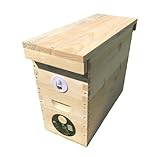
- Langstroth-Compatible Design –This swarm trap mimics the dimensions and structure of a traditional Langstroth hive, making it easy for scout bees to recognize and accept as a new home
- Fully Assembled & Ready to Hang – Each trap comes pre-assembled and includes a hanger for fast attachment to trees or posts.
- Durable Wooden Construction – Built to withstand outdoor elements and designed for repeated seasonal use. Quality craftsmanship ensures long-lasting use
- Proven Swarm Catching Design – Tested and proven effective for attracting honey bee swarms during spring and early summer months.
- Easy to Relocate Bees – Once a swarm moves in, simply remove the trap and transfer the bees to your hive with minimal disruption.
The prime swarm
The prime swarm leaves with the old queen. In the authors’ account, this is the parent superorganism relocating to another nest. Because it happens before fertilization, the authors say the swarm itself is not reproduction.
Recommended Free Tools
Afterswarms
Afterswarms leave with young, unmated queens. The authors argue that these later departures allow one reproductive cycle to produce more than one offspring. In their view, the reproductive role of swarming lies in the afterswarms rather than in the first departure.
Rank #3

- Very Good Instructions Included - Very Easy Swarm Transfers To Hives
- Used By Professional Swarm Trappers
- Specifically Designed & Engineered To Maximize Swarm Captures
- More Durable & Weighs a Fraction of Wood
- Assembled (except for hanger) and ready To Hang
The gestation analogy
The authors also propose that a daughter superorganism develops inside the maternal colony. During this period, workers provide extensive care. The daughter becomes independent as the older workers die and are replaced by the daughter’s own workers.
Bonhoff makes the comparison explicit in the news coverage: “The bee colony, as a superorganism, can be likened to an individual mammal that goes through a period of gestation involving extensive parental care.” This is an analogy drawn from animal life cycles. It is not an observed pregnancy in the mammalian sense, and the review does not present it as one.
Rank #4

- SUPERIOR PERFORMANCE: Our synthetic nasonov pheromone is a proven method for attracting honey bees. Studies show that using Bee Bait Swarm Lures increases your chance of successful swarm capture by over 75%.
- Contains additional ALL NATURAL ingredients that replicate the NASONOV pheromone and other attractive scents of a hive.
- 1 Ounce bottle with convenient easy to use dropper.
- Lasts up to 2 years!
- GREAT FOR CATCHING SWARMS FROM YOUR OWN HIVES: Never loose another swarm from your own hive by applying Bee Bait to an empty hive with frames placed within a few hundred feet of your apiary.
Why the reading of colony lifespans could change
If the authors are right about identity, some reported lifespans of wild colonies may describe how long a nest stayed occupied, not how long one superorganism lived. The review raises this as a possible reinterpretation. It does not show that every lifespan study is invalid, and it does not supply a new number.
The table below sets the usual framing beside the review’s framing. The “usual framing” column is a summary of common descriptions rather than a quotation from one source.
Best Value

- DURABLE MATERIAL - Heavy Wax Coated Cedarwood Beehive and Pinewood Honeycomb Frames with Wax Coated Foundations. This Bee Nuc Box is Stylish and Beautiful; Beeswaxed Food Grade Plastic Foundations Help Bees Build Comb Quickly
- PREMIUM DESIGN - The Honeycomb Frame Features Precision-Cut Dovetail Joints for Easy Assembly. Metal Top Cover and Wax Coated Hive Body, It Effectively Keeps the Interior Dry
- REMOVABLE BOARDS - All Boards are Prepared ,Sanded and Wax Coated for Security Use. Inner Boards are Designed with Vents For Better Ventilation. A Detachable Bottom Board with an Entrance Reducer Allow For Easy Cleaning And Protection For Your Bees
- LARGE SPACE - The Entire 1 Layer Hive Measures 9"(W)x 19.9"(D) x 13.3"(H), While the Nuc Box is 19.9" x 9" x 9.5". The Nuc Box Holds 5 Frames and Foundations; Ample Space for Honey Collection
- COMPLETE KIT - Comes with 1 x Bottom Board, 1 x Entrance Reducer, 1 x Inner Cover, 1 x Top Cover, 5 x Deep Frames (including beeswaxed plastic foundation) and 1x Nuc Bee Box
| Question | Usual framing | Review’s framing (Bonhoff and Helanterä, 2026) |
|---|---|---|
| What is the individual? | One long-lived colony tied to a nest | A succession of distinct superorganisms forming a matrilineage; a new queen with a different genotype marks a new superorganism |
| What does swarming do? | Often described as the colony reproducing | The prime swarm relocates the parent before fertilization, so it is not reproduction; afterswarms with young unmated queens can contribute to multiple offspring from one reproductive cycle |
| What does a long observed lifespan measure? | The life of one colony | Possibly the continued occupation of a nest by successive superorganisms |
Requeening
The most provocative line in the coverage is Bonhoff’s statement: “Requeening does not rejuvenate a colony but kills it.” It expresses the authors’ conceptual position about superorganism identity. It is not the result of a management experiment that measured how requeened colonies died. Under the review’s definition, replacing the queen ends one superorganism and starts another, so the idea of a rejuvenated colony does not fit the model. Whether that definition is the most useful one for beekeeping is a question the review leaves to readers and to future work.
Further reading
For background on how swarms choose a new nest and make collective decisions, Thomas D. Seeley’s Honeybee Democracy is a well-established book on the subject. It is not the 2026 review, and it does not by itself establish the life-history interpretation discussed here.
Quick Recap
Product prices and availability are accurate as of the date/time indicated and are subject to change. Any price and availability information displayed on Amazon at the time of purchase will apply.
Free tools Windows power users keep installed
One-click scans. No signup required.

