Short answer: In HotHardware’s January 31, 2024 synthetic and VR tests, the GeForce RTX 4080 SUPER was generally close to the Radeon RX 7900 XTX in raster-oriented work, ahead in the review’s ray-tracing comparisons, and still well behind the RTX 4090 where the test separated the cards. The review’s “under $1K” wording is historical; neither that page nor NVIDIA’s current product page establishes a current street price or availability.
What this page actually tests
This is page 3 of Marco Chiappetta’s HotHardware review, published January 31, 2024. It covers synthetic 3DMark tests and two VR-oriented benchmarks, not the review’s complete gaming suite or overall verdict. The results below are therefore test-specific observations, not a claim that one GPU wins every game or workload.
As an Amazon Associate I earn from qualifying purchases.
HotHardware compares the RTX 4080 SUPER with the original RTX 4080, RTX 4090 and Radeon RX 7900 XTX. The review describes relative positions in its charts, but its prose does not provide a normalized suite-wide average.
PC Slower Than It Used to Be?
A free scan shows the junk files, broken settings and background clutter dragging Windows down - then fixes them in one click.Free scan · Windows 10 & 11Outdated Drivers Are Slowing You Down
One free scan finds every outdated or missing driver and matches the right update for your exact hardware.Free scan · exact hardware match3DMark results: workload matters
| Test | What it emphasizes | HotHardware’s finding |
|---|---|---|
| Speed Way | DirectX 12 Ultimate features, including ray-traced global illumination and reflections | RTX 4080 SUPER narrowly beats the original RTX 4080 and significantly outpaces the tested RX 7900 XTX. |
| Time Spy Extreme | Primarily raster-focused DirectX 12 rendering | RTX 4080 SUPER sits just behind the RX 7900 XTX, with roughly similar raster performance; the GeForce has the advantage in the review’s ray-tracing comparison. |
| DXR Feature Test | Ray-tracing performance | The SUPER improves only modestly over RTX 4080. RTX 4090 is in a separate class, while the Radeon cards rank lower in this particular test. |
Speed Way favors the GeForce’s ray-tracing design
Speed Way uses DX12 Ultimate effects that include ray-traced global illumination and reflections. HotHardware reports a narrow RTX 4080 SUPER lead over the original RTX 4080 and a much larger margin over the RX 7900 XTX in this result. That is useful evidence for ray-traced rendering, but it should not be converted into a general gaming percentage.
#1 Best Overall

- Powered by NVIDIA DLSS3, ultra-efficient Ada Lovelace arch, and full ray tracing
- 4th Generation Tensor Cores: Up to 4x performance with DLSS 3 vs. brute-force rendering
- 3rd Generation RT Cores: Up to 2x ray tracing performance
- OC mode: 2640 MHz (OC mode)/ 2610 MHz (Default mode)
- Axial-tech fans scaled up for 23% more airflow
Time Spy Extreme is a different story
In the raster-oriented Time Spy Extreme test, HotHardware places the RTX 4080 SUPER just behind the RX 7900 XTX. The description characterizes their rasterization performance as broadly similar, while noting stronger ray-tracing performance for the GeForce. This contrast is why a single “winner” label is misleading: the answer changes with the rendering workload.
DXR shows the 4090 gap
The DXR Feature Test gives the RTX 4080 SUPER only a relatively small improvement over the original RTX 4080. HotHardware places the RTX 4090 in a class of its own and the Radeon cards lower in this specific test. The result demonstrates that the SUPER is not a near-equivalent substitute for the 4090 in heavy ray-tracing workloads.
VR benchmarks
Unigine Superposition VR Future
Superposition’s overall score is capped at 10,000. That ceiling can make the RTX 4080 SUPER appear tied with the RTX 4090 and RX 7900 XTX even though their individual results differ. HotHardware says the individual results put the RTX 4090 clearly ahead and the Radeon ahead of the RTX 4080 SUPER. Always inspect the component scores rather than treating the capped aggregate as a true tie.
Rank #2

- Powered by NVIDIA DLSS 3, ultra-efficient Ada Lovelace arch, and full ray tracing
- 4th Generation Tensor Cores: Up to 4X performance with DLSS 3 vs. brute-force rendering
- 3rd Generation RT Cores: Up to 2X ray tracing performance
- WINDFORCE Cooling system
- Metal backplate
UL VRMark Blue Room
Blue Room is a non-ray-tracing VR test. HotHardware reports that the RTX 4080 SUPER nearly catches the RX 7900 XTX and beats the original RTX 4080 by a couple of percentage points. This result aligns more closely with the raster-focused Time Spy picture than with Speed Way or DXR.
RTX 4080 SUPER reference specifications
NVIDIA’s GeForce RTX 4080 family page lists these figures for the reference RTX 4080 SUPER configuration (accessed September 28, 2026):
- 10,240 CUDA cores
- 2.55 GHz boost clock
- 16 GB GDDR6X memory
- 320 W total graphics power
- 750 W minimum system power recommendation
- 304 mm length, 137 mm width and three-slot reference Founders Edition dimensions
These are reference specifications. NVIDIA warns that add-in-board models can differ, so the exact manufacturer card—not just the GPU name—determines fit, connectors, clock settings and power requirements.
Rank #3

- Chipset: GeForce RTX 4080 Super
- Boost Clock / Memory: 2625 MHz / 23 Gbps
- Video Memory: 16GB GDDR6X
- Memory Interface: 256-bit
- Output: DisplayPort x 2 (v1.4a) / HDMI x 2 (2.1a)
Power supply, connector and case-clearance requirements
For its reference guidance, NVIDIA specifies either three PCIe 8-pin cables connected through the included adapter or one PCIe Gen 5 cable rated for 450 W or greater. It also recommends allowing an additional 36 mm of space for the power cable beyond the card’s dimensions.
The Tool Desk
Outbyte Driver Updater FREEFix the driver behind crashes, sound loss and screen glitchesFind Drivers →Outbyte PC Repair FREEClear out junk files and repair common Windows errorsFree Scan →- Check the selected board partner card’s length, width and slot thickness against your case.
- Confirm whether that model uses the included adapter, a native PCIe Gen 5 connector or another arrangement.
- Use NVIDIA’s 750 W figure only as the reference-configuration minimum; account for your CPU, drives, fans, overclocking and the PSU’s quality.
- Route the cable without a sharp bend at the connector and follow the card and power-supply manufacturers’ installation instructions.
Do not assume every RTX 4080 SUPER has identical power hardware. Verify the model-specific manual and specifications before buying a PSU or cable.
Features and display capability
NVIDIA lists DLSS 3.5 features for the 4080 SUPER family, including Super Resolution, DLAA, Ray Reconstruction and Frame Generation. The product page also lists support for 4K at 240 Hz or 8K at 60 Hz with Display Stream Compression (DSC). Those are feature and output capabilities, not a promise that every game supports every DLSS function or that a particular title will reach those frame rates.
Rank #4
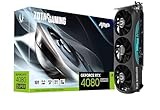
- Powered by NVIDIA DLSS 3, ultra-efficient Ada Lovelace arch, and full ray tracing
- 16GB GDDR6X, 256-bit, 23 Gbps, PCIE 4.0; Boost Clock 2610 MHz
- IceStorm 2.0 Advanced Cooling, SPECTRA RGB Lighting, 3x 90mm fans, FREEZE Fan Stop, Active Fan Control, Metal Backplate, Bundled GPU Support Stand
- 8K Ready, 4 Display Ready, HDCP 2.3, VR Ready
- 3 x DisplayPort 1.4a, 1 x HDMI 2.1a, DirectX 12 Ultimate, Vulkan RT API, Vulkan 1.3, OpenGL 4.6
What “for under $1K” means here
“For Under $1K” belongs to HotHardware’s January 2024 review framing. NVIDIA’s product page, as accessed September 28, 2026, displayed placeholders for starting price and release month. The available sources therefore do not establish a current retail price, stock position or present-day value comparison.
For a purchase decision, check the current listing for the exact card, seller, warranty, dimensions and power connector. A cheaper model may have different cooler size or factory settings, while a premium model may cost more without changing the underlying benchmark class.
How to interpret the verdict
- Against the RTX 4090: The 4080 SUPER can look close in a capped Superposition aggregate, but the uncapped component results and DXR test show the 4090 remains substantially stronger in the workloads that expose the difference.
- Against the RX 7900 XTX: The Radeon leads or nearly leads in the raster-oriented and some VR results described by HotHardware, while the GeForce performs better in the review’s ray-tracing comparisons.
- Against the original RTX 4080: Improvements are usually small in these tests, although Speed Way and Blue Room show measurable gains.
- For buyers: Choose based on the games and rendering features you use, then verify current price, card dimensions and power requirements. The January 2024 benchmark page alone cannot establish today’s best value.
On this defined synthetic and VR test set, the RTX 4080 SUPER is a high-end card that narrows some gaps but does not catch the RTX 4090 across the board. Its strongest case is ray-traced performance and NVIDIA’s software feature set; the RX 7900 XTX remains highly competitive in raster-focused and selected VR workloads.
Quick Recap
Product prices and availability are accurate as of the date/time indicated and are subject to change. Any price and availability information displayed on Amazon at the time of purchase will apply.

