Recommended Free Tools
Turning chicken manure into a profitable protein business is not as simple as feeding it to insects and selling the larvae. The business depends on three things lining up: a feedstock that is permitted for the intended use, a process and facility that can handle it consistently, and buyers for both the insect biomass and the residual frass. A venture can also earn money by selling or deploying processing equipment, rather than relying only on product sales.
The distinction matters because “organic residues” do not automatically include poultry manure for every insect-feed pathway. The commercial examples available show different revenue models and levels of evidence; they do not establish a universally legal or independently verified manure-to-feed process.
As an Amazon Associate I earn from qualifying purchases.
How insect bioconversion can create more than one revenue stream
In an insect-bioconversion system, larvae consume a suitable organic substrate and grow into biomass that may be sold live or processed into ingredients such as protein meal and fat. The remaining material, commonly called frass, may be marketed as a fertilizer input. Whether a particular substrate can legally produce larvae for a particular end use depends on the facility’s jurisdiction, the insect species, the processing steps and the rules governing the final product.
The Tool Desk
Outbyte PC Repair FREEClear out junk files and repair common Windows errorsFree Scan →Outbyte Driver Updater FREEFix the driver behind crashes, sound loss and screen glitchesFind Drivers →This creates several possible sources of commercial value, but not every operator captures all of them:
#1 Best Overall

- For Chicken, Bird & Reptile Keepers: Raise mealworms at home for poultry, reptiles, birds, fish, or other appropriate animals. This mealworm farm starter kit helps you manage your own colony using a dry substrate and suitable vegetable scraps, giving you an organized alternative to keeping loose containers or bins.
- Organized Mealworm Container System: Three stackable trays, three lids, and a beetle inlay help separate and manage eggs, larvae, pupae, and adult beetles as the colony develops. The tiered layout gives each life stage a dedicated space, making routine feeding, observation, and stage changes easier to manage.
- Compact Worm Farm Kit for Indoor Use: The vertical 3-tier design is intended for a well-ventilated indoor area between 68–80°F (20–27°C). Use it in a home, utility room, barn, garage, or shed where you can monitor the colony and maintain suitable conditions without spreading multiple worm bins across your space.
- Stackable, Durable Construction: Made from sturdy recycled fridge-freezer plastic, the trays are designed for repeated colony management. Built-in ventilation openings and included carbon filters support airflow, while the compact stackable format keeps your setup contained and easy to access during feeding and maintenance.
- Starter Components Included: This mealworm starter kit comes with 3 trays, 3 lids, 1 beetle inlay tray, 3 carbon filters, and 1 plastic tweezer. Mealworms are not included; purchase live mealworms or beetles separately to begin your colony. Clear component details help buyers know exactly what arrives in the box.
- Equipment or facility revenue: designing, building, selling or deploying a modular insect-processing unit.
- Processing revenue: handling eligible residue for a customer. The cited company pages do not disclose a specific fee structure, so no standard service charge can be inferred.
- Biomass revenue: selling larvae or processing them into protein and fat for permitted feed uses.
- Frass revenue: marketing the residual material as a fertilizer input, subject to product and market requirements.
- Value to the feedstock host: a farm or other residue generator may gain an alternative use for material or potentially avoid some disposal expense. The cited sources do not quantify those savings.
A project that depends on only one output may be exposed to a weak market or a product that fails qualification. Conversely, multiple possible outputs do not by themselves prove that the combined revenues cover feedstock collection, transport, labor, utilities, processing, compliance and sales costs.
What the documented business models show
REPLOID’s ReFarmUnit is the clearest documented modular example in the available sources. REPLOID describes decentralized facilities processing regionally sourced organic residues. Depending on the arrangement, the facility customer may use the larvae or sell them back to REPLOID; REPLOID says it can market larvae directly or process them into protein and fat, including for animal-feed customers. The company also identifies frass as a basis for fertilizer. These are described routes to market, not proof that every feedstock or output is permitted in every location (REPLOID Group AG, “REPLOID’s Business Model”).
Rank #2
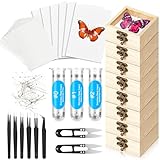
- Impressive Package Inclusions: with an ample package set of 55 pieces, including 8 pcs display boxes, 3 tubes of pins in different sizes (totally 300 pieces), 6 pcs EVA foam pin boards, 2 pairs of scissors, 6 pcs tweezers in different sizes and 30 sheets tracing papers, this kit effectively covers all your specimen collection and study needs
- Sized for Convenience: tailored to your needs, the insect pinning kit comes in flexible size dimensions, the display box sizing approx. 3.54 x 3.54 x 1.77 inches/ 9 x 9 x 4.5 cm, the foam board measures about 8.07 x 5.55 x 0.39 inches/ 20.5 x 14.1 x 1 cm, and the pins are about 1.57 inches/ 40 mm in length, and their diameters are about 0.29 mm, 0.32 mm and 0.38 mm respectively, 100 pieces for each size
- Quality Material: crafted from quality materials, our insect specimen tools kit is designed to last long and withstand regular utilization; The wooden butterfly shadow box has the top made of glass, and the buckle in the front, the pins are stainless steel, robust and reliable against deformation; The scissors are feasible to cut down the patterns on the paper
- Distinctive Insect Collection Style: inspired by research techniques, the insect collection kit embodies a unique insect collection style; It is designed to match the rhythm of scientific inquiry and discovery; This style ensures that you are using industry standard tools for your investigations
- Wide Range of Applications: the butterfly preservation kit's versatility goes beyond being an ideal tool for insect specimen collection; It is also ideal for educational purposes, class demonstrations, biological research, laboratory, camping activity, insect hobbyist and more
The European Climate, Infrastructure and Environment Executive Agency (CINEA) says the ReFarmUnit can process 10,000 tonnes of waste per year and reports sales in Germany, Austria and Italy. CINEA’s 11 March 2026 account describes the unit as commercially validated. That supports a claim of reported commercialization and stated capacity; it is not an audited profitability result or a manure-specific processing benchmark.
A different model is promoted by IMAGO Engineering: a housefly-based closed bioreactor advertised for poultry manure, with protein and fertilizer outputs. Its investor page gives projected or advertised economics and performance, but also says first sales are targeted in the current round and labels future projections illustrative. Those figures should therefore be read as company claims rather than independently confirmed operating results.
Rank #3
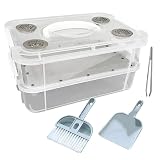
- Hygienic Breeding Solution: The Mealworm Breeding Kit utilizes a fine mesh screen for automatic waste separation, creating a consistently clean space that reduces labor-intensive cleaning and supports optimal conditions for raising mealworms efficiently
- Advanced Odor Control: Designed with a PE material sealed system, the Mealworm Farm ensures odor-resistant functionality, promoting hassle-free indoor breeding over extended periods while addressing humidity-related challenges seamlessly
- Transparent Visual Observation: Designed with durable clarity, the Worm Farm Starter Kit provides uninterrupted visibility into worm activity, promoting better control over the composting process and supporting sustainable gardening practices effortlessly
- Airflow-Focused Structure: Designed with ventilation channels and a porous mesh exterior, this Mealworm Container facilitates accelerated air circulation, providing a sustainable environment that supports healthy reproduction and ensures thriving mealworm populations for farming or research purposes
- Space-Saving Design: The Silkworm Breeding Kit features a flexible multi-layer structure that saves space while expanding capacity for group rearing, making it ideal for stacking expansion and suitable for yellow mealworms or corn borers in compact environments
| Example | Feedstock and system described | Commercial pathway described | Evidence and qualification |
|---|---|---|---|
| REPLOID ReFarmUnit | Modular facilities processing regionally sourced organic residues; CINEA reports capacity of 10,000 tonnes of waste per year. | Facility deployment; larvae used by a customer or sold back to REPLOID; larvae marketed directly or processed into protein and fat; frass used as a fertilizer basis. | CINEA reported commercial validation and sales in Germany, Austria and Italy on 11 March 2026. The cited account does not establish audited profitability or specify that the reported capacity is poultry-manure capacity. |
| IMAGO Engineering | Company describes a housefly-based closed bioreactor for poultry manure. | Company advertises protein and fertilizer outputs, along with unit and plant economics. | The 2026 investor page claims a 33% plant-build margin, a 2.5–3 year container-unit payback, $300 value per tonne of manure and 55–67% protein in meal. The page labels future projections illustrative, targets first sales in the current round and does not establish independent audit of deployments or performance. |
The figures in this table are not a head-to-head performance comparison. CINEA’s capacity and commercialization reporting for ReFarmUnit and IMAGO’s investor-page projections describe different things, with different evidence quality. No independently verified, directly comparable poultry-manure-to-protein cost, yield or profitability benchmark is established by these sources.
Why “organic residue” is not the same as “poultry manure”
Feedstock legality is a core design constraint, not a minor compliance detail. A 2019 Fraunhofer magazine article says EU rules prohibit feeding insect larvae with manure or catering waste and discusses food-industry by-products, such as fruit pomace, as alternative substrates. That is a dated account, not a complete statement of current EU law, and it says nothing definitive about rules in other jurisdictions (Fraunhofer magazine, “Insect protein,” 4/2019).
Rank #4

- Complete Starter Kit for Beginners: Everything You Need to Start Preserving Insects. Whether you’re preserving your first butterfly, moth, beetle or bee, this complete insect pinning kit includes all the essential tools needed to begin mounting specimens with confidence. Perfect for beginners, hobbyists, students and nature lovers.
- Innovative Combination EVA Foam Board: Adjustable Foam Board for Different Insect Sizes.Unlike traditional fixed spreading boards, our high-density EVA foam board features one large board and two movable side boards, allowing you to easily adjust the spacing for butterflies, moths, dragonflies and many other insects. Durable, reusable and easy to pin.
- Wing Spreading Paper Included: Protect Delicate Wings During Drying.Soft translucent wing spreading paper gently holds butterfly and moth wings flat while drying, helping preserve their natural shape without sticking or damaging fragile scales. Ideal for creating professional-looking specimens.
- High-Quality Tools for Easy Pinning: Designed for Precision and Convenience. Includes stainless steel insect pins, precision tweezers and thread scissors to help position delicate legs, antennae and wings with ease. Everything works together to make insect preparation simple—even for first-time users.
- Perfect Gift for Nature Lovers: Learn, Preserve & Display Beautiful Specimens. Great for homeschool science projects, classroom education, family activities, entomology students, collectors and DIY hobbyists. Preserve memorable insects and transform them into beautiful display pieces for your home or collection.
Before describing a venture as turning chicken manure into insect protein for feed, verify the current rules that apply to the actual site, insect species, feedstock, processing method and intended product market. A facility might be able to process manure for a fertilizer or other route while being barred from using manure to rear insects whose biomass enters feed. These are distinct pathways and should not be presented as interchangeable.
Do these 3 things before closing this tab:
1Scan for outdated or missing drivers - takes under a minute2Repair Windows errors before they cause bigger problems3Fix the driver behind crashes, sound loss and screen glitches- Identify the exact substrate: poultry manure, litter, food-processing by-products or a blend.
- Confirm that the substrate is allowed for the relevant insect species and production purpose in the facility’s jurisdiction.
- Check whether the resulting larvae, processed meal, fat and frass may be sold for their intended uses in each target market.
- Confirm any applicable processing, sanitation, handling, testing, labeling and permitting requirements with the relevant authorities and qualified advisers.
How to assess whether the revenue model is credible
A strong business case has to connect a permitted feedstock to a reliable process and qualified buyers. Capacity alone does not establish that a plant can secure enough suitable material, sell all its outputs or make a profit. The cited pages do not quantify the economics of transport, seasonal variation, storage, sanitation or frass handling, so these need to be tested for the proposed site rather than assumed.
Best Value
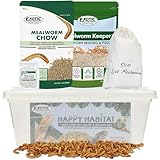
- ✔ CONVENIENT -The perfect kit to begin the breeding process! Don't worry about scrambling to find items, use this all-in-one starter pack!
- ✔ INCLUDES - Happy Habitat Large (12.75" x 8.5" x 6.5"), Mealworm Keeper Bedding 1 lb., Mealworm Chow Food 1 lb., live mealworms
- ✔ ECONOMICAL - Save $$ by raising your own mealworms instead of continuously purchasing through a supplier month after month!
- ✔ HEALTHY - Your starter supply of live mealworms are farm-raised and all-natural. You can choose to bulk them up to your desire by gut-loading with nutrients and supplements to offer your pet more!
- Map feedstock eligibility and supply. Establish which residues can legally enter the proposed process, in what condition and volume, and whether supply is consistent across the year. Record collection distance, handling needs and any competing uses.
- Match facility scale to local conditions. Compare a decentralized modular unit with the actual volume and location of available feedstock. Ask whether the stated capacity is nameplate capacity, demonstrated throughput or a different measure; do not treat a waste-capacity figure as a guaranteed output or as proof of profitability.
- Specify each product and buyer. Identify who will buy live larvae, processed protein or fat, and frass; what specifications and approvals those buyers require; and whether sales depend on a contract, trial or an uncommitted target market.
- Model each revenue stream separately. Distinguish equipment sales or deployment from recurring processing income and sales of biomass and frass. Do not count potential customer disposal savings as venture revenue unless the arrangement and savings are documented.
- Test the operating and residual-material plan. Account for collection, transport, storage, process inputs, labor, utilities, quality control and the cost or value of managing frass. The available sources do not supply comparable values for these items.
- Grade the evidence behind every claim. Separate a reported sale or installed unit from demonstrated operating performance, audited financial results and forward-looking projections. Request the underlying measurement period, feedstock, output specification and independent verification before relying on a forecast.
What the reported commercial figures do—and do not—mean
CINEA’s 11 March 2026 article says the LIFE Waste2Protein project laid the foundation for REPLOID’s business. It reports a €200 million market capitalization and revenues in the double-digit-million range for the resulting business, as well as ReFarmUnit sales in Germany, Austria and Italy. These are CINEA-reported figures, not audited financial statements in the cited account. Market capitalization is a valuation measure, not project funding or revenue; the revenue range is a separate measure and should not be treated as an independently verified financial result.
IMAGO’s investor page claims a 33% plant-build margin, a 2.5–3 year payback for a container unit, $300 of value per tonne of manure and 55–67% protein in meal. The page itself characterizes future projections as illustrative and says first sales are targeted in the current round. Without independent verification and clearly stated operating conditions, these numbers are not a reliable basis for comparing expected returns with ReFarmUnit or another system.
There is no directly comparable, independently verified benchmark here for poultry-manure conversion cost, yield or profitability. Any investment decision needs evidence tied to the specific feedstock, facility, legal pathway, output quality and sales contracts being considered.
What’s actually slowing this PC down?
Pick the symptom - the matching free tool is one click away.
Quick Recap
Product prices and availability are accurate as of the date/time indicated and are subject to change. Any price and availability information displayed on Amazon at the time of purchase will apply.

