Quick wins for a faster PC:
Repair Windows errors before they cause bigger problemsFix Now →Scan for outdated or missing drivers - takes under a minuteDriver Scan →A stuttering drone motor can be caused by ESC desynchronization, but the symptom alone does not prove it. Desync occurs when an electronic speed controller (ESC) loses track of a motor’s commutation timing; the motor may hesitate or stall. On an FPV quad, one motor stalling while the others keep spinning can cause a rapid roll or spin. Start with propellers removed, compare the motor behavior, and check for mechanical, electrical, power, and configuration problems before changing settings.
What motor stuttering can—and cannot—tell you
ESC desync is one possible cause of a motor that stutters, twitches, hesitates, or stops. It is not the only one. A damaged motor, poor connection, ESC fault or overheating, low motor idle, and a sharp battery-voltage drop can produce similar symptoms. The pattern matters: note whether the problem occurs only when arming, during a bench motor test, during abrupt throttle changes, or in flight.
As an Amazon Associate I earn from qualifying purchases.
- One motor stalls while the others continue: this is consistent with a motor or ESC problem, including desync. On a quad, the resulting imbalance can make the aircraft roll or spin quickly.
- All motors stop together: consider a failsafe or loss of power rather than assuming a single-motor desync.
- A motor stutters only at the very bottom of a bench test: Betaflight’s setup guidance says slight stuttering at very low slider values can occur before the motor spins smoothly at a higher value.
For an FPV quad with Blackbox logs, a motor that stalls while its commanded signal rises to its maximum is evidence consistent with desync, not proof of which component failed. Frame-by-frame DVR review may offer clues if logs are unavailable, but footage also cannot identify the failed part by itself.
How to troubleshoot safely
-
Remove the propellers
Take off every propeller before plugging in a battery or testing motors. A motor can start unexpectedly, and a propeller can cause serious injury. Do not fly if a configuration or motor check reveals a fault.
#1 Best Overall
 40A Brushless ESC 2-4S Speed Controller 5V 3A BEC with XT60 Plug for RC Drone Airplanes Multi-axis Aircraft Helicopter
- Output Capacity: Continuous Current 40A, Short-Time Current 55A
- BEC Output: 5V@3A (Linear Regulator Mode - Linear Mode) ; Power Input: 2-4 Lithium Batteries(Not Included)
- Maximum Speed: 210,000 RPM For 2-Pole Motor, 7000 RPM For 6-Pole Motor, 35,000 RPM For 12-Pole Motor
- Timing Can Be Changed To Be Suitable For Different Brushless Motors ; Compatible with lithium batteries, and owning full protection, low pressure cut off protection/overheat protection/throttle signal loss protection.
- Providing safety protection, no matter where the throttle is, the motor will not rotate when connected to the battery.
-
Compare arming behavior with the motor sliders
In Betaflight’s Motors tab, raise the slider gradually and compare the motors at the same output. Note whether one motor behaves differently, whether it becomes smooth as output rises, and whether the symptom occurs during slider testing or only when the quad is armed. Do not jump straight to high output.
-
Check motor and ESC connections
With the battery disconnected, inspect motor wires, solder joints, and ESC pads for loose connections, bridged solder, or visible damage. Check whether a motor screw is long enough to reach the windings; a screw that contacts the windings can damage a motor. Look for signs of heat or physical damage on both motor and ESC.
Rank #2
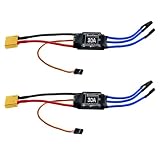 2PCS 30A Electric Brushless Motor Controller, ESC Speed Controller with XT60 and 3.5mm Bullet Plugs for RC Drone Airplane Helicopter
- Quick Heat Dissipation: The output MOSFET power tube comes with an independent heat sink to minimize the temperature rise of the device. This not only enhances its performance but also improves the system's high-current working capability
- 30A Current Operation: Made of high quality electronic components, dependable to use. Features 30A continuous current and 40A peak current
- High Anti-interference Capabilities: This 30A brushless ESC features a power input terminal that uses a low-impedance and high-capacity electrolytic capacitor to improve its anti-interference capabilities
- XT60 Power Plug & 3.5mm Bullet Connectors: Secure, high-current connections for battery and motor wires, ensuring minimal power loss and easy installation
- Wide Application Compatibility: The esc 30a is practical accessory for RC remote control drone, helicopter and FPV applications. Easy to install, no complicated setup required
-
Verify the motor protocol and setup
Confirm that the ESC and flight-controller output are configured for a protocol the hardware supports. Betaflight’s setup documentation describes DShot300 and DShot600 as common choices for many modern ESCs, with processor and gyro setup affecting the recommended speed. This is configuration guidance, not a universal desync fix: use the documentation for the specific hardware and software version.
Special offer. See more information about Outbyte and uninstall instructions. Please review EULA and Privacy policy. -
Check whether the fault follows the motor
If one motor lags or stutters badly, a motor swap can help localize the fault. If the behavior moves with the motor, suspect the motor or its leads; if it remains on the same arm, investigate that arm’s ESC output, wiring, and connections. Disconnect power before moving wires, and only perform a swap if you can do so safely and correctly.
Rank #3
 SEQURE 65A 4in1 ESC 2-6S Electric Speed Controller 30.5x30.5mm for FPV Racing Drones Freestyle - AM32
- Adopts AT32F421 32-bit processor. PWM frequency supports 8 KHz- 96 KHz. Continuous current 65A, peak current up to 120A.
- High-power MOSFET, ultra-high efficiency conversion, reducing losses and extending flight time
- 30.5mm installation hole spacing is more suitable for large-sized load-type flight vehicles and is easy to install.
- Supports digital protocol DShot600/300/150 and is compatible with Oneshot/MultiShot/PWM protocol.
- Innovative angled solder pad reduces the difficulty of welding. Multi-layer PCB design increases over-current capability, effectively dissipating heat.
-
Review logs and power symptoms
When available, inspect Blackbox data for the stalled-motor and rising-command pattern associated with a possible desync. Also consider battery voltage loss, ESC overheating, and motor damage. A crash or sudden drop alone does not distinguish among these causes.
Use the symptom to choose the next check
| Observed symptom | Useful next check | What it may indicate |
|---|---|---|
| Stutters only at very low slider output, then runs smoothly | Raise the slider gradually and compare with the other motors | Low-output behavior may be normal; a motor that remains rough or differs from its peers needs further investigation. |
| Runs in the Motors tab but stutters on arming | Check motor idle and arming behavior | A low idle is one possible cause; it is not by itself proof of desync. |
| One motor stalls during flight while others continue | Review Blackbox if available; inspect that motor, its wiring, and ESC output | Possible desync or a motor/ESC fault. |
| All motors stop or power disappears | Investigate failsafe, battery, and power connections | Possible loss of power or failsafe rather than an isolated motor desync. |
| Problem follows a motor swap | Inspect the motor and its leads | The fault may be with the motor or its wiring. |
| Problem stays on the same arm after a motor swap | Inspect the ESC output, solder pads, and arm wiring | The fault may be on the ESC or in the connection path. |
When to change settings—and when not to
Change one setting at a time, and treat each change as a test tied to an observed symptom. Values and options depend on firmware, ESC firmware, and the build; a setting suggested for one symptom is not a universal cure.
Rank #4

- Robust 2-6S LiPo Support – Handles input voltages from 2S to 6S (7.4V–22.2V), making it versatile for lightweight racers and high-power FPV drones alike
- Ultra-Compact & Lightweight – At just 13x28.5mm and 6.6g, it’s engineered for space-constrained builds without sacrificing performance
- High-Current Output – Delivers 45A continuous (55A peak for 10s) through 18AWG power wires (90mm), ensuring reliable power delivery under heavy loads
- Modern Protocol Compatibility – Supports DShot150/300/600 and OneShot125 for near-instantaneous throttle response and seamless integration with Betaflight/Cleanflight
- Streamlined Design – No BEC (reducing clutter), matched dimensions with 35A ESC (for easy upgrades), and 150mm signal wires for flexible mounting
- Motors spin in the Motors tab but stutter on arming: one troubleshooting guide suggests checking whether motor idle is too low and testing Betaflight’s default 5.5% value. That is a symptom-specific suggestion, not a guaranteed setting for every build.
- Suspected desync: another guide suggests trying a somewhat higher idle, around 6.5–7. These figures are not interchangeable with the arming-only suggestion above. Confirm the applicable Betaflight and ESC context before testing.
- BLHeli-supported settings: startup or ramp-up power and demagnetization compensation may be worth investigating in the relevant BLHeli context. Do not apply BLHeli-specific settings to an ESC running incompatible firmware. A change can affect motor response and performance as well as recovery.
- Protocol mismatch: use a supported, correctly configured protocol and speed. Selecting DShot does not prove that it will resolve every stutter or desync.
- Possible electrical noise: a low-ESR capacitor on the ESC power input is one possible mitigation. Its rating, polarity, and fit must be appropriate for the specific battery and ESC; do not choose a generic value without those details.
- Symptoms tied to high RPM or abrupt throttle changes: check that motor and ESC capabilities are appropriately matched and consider whether sudden speed changes correlate with the event.
After a change, retest with propellers removed and compare the same motors and conditions. If the motor still behaves abnormally, return to hardware diagnosis instead of stacking more setting changes.
The Tool Desk
Outbyte Driver Updater FREEFix the driver behind crashes, sound loss and screen glitchesFind Drivers →Outbyte PC Repair FREEClear out junk files and repair common Windows errorsFree Scan →When electrical testing or repair is appropriate
A digital multimeter with continuity mode can help investigate a suspected ESC fault, but continuity readings are indications—not a complete diagnosis. Disconnect the battery and follow the meter and aircraft documentation. If you are not confident interpreting the result or making safe measurements, stop and ask a qualified repairer.
Best Value

- 30A Current Operation: Made of high quality electronic components, dependable to use. Features 30A continuous current and 40A peak current.
- High Anti-interference Capabilities: This 30A brushless ESC features a power input terminal that uses a low-impedance and high-capacity electrolytic capacitor to improve its anti-interference capabilities.
- Quick Heat Dissipation: The output MOSFET power tube comes with an independent heat sink to minimize the temperature rise of the device. This not only enhances its but also improves the system's high-current working capability.
- Smooth Control: The singlechip microcomputer adopts an independent voltage regulator chip, which avoids the power interference caused by the BEC load change and improves the working stability.
- Widely Use: This brushless ESC is a practical accessory for any RC remote control drone, helicopter, FPV, and more. With its simple installation process, no complicated operations are required.
ESC MOSFET replacement is component-level repair. It can require professional equipment, advanced soldering skill, and the exact replacement component. For many pilots, replacing a damaged ESC is more practical. Check compatibility with the aircraft’s battery, current requirements, motors, flight-controller setup, firmware, dimensions, and wiring before installing a replacement. If electrical noise is suspected, verify any capacitor against the same build requirements rather than adding an unspecified part.
Quick Recap
Which evidence points toward which repair path?
| Evidence | Reasonable next step | Important qualification |
|---|---|---|
| Visible loose connection, bridged pad, or damaged wire | Correct the connection or have it repaired, then retest without propellers | Inspect with the battery disconnected; avoid creating a short while handling the board. |
| Fault moves with the motor in a swap | Investigate or replace the motor and inspect its leads | A swap localizes the likely side of the fault but does not, by itself, prove the exact failure. |
| Fault remains on one arm after a motor swap | Investigate the ESC channel and wiring | Further electrical testing may be needed to distinguish an ESC fault from a connection fault. |
| Continuity test suggests a damaged MOSFET | Seek an experienced electronics repairer or consider a compatible replacement ESC | A continuity indication is not conclusive, and board-level rework requires suitable equipment and skill. |
| Stall pattern appears in Blackbox, with no clear visible damage | Continue investigating motor, ESC, power, and configuration causes | The log pattern supports a desync diagnosis but does not identify the failed component on its own. |
Before the next flight
- Confirm the motor and ESC configuration matches the installed hardware.
- Recheck solder joints, wiring, and motor screws after any repair.
- Test each motor with propellers removed and confirm smooth behavior across the relevant slider range.
- Do not fly while a motor still stutters, a connection is uncertain, or the cause of an in-flight stall remains unresolved.
Product prices and availability are accurate as of the date/time indicated and are subject to change. Any price and availability information displayed on Amazon at the time of purchase will apply.

