What’s actually slowing this PC down?
Pick the symptom - the matching free tool is one click away.
Short answer: Nintendo confirms that Nintendo 64 sound memory was tightly restricted, and that The Legend of Zelda: Ocarina of Time used cartridge ROM to assemble music that changed with the player’s situation. Nintendo staff also describe the game as having relatively few dialogue lines compared with an RPG. However, the published interviews do not say that memory limits caused the game’s restrained voice acting. That connection remains a plausible interpretation, not an established developer explanation.
The evidence is strongest when the three facts are kept separate: a constrained audio environment, an unusually adaptive music system, and a smaller amount of dialogue than a text- and speech-heavy role-playing game. Together they explain the design problem Nintendo was solving, but they do not prove why the team chose the exact level of spoken performance heard in the game.

As an Amazon Associate I earn from qualifying purchases.
What Nintendo actually confirms
Nintendo’s retrospective interviews from 2011 provide a useful but limited record. In the Iwata Asks sound interview, Satoru Iwata explains that sound memory was strictly restricted during the Nintendo 64 era. He says that developers commonly streamed pre-created music tracks under those conditions. He then describes a different approach for Ocarina of Time: the game used Nintendo 64 cartridge ROM so music tracks could be combined and generated according to the current situation.
A separate development interview has Eiji Aonuma say, “There aren’t a ton of lines of dialogue like in an RPG.” That is direct evidence about the amount of dialogue, not a statement about its cause. Neither interview says that Nintendo reduced speech because the audio budget was too small, nor does either identify a planned voice-acting limit.
#1 Best Overall

- Classic Adventure Gameplay – Explore a vast world, complete quests, solve puzzles, and battle enemies in one of the most iconic retro gaming experiences
- Compatible with Nintendo 64 Systems – Designed to work with N64 consoles for smooth, plug-and-play gameplay
- Tested & Fully Functional – Each cartridge is tested to ensure proper performance and reliability
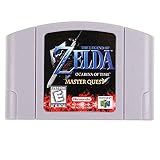
- Third Party Game Cartridge High-quality third-party card designed for long-lasting use.
| Question | What Nintendo says | What that supports |
|---|---|---|
| Was N64 sound memory constrained? | Iwata describes strict restrictions on the amount of memory that could be allocated to sound. | The platform imposed a real audio-resource constraint. |
| How did Ocarina of Time use that platform? | Cartridge ROM allowed music tracks to be combined and generated according to the situation. | The game’s soundtrack was designed to react to gameplay rather than rely only on one fixed track. |
| Did the game contain much dialogue? | Aonuma says there were not many lines compared with an RPG. | Dialogue quantity was relatively restrained. |
| Did the memory limit force that restraint? | No quoted Nintendo statement makes that causal link. | The claim must be presented as a hypothesis, not a confirmed explanation. |
Why sound memory mattered on the Nintendo 64
Fixed resources changed the design question
On a modern system, a developer can often treat recorded speech as one asset category among many. In the Nintendo 64 period, sound competed for a tightly limited allocation of memory. Iwata’s wording is qualitative rather than numerical: Nintendo does not publish an audio-memory budget, a sample rate, a compression ratio, or a maximum number of spoken lines for this game. Those figures should not be inferred from the interviews.
The practical issue was not simply whether one sentence could fit. A voiced game needs a collection of assets, playback rules and enough room for those assets alongside music, effects, animation and game data. Every additional recording can increase the amount of material that must be stored and addressed. A design with many spoken exchanges therefore raises different storage and playback questions from a game that uses text for most conversations.
Streaming was the conventional alternative
Iwata says that, when sound memory was restricted, it was common to stream pre-created music tracks. In that model, a prepared piece is played as a unit when the game calls for it. His description of Ocarina of Time emphasizes a more flexible use of the cartridge: music material could be combined and generated depending on the situation.
That distinction is important. It shows Nintendo thinking carefully about how to spend limited sound resources, but it does not identify voice recording as the resource that was sacrificed. The interview discusses music playback and composition. It does not give a production budget for dialogue or say that speech was removed to make room for adaptive music.
How the game’s adaptive music works conceptually
Three Hyrule Field patterns
The sound interview identifies three Hyrule Field music patterns: normal, battle and quiet. The soundtrack changes as the game situation changes, so entering danger, leaving danger or moving through a calmer state can alter the musical behavior without requiring the player to load an entirely unrelated game area.
Nintendo presents this as a system built around the Nintendo 64 cartridge’s ROM. Tracks could be combined and generated in response to conditions rather than treated as isolated songs only. The result is an audio design that makes the environment feel responsive while working within the hardware’s restrictions.
Why adaptive music is relevant to the voice question
Adaptive music demonstrates that Nintendo used its available storage and playback mechanisms creatively. It is tempting to extend that observation into a broader claim: if music was engineered to react to gameplay, perhaps fewer lines of speech were a direct consequence of the same limitations. The evidence does not go that far.
Recommended Free Tools
Music and dialogue have different production and playback requirements. A statement about combining musical material cannot be converted into a statement about recorded character speech without an explicit developer explanation. The most defensible conclusion is narrower: the game’s audio architecture was shaped by memory constraints, and that architecture included a sophisticated response system for music.
What “not a ton of lines of dialogue” tells us
Aonuma’s comparison is about quantity
Aonuma’s comment compares Ocarina of Time with an RPG. In context, it establishes that the game did not contain the large volume of dialogue associated with a text-heavy role-playing format. That helps explain why the game can feel directed by short exchanges, prompts and event-driven conversations rather than by continuous spoken narration.
The wording is deliberately broad. “Not a ton” is not a count, and Nintendo supplies no published total for the game’s dialogue lines. It also does not distinguish text-only lines from vocal reactions or identify how many lines, if any, were recorded in full. A precise line count or recording budget would be an invention unless Nintendo documents it elsewhere.
Quantity is not the same as voice-acting policy
A smaller script can result from many design decisions. A game may use text to keep conversations fast, reserve sound for musical atmosphere, avoid interrupting exploration, or fit the rhythm of an action-adventure format. Aonuma’s sentence does not tell us which of those considerations mattered most.
It is therefore accurate to say that the game had comparatively limited dialogue and that Nintendo worked under strict sound-memory conditions. It is not accurate to state as fact that the hardware forced Nintendo to avoid extensive voice acting. The interviews leave the decision-making link undocumented.
The cartridge and the wider N64 development context
The original product was a Nintendo 64 Game Pak
Nintendo’s official instruction booklet identifies the original release as a Nintendo 64 Game Pak. The official manual confirms the cartridge-based product path. That matters because the sound interview specifically attributes the game’s adaptive music capability to the ROM cartridges of the Nintendo 64 system.
The manual does not provide audio specifications. It confirms the medium, not a particular storage capacity, compression method or speech limit. Those technical details should remain unspecified when discussing this question.
The 64DD idea shows a broader scope problem
In a separate Nintendo UK interview, the development team explains that the N64’s fixed memory limited the scope of development and that it initially considered the 64DD before proceeding with a ROM cartridge. The discussion concerns broad development issues, including how animation data was retrieved; it does not address voice acting.
Free tools Windows power users keep installed
One-click scans. No signup required.
Rank #4

- Nintendo 64
- Zelda Ocarina of time
- Super Mario 64
- All cables
- Memory expansion pack
That distinction prevents a common overreach. Evidence that fixed memory affected the overall project does not automatically prove that it determined the amount of dialogue. The 64DD and memory interview is useful context for the platform’s constraints, but it is not a voice-acting explanation.
Testing the causal claim carefully
The title’s implied question can be broken into claims with different levels of support:
| Claim | Evidence level | Careful wording |
|---|---|---|
| The N64 imposed sound-memory restrictions. | Directly stated by Iwata. | Nintendo describes strict limits on memory allocated to sound. |
| The game used situation-dependent music. | Directly described by Iwata, including normal, battle and quiet Hyrule Field patterns. | Cartridge ROM enabled music to be combined and generated according to gameplay conditions. |
| The game had fewer dialogue lines than an RPG. | Directly stated by Aonuma, without a numerical count. | Nintendo staff characterize the dialogue volume as relatively small compared with an RPG. |
| Audio limits caused restrained voice acting. | Not established in the cited interviews. | This is a plausible interpretation, not a documented developer conclusion. |
Why the evidence gap matters
Technical constraints often influence creative choices, but influence is not the same as documented causation. To prove that sound memory shaped voice acting specifically, a primary source would need to connect the decisions: for example, a developer explaining that a planned spoken sequence was shortened, replaced with text or omitted because of available audio memory. The cited interviews contain no such explanation.
They also do not establish competing hardware options for a like-for-like comparison. Nintendo does not provide a table of audio memory across consoles, a speech-recording allowance for this game, or a before-and-after plan showing how the script changed. Without those measurements, a claim that the N64 “forced” a particular voice strategy would sound more certain than the evidence allows.
This is not a reason to dismiss the hardware. The memory restriction is part of the design environment, and the adaptive music system is a concrete response to that environment. It simply means the strongest explanation stops at the level Nintendo actually describes: constrained sound resources shaped audio engineering, while the reasons for the dialogue volume remain open.
Best Value

- Version: (US Version) All items are tested and function and work well.
- Level: entry level, fever level, elite level, ashes level.
- Size: 117mm*77mm*20mm
- Features: N64 game tapes are tested and guaranteed to work flawlessly. 100% brand new and high quality.
- Note: This product is not an original, but a perfect reproduction. If you have any questions, please contact us.
How to describe Ocarina of Time’s voice acting accurately
Use “restrained” for the amount of speech
“Restrained voice acting” can be a useful description when it refers to the relatively small amount of dialogue compared with an RPG. It should not be used as shorthand for a proven hardware mandate. A clear sentence separates observation from interpretation: the game presents fewer dialogue lines than an RPG, and the N64 had strict sound-memory limits, but Nintendo has not said that one directly caused the other.
Separate spoken performance from the wider soundscape
The game’s audio identity includes music that reacts to changing conditions. That system may be more visible to players than the storage decisions behind it, because the transition between normal, battle and quiet patterns is experienced during play. The existence of that system does not reveal how Nintendo allocated resources for character speech.
Avoid invented specifications
No official figure in these interviews establishes an audio-memory size, sample rate, compression ratio, number of recorded voices or exact dialogue total. Claims built around those numbers should be treated skeptically unless they cite a separate primary technical document. The available Nintendo material supports qualitative conclusions, not a spreadsheet of voice limits.
Crashes, No Sound, or Screen Glitches?
Random freezes, missing sound and display glitches usually trace back to one bad driver. Find and replace yours safely.Free scan · under a minuteWindows Errors? Fix Them Before They Spread
Repair common Windows errors and clear accumulated junk for a smoother, more stable PC - no reinstall needed.Free scan · no reinstallWhat can be concluded with confidence
- The Nintendo 64 was an audio-constrained platform. Iwata explicitly describes strict restrictions on memory allocated to sound.
- Ocarina of Time turned the cartridge into part of its music strategy. Nintendo says ROM made it possible to combine and generate music according to the situation.
- Hyrule Field’s music was state-aware. Nintendo identifies normal, battle and quiet patterns that respond to changing circumstances.
- The game’s dialogue volume was modest beside an RPG. Aonuma’s retrospective description supports that comparison, but gives no numerical count.
- The specific voice-acting cause remains unconfirmed. The cited interviews never say that sound-memory limits forced Nintendo to reduce or avoid spoken dialogue.
Bottom line
N64 audio limits clearly shaped the way Ocarina of Time handled sound, especially its cartridge-based, situation-dependent music. Nintendo also acknowledges that the game had relatively few dialogue lines compared with an RPG. What Nintendo has not established is the missing causal step: that those memory limits dictated the game’s restrained voice acting. The responsible reading is therefore a qualified one—hardware constraints created the conditions, but the interviews do not document them as the reason for the voice-acting choice.
Quick Recap
Product prices and availability are accurate as of the date/time indicated and are subject to change. Any price and availability information displayed on Amazon at the time of purchase will apply.

