Quick wins for a faster PC:
Clear out junk files and repair common Windows errorsFree Scan →Scan for outdated or missing drivers - takes under a minuteDriver Scan →Repair Windows errors before they cause bigger problemsFix Now →Data-center waste heat can be cheaper than conventional district-heating supply, but only in the right system. The strongest case is a nearby, steady data center connected to a low-temperature network with year-round demand, modest connection costs and electricity priced favorably against the fuel or heat it displaces. A high-temperature network, long pipe connection, poor seasonal demand match or expensive electricity can erase the advantage.
The available studies do not support one Europe-wide price ranking. A 2025 Göttingen, Germany, model found recovery alone to be the best-performing option among its tested scenarios, while a 2017 Espoo, Finland, model estimated system operating-cost savings of 0.6–7.3%. Those results use different years, temperatures, boundaries and assumptions. They are useful benchmarks, not transferable tariffs.

As an Amazon Associate I earn from qualifying purchases.
What the comparison actually measures
“Data-center waste heat” is heat removed from servers and cooling equipment that would otherwise be rejected to the environment. It is not automatically a drop-in replacement for district heat. The district network may require a higher supply temperature than the data center can provide, so a heat pump must raise the temperature. That lift consumes electricity, and the electricity price and carbon intensity become part of the comparison.
Do these 3 things before closing this tab:
1Repair Windows errors before they cause bigger problems2Scan for outdated or missing drivers - takes under a minute3Clear out junk files and repair common Windows errors“Conventional district heating” is also not one technology. A network may use heat-only boilers, combined heat and power (CHP), biomass, large heat pumps, solar thermal, geothermal resources, recovered industrial heat or a mixture. The relevant question is therefore not whether waste heat beats a generic boiler. It is whether recovered heat, including all additional equipment and operating energy, can displace the specific generation that a particular network would otherwise run.
#1 Best Overall

- Used Book in Good Condition
A fair comparison should identify five separate cost boundaries:
- Data-center-side changes: heat exchangers, cooling-loop modifications, controls and any change in operating practice.
- Temperature-raising equipment: heat pumps, compressors, pumps, electrical infrastructure and their maintenance.
- Connection: transmission pipe, substations, metering, civil works and the district network interface.
- Displaced production: the utility’s avoided fuel, electricity, emissions costs and variable operating costs.
- Reliability and timing: backup capacity, peak equipment and storage needed when data-center output and heat demand do not coincide.
Counting only the heat available at the server cooling loop will understate the delivered cost. Counting only a utility’s fuel bill will understate the cost of conventional supply when capital, maintenance, backup and electricity production are material.
How recovered heat reaches a district-heating customer
Capture at a useful temperature
Most data-center heat is available at a temperature below the design supply temperature of older district-heating systems. The European Commission’s 2024 recommendation says a cost-benefit analysis should examine whether heat can be captured at a useful temperature with minimal ancillary energy, while accounting for seasonal demand. In practice, the cooling system, heat exchanger and network interface must be designed together rather than treating the data center as a fixed-temperature boiler.
Windows Errors? Fix Them Before They Spread
Repair common Windows errors and clear accumulated junk for a smoother, more stable PC - no reinstall needed.Free scan · no reinstallOutdated Drivers Are Slowing You Down
One free scan finds every outdated or missing driver and matches the right update for your exact hardware.Free scan · exact hardware matchLower-temperature networks generally need less temperature lift. That can reduce compressor work and improve the amount of useful heat obtained per unit of electricity. A high-temperature network may still accept the heat, but its heat pump, electrical connection and operating cost can become the dominant parts of the project.
Move and upgrade the heat
A heat pump transfers heat from the data-center loop to the district-heating loop. Its electricity use depends on the source temperature, required supply temperature and operating conditions. The project must also provide circulation pumps, controls, protection, metering and a heat exchanger that keeps the two water circuits separate where required.
Match supply with demand
Servers can produce a relatively steady heat stream, but district-heating demand is seasonal and weather-dependent. Summer demand may be much lower than winter demand, while the data center may continue operating at a similar level. Storage, an alternative heat sink or a backup heat source can be needed to avoid curtailing recovered heat. Conversely, a district network still needs dependable peak and emergency capacity if the data center or its heat-recovery equipment is unavailable.
Connect the sites
The value falls quickly when the data center is far from the network or when a connection requires major civil works. The connection can include new pipes, a transfer station, controls, electricity reinforcement and rights-of-way. These costs are often allocated differently between the data-center owner and the utility, so the same physical project can look attractive to one party and unattractive to the other.
What the 2025 Göttingen study found
The most detailed recent result in the available evidence is a modeled north-campus case in Göttingen, Germany, published in Energy Conversion and Management on 15 June 2025. The paper compared recovery at district-heating design supply temperatures of 120°C, 95°C, 70°C and 48°C, with and without shallow borehole thermal energy storage. Its figures are model outputs for that site, not quotations for a generic data center.
| Network design supply temperature | Modeled levelized heat cost for recovery | Average marginal waste-heat price | Interpretation |
|---|---|---|---|
| 120°C | €124/MWh | €48/MWh | Highest-temperature case in the study; the marginal price is not the levelized cost. |
| 95°C | €119/MWh | €56/MWh | Still requires substantial temperature lift compared with low-temperature networks. |
| 70°C | €94/MWh | €90/MWh | Lower design temperature narrows the gap between the two reported metrics. |
| 48°C | €88/MWh | €93/MWh | Lowest modeled levelized cost, but the highest marginal-price result in this set. |
The two columns must not be combined. Levelized heat cost spreads the modeled investment and operating costs over the project’s useful output. The marginal waste-heat price is a modeled price signal for additional heat under the paper’s assumptions. Neither is a current retail tariff, and neither can be applied to another city without rebuilding the load, equipment, price and financing assumptions.
Capital cost and coverage
Across the temperature scenarios, recovery without storage required modeled capital expenditure of €1.9–2.6 million. The recovery scenario covered around 70% of the considered heating and cooling demand. Adding shallow borehole storage increased modeled capital expenditure to €6.1–7.2 million and covered about 20% more demand.
Against the study’s modeled business-as-usual case, recovery alone produced annual savings of €0.34–0.52 million. Among the scenarios evaluated, it was the economically strongest option. Storage could deliver greater carbon-dioxide savings and broaden the amount of demand served, but the paper found that it would need a substantial cost reduction or a different relationship between heat prices and electricity prices to become economical under those assumptions.
What the Göttingen numbers do and do not prove
The results show why network temperature matters and why a steady local source can be valuable. They do not establish that every data center can deliver heat for €88–124/MWh, that every low-temperature network will have the same marginal prices, or that storage will pay back elsewhere. The study’s load profiles, equipment sizing, energy prices, cost allocation, financing and definition of the business-as-usual system all affect the result.
The paper also reports that low-temperature district heating is better suited to data-center waste heat. It notes that when waste-heat prices are held constant across network temperatures, lower-temperature networks can leave more room for operator profit. That is a modeled relationship, not a guarantee of profit in a particular market.
Why temperature changes the economics
Temperature affects both the amount of electricity a heat pump needs and the equipment required to deliver a specified network supply temperature. A source that can feed a 48°C or 70°C network may require less lift than one serving a 95°C or 120°C system. The resulting electricity consumption must be valued at the project’s actual tariff or market exposure, including demand charges where applicable.
Rank #3

- 【Premium Quality】Our plate heat exchanger is made of high quality 316L stainless steel which are brazed together by 99.9% copper at the edges for a reliable and rugged part to form a durable, integral piece that can resist leakage and withstand high pressure and temperature.
- 【Convenient For Use And Energy Saving】Smooth Thread makes a easy, quick, flexible hookup. Highly conductive and super-thin stainless steel plates make good performance and economy for heating transfer and cooling without electricity consumption and oxygen consumption.
- 【Product Parameter】250,000 - 330,000 BTU CAPACITY: Depending on the application, this product can produce 250kBtu to 330kBtu per hour. 30 PLATES; 4"x 12", 1" MPT: 30 brazed plates work to efficiently heat water for your application.
- 【Multiple Applications】AB water heat exchanger offers the highest level of thermal efficiency and durability in a compact & lightweight unit, perfect for domestic water heating, Floor Heating, Snow Melting, District or Zone Heating Systems, Outdoor Wood Furnaces, Hydraulic and Lube Oil Coolers, Radiator Heating, Hydronic Heating, Solar Heating, Wood Boiler.
- 【Product Support】 Quality-focused manufacturing backed by responsive support for product questions, selection and installation guidance.
The Göttingen results illustrate the distinction. Its modeled levelized heat cost fell from €124/MWh at 120°C to €88/MWh at 48°C. Yet the reported average marginal waste-heat prices were €48/MWh at 120°C, €56/MWh at 95°C, €90/MWh at 70°C and €93/MWh at 48°C. These are not contradictory measurements of the same thing; they answer different accounting questions. A project appraisal should label each figure as a marginal price, levelized cost or utility system cost before comparing it with a fuel or heat tariff.
Network temperature is only one variable. Return temperature, flow rates, heat-exchanger approach temperatures, heat-pump efficiency, electricity price, operating hours and the fraction of heat that can be used in each season can be equally important. A lower-temperature network with weak demand or costly connection works may still be less attractive than an efficient conventional plant already located beside customers.
How conventional sources compare
Conventional supply should be compared on the same delivered-energy basis as recovered heat. A fuel-only price is not a levelized heat cost, and a plant’s average cost is not necessarily the marginal cost of the production that waste heat would displace.
| Source | What determines its comparison with waste heat | Main trade-offs |
|---|---|---|
| Natural-gas or other heat-only boilers | Fuel price, efficiency, carbon cost, operating hours, existing capacity and the cost of any replacement plant. | Dispatchable and familiar, but fuel expenditure and emissions vary with the fuel and operating profile. |
| CHP | Fuel and power prices, heat-to-power allocation, operating hours and the value of electricity that would otherwise be generated. | Produces heat and electricity together; assigning costs and opportunity value between the two products is essential. |
| Biomass, biofuels and renewable waste | Local fuel availability, transport, sustainability constraints, plant capital and emissions accounting. | Can provide dispatchable heat, but resource limits and logistics are location-specific. |
| Large heat pumps | Electricity price and carbon intensity, source temperature, network temperature, capital and grid capacity. | Can fit low-temperature systems but shares electricity-price and capacity risks with data-center recovery. |
| Geothermal | Resource quality, drilling risk, well lifetime, reinjection and distance to the network. | Potentially steady heat where the resource exists; exploration and site risk can dominate. |
| Solar thermal | Solar resource, land, seasonal output, storage and backup requirements. | Low operating emissions but variable production and a need to bridge seasonal mismatch. |
The European Commission’s 2021 staff working document provides indicative technology-cost comparisons and operation-and-maintenance assumptions for several of these technologies. Those are historical inputs, not present-day prices for a specific project. The document’s EU-27 district-heating supply mix for 2018 was 30.1% natural gas, 26.9% biomass, biofuels and renewable waste, and 26.7% coal and peat. The figures describe an aggregate from 2018; they should not be treated as a current national mix or as the fuel mix of the network being assessed.
District-energy networks serve around 600 million people worldwide, according to the International Energy Agency’s 10 June 2026 report. That scale does not indicate how much heat comes from data centers, and no Europe-wide current share of data-center heat in district heating is established by the evidence here.
What the Espoo case adds
A 2017 Energy study of Espoo, Finland, modeled integration of 20–60 MW of data-center waste heat into a district-heating system. It estimated system operational-cost savings of 0.6–7.3%, depending on the scenario and procurement-price assumptions.
Those percentages describe the modeled district-heating system, not the data-center owner’s return and not a guaranteed customer-tariff reduction. The study and the Göttingen paper also differ in year, geography, network design, model boundary and energy-price assumptions. Their values should therefore be read as examples of sensitivity to system conditions rather than combined into a single average.
Rank #4

- High-Quality Materials: The entire unit is copper brazed at edges and contact points, forming a durable and leak-resistant piece that withstands high pressure and temperature.
- Durable and Corrosion-Resistant: Features epoxy-coated fins, providing high hardness, wear resistance, and corrosion protection. This reduces internal water vapor scaling, promoting maximum heat exchange between air and fins. Suitable for operating temperatures of -40-356℉ / -40-180°C.
- Efficient Heat Transfer: The heat exchanger generates up to 160kBtu per hour, with 12 aluminum fins per inch and 3 rows of 3/8" seamless copper tubes. The threaded copper tubes increase the contact area and capacity of the fluid medium, significantly enhancing the heat exchanger's performance.
- Large Heat Exchange Area: With an effective heat exchange area of 18”x20” and 242 fins, this heat exchanger provides excellent heat transfer performance to meet various needs.
- Tight and Leak-Proof: To eliminate the possibility of micro-leaks, the heat exchanger uses high-pressure vacuum brazing and undergoes rigorous leak testing, ensuring long life and high reliability.
When recovered heat is most likely to compete
A project is more promising when most of the following conditions hold:
- The data center is close enough to an existing district-heating network that pipework and civil works are limited.
- The network operates at a supply temperature compatible with the recovered source or can be converted without excessive cost.
- Heat production is steady and local demand is available for many of the same hours.
- The heat pump can obtain electricity at a predictable price and the grid connection has adequate capacity.
- The utility has generation that can actually be displaced, rather than only surplus capacity that would continue operating.
- Connection, heat-pump, controls, metering, maintenance and backup costs are assigned transparently.
- The parties can manage outages, data-center expansion, cooling-system changes and long-term contractual risk.
It is less likely to compete when the network needs very high supply temperatures, the connection is remote, demand is strongly seasonal without affordable storage, electricity is expensive relative to displaced fuel, or the existing plant has very low marginal cost and high utilization.
What’s actually slowing this PC down?
Pick the symptom - the matching free tool is one click away.
A practical cost-benefit analysis
The European Commission Recommendation (EU) 2024/2395 says economic feasibility means that a waste-heat project can cover its costs and provide reasonable remuneration for risk and return on investment. Its recommended analysis is broader than a heat-price comparison. Use the following sequence to make the boundary explicit.
- Define the reference case. Record which boiler, CHP unit, heat pump or other source would operate without recovery, including its efficiency, fuel, electricity output and remaining capacity.
- Characterize the source. Measure or model available heat by hour, source temperature, return temperature, minimum output, planned maintenance and future data-center load.
- Characterize the network. Document supply and return temperatures, flow limits, seasonal demand, peak demand, nearby substations, available connection points and any planned temperature transition.
- Size the heat pump and interface. Include heat exchangers, pumps, controls, electrical connection, backup equipment and expected performance at design and part-load conditions.
- Price every energy input. Use the project’s electricity procurement terms, demand charges, fuel prices, carbon costs and any revenue or cost associated with displaced CHP electricity.
- Add connection and financing costs. Include pipework, civil works, land or rights-of-way, permitting, metering, installation, financing, insurance, maintenance and replacement reserves.
- Test timing and reliability. Model hourly or otherwise sufficiently granular demand and supply, outages, peak periods, summer curtailment and the cost of storage or backup.
- Allocate benefits and risks. Separate savings to the utility, data-center owner and customers. Define who pays for upgrades and who bears the risk if heat availability, prices or demand change.
- Run sensitivities. Vary electricity and fuel prices, network temperature, heat-pump performance, connection cost, operating hours, storage cost, carbon value and the share of heat that can be used.
- Report the metric clearly. Label results as marginal cost, levelized heat cost, total system cost, capital expenditure, annual operating savings or customer tariff effect. Do not place unlike metrics in one ranking.
The Commission’s framework also calls for technical feasibility, energy-efficiency effects, local demand, seasonal variation, ancillary energy, financing, risk and expected returns. A project that is cheapest on an annual average can still require a reliability arrangement that makes it unattractive to the network operator.
Independent reader supportYour contribution helps us test, update, and keep practical guides available for everyone.Storage, backup and reliability trade-offs
Thermal storage can absorb heat when the data center is producing more than the network needs and release it later. In Göttingen, shallow borehole storage increased modeled demand coverage by about 20% and offered greater potential CO₂ savings, but raised capital expenditure from €1.9–2.6 million for recovery alone to €6.1–7.2 million. It was not the most economical scenario under that study’s assumptions.
Storage is not the only reliability option. A network may retain boilers, CHP or another heat source for peaks and outages; a data center may reject heat to its original cooling system when the network cannot accept it. The correct choice depends on the value of uninterrupted heat, the duration and frequency of shortfalls, and who is contractually responsible for them. Those arrangements should be priced rather than treated as free insurance.
Emissions and system effects
Recovered heat can reduce emissions when it displaces fuel-fired production or electricity-intensive production with a lower-carbon alternative. The result is not automatic: a heat pump’s electricity emissions, the efficiency of the displaced plant and the timing of operation all matter. A CHP system also produces electricity, so replacing its heat output can change power production and the associated emissions.
Best Value
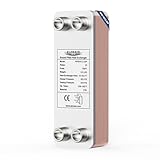
- Excellent Quality: This brazed plate heat exchanger is made of high-quality SS316L stainless steel, brazed with copper in a vacuum environment, ensuring a reliable and robust component. It offers superior resistance to high temperatures, high pressures, corrosion, and leaks, playing an excellent role in supporting various refrigeration, heating, high-temperature, and high-pressure industrial fields.
- Heat-transfer Efficiency increased by 99%: The heat exchanger adopts a fishbone corrugated design, which increases the intensity of the turbulence and creates various support points that reduce the secondary side pressure, resulting in a rapid increase in channel heat transfer efficiency by 99%.
- Convenient to Use and Energy Saving: The smooth threads allow for quick and flexible disassembly and installation. Ultra-thin stainless steel plates provide excellent performance and economy in heating and cooling, improving energy efficiency and reducing operating expenses.
- Product Parameter:Mode WHE4X12-20P can produce up to 275000 btu per hour depending on different applications, 5.6 sq.ft heat transfer area,4"x12"-20 plates with 1"MPT.
- One-year limited warranty: The stainless steel heat exchanger provides exceptional thermal efficiency and durability in a compact, lightweight design and ALORAIR offers a one-year limited warranty covering manufacturing defects.
Storage can improve utilization and reduce curtailment, but its embodied equipment, pumping electricity and additional capital should be included. Likewise, a conventional source should receive credit for existing infrastructure and for services such as peak capacity when those services would otherwise have to be built for the recovery project.
Why one city’s price cannot be copied to another
Results differ because the projects answer different physical and financial questions. The Göttingen analysis is a 2025 model of one campus and several network temperatures. Espoo is a 2017 model of a Finnish system integrating 20–60 MW. Their percentages, euros and operating assumptions are not interchangeable.
At minimum, a transfer to another city would need to adjust for:
Free tools Windows power users keep installed
One-click scans. No signup required.
- local supply and return temperatures and any planned low-temperature conversion;
- distance, pipe size, civil works and connection-point availability;
- data-center cooling technology, source temperature and future server load;
- hourly heat demand, summer load and the value of storage;
- electricity, fuel, carbon and procurement prices for the relevant year and contract;
- the generation actually displaced, including CHP electricity value;
- financing costs, ownership, maintenance and allocation of connection expenditure;
- local permitting, reliability standards and backup requirements.
For that reason, there is no defensible single current €/MWh ranking of data-center heat against all conventional district-heating sources, and no evidence here of a general consumer-tariff effect.
Bottom line for a project decision
Start with the network, not the data center’s headline heat output. A nearby, steady source feeding a low-temperature network can compete strongly because it needs less temperature lift and can displace fuel for many hours. The Göttingen model supports that direction: recovery-only capital cost was €1.9–2.6 million, modeled annual savings were €0.34–0.52 million, and lower design temperatures had lower levelized heat costs.
Then test the liabilities that simple comparisons omit: heat-pump electricity, connection works, seasonal mismatch, storage, backup, financing and risk allocation. Espoo’s modeled 0.6–7.3% operating-cost savings show that system benefits are possible, but they are not a promise to another utility or to a data-center owner. Conventional boilers, CHP, biomass, geothermal, solar thermal and large heat pumps remain legitimate alternatives, each with local costs and constraints. The winning option is the one that delivers reliable heat at the lowest fully accounted system cost for that specific network.
Quick Recap
Product prices and availability are accurate as of the date/time indicated and are subject to change. Any price and availability information displayed on Amazon at the time of purchase will apply.
Recommended Free Tools

