Recommended Free Tools
For most AI workstations, start with the GPU’s stock air cooler and a case designed for unobstructed airflow. Move to a custom GPU water loop when sustained workloads, several closely spaced cards, strict noise limits, or the need for thinner single-slot cards justify the added cost, installation work and maintenance. Liquid cooling can lower temperatures, but the strongest published comparison is between two eight-GPU H100 servers—not ordinary one- or two-GPU desktops—so it does not establish a universal performance gain for a workstation.
Air cooling is the sensible starting point for most AI workstations
An air-cooled GPU uses a heatsink, heat pipes or a vapor chamber, and fans to move heat from the graphics processor into the case airflow. The design is self-contained: the card arrives assembled, there are no tubes or pump to route, and replacing the card does not require opening a cooling circuit.
As an Amazon Associate I earn from qualifying purchases.
That simplicity is valuable for AI workloads. Training, inference, model conversion and rendering can run for hours, so the relevant question is not the temperature reached during a short benchmark. It is whether the complete system maintains acceptable temperature, clock speed, fan noise and stability throughout the longest job you actually run.
Free tools Windows power users keep installed
One-click scans. No signup required.
Why the case matters as much as the cooler
NVIDIA’s certified-systems guidance notes that operating temperature can affect GPU performance and that air-cooling results depend on device placement, enclosure layout and fan curves. The same GPU can therefore behave differently in a spacious workstation case, a compact enclosure or a multi-card chassis with one card immediately above another.
#1 Best Overall
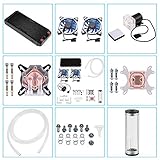
- 【Professional Water Cooling Kit】This liquid CPU cooler kit provides a 240mm heat sink within screw pack+2pcs LED fan+universal CPU block within 4pcs screws+universal GPU Block within 4pcs screws+cylindrical water reservoir (Including screw pack+2pcs plastic bracket+2pcs metal bracket)+transparent hose water pump with shock pad+a set of water pipe connectors,hose clamps and plugs
- 【High Performance】The CPU/GPU block is constructed with a copper base to provide exceptional heat transfer and cooling performance.The extreme performance fans offer a high air static pressure with lower noise. 9W 600L / H G1/4 Thread size High quiet water Pump,high stability,long lasting.Easy and intuitive installation and setup,set your fan and pump speeds to their lowest possible noise level while still keeping your system exceptionally cool
- 【Super Water Circulation Cooling System】240mm Heat Sink: Provide the excellent heat dissipation, as you need for highly overclocked desktop processors.160mm high capacity cylindrical water reservoir is manufactured from transparent acrylic so that the circulation system is visible.Upgraded flexible anti-explosion, hoses enable a space-saving installation and exceptional durability
- 【Universal Water Cooling Block】The CPU water cooling block made of copper and transparent plexiglass suitable for / Platform,the 0.8MM parallel waterway G1/4 universal thread GPU water cooling block made of copper and POM high temperature materials support 9.5mm ID / 12.7mm OD PU tube,or 10mmID/16mmOD solid tube,or 8mmID/12mmOD silicon tube.Complete Accessories,you don't have to worry about installation at all
- 【Quality Service】This liquid CPU cooler kit will dramatically improve heat dissipation experience, especially in terms of stability, silence, efficiency, and convenience.If this product has any quality problems or you have any questions about this product, you can us at any time. We have a professional customer service team that will provide you with the best service. will do our best to solve your problem in time, please rest assured to buy
- Leave an unobstructed intake path for every card. A card pressed against the next card may ingest preheated air rather than fresh case air.
- Use front-to-back or bottom-to-top airflow that matches the chassis design. Avoid filling every fan position without checking whether the resulting pressure pattern feeds the GPUs.
- Set a fan curve for the sustained workload, not for an idle desktop. A quiet idle profile can allow heat soak during a long training run.
- Watch hotspot and memory temperatures when the monitoring software exposes them; a low core temperature alone does not prove that the entire board is comfortable.
- Clean filters and heatsinks on a schedule appropriate to the room. Dust raises the thermal resistance of an otherwise adequate cooler.
If a well-ventilated air-cooled build holds its target temperatures without objectionable noise or throttling, a custom loop solves a problem you do not have.
What a custom GPU water loop changes
A custom loop replaces the card’s stock heatsink and fans with a water block that transfers heat to coolant. A pump moves the coolant through tubing to a radiator, where separate fans release the heat to the room. A reservoir, fittings, drain point and coolant complete the circuit.
Potential advantages
- More thermal headroom: A large radiator can absorb sustained GPU heat without relying on a small heatsink mounted directly on each card.
- Lower card thickness: A supported full-cover block can turn a two- or three-slot card into a single-slot installation, which can improve spacing in a dense chassis.
- Different noise profile: Radiator fans and a pump can be placed and tuned independently of the GPU board. This may reduce annoying high-pitched card-fan noise, although the final result depends on fan speed, pump speed, radiator size and room acoustics.
- Shared heat management: One loop can cool multiple GPUs and, when designed for it, other components. The loop must be sized for the combined heat load rather than for one card.
Costs and liabilities
- The block must match the exact PCB, memory layout and power components of the card. A block for one edition is not proof of compatibility with another edition carrying the same family name.
- You must provide pump, reservoir, radiator capacity, tubing, fittings, coolant and a case with room for them. Comparing only the price of a water block gives a misleading total.
- Installation introduces leak testing, cable and tube routing, filling and future draining. A workstation that cannot be offline for service may be a poor candidate.
- The cited sources do not establish a controlled, long-term reliability advantage for either desktop approach. A loop is not automatically less reliable or more reliable; its outcome depends on component quality, assembly and maintenance.
What published measurements actually show
The clearest direct comparison comes from Supermicro’s October 2025 white paper. It tested two eight-GPU NVIDIA H100 80GB systems using synthetic stress tests and AI training workloads. The systems used different CPU models, and the test was conducted on large servers rather than desktop workstations.
| Measure | Liquid-cooled H100 system | Air-cooled H100 system | How to interpret it |
|---|---|---|---|
| GPU temperature | 46–54°C | 55–71°C | Measured ranges for the tested eight-GPU servers, not a desktop guarantee. |
| Synthetic stress-test throughput | Liquid system up to 17% higher | A stress-test result from that configuration; it should not be presented as a general AI-workstation speed increase. | |
| Real-world training time | Liquid system 1.4% faster | A modest difference in the reported training workload, with unlike CPU models between systems. | |
The contrast matters. Liquid cooling produced a large temperature difference and a much larger stress-test throughput difference, yet the measured training-time improvement was only 1.4%. A workload that is limited by data loading, CPU preparation, synchronization or another subsystem may gain little from lower GPU temperature.
NVIDIA’s older DGX Station architecture paper offers a separate, product-specific example. For its integrated four-V100 workstation, NVIDIA stated that the water-cooling system captured 90% of GPU thermal design power and provided more than twice the noise abatement compared with air cooling. That design was engineered as a complete product; it is not a general statistic for a modern, user-built loop.
Modern Blackwell discussions from NVIDIA address high-density data-center racks where traditional air cooling struggles at cited rack power levels. Those facility-scale statements cannot be applied directly to an office workstation with one or two GPUs.
Rank #2

- Includes: 1x iCUE LINK XC7 RGB ELITE CPU Block, 1x iCUE LINK XD6 RGB Pump Reservoir Combo, 3x iCUE LINK RX120 RGB fans, 1x XR5 360mm Radiator, 1x iCUE LINK System Hub, XT Hardline Tubing & Fittings
- Gorgeous Hardline Cooling, Made Simple – This complete Hydro X Series custom cooling kit delivers the stunning look that only hardline loops can achieve, with iCUE LINK making the build simpler than ever.
- Dynamic RGB Lighting - Individually addressable RGB LEDs integrated into the CPU water block, pump/reservoir, and cooling fans give your PC a striking look to make it stand out from the crowd.
- Low-Noise Custom Cooling - CORSAIR iCUE software lets you adjust fan and pump settings, monitor temperatures, customize RGB lighting, and synchronize it with all iCUE-compatible products in your setup.
Choose by workload, not by the word “AI”
Short inference jobs and interactive development
If inference requests arrive in bursts, notebook sessions are interactive, or utilization frequently falls back to idle, air cooling usually offers the best balance. Monitor temperatures during the longest expected burst and confirm that fan noise is acceptable at your desk.
Continuous training and rendering
Long, near-100% utilization makes thermal saturation and fan behavior important. First test the air-cooled configuration with the real model, batch size and data pipeline. Consider liquid cooling if the card repeatedly reaches its thermal limit, clocks fluctuate after heat soak, or the required fan speed is too loud for the room.
Several GPUs in one chassis
Card spacing can be more important than the nominal cooler specification. Three thick cards may leave the upper cards starved for intake air. A supported single-slot water block can create physical space, but only if the complete loop, radiator and tubing fit the chassis and the block is approved for the exact board.
Noise-sensitive offices or studios
Do not assume “water-cooled” means silent. Compare measured sound and fan speeds under the sustained workload. A large radiator running slowly may be quieter than small card fans, while an undersized radiator can make its fans run continuously at high speed. Pumps also produce a distinct tone and vibration that some users find more noticeable than airflow.
GPU count and card spacing are often the deciding factors
Single-GPU systems have room to breathe, so the stock cooler is often sufficient. As card count rises, the enclosure becomes a thermal design exercise:
What’s actually slowing this PC down?
Pick the symptom - the matching free tool is one click away.
- Measure slot spacing, not just the number of motherboard slots. A three-slot card can block the intake of the card below it.
- Check where each card exhausts. Recirculating hot air inside a closed case can erase the benefit of a powerful heatsink.
- Confirm that a water block’s terminal or manifold arrangement works with the chosen card order.
- Reserve radiator volume and pump access before selecting the motherboard and storage layout.
A thinner card can improve density, but replacing the stock cooler may affect the manufacturer’s warranty terms. Ask the card and block manufacturers about warranty treatment before modifying a production workstation.
Rank #3

- FAST HEAT DISSIPATION: Water cooling system with 160MM aluminum cooling row, 2 2000RPM fans, fast heat dissipation.
- FAST WATER FLOWS: Water cooling pump head 2 meters, pump flows 600L/H, fast water flows, voltage 100‑240V.
- G1/4 THREADED INTERFACE: Water cooled pc pump adopts G1/4 threaded interface, convenient to take over, easy to install.
- BOTTOM MOUNTING SLOTS: Water cooling pump is equipped with 2 mounting slots at the bottom, which can be mounted on other equipments with screws.
- PLEASE NOTE: Make sure the input of the module is 12V voltage, the current is more than 2A, more than 12V voltage are not available, non standard voltage adapter may burn damage to the pump and fan, hardware damage caused by over voltage use.
Exact block compatibility is non-negotiable
GPU blocks are model-specific. The Alphacool ES one-slot block listed for the NVIDIA RTX PRO 6000 Blackwell Workstation Edition is described as cooling the GPU, VRAM and voltage regulators. EK’s EK-Pro listing identifies compatibility with the RTX PRO 6000 Blackwell Server Edition and RTX PRO 6000 Blackwell Max-Q Workstation Edition and specifies coolant and material restrictions.
These listings demonstrate that blocks exist for selected RTX PRO 6000 variants; they do not establish compatibility with every card sold under that family name. Before ordering, match all of the following:
- The complete manufacturer model and SKU, including workstation, server or Max-Q designation.
- The PCB revision and memory arrangement shown in the block’s compatibility document.
- Terminal location, fitting orientation and the space available above the motherboard and beside adjacent cards.
- Coolant chemistry and material requirements stated by the block maker.
- The manufacturer’s instructions for removing the original cooler and the effect on warranty support.
Product listings and inventory can change, so verify the current compatibility document at the time of purchase.
A practical decision process
- Define the sustained job. Record the longest training, inference or rendering run, average GPU utilization, batch size and whether the job is compute- or data-pipeline-limited.
- Build the air-cooled baseline. Use the stock cooler, a case with clear intake and exhaust paths, and a fan curve that does not immediately run every fan at maximum.
- Measure the right signals. Log core temperature, hotspot temperature where available, memory temperature, clock speed, power, fan speed and any thermal-throttling flag throughout the job.
- Check physical spacing. If one card’s intake is blocked by another, improve the layout or airflow before concluding that the cooler itself is inadequate.
- Set acceptance limits. Decide what noise level, temperature range and clock stability are acceptable for your room and application. Use the same limits when comparing cooling methods.
- Estimate the complete loop. Include block(s), radiator(s), pump, reservoir, fittings, tubing, coolant, fans, drain access, mounting hardware and the time required for installation and service.
- Verify the exact block. Do not design the system around a block until the manufacturer confirms the precise GPU edition and PCB.
- Plan downtime and recovery. Allow time for leak testing and keep an air-cooled spare or a replacement plan if the workstation supports important projects.
- Re-measure after installation. Compare identical workloads and settings. A lower temperature without a meaningful improvement in clock stability, noise or throughput may not justify the added complexity.
Loop sizing and installation considerations
Radiator capacity should be chosen for the sustained heat of every component connected to the loop, not for a brief peak. Mount radiators where they receive room-temperature air and where their exhaust does not feed directly into another radiator. Leave access to the fill port and drain point; a loop that cannot be serviced without removing the motherboard is difficult to maintain.
Leak-test the assembled loop before powering the electronics. Protect the hardware from a possible drip during filling, follow the coolant maker’s material requirements, and inspect fittings after the system has reached operating temperature. Route tubes with gentle bends and avoid tension on GPU terminals. Secure the reservoir and pump so vibration is not transmitted into the chassis.
Independent reader supportYour contribution helps us test, update, and keep practical guides available for everyone.Maintenance, failure modes and troubleshooting
Temperature rises over time
Check dust filters, radiator fins, pump speed, coolant level and fan operation. A clogged radiator or a pump profile that was accidentally reset can look like a failing GPU.
Rank #4

- Cylindrical Water Reservoir: The cylindrical water reservoir is manufactured from transparent acrylic so that the circulation system is visible.
- CPU / GPU Block: The CPU/GPU block is constructed with a copper base to provide exceptional heat transfer and cooling performance.
- Transparent Hose: Upgraded flexible anti-explosion, hoses enable a space-saving installation and exceptional durability.LED Fan: The extreme performance fans offer a high air static pressure with lower noise.
- : stable, high quiet, long life. 240mm Heat Sink: Provide the excellent heat dissipation, as you need for highly overclocked desktop processors.
- Well made: Any question,please feel to us, we will reply to you soon.
One GPU is much hotter than the others
Confirm block contact, thermal-pad placement, flow direction and card position. In a multi-GPU loop, a restriction or poorly seated block can affect one card disproportionately.
The Tool Desk
Outbyte PC Repair FREEClear out junk files and repair common Windows errorsFree Scan →Outbyte Driver Updater FREEFix the driver behind crashes, sound loss and screen glitchesFind Drivers →Noise is higher than expected
Separate pump noise from radiator-fan noise by changing one control at a time. Inspect for air trapped in the pump or radiator, check for vibration against the case, and retune the fan curve using the sustained workload as the reference.
A leak or coolant warning appears
Shut down safely, disconnect power and do not restart until the source is found and all affected components are completely dry. Replace damaged tubing, seals or fittings rather than tightening indefinitely. A leak sensor and a planned drain point can reduce response time but cannot replace careful assembly.
The air-cooled system throttles
Verify that the card is actually reporting thermal throttling rather than a power, voltage or application limit. Check intake temperature, card spacing and fan operation before moving to liquid cooling. If the workload is limited elsewhere, a lower GPU temperature may not change completion time.
How to compare performance fairly
Run the same software version, model, dataset, batch size, precision mode and power limit on each configuration. Warm the system to its normal operating state before recording results; a five-minute test can hide heat soak that appears during a multi-hour job. Capture median and worst-case temperature, sustained clock, fan and pump speed, energy use if available, and completed samples or training time.
Report the result as a property of that hardware and workload. The Supermicro figures show why: a system can post up to 17% higher synthetic stress-test throughput while completing a real-world training task only 1.4% faster. No independent controlled statistic in the cited material compares custom GPU loops with air-cooled single- or dual-GPU desktop AI workstations.
Total-cost and fit checklist
| Decision factor | Air cooling | Custom GPU water cooling |
|---|---|---|
| Up-front hardware | Usually included with the GPU and case; add case fans if airflow requires them. | Block, pump, reservoir, radiator, fittings, tubing, coolant and suitable fans or mounts. |
| Installation | Install the card and set airflow. | Remove the stock cooler, assemble and leak-test the loop, fill and bleed air. |
| Multi-GPU density | Limited by card thickness and intake obstruction. | May improve density with a supported single-slot block, subject to terminal and radiator clearance. |
| Sustained temperatures | Depend strongly on chassis, spacing and fan curves. | Can be lower in a properly sized loop; published ranges are configuration-specific. |
| Service | Clean filters and heatsinks; replace fans if needed. | Inspect tubing, fittings, pump, coolant and radiator; plan draining and downtime. |
| Evidence for desktop performance gain | No independent controlled single- or dual-GPU comparison is established in the cited material. | |
Bottom-line recommendation
Choose air cooling when you are building one or two GPUs, the cards have breathing room, and measured temperatures, clocks and noise remain acceptable during the real workload. It is the lower-complexity path and gives you a clear baseline.
Choose a custom GPU loop when the baseline fails a defined requirement: sustained thermal throttling, unacceptable fan noise, or physical crowding that prevents adequate airflow. Confirm the exact block and design the entire loop before buying any component. Treat lower temperatures as a means to stable clocks, better acoustics or higher density—not as proof of a fixed percentage speedup. The available server evidence supports thermal benefits and workload-dependent gains, while the result for a desktop AI workstation must be measured in that workstation.
Quick Recap
Product prices and availability are accurate as of the date/time indicated and are subject to change. Any price and availability information displayed on Amazon at the time of purchase will apply.
Do these 3 things before closing this tab:
1Clear out junk files and repair common Windows errors2Scan for outdated or missing drivers - takes under a minute3Repair Windows errors before they cause bigger problems
