Cities: Skylines II is most compelling for players who want a broad, systems-driven city-building sandbox and have a PC near its recommended specifications. Its main drawback is the hardware demand: publisher Paradox calls it “performance-heavy,” and Steam’s recommended graphics card is an RTX 3080 or RX 6800 XT. Steam’s recent review snapshot is more positive than its all-time English-language rating, but the overall history remains Mixed.
What kind of game is Cities: Skylines II?
Cities: Skylines II is a single-player city-building simulation for PC. Its central loop is to lay infrastructure, zone land, expand a city, manage its economy and respond to residents’ needs. The Steam listing frames it as a sandbox, while Paradox describes building both upward and outward across a large map. That is the intended creative appeal, not an independently measured map-size comparison.
As an Amazon Associate I earn from qualifying purchases.
The game’s systems are presented as interconnected: infrastructure and planning sit alongside city economics, citizen life paths, climate, pollution, changing weather and seasonal challenges. Players who enjoy open-ended planning and seeing how decisions affect a wider simulation are the clearest fit. The store’s phrase “world-building without limits” is marketing language, not a literal guarantee that every building or system is unrestricted.
Do these 3 things before closing this tab:
1Repair Windows errors before they cause bigger problems2Scan for outdated or missing drivers - takes under a minute3Clear out junk files and repair common Windows errorsThe main pros
A large canvas for city planning
The game is designed around growing a city across a broad area and building vertically as well as outward. That makes it attractive to players who want room to experiment with layouts, roads, zoning and long-term expansion rather than complete a fixed sequence of missions.
#1 Best Overall
![Cities: Skylines - Content Creator Pack: Map Pack 2 DLC - PC [Online Game Code]](https://m.media-amazon.com/images/I/51pT34kOSCL._SL160_.jpg)
- This Content Creator Pack adds 10 maps that represent different biomes such as Boreal, Desert, Tropical, and Temperate.
Planning touches multiple city systems
Paradox and Steam emphasize the relationship between infrastructure, the economy and residents’ lives, with weather, climate and pollution also part of the simulation. The appeal is the possibility of treating a city as a connected system: a planning choice is meant to matter beyond the immediate block. Official descriptions establish that scope, but do not independently verify how well every system performs in practice.
Ongoing PC updates and announced content
Paradox’s news index includes development and patch posts in 2026. Expansion Pass 2 became available on PC in September 2026, but it is a mix of an immediate unlock and announced future content—not a bundle in which every item was already delivered at that time.
Paradox’s schedule lists Park Adventures for Q4 2026, creator packs and a map pack for Q1 and Q2 2027, and City Vacations for Q2 2027. These are announced target windows and may change; check the product page for each item’s current status before buying the pass based on a particular release.
Free tools Windows power users keep installed
One-click scans. No signup required.
Rank #2

- Two-Sided Game Board
- New Version
- Two explorers embark on research journeys to remote corners of the world: the Himalayan mountains, the Central American rainforest, the Egyptian desert, a mysterious volcano, and the bottom of the sea
- The rules of the game are simple, but beware: The Lost Cities hold many unseen mysteries!
The main cons and caveats
Recommended PC hardware is demanding
Paradox’s support guide explicitly calls the game “performance-heavy.” Steam’s listed recommended PC requirements are:
| Component | Recommended specification |
|---|---|
| Processor | Intel Core i5-12600K or AMD Ryzen 7 5800X |
| Memory | 16 GB RAM |
| Graphics card | Nvidia GeForce RTX 3080 (10 GB) or AMD Radeon RX 6800 XT (16 GB) |
These are Steam’s currently listed recommended specifications, not a guarantee of a particular frame rate. The minimum requirements are lower, but meeting a minimum does not establish how the game will perform in a large or heavily detailed city. No representative benchmark across different CPU and GPU configurations is established here, so judge your PC against the published requirements rather than assuming a specific result.
Performance can be a concern even when the game runs
Paradox’s optimization guidance discusses virtual texturing and notes that buildings may look dark or show graphical artifacts while textures are processing. The guide offers setup advice, but it does not promise that a particular adjustment or computer will run the game smoothly. Players who expect uniformly strong performance as a city grows should weigh that uncertainty alongside the recommended hardware.
Rank #3
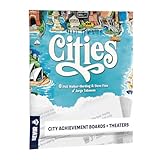
- 🏙️ EXPAND YOUR CITY-BUILDING EXPERIENCE (COMPATIBLE WITH CITIES, NOT CITIES USA) Enhance your games of Cities with new strategic possibilities, adding variety and replayability to every playthrough.
- 🌍 NEW CITY ACHIEVEMENT BOARDS Includes 11 double-sided achievement tiles featuring cities from around the world such as Budapest, Berlin, Paris, Prague, Amsterdam, Moscow, Seoul, Warsaw, Shanghai, Rome, Tokyo and more.
- 🎭 THEATERS MINI-EXPANSION MODULE Introduces Theater tokens that can replace Monument or Special Feature tiles, offering new placement decisions and scoring opportunities.
- 🎯TARGET AUDIENCE Ideal for strategy gamers, city-building fans, and players who enjoy expanding and customizing their favorite games. Perfect for groups seeking deeper tactical options and replayability.
- 📦GAME DETAILS & SPECIFICATIONS Players: 1–4, Recommended Age: 10+, Playtime: 45 minutes, Learning Time: 15 minutes, Teaching Time: 10 minutes. Language ( English )
Overall Steam reception is still Mixed
Steam’s accessed snapshot showed 57% positive among 34,605 English-language reviews overall, categorized as Mixed. In the last 30 days of that snapshot, 73% of 770 reviews were positive, categorized as Mostly Positive. Those figures indicate a more favorable recent Steam sample than the full English-language history; they are a moving platform-specific snapshot, not a survey of all players.
How to decide whether it suits you
- Consider it if you enjoy open-ended city planning, interconnected management systems and long-term building, and your PC is close to Steam’s recommended specifications.
- Think carefully if your PC is below the recommended level, you expect performance to remain uniform in large cities, or you prefer to make a decision from a single review score.
- Check before purchasing an expansion pass if a specific future pack is the reason you are interested; compare its scheduled window with its actual release status on Paradox’s product page.
For a fair comparison with another city builder, look at simulation depth, the clarity and effect of management systems, building and road tools, performance on your own hardware, current content and mod or asset support, and the combined cost of the base game and the expansions you want. The information available here does not establish a direct competitor ranking.
Quick Recap
Sources
- Paradox Interactive: Cities: Skylines II
- Paradox Interactive: game news
- Steam: Cities: Skylines II store page
- Paradox Support: performance guidance
- Paradox Interactive: Expansion Pass 2
- Paradox Interactive: Expansion Pass 2 announcement
Product prices and availability are accurate as of the date/time indicated and are subject to change. Any price and availability information displayed on Amazon at the time of purchase will apply.

