Ask ChatGPT for something random and you may get a confident answer that looks arbitrary. That is not the same as reliably sampling from a specified distribution. A 2026 evaluation of 11 language models found serious weaknesses on that more demanding task—but its headline results do not give ChatGPT a standalone score.
Why are people asking whether ChatGPT always picks 17?
A community post described asking for random items and getting “17, 23, Saturn, triangle.” It is a memorable example, not a controlled test: one person’s account cannot establish that ChatGPT always chooses 17, or show how often any number appears across users and prompts. The post does capture a common frustration: an answer can look oddly patterned even when a user asked for randomness.
As an Amazon Associate I earn from qualifying purchases.
The available evidence does not establish why a particular number recurs. It does not identify training data, prompt wording, decoding settings, or another factor as the cause. The more useful question is what kind of randomness the request actually requires.
Recommended Free Tools
What does “random” mean when you ask a chatbot?
A plausible one-off choice
If you ask for one number for a casual decision, a chatbot can give you a choice. But seeing one answer that looks arbitrary does not demonstrate that the model selected it through a uniform random process—or any other distribution you had in mind.
#1 Best Overall

- THE RANDOM NUMBER GENERATOR (RNG-01) is a laboratory quality instrument that uses the immutable randomness of radioactivity decay to generate random numbers
- THE RNG-01 PRODUCES approximately one to three random numbers every minute from background radiation.
- TRUE RANDOM NUMBERS that are useful for data encryption (cryptography), statistical mechanics, probability, gaming, neural networks and disorder systems, PSI and ESP testing, micro PK experiments, etc.
- SELECTION OF RANDOM NUMBER RANGES: 1-2, 1-4, 1-8, 1-16, 1-32, 1-64 and 1-128 .
- This unit is the Clear Transparent Etched Case. IMAGES SCIENTIFIC INSTRUMENTS INC., manufacturing electronic instruments and kits for over 25 years.
Sampling from a defined distribution
A stricter task specifies the possible outcomes and their probabilities: for example, choosing each integer in a range with equal probability. Testing that requires many samples and statistical checks. A model may produce a plausible-looking number or sequence without faithfully following those probabilities.
What did the 2026 language-model evaluation find?
An Association for Computational Linguistics paper by Minda Zhao, Yilun Du, and Mengyu Wang evaluated 11 language models across 15 probability distributions. Its abstract describes two protocols: generating a batch of 1,000 samples in one response, and making 1,000 stateless independent requests. The paper’s abstract and bibliographic record report the following headline findings:
Rank #2
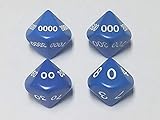
- Roll A Random Number 1 to 10000!
- 4 Dice Set (UNIT, TENS, HUNDREDS, THOUSANDS)
- Great for Random Numbers & Loot in RPGs
- The Dungeon Master's Friend
- Batch generation: The median pass rate across the tested models was 7%. This is a median for the study’s model set and batch protocol, not ChatGPT’s individual score.
- Independent requests: 10 of the 11 models passed none of the tested distributions under the study’s 1,000-stateless-call protocol. This is a result for that model set and distribution suite, not a claim about every ChatGPT version or every possible prompt.
The authors also report that sampling fidelity fell as distributions became more complex and as the sample horizon grew. Their abstract describes downstream problems in balancing multiple-choice answer positions and meeting demographic targets in constrained image-prompt synthesis. They conclude: “These findings indicate that current LLMs lack a functional internal sampler, necessitating external tools for applications requiring statistical guarantees.” That is the authors’ conclusion about the systems and protocols they studied, not an official verdict about every ChatGPT release.
The Tool Desk
Outbyte Driver Updater FREEScan for outdated or missing drivers - takes under a minuteDriver Scan →Outbyte PC Repair FREEClear out junk files and repair common Windows errorsFree Scan →Does this prove ChatGPT itself is bad at randomness?
It supports caution about relying on ordinary language-model responses as statistically faithful samples. It does not, from the available abstract, establish a ChatGPT-only pass rate. The study’s summary identifies the number of models, distributions, protocols, and headline results, but does not provide an individual ChatGPT breakdown.
Rank #3

- VERSATILE USE: Perfect for lottery number selection, bingo and random number generation activities with family and friends
- PORTABLE DESIGN: Compact and lightweight electronic number selector that's easy to carry and store when not in use
- EASY OPERATION: Simple push-button mechanism generates random numbers quickly and efficiently for various
- ELECTRONIC DISPLAY: Clear digital screen shows selected numbers, making it easy to read and announce during
- NIGHT ESSENTIAL: Ideal for family gatherings and social events where random number selection is needed
To compare randomness claims fairly, check which model and version were tested; whether the task requested one number, a sequence, or samples from a defined distribution; whether samples came in one batch or in independent prompts; how many samples were collected; and what statistical test and pass criterion were used. Those distinctions can change what a result means.
Why does another study say ChatGPT-3.5 did well?
A preliminary 2024 study adapted a human random-number generation test and reported that ChatGPT-3.5 avoided repetitive and adjacent-number patterns more effectively than the human comparison group. That study examined a different task from testing whether a model faithfully samples specified probability distributions.
Rank #4
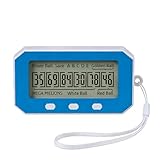
- Experience the thrill of our smart algorithm. It generates balanced and diverse number combinations through strategic calculation. This fresh approach for every game turns.
- Long-lasting, Portable & Always Ready Crafted from high-quality, impact-resistant materials, this device is built to endure. Its compact, lightweight design fits easily in your pocket, making it the perfect companion for game nights, parties, or on-the-go fun.
- Easy One-Button Use No guesswork, no complexity—just a single button press. Generate your numbers instantly on the clear LCD screen and effortlessly review past draws. Every selection is quick, simple, and purely entertaining.
- Flexible Modes for Popular Games Easily tailor your experience. Switch between “Quick Pick” for instant numbers and “Past Results” mode with one button. It’s ready for all major lottery-style games (compatible with rules like 5 main numbers plus a bonus number)—the versatile tool dedicated players want.
- Package Includes: You will receive one number picker, one lanyard, and one user manual. This number picker features long-lasting performance, allowing you to use it with confidence. It’s portable and convenient to carry anywhere without worry.
There is no necessary contradiction. A system can produce sequences that look less repetitive than people’s choices in one test while still failing to match target probabilities across distributions in another. “Looks random” and “samples the requested distribution” are different standards.
What’s actually slowing this PC down?
Pick the symptom - the matching free tool is one click away.
Was a ChatGPT bug responsible for repeated numbers?
OpenAI documented a specific incident in February 2024 in which incorrect inference-kernel results on certain GPU configurations affected number selection during language processing. The company says it deployed a fix and confirmed the incident was resolved. That incident write-up concerns a particular bug; it does not explain casual reports of repeated numbers generally.
What should you use when the outcome needs to be random?
For a low-stakes choice
If the consequences are trivial, asking a chatbot for a pick may be convenient—but treat it as a choice, not proof of a statistically fair draw. A physical die is a simple, visible alternative for a casual decision.
For statistical guarantees
Use an external tool designed for the specific requirement rather than relying on a conversational response. The right choice depends on what you need: uniform sampling, a particular probability distribution, reproducibility, or another guarantee. The cited evaluation supports using an appropriate external tool for applications that require statistical guarantees; it does not assess or endorse a particular generator.
Quick Recap
Product prices and availability are accurate as of the date/time indicated and are subject to change. Any price and availability information displayed on Amazon at the time of purchase will apply.

