Short answer: Carbon fiber can help a racing shell achieve a high stiffness-to-weight ratio, while fiberglass and mixed-material shells often prioritize impact tolerance, easier repair and lower construction cost. Neither material wins every category. The finished boat’s core, laminate schedule, fiber orientation, structural members, hull shape, fittings, condition and intended use can outweigh the fiber label.
A fair comparison is therefore between complete shell designs—not “carbon” versus “fiberglass” in isolation. A lightweight carbon shell with a delicate honeycomb core may suit racing transport and minimum-weight goals, while a heavier fiberglass-skinned shell with a tougher core may be the better choice for club storage, frequent handling or a used-boat budget.
As an Amazon Associate I earn from qualifying purchases.
What a racing shell is actually made of
A racing shell is a composite structure. Its strength and stiffness come from several layers working together: inner and outer skins, a core between them, local reinforcements, bonded structural members and the shape of the hull itself.
PC Slower Than It Used to Be?
A free scan shows the junk files, broken settings and background clutter dragging Windows down - then fixes them in one click.Free scan · Windows 10 & 11Outdated Drivers Are Slowing You Down
One free scan finds every outdated or missing driver and matches the right update for your exact hardware.Free scan · exact hardware matchSwift International describes sandwich construction in which reinforcing cloth—carbon, Kevlar or fiberglass—is laminated over a core such as honeycomb or coremat. The skins carry tension and compression; the core keeps them separated and resists buckling. Increasing that separation can raise panel stiffness without simply adding solid laminate weight.
#1 Best Overall

- Multifunctional Marine Fiberglass Repair Kit - It is suitable for repairing chips, cracks, pits, gouges, scratches and holes on various watercraft such as jet skis, canoes, kayaks, sailboats, speedboats, yachts, dinghies, surfboards and decks, keeping the vessels in good condition.
- Extremely Hard and Durable - After curing, the marine fiberglass repair kit has super-strong adhesion, is resistant to ultraviolet rays and waterproof, causing no damage to the fiberglass boat surfaces and being able to withstand harsh marine conditions. It is also safe for both users and the environment.
- Easy to Use - Clean the repair area thoroughly and keep it dry. Then cover the surrounding areas with stickers. Mix Part A and Part B in a 1:1 ratio. Apply the mixture, smooth it with a scraper, and remove the tape. Wait for 24 hours for it to cure. Finally, sand the repaired area with sandpaper until it is smooth.
- Economical - Marine Fiberglass Repair Kit allow you to fix it yourself instead of hiring expensive professionals to repair your boats.
- Your satisfaction is our pursuit - Any product-related problems are welcome to contact us, we will do our best to serve you!
Maas Boat Company likewise describes foam cores of different densities, fiberglass for impact resistance and stiffness, carbon for stiffness and strength, vinylester resin and rigid I-beam construction. Its boats combine those ingredients rather than relying on one material. Maas says its composite boats can be repaired by a local fiberglass repair shop, an important ownership consideration when a shell is damaged away from the manufacturer.
Other construction details matter just as much as the headline fiber:
- Core type and density: Honeycomb is selected for low weight in many racing constructions; coremat and denser foams can favor durability, repairability or cost.
- Skin schedule: The number, thickness and type of plies determine how much material is present.
- Fiber orientation: Unidirectional, biaxial and woven fabrics place reinforcement where the hull needs it.
- Resin and bonding: Resin choice, cure quality and the bond between skins, core and members affect the finished structure.
- Structural members: An I-beam, bulkhead, foot-stretcher support or other reinforcement can control local flex.
- Hull geometry and fittings: Waterline shape, rocker, chines, seats, riggers and hardware influence weight, handling and loads.
That is why a material name is not a specification by itself. Ask for the complete construction and the boat’s measured configuration.
Free tools Windows power users keep installed
One-click scans. No signup required.
Weight: compare specific boats, not material stereotypes
Carbon is commonly used when a builder is pursuing low mass, but the evidence does not establish a universal rule that every carbon shell is lighter than every fiberglass shell. Core thickness, safety margins, reinforcements, hardware and the design’s target crew weight can produce a heavier or lighter result regardless of the outer fiber.
Swift’s grade-to-grade figures
Swift publishes useful figures for its own grades, but they are not a controlled carbon-versus-fiberglass experiment. Within Swift’s range, Club A is approximately heavier than Elite Plus by the amounts below:
Rank #2

- 【Multifunctional Marine Fiberglass Repair Kit】It is suitable for repairing chips, cracks, pits, gouges, scratches and holes on various watercraft such as jet skis, canoes, kayaks, sailboats, speedboats, yachts, dinghies, surfboards and decks, keeping the vessels in good condition.
- 【Color Matching】It is equipped with a white base color and four colors pastes including blue, brown, maroon and black, enabling seamless repairs and perfectly matching the original color of the boat.
- 【Extremely Hard and Durable】After curing, the marine fiberglass repair kit has super-strong adhesion, is resistant to ultraviolet rays and waterproof, causing no damage to the fiberglass boat surfaces and being able to withstand harsh marine conditions. It is also safe for both users and the environment.
- 【Easy to Use】Clean the repair area thoroughly and keep it dry. Then cover the surrounding areas with stickers. Mix Part A and Part B in a 1:1 ratio. Add color pastes to adjust the color. Apply the mixture, smooth it with a scraper, and remove the tape. Wait for 24 hours for it to cure. Finally, sand the repaired area with sandpaper until it is smooth.
- 【Your satisfaction is our pursuit】Any product-related problems are welcome to contact us, we will do our best to serve you!
| Boat | Club A versus Elite Plus | Qualification |
|---|---|---|
| Single | Approximately 2 kg (4.4 lb) heavier | Swift grade comparison; model configuration and rigging still matter |
| Double | Approximately 2.5 kg (5.5 lb) heavier | Swift grade comparison; not a material-only test |
| Four | Approximately 4 kg (8.8 lb) heavier | Swift grade comparison; not a material-only test |
| Eight | Approximately 8 kg (17.6 lb) heavier | Swift grade comparison; not a material-only test |
Swift also reports Club B as approximately 1.5 kg (3.3 lb) heavier than Club A for singles and doubles, and approximately 3 kg (6.6 lb) heavier for fours. These numbers come from Swift International’s 2026 information, version 2.16A (the linked document is dated May 19, 2026). They describe differences among Swift construction grades; they do not isolate the effect of carbon cloth from fiberglass in otherwise identical boats.
A mixed-material example
Peinert Boat Works lists a rigged Zephyr weight of 42–47 lb, depending on options. Its described construction includes Kevlar, fiberglass, carbon, core and an I-beam. The range demonstrates why a quoted boat weight must include the exact options and rigging. It cannot be used as a direct comparison with a carbon-only shell of another design.
Quick wins for a faster PC:
Repair Windows errors before they cause bigger problemsFix Now →Scan for outdated or missing drivers - takes under a minuteDriver Scan →Minimum weights and ballast
Racing rules also influence how builders approach weight. Swift notes that some of its shells may require ballast to reach World Rowing minimums. In that situation, removing material is not automatically beneficial: a shell that is below the legal limit may need additional weight, while a boat built close to the limit leaves less margin for variations in fittings or repairs.
World Rowing’s equipment-compliance information calls for production information including the builder, construction year, designed crew weight and boat weight. For a purchase or club inventory, record the exact model, serial or identification information, measured weight and whether the number is shell-only or fully rigged. A scale reading on the actual boat is more useful than inferring weight from “carbon” or “fiberglass” in a brochure.
Stiffness: carbon helps, but architecture decides the result
Carbon fiber is attractive for performance shells because manufacturers associate it with high stiffness and strength at relatively low mass. King Racing describes high-modulus carbon as a route to a high weight-to-stiffness ratio. Maas similarly presents carbon’s stiffness and strength as part of a larger system that includes core material and rigid I-beam construction.
Rank #3

- Marine Fiberglass Repair Kit: This all-in-one epoxy filler can fix fiberglass boat damage efficiently, repairing deep scratches, cracks, chips, and holes in the boat, jet ski, yacht, surfboards, and other water vehicles. Our fiberglass repair kit has super strong adhesion and perfectly achieves seamless repair of marine gel coat, giving the boat finish a new life.rine Fiberglass Repair Kit
- Strong Adhesion & Lasting: Our gel coat repair kit for boats provides super-strong adhesion, UV resistance, and waterproof protection, ensuring durable repairs that withstand harsh marine conditions without damaging fiberglass surfaces. The premium fiberglass boat repair kit is both safe for you and the environment.
- Wide Applications: Our gelcoat repair kit for boats can be applied to vertical surfaces and works perfectly on most hard surfaces, carbon fiber, aluminum, PVC, acrylic, and wood. The boat gel coat repair kit is only for use on boat parts above the waterline. Our boat gel coat repair kit is the ideal choice for diverse marine repair needs.
- Easy To Use: 1. Clean the area to be repaired. 2. Remove the lid, place the push rod at the end of the boat fiberglass repair kit, and squeeze out the A&B boat paint in a 1:1 ratio 3. Mix A & B with a stirring stick until the color is uniform. 4. Apply the marine paint to the damaged area and smooth the surface with a yellow scraper. 5. Wait more than 24 hours for the repair paste to cure. 6. Sand the repaired area with sandpaper until the surface is smooth.
- Satisfaction: We're so confident that you'll love our fiber glasses repair kit, if you don't like this surfboard repair kit and if you have any problem with our Boat fiberglass repair kit, contact us at any time for help.
Stiffness is a property of the finished hull, not a simple property of the fiber name. A deep, well-bonded sandwich can resist panel bending more effectively than a thin laminate. Fiber direction determines whether reinforcement is aligned with longitudinal bending, transverse loads or local attachment forces. Bulkheads, I-beams, rigger mounts and the continuity of the skin can change how the shell flexes under a rower’s stroke.
The Tool Desk
Outbyte Driver Updater FREEFix the driver behind crashes, sound loss and screen glitchesFind Drivers →Outbyte PC Repair FREEClear out junk files and repair common Windows errorsFree Scan →Kanghua distinguishes a carbon-fiber honeycomb-sandwich range from a fiberglass-skinned coremat range with carbon reinforcement. That comparison illustrates two different design priorities, but it does not prove that one company’s category is stiffer than every other shell. A fiberglass skin over a well-designed core can be very rigid; a poorly supported carbon panel can still flex or suffer local damage.
What a stiffness claim should include
When a seller says a shell is “stiff,” ask:
- Is the claim about the whole hull, a panel, a rigger area or a seat structure?
- What core, skin schedule and fiber orientations are used?
- Was stiffness measured with a standardized test, and what load and support conditions were used?
- Is the figure for a shell-only boat or a rigged boat with fittings installed?
- Does the builder publish a numerical deflection or load result that can be compared with another boat?
The manufacturer pages available for these materials describe design intentions but do not provide an independent, standardized stiffness test across matched carbon and fiberglass shells. There is therefore no defensible universal percentage improvement or guaranteed speed gain to quote. Hull shape, stability and fit can affect real-world performance as much as a material change.
Durability and repair: a tradeoff rather than a ranking
Durability depends on the laminate and core, but also on what happens to the boat. Repeated loading, dock impacts, trailer or roof-rack pressure, careless lifting, ultraviolet exposure, water intrusion, poor storage and previous repairs all influence service life.
Swift explicitly contrasts racing honeycomb construction, where low weight is a priority, with club construction that emphasizes durability, ease of repair and cost. Maas describes fiberglass as contributing impact resistance and says its composite boats are readily repairable by a local fiberglass repair shop. Those statements support a practical tradeoff: a more robust or repair-friendly build may weigh more, while an aggressively light build may demand more careful handling.
Recommended Free Tools
Rank #4
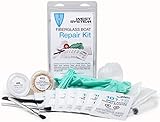
- Fiberglass boat repair kit – Includes eight packets of WEST SYSTEM 105 Epoxy Resin and 205 Fast Hardener, fiberglass fabric, adhesive and fairing fillers, mixing pots, glue brushes, reusable mixing stick, application syringe, protective gloves, and illustrated repair instructions.
- Designed for fiberglass boat repairs – Repair cracks and scrapes, gelcoat blisters, loose hardware, delaminated decks and panels, damaged keels, and holes up to 1″ diameter in solid laminates up to ¼″ thick, as well as smaller holes in thicker laminates.
- Professional WEST SYSTEM Epoxy system – Uses the proven 105 Epoxy Resin and 205 Fast Hardener combination to create strong, waterproof epoxy bonds for structural reinforcement and durable marine repairs.
- Works on fiberglass and composite materials – The included fiberglass fabric and epoxy fillers allow reliable repairs on fiberglass laminates and composite materials commonly found in boat hulls, decks, and structural components.
- Compact, resealable kit for onboard storage – All components are packaged in a sturdy resealable container you can store aboard your boat, keeping repair supplies organized and ready whenever unexpected damage occurs.
King Racing notes that woven carbon is stiff but more costly and brittle than some alternatives. “Brittle” does not mean a carbon shell will inevitably fail sooner; it means damage behavior and the margin for abuse can differ from a tougher, more forgiving laminate. A collision can produce hidden delamination or crushed core even when the outer surface looks acceptable.
Factors that usually matter more than the label
- Impact location: A strike on a pointed bow, keel, rigger mount or thin panel is more consequential than a superficial scuff.
- Core condition: Crushed, wet or detached core can reduce stiffness even when the skin appears intact.
- Load paths: Rigger bolts, foot-stretcher mounts and seat rails concentrate forces and need regular inspection.
- Handling routine: Two-person lifting, padded supports and correct tie-down pressure reduce avoidable damage.
- Storage: Dry, shaded storage and ventilation limit moisture and heat-related problems.
- Repair quality: A correctly scarfed and bonded repair can restore function; an incompatible patch can add weight or conceal continuing damage.
Repair safely
Do not treat a generic repair kit as universally suitable. The resin, cloth, core replacement and surface preparation must match the shell, and a structural failure needs more than cosmetic filler. Minor compatible repairs may be within an owner’s ability if the manufacturer permits them and the damage is clearly non-structural. For cracks near a rigger, bulkhead, seat support or other load-bearing area, use a qualified composite or boat-repair professional. Ask the builder or an authorized service provider for the laminate and resin requirements before cutting into the hull.
How the main construction approaches differ
| Construction approach | Typical priority | Potential advantages | Trade-offs and questions |
|---|---|---|---|
| Carbon skins with a lightweight honeycomb sandwich | Low mass and high stiffness-to-weight potential | Can support a light racing shell when the layup and structure are well engineered | Ask about impact tolerance, core repair, local reinforcements and handling requirements; low weight is not a guarantee of longer life |
| Fiberglass skins with coremat or a denser core | Durability, repairability and cost | Fiberglass can provide impact resistance and local repair expertise is often available | May weigh more than a builder’s lightest racing grade; actual stiffness depends on core depth and laminate |
| Mixed carbon, fiberglass and/or Kevlar construction | Place each material where its properties are useful | Can balance stiffness, impact behavior and weight in one design | Requires the exact layup and repair instructions; the word “carbon” alone reveals little |
| Carbon-reinforced fiberglass-skinned sandwich | Intermediate design target | Can add directional stiffness without making every skin ply carbon | Compare measured weight and flex data rather than assuming it matches a full-carbon shell |
The categories above are design patterns, not quality grades. A shell’s suitability depends on the builder’s execution, the rower’s weight range, the boat’s condition and the environment in which it will be used.
Independent reader supportYour contribution helps us test, update, and keep practical guides available for everyone.A practical comparison process for two real shells
Use the following sequence when comparing boats from different builders or deciding between a new and used shell.
- Match the boat class and crew range. Compare singles with singles, doubles with doubles and so on. Confirm the designed crew-weight range; a shell optimized for a heavier crew may carry different reinforcement than one for lightweight rowers.
- Identify the exact construction grade. Record the model name, production year, shell number and whether it is an elite, club or other grade. “Carbon” without a grade is incomplete information.
- Define what is being weighed. Request shell-only and rigged weights where available. Remove ambiguity about seats, shoes, riggers, electronics, covers and ballast. If possible, weigh the actual boat on a calibrated scale.
- Document the laminate and core. Ask whether the skins are carbon, fiberglass, Kevlar or a combination; whether the core is honeycomb, coremat or foam; and where local reinforcements or I-beams are installed.
- Interrogate stiffness claims. Request the test method, load, support points and measured deflection. If there is no standardized number, treat “stiff” as a design description rather than a directly comparable specification.
- Check repair support before buying. Find out who can repair the boat locally, which resin and fabrics are approved, whether structural parts are available and how warranty coverage handles impact damage.
- Inspect a used shell methodically. Look for cracks, soft spots, ripples, crushed core, water staining, loose fittings, distorted rigger mounts and evidence of repainting. Tap-testing or moisture checks are useful only when performed by someone who understands composite structures.
- Verify compliance information. For racing use, retain the builder, construction year, designed crew weight and boat-weight records requested by World Rowing. Confirm any class-specific minimum weight and whether ballast is installed.
- Assess fit and handling on the water. Seat height, foot-stretcher adjustment, rigger geometry and stability can make a bigger practical difference than a modest weight change. If possible, row both boats in conditions representative of your use.
Hull shape and stability still matter
Material does not determine whether a shell is appropriate for a particular rower. Momentum Rowing and Nelo Rowing North America explains that hull shape involves a speed-and-stability tradeoff. A narrow, aggressive hull may reward a skilled crew in flat water but be less forgiving for a developing rower or rough venue. A more stable shape can improve confidence, balance and the ability to apply power consistently.
Best Value

- PRE-THICKENED FIBER REINFORCED POLYESTER PUTTY for high-strength structural filling, fitting, bonding, bedding & radius forming; great for boat building & repair on fiberglass, wood, metal, polyester laminates & core materials; use above or below waterline
- MARINE FILLER has premium polyester resin and long strand glass fibers for strength, impact resistance & elasticity; ideal for bonding decks, stringers & liners to hulls; filleting and bonding bulkheads, and filling screw holes, bolt holes, chips & dents
- EASY TO MIX, EASY TO APPLY: For a 100g mass, catalyze with 1% MEKP to get 15-20 min. of working time at 70°F (14 drops of MEKP per ounce of putty); adjust amount of catalyst to control working time; paste-like consistency is easy to spread and won’t sag
- FAST-SETTING STRUCTURAL ADHESIVE is ideal for fiberglass & gelcoat repair; for cosmetic fairing, overcoat Polyester Structural Repair Putty with TotalBoat Polyester Fairing Compound; it sands smooth easily & can be finished with TotalBoat Gelcoat with wax
- AVAILABLE IN QUART AND GALLON KITS: Includes 2 oz. MEKP. This versatile bonding compound can bond dissimilar materials and can also be used in many home, auto, construction, and aerospace applications, with no shrinking or cracking, even in bulk fillings
When the choice is close, include hull fit, stability, seat travel, foot-stretcher range, rigger adjustment and local water conditions in the decision. A shell that is theoretically lighter or stiffer is not automatically faster if the crew cannot row it efficiently or spends more time correcting balance.
Choosing by use case
Racing-focused crews chasing minimum weight
Prioritize a verified rigged weight, legal ballast margin, stiffness information and a construction that matches the crew’s handling discipline. A lightweight honeycomb design may make sense when transport is controlled and impact risk is low, but confirm how the builder expects the shell to be supported and repaired.
Clubs with frequent transport and shared use
Durability, straightforward inspection and local repair access can be worth more than the last kilogram. A fiberglass or mixed-material shell with a robust core may reduce downtime when many rowers handle the boat. Ask how replacement parts and structural repairs are managed, not just what the shell weighs on delivery.
Rowers buying used equipment
Condition and repair history outrank the original material label. A well-maintained fiberglass shell can be a better purchase than a neglected carbon shell with crushed core or poorly repaired impact damage. Budget for a professional inspection when the purchase price is significant or any structural symptom is present.
Owners who need simple local servicing
Confirm that a competent composite or fiberglass boat shop is available nearby and that the builder will provide compatible materials and procedures. Maas specifically describes local fiberglass-shop repairability, but every model still needs its own instructions; do not assume another shell uses the same resin, core or scarf dimensions.
Questions to ask a builder or seller
- What is the measured weight of this exact boat, and does it include riggers, seats, shoes and ballast?
- Which skins, core, resin and structural members are used in this model and grade?
- What crew-weight range was the hull designed for?
- Is there a published stiffness test or only a qualitative design claim?
- What damage is considered cosmetic, and what requires a structural inspection?
- Who is authorized to repair the shell, and what materials must be used?
- What is covered by the warranty, and how do previous repairs affect it?
- For a used boat, can the seller provide repair invoices, storage history and compliance records?
Bottom line for carbon versus fiberglass
Choose carbon when the complete design delivers a verified weight and stiffness benefit that matters to your racing, and when you can protect and service the shell appropriately. Choose fiberglass or a mixed construction when impact tolerance, repair access, club use and purchase cost carry greater weight. The sound decision is based on measured boat weight, documented construction, actual stiffness evidence, hull fit, condition and support—not on the fiber name printed in a listing.
Independent, matched tests comparing carbon and fiberglass shells for weight, stiffness and lifespan are not established by the manufacturer information cited here. Treat brand specifications as model-specific claims, keep their qualifications attached, and compare like-for-like boats before drawing a material conclusion.
Quick Recap
Product prices and availability are accurate as of the date/time indicated and are subject to change. Any price and availability information displayed on Amazon at the time of purchase will apply.

