Quick wins for a faster PC:
Repair Windows errors before they cause bigger problemsFix Now →Fix the driver behind crashes, sound loss and screen glitchesFind Drivers →Clear out junk files and repair common Windows errorsFree Scan →A Canon Pixma G3270 that will not print usually has a fixable problem upstream of the print head. Work in this order: confirm power and initialization, verify the job and paper settings, check the selected printer and connection, then branch to Wi‑Fi discovery, paper feeding or support code 1300, and finally ink quality. This sequence prevents you from running ink-cleaning cycles on a printer that the computer or phone cannot even reach.
The G3270 is covered by Canon’s G3070-series online manual. Use the G3070-series manual index and its troubleshooting FAQ when an LCD support code appears.
As an Amazon Associate I earn from qualifying purchases.
First, identify what “won’t print” means
Different symptoms point to different causes. Choose the closest branch before changing settings.
Recommended Free Tools
| What you see | Most likely area | Start here |
|---|---|---|
| The printer is completely idle, or the job remains in the queue | Power, initialization, queue, printer selection, driver, or connection | Run the basic checks below before touching ink settings. |
| Your computer or phone says the printer is offline or cannot find it | Wi‑Fi association, network credentials, permissions, range, or interference | Check both ends of the connection and determine whether you are using router Wi‑Fi or Wireless Direct. |
| The printer says there is no paper, pulls paper incorrectly, or will not feed | Loading, paper condition, guides, settings, obstruction, or feed roller | Reload suitable paper and match the print-dialog settings. |
| Support code 1300 appears | Paper jam | Follow the jam procedure; do not force the sheet or tilt the printer. |
| A page is blank, faint, streaked, or missing one color | Nozzle, ink level, print quality, or print-head condition | Print a nozzle check, then use Canon’s cleaning sequence. |
If an LCD code is shown, use Canon’s support-code list rather than applying a generic fix. A code identifies a physical or operational condition that may require a specific recovery procedure.
#1 Best Overall

- Wireless Print/Copy/Scan
- Up to 2 years of ink included (2)
- Print up to 6,000 black & white / 7,700 color pages using a single set of inks! (1)
- Save up to $1,000 on ink (1)
- 1.35” Square LCD display
Run the no-print checklist in order
Canon’s “Printer Does Not Print” procedure begins with checks that are easy to overlook. Complete each one before moving to a more invasive branch. The full procedure is at Canon’s no-print troubleshooting page.
- Confirm power. Make sure the power cord is firmly connected, the printer is switched on, and the startup or initialization process has finished. If the printer has just been turned on, wait until it is ready before sending a job.
- Check the destination printer. In the print dialog, select the G3270 rather than another registered Canon printer, a duplicate queue, a virtual PDF printer, or an old offline entry. On a computer, also confirm that the installed driver corresponds to the G3270/G3070 series.
- Inspect the queue. Delete obsolete, paused, or failed jobs that are blocking the current document. Send a small test page after the queue is clear instead of repeatedly submitting the same large file.
- Match paper settings. The size and media type selected in the application or driver must agree with the paper loaded in the rear tray. A mismatch can stop a job even when paper is physically present.
- Verify the connection. For a network job, confirm that the printer and the sending device are connected to the intended network. If you are printing by cable or through a previously configured computer connection, check that the connection is active and that the correct driver port is selected.
- Allow processing time for large jobs. High-resolution photographs and graphics can take longer to process before the printer begins feeding paper. Do not cancel a job immediately if the printer is powered, connected, and still processing.
If a small text document prints but a particular photo or application does not, the printer is probably reachable; investigate that application’s paper, quality, or document settings rather than resetting Wi‑Fi.
Use a small test to isolate the failure
After clearing the queue, send a short text document on ordinary supported paper. A successful test proves the basic path from the device to the printer and narrows the problem to the original file, application, paper choice, or print-quality setting. If even the test document remains queued, do not spend ink on cleaning; return to power, printer selection, driver, and connection checks.
Large photographs and graphics may appear idle while data is being prepared. Give them additional processing time, but cancel a job that is demonstrably stuck only after confirming the printer is not displaying a paper, jam, or other support message. Resubmitting the same large file repeatedly can create a queue blockage and make diagnosis harder.
When the G3270 is missing from Wi‑Fi
Network discovery requires a working path at both ends: the G3270 must be associated with the right network, and the computer or mobile device must be allowed to discover it. Canon’s smartphone and tablet troubleshooting guidance is at this communication troubleshooting page.
Check the printer and the device
- Confirm that the printer is powered on and that Wi‑Fi is enabled on the phone, tablet, or computer.
- Look for the printer’s wireless connection indicator. If it does not show a network connection, reconnect the printer before troubleshooting the computer.
- Verify that the printer and device use the same router network name (SSID). A device connected to a guest network, extender network, or different band/segment may not discover the printer even when both have internet access.
- Re-enter or verify the router password on the printer. One incorrect character prevents association.
- Move the printer closer to the router and reduce walls, cabinets, metal objects, and other obstructions. Nearby wireless equipment can also cause interference.
For a computer-based diagnosis, Canon recommends its Wi‑Fi Connection Assistant. Use it to inspect the printer’s network status and diagnose discovery issues rather than installing an unrelated “driver fixer.”
Allow local-network discovery on macOS 15 or later
On macOS 15 and later, each application that needs to discover devices on the local network requires permission. Open System Settings > Privacy & Security > Local Network, enable access for the application you use to print, and retry discovery. Canon documents this requirement in its network troubleshooting notes: network discovery guidance. If permission is denied, an application may not list the G3270 or may fail to start its printer-discovery function correctly.
Free tools Windows power users keep installed
One-click scans. No signup required.
Rank #2

- Wireless Print/Copy/Scan
- Up to 2 years of ink included (2)
- Print up to 6,000 black & white / 7,700 color pages using a single set of inks! (1)
- Save up to $1,000 on ink (1)
- 1.35” Square LCD display
Choose the correct connection route
Router Wi‑Fi and Wireless Direct are separate paths. The device must join the path you intend to use.
| Route | What the device joins | Checks |
|---|---|---|
| Router Wi‑Fi | Your normal wireless network | The G3270 and device use the same SSID and password; router range and interference are acceptable. |
| Wireless Direct | The printer’s own Wireless Direct SSID | Enable Wireless Direct on the printer, select that printer-specific SSID on the device, and enter the configured Wireless Direct password. |
Wireless Direct supports at most five connected devices. If a sixth phone or computer is trying to join, disconnect an existing device first. A device that remains on the household router Wi‑Fi will not print through Wireless Direct until it changes to the printer’s direct SSID.
If the router is the suspected failure
Restarting the router can restore a lost association. Router configuration and firmware differ by manufacturer, so use the router maker’s instructions for channel, band, security, or firmware changes. Do not change several router settings at once; first establish whether the G3270 can reconnect with the existing configuration.
When testing Wireless Direct, temporarily disconnect the phone or computer from other saved networks so it does not silently switch away from the printer’s SSID. When testing router Wi‑Fi, reverse that process and reconnect both devices to the intended household network. This simple distinction prevents treating a correct connection as a printer failure.
What’s actually slowing this PC down?
Pick the symptom - the matching free tool is one click away.
When paper will not feed or “No Paper” appears
Paper errors are commonly caused by loading or a settings mismatch, not an empty tray. Canon’s complete feed procedure is at paper-feed troubleshooting.
Reload the rear tray correctly
- Remove the stack and inspect it. Use supported, flat paper; replace sheets that are curled, damp, damaged, or stuck together.
- Load the stack in portrait orientation in the rear tray, with the printable side facing up.
- Align the stack edges before inserting it. Do not exceed the tray’s load limit.
- Slide the paper guides until they touch the edges without bending the paper. Guides that are too loose can allow skew; guides that are too tight can prevent feeding.
- Remove any scraps or foreign objects visible in the tray or feed path.
- In the application’s print dialog, select the exact loaded paper size and a matching media type. The printer uses those settings to control feeding and print quality.
Do not assume that ordinary letter paper settings are correct for envelopes, photo stock, or other media. A physical sheet can fit while still being unsupported or incorrectly identified by the driver. If you need replacement stock, choose flat, supported letter-size plain paper and verify the size and media type in the driver; paper cannot correct a network or queue problem.
Clean the feed roller only when necessary
If suitable paper is loaded, the guides are aligned, and the path is clear but feeding still fails, Canon provides a feed-roller cleaning operation. The roller surface is abraded during cleaning, so Canon says to perform it only when necessary. Follow the printer’s maintenance instructions and stop if the problem persists; repeated cleaning is not a substitute for service.
Rank #3

- Wireless Print/Copy/Scan (2)
- Up to 2 years of ink included
- Print up to 6,000 black & white / 7,700 color pages using a single set of inks! (1)
- Save up to $1,000 on ink (1)
- 2.7” LCD Color Touchscreen
Never turn or tilt the printer while trying to remove an obstruction. Ink can leak if the unit is handled that way.
Support code 1300: treat it as a paper jam
Code 1300 indicates a jam branch, not a Wi‑Fi or ink problem. Use Canon’s illustrated paper-jam procedure.
- Check the output slot and the rear-tray feed slot for visible paper.
- Remove the sheet slowly and evenly so it does not tear. Do not yank it or force it against the rollers.
- If paper is torn or cannot be reached from the outside, use Canon’s inside-printer removal steps. Look for every fragment; a small remaining piece can trigger another jam.
- Do not tilt, turn upside down, or forcibly pull the printer. Ink may leak, and mechanical parts can be damaged.
- After the path is clear, reload appropriate paper and press OK when the printer requests confirmation.
Switching the printer off during jam recovery can cancel queued jobs. If a job disappears after the printer restarts, resend it only after the jam message has cleared. If code 1300 returns with no visible paper, stop repeating the removal attempt and contact Canon or an authorized service provider.
Blank, faint, streaked, or missing-color output
Do not begin with repeated deep-cleaning cycles. First verify that the printer can feed the paper and that the selected size, media type, and quality are appropriate. Then use a nozzle check to separate an ink-delivery problem from an application or paper-setting problem. Canon’s staged instructions are on its ink and nozzle troubleshooting page.
Print and read a nozzle-check pattern
- Start the printer’s nozzle-check pattern from its maintenance controls or the Canon printer driver.
- Inspect the pattern for missing segments, gaps, banding, or an absent color.
- Check the corresponding ink tank level. A low or empty tank can explain a missing color; do not run cleaning cycles without confirming that ink is available.
A clean nozzle pattern with poor output from one application points back to document, media-type, or quality settings. An incomplete pattern points to the print system and requires the maintenance sequence.
PC Slower Than It Used to Be?
A free scan shows the junk files, broken settings and background clutter dragging Windows down - then fixes them in one click.Free scan · Windows 10 & 11Crashes, No Sound, or Screen Glitches?
Random freezes, missing sound and display glitches usually trace back to one bad driver. Find and replace yours safely.Free scan · under a minuteUse Canon’s maintenance sequence
When ink remains but the nozzle pattern is incomplete, proceed in Canon’s order. Run ordinary print-head cleaning, print another nozzle check, and evaluate the new pattern. If it remains defective, use the documented deep-cleaning step and print another nozzle check. Follow the manual’s later ink-replacement procedure if Canon directs you to do so, again checking the pattern afterward.
Cleaning consumes ink. Running the deepest operation repeatedly without checking the pattern can waste ink and may not correct a mechanical or electrical print-head fault. A print-head replacement is a later remedy in Canon’s procedure, after the nozzle check, normal cleaning, deep cleaning, and the specified ink-replacement steps have failed to restore the pattern.
Rank #4
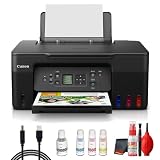
- Items Include: Canon PIXMA G3270 MegaTank All-in-One Inkjet Printer (Black) for Home Office, Photos, Flyers, Invitations, Labels, Student Work and Easy Wireless Printing, Printer Cable, Cleaning Kit
- Built to handle daily printing with less friction, the Canon PIXMA G3270 MegaTank All-in-One Wireless Inkjet Color Printer (Black) combines Print, Scan & Copy Functions, Compact Design for Home or Small Office, 8.5 x 14 in Legal-Size 100-Sheet Rear Tray, and Print up to 8.5 x 11 in Borderless Photos. That mix supports smoother workflow at home or work, whether you are printing school packets, shipping labels, client forms, borderless photos, or presentation pages.
- Connectivity and convenience matter just as much as print quality, which is why this model is positioned for flexible use from desks, shared spaces, and mobile devices. With features such as 4800 x 1200 dpi Print Resolution, Print on Plain Paper, Cards, Envelopes, 8.5 x 11.7 in Flatbed for Scanning/Copying, and Wi-Fi and USB Connectivity, it fits naturally into modern routines where people print from laptops, phones, and tablets without wanting extra complexity.
- Speed, paper handling, and media support help determine whether a printer actually saves time, and this one is configured for dependable everyday performance. Specs like 11 ipm Letter-Size Black Printouts, 6 ipm Letter-Size Color Printouts, and the broader feature set make it a strong option for documents, color graphics, forms, cards, envelopes, and creative household or office tasks.
- Whether you need a compact family printer, a reliable home office upgrade, a high-volume MegaTank model, or a photo-focused option for craft projects, the G3270 is built to cover real use cases with clear output and practical controls. It supports the kind of everyday print, scan, copy, or fax workflow that helps reduce interruptions and keeps important jobs moving from start to finish.
If a tank is low, use Canon’s refill instructions and confirm regional bottle compatibility for the G3270 before buying. An ink purchase is relevant only when the tank level or nozzle check indicates an ink-delivery issue; it will not fix an undiscovered printer, a blocked queue, a paper jam, or a mismatched media setting.
Independent reader supportYour contribution helps us test, update, and keep practical guides available for everyone.Computer and mobile paths are not identical
Windows
On Windows, confirm that the G3270 is the selected printer in the application and that its queue is not paused or offline. If the printer is not listed, verify the computer’s Wi‑Fi network, the printer’s SSID association, and the installed Canon driver. Canon’s Wi‑Fi Connection Assistant can help diagnose a reachable printer that is not being discovered by the operating system.
The Tool Desk
Outbyte Driver Updater FREEFix the driver behind crashes, sound loss and screen glitchesFind Drivers →Outbyte PC Repair FREEClear out junk files and repair common Windows errorsFree Scan →macOS
On macOS, check the selected printer in the application, then check Local Network permission for that application on macOS 15 or later. A denied permission can look like a missing printer even when the G3270 is connected to the router.
iPhone, iPad, and Android devices
Decide whether the mobile device should print through the household router or Wireless Direct. For router printing, both devices must use the same SSID. For Wireless Direct, join the G3270’s direct SSID and enter its password; the five-device maximum still applies. If the phone silently switches back to another saved network, reconnect it to the intended route before retrying.
When the basic branches do not solve the problem
Stop and seek Canon or authorized service when the printer repeatedly reports a jam after every fragment has been removed, cannot feed known-good supported paper after correct loading and a necessary roller-cleaning attempt, or continues to produce a defective nozzle pattern after Canon’s complete maintenance sequence. Service is also appropriate when the printer will not complete initialization, shows physical damage, leaks ink, or cannot retain network settings.
Before contacting support, record the exact LCD support code, the connection route (router Wi‑Fi or Wireless Direct), the device and operating system, the loaded paper type, and what the nozzle-check pattern looks like. That information identifies the correct branch faster than describing the symptom only as “it won’t print.”
Frequently Asked Questions
Why is my Canon G3270 on but not printing?
Confirm that initialization has finished, select the G3270 rather than another queue, clear paused or failed jobs, and match the driver’s paper size and media type to the loaded paper. Large photo files may also need extra processing time.
Best Value

- Wireless Print/Copy/Scan (2)
- Up to 2 years of ink included - Disclaimer: Claim of up to two (2) years of ink based on average monthly document print volumes of 200 pages continuous printing using ‘default printing mode’.
- Print up to 6,000 black & white / 7,700 color pages using a single set of inks! (1)
- Save up to $1,000 on ink (1)
- 2-line LCD display
Why can’t my computer find the G3270 on Wi‑Fi?
Check the printer’s wireless indicator, confirm both devices use the same SSID and password, reduce distance and obstructions, and verify that the application has local-network permission on macOS 15 or later. Canon’s Wi‑Fi Connection Assistant can help on computers.
What is the difference between router Wi‑Fi and Wireless Direct?
Router Wi‑Fi uses your normal household network. Wireless Direct uses the printer’s own SSID and password; the device must join that SSID directly. Wireless Direct allows no more than five connected devices.
What should I do when the G3270 says No Paper?
Reload supported, flat paper portrait-style in the rear tray, printable side up. Align the guides without bending the stack, stay below the load limit, remove obstructions, and make the print-dialog size and media type match.
What does Canon support code 1300 mean?
It is a paper-jam condition. Check the output and rear-tray slots, remove paper slowly, follow Canon’s inside-printer steps for torn sheets, never tilt the unit, then reload paper and press OK.
How do I fix blank or streaked pages?
Verify paper and quality settings, print a nozzle-check pattern, and inspect the affected tank. If ink remains and the pattern is incomplete, perform ordinary cleaning, check again, then deep cleaning and Canon’s later documented steps only as directed.
Should I replace the print head immediately?
No. Canon places print-head replacement after a nozzle check, normal cleaning, deep cleaning, and the specified ink-replacement procedure fail to restore the pattern.
Can cleaning fix a printer that the computer cannot discover?
No. Cleaning addresses ink-delivery symptoms. A missing or offline printer requires power, queue, driver, network, SSID, range, or permission checks first.
The Bottom Line
Trace the failure in order: power and initialization, selected printer and queue, matching paper settings, connection route, paper feed or code 1300, and finally nozzle and ink maintenance. Keep router Wi‑Fi separate from Wireless Direct, allow local-network discovery on macOS 15 or later, and follow Canon’s staged cleaning procedure instead of repeating deep cleaning or buying ink for a network problem.
Quick Recap
Product prices and availability are accurate as of the date/time indicated and are subject to change. Any price and availability information displayed on Amazon at the time of purchase will apply.

