Yes. You can compose or trigger an eclipse photo using a camera’s rear display or a remote control instead of putting your eye to the optical viewfinder. That changes how you frame the shot, not how you protect your eyes or camera. During any partial or annular phase, a special-purpose solar filter must be secured over the front of the camera’s optical system. NASA’s safety guidance warns that viewing the bright Sun through camera optics without the correct front-mounted filter can cause severe eye injury. See NASA’s Eclipse Viewing Safety guidance and its photography guidance.
The short answer: screen or remote framing is fine, unfiltered optics are not
The camera viewfinder is only one way to compose a picture. A rear LCD screen, an electronic display, or a remote control can let you aim and trigger the camera without placing your eye at the optical viewfinder. This is useful if you want to keep your face away from the camera while it points toward the Sun.
As an Amazon Associate I earn from qualifying purchases.
It does not make the camera safe by itself. The hazard comes from the bright Sun entering the camera’s optical system, not from the act of looking through a particular type of viewfinder. For partial and annular phases, NASA requires a special-purpose solar filter attached at the front of the camera lens or other optics. The filter requirement still applies when you use the rear screen, a phone display, or a remote trigger.
Free tools Windows power users keep installed
One-click scans. No signup required.
NASA’s wording is direct: “A special-purpose solar filter must be attached to the front of any telescope, binoculars, camera lens, or other optics.” Read the complete NASA safety page before choosing equipment.
#1 Best Overall

- SOLAR SAFE TELESCOPE FILTER: Filter conforms to the ISO 12312-2:2015(E) international safety standard for filters directly viewing the Sun. The ideal tool for viewing eclipses, sunspots, or the Sun any day!
- WORKS WITH YOUR EXISTING TELESCOPE, SPOTTING SCOPE, OR DSLR CAMERA: Compatible with objective lenses with an outside diameter of 75mm to 100mm.
- SAFE, SECURE FIT: Adjust the side panels to fit the filter to your telescope or camera and attach the elastic band to secure. When you're done observing, fold the filter flat and store it in the reusable bag.
- SOLAR FILM MADE IN THE USA: Celestron Solar Safe film is produced in the USA by American Paper Optics, one of the suppliers recommended by NASA & the American Astronomical Society for safe solar viewing, & independently tested by a third-party lab.
- GREAT VIEWS AND IMAGES: This filter features an orange tint, producing a natural look perfect for visual observing and capturing images through your telescope, spotting scope, or DSLR camera.
What changes at each stage of an eclipse?
Protection depends on both the eclipse phase and what you are doing. Direct eye viewing and camera photography are related but separate activities, so do not transfer a rule for one to the other.
| Eclipse situation | Direct eye viewing | Camera optics | Can you use the screen or a remote? |
|---|---|---|---|
| Partial phase | Use safe solar-viewing glasses or a handheld solar viewer. | Use a special-purpose solar filter secured over the front of the lens or optical system. | Yes. Screen or remote framing avoids the optical viewfinder, but it does not replace the camera filter. |
| Annular phase | The bright solar face remains visible, so use safe solar viewers. | Use a special-purpose front-mounted solar filter. | Yes, with the same filter requirement. |
| Totality, while the bright face is completely obscured | NASA identifies this brief period as the eye-safety exception to eclipse glasses. | The cited NASA guidance does not give a camera-specific instruction to remove or reinstall a photographic filter. | Yes, but screen or remote use does not answer the separate camera-filter question. |
| Immediately before or after totality | Put eye protection on and keep it on while any bright part of the Sun is visible. | Follow the appropriate photographic-filter guidance for the equipment and phase. | Yes, provided the camera is configured safely for the phase. |
The eye exception during totality is narrow: it applies only while the Moon completely covers the Sun’s bright face. NASA says to use eye protection during the partial phases and to put it back on as soon as any bright part reappears. That statement concerns direct viewing; it does not authorize removing a camera filter.
How to photograph without using the optical viewfinder
The following workflow separates composition from protection. The order matters because a successful frame is never worth aiming an unfiltered camera at the Sun.
Recommended Free Tools
Rank #2

- Black polymer is the most common filtering material for observing sunspots and granulation, through telescopes and binoculars.
- These sheets are a quality product of Thousand Oaks Optical, Arizona, a manufacturer of safe solar filters for over 30 years. "Stronger than Mylar with the filtering properties protected within the substrate. Guaranteed five years."
- Make a filter on your own for any telescope / binoculars / camera, and for a fraction of what factory made filters cost.
- The sun will appear in a natural orange color when viewed through your telescope using this filter.
- WARNING: ALWAYS MAKE SURE THE FILTER IS WELL ATTACHED TO THE TELESCOPE/BINOCULARS, USING STICKY TAPE, TO KEEP IT FROM FALLING WHILE OBSERVING!
- Identify the phase you will photograph. If the bright solar face will be visible, treat the session as a filtered-camera activity. That includes every partial and annular phase and the moments before and after totality when even a small bright portion returns.
- Choose a viewing method that keeps your eye away from the optical finder. Use the camera’s rear display if it provides the framing information you need, or use a remote control to trigger the shutter after composing. This answers the viewfinder concern without changing the optical-safety requirement.
- Obtain a filter made for the camera’s optical system. NASA describes the needed item as a special-purpose solar filter and says it must be attached at the front of the lens or other optics. A filter intended for one piece of equipment should not be assumed to fit another. NASA recommends seeking expert advice from an astronomer about filters for cameras and other optical devices.
- Secure the filter before pointing the camera toward the Sun. The filter belongs over the front of the optical path. Do not aim first and plan to add protection afterward. Check that the filter is held firmly and covers the entire front opening.
- Compose on the rear display or through your remote setup. Keep your eye away from an optical viewfinder if that is your chosen safety practice. A screen-based workflow can also make it easier for a second person to observe the camera without crowding the photographer.
- Keep the front-mounted filter in place during filtered phases. Do not remove it simply because the screen looks dim, the framing is difficult, or the camera does not immediately produce the image you expect. Solve a composition or exposure problem without exposing the optics.
- Handle totality as a separate decision. The cited NASA pages explain when direct eye protection may be removed, but they do not provide a camera-specific instruction for removing or reinstalling a photographic filter. Do not infer a camera procedure from the eye-viewing exception. If you plan to photograph totality, obtain equipment-specific advice from a qualified astronomy expert and follow the instructions supplied for that system.
- Restore eye protection as soon as bright light returns. When totality ends and any bright part of the Sun becomes visible, put safe solar-viewing protection back on for direct observation.
Can a smartphone photograph the eclipse?
Yes, but a phone is not exempt from the optical-filter rule. NASA’s eclipse FAQ says a smartphone can photograph an eclipse when a specialized eclipse filter is placed between the camera and the Sun. The phone’s display lets you compose without looking through a conventional viewfinder, but the filter still has to protect the camera’s optics.
Use a filter specifically suitable for the phone-camera arrangement you are using. A handheld eclipse viewer or a pair of eclipse glasses is designed for direct eye viewing, not as a substitute camera filter. NASA’s safety guidance says not to use eclipse glasses or handheld viewers with cameras, binoculars, or telescopes.
For NASA’s smartphone answer, see the Total Solar Eclipse FAQ. The FAQ’s yes applies to a phone used with a specialized eclipse filter, not to an unfiltered phone pointed at the Sun.
Rank #3

- Black polymer is the most common filtering material for observing sunspots and granulation, through telescopes and binoculars.
- These sheets are a quality product of Thousand Oaks Optical, Arizona, a manufacturer of safe solar filters for over 30 years. "Stronger than Mylar with the filtering properties protected within the substrate. Guaranteed five years."
- Make a filter on your own for any telescope / binoculars / camera, and for a fraction of what factory made filters cost.
- The sun will appear in a natural orange color when viewed through your telescope using this filter.
- WARNING: ALWAYS MAKE SURE THE FILTER IS WELL ATTACHED TO THE TELESCOPE/BINOCULARS, USING STICKY TAPE, TO KEEP IT FROM FALLING WHILE OBSERVING!
What counts as the correct solar filter?
The important characteristics are purpose, placement, and compatibility:
What’s actually slowing this PC down?
Pick the symptom - the matching free tool is one click away.
- Special-purpose: The filter must be intended for safe solar observation or photography. Ordinary sunglasses, neutral-density filters, polarizers, or improvised materials are not established as safe by the NASA guidance cited here.
- Front-mounted: The filter must be secured over the front of the camera lens or other optical system. NASA uses this placement requirement for cameras, telescopes, binoculars, and similar optics.
- Equipment-specific: A filter that fits one lens, telescope, or phone adapter may not fit another. NASA advises consulting an astronomer about filters for cameras and other optical devices.
- Secure: The filter should remain attached while the camera is aimed at the bright Sun. A loose sheet held in front of the lens is not the same as a secured filter.
NASA says it does not approve any particular brand of solar viewer. Therefore, treat a retailer’s claim of NASA endorsement with caution. The NASA safety page points readers toward the American Astronomical Society for trusted solar-filter vendors, but the right choice still depends on the specific camera or optical device.
Why eclipse glasses cannot be used as camera filters
Eclipse glasses and handheld solar viewers are made for a person looking directly at the Sun. They are not camera filters. Placing glasses over a lens, taping a viewer to a phone, or holding one in front of a telescope does not satisfy NASA’s instruction to attach a special-purpose solar filter at the front of the camera optics.
Rank #4

- 【Ultra Dark ND Filter】Capture stunning images with unparalleled clarity and natural color, with our exclusive ND100000 Filter.
- 【16.6 Stops Light Reduction】This ND100000 lens filter provides 16.6 stops light reduction, blocks extreme amounts of light. It delivering crisp, sharp, and vivid images without overexposure or color cast.
- 【Premium Material 】This ND lens filter made by imported AGC optical glass, 0.2% reflectivity; Aviation aluminum alloy frame, super slim and lightweight, avoiding vignetting on the wide-angle lens. Extra tough frame ensuring durability and jamming prevention.
- 【28 Multi-Layer Coatings】Multi-Layer coated process suppresses ghosting, flare, and reflections, and increases light transmission; effectively reducing the light reflection of the surface, and improving image quality.
- 【Compatible Note】The 49mm fixed nd filter ONLY be used on 49mm lens, please verify your lens size before ordering, this number is always preceded by a "ø" (diameter) symbol.
This distinction also explains why the rear screen is not a safety workaround. The screen changes where you look; it does not change the amount of solar energy entering the lens. The front-mounted filter is the component that addresses the camera’s optical path during partial and annular phases.
Independent reader supportYour contribution helps us test, update, and keep practical guides available for everyone.Common mistakes and what to do instead
Assuming live view makes an unfiltered camera safe
A rear display can keep your eye away from the viewfinder, but it cannot protect the camera optics. If the bright Sun is visible, attach the proper front-mounted solar filter before aiming.
Quick wins for a faster PC:
Scan for outdated or missing drivers - takes under a minuteDriver Scan →Clear out junk files and repair common Windows errorsFree Scan →Using ordinary sunglasses or a household material
NASA’s guidance calls for a special-purpose solar filter. Do not substitute eyewear or an unverified material because it appears dark to your eyes.
Best Value
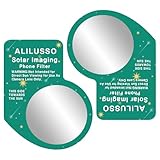
- [ALILUSSO Imaging Filter] The Filter for smartphones allows you to capture events safely and in clear detail. Whether it's the partial phases, the breathtaking diamond ring effect, or the ethereal corona during totality, our filter is designed to help you capture each stage effectively.
- [Protect your smartphone camera] We prioritize your safety while photographing the sun. The ALILUSSO Smartphone Photo Filter is a imaging filter that protects your smartphone camera from harmful rays, so you can focus on capturing the event's wonder without worry.
- [How to Use the Filter] Step 1: Place the filter over your smartphone's camera lens. Pro Tip: for best results remove your phone case. Step 2: Locate the sun in the frame, zoom in, and steady your hands. Step 3: Tap on the sun on your screen to lock focus and exposure. Step 4: Use your phone's camera settings to reduce the exposure. Then, take the picture.
- Create memories that last a lifetime and share the wonder of events with friends and family. The ALILUSSO Smartphone Photo Filter's high-quality film allows you to showcase your event photos with pride and awe.
- [WARNING] This is a smartphone filter only. Not for direct eye viewing. Looking directly at the sun, even through this filter, can cause permanent blindness and eye damage. For use by persons ages 18 and older only.
Putting a filter behind the lens
The NASA requirement specifies the front of the lens or optical system. A filter placed elsewhere should not be treated as equivalent. If your equipment cannot accept a secure front-mounted filter, stop and ask an astronomer for equipment-specific advice.
Removing the camera filter because totality has begun
The brief totality exception described by NASA concerns direct eye viewing while the bright face is completely covered. The cited pages do not state when a photographic filter should be removed or replaced. Keep the camera procedure separate from the eye procedure and do not guess.
Leaving eye protection off after totality
As soon as any bright portion of the Sun reappears, direct viewers need protection again. Put safe solar-viewing glasses or a handheld viewer back in place before looking at the Sun.
Assuming a phone needs no protection
NASA’s FAQ allows smartphone photography only with a specialized eclipse filter between the camera and the Sun. The fact that a phone has a small lens does not remove that condition.
A practical pre-shoot checklist
- Confirm whether the planned moment is partial, annular, total, or immediately adjacent to totality.
- Have a special-purpose solar filter that is designed to fit the exact camera, lens, telescope, binocular, or phone adapter.
- Verify that the filter attaches over the front of the optical system and is secure before aiming.
- Choose the rear display or a remote trigger if you do not want to use the optical viewfinder.
- Keep eclipse glasses and handheld viewers for direct eye viewing only.
- Do not transfer the direct-eye totality exception to the camera without equipment-specific guidance.
- Put eye protection back on immediately when any bright solar face becomes visible after totality.
Bottom line for photographers
You can photograph an eclipse without looking through the camera’s optical viewfinder: compose on the rear screen or trigger the camera remotely. That is a framing choice, not a solar-safety measure. For partial and annular phases, protect the camera’s optical system with a special-purpose filter secured at the front, and use separate certified protection for direct viewing. A smartphone also needs a specialized filter. During totality, NASA’s brief eye-safety exception applies only to direct viewing while the bright face is fully hidden; the cited guidance does not tell photographers to remove a camera filter, so do not assume that step.
Quick Recap
Product prices and availability are accurate as of the date/time indicated and are subject to change. Any price and availability information displayed on Amazon at the time of purchase will apply.

