Yes—at Summit, Greenland, some water that sublimates from snow can return to the surface rather than escaping permanently. A 2016 study describes vapor condensing onto fog particles that settle back onto the snow. The finding identifies a local moisture-recycling process; it does not establish how much water is recycled across Greenland as a whole.
How can sublimated water return to the snow?
Sublimation is the change from solid snow or ice directly into water vapor. It moves water out of the snowpack, but that vapor does not necessarily leave the local surface environment. Under certain conditions, it can condense onto tiny fog particles. Those particles grow or settle under gravity, carrying moisture back to the surface.


As an Amazon Associate I earn from qualifying purchases.
The authors of the 2016 study, “Surface-atmosphere decoupling limits accumulation at Summit, Greenland,” describe the process this way: “The isolation of the surface also acts to recycle sublimated moisture by recondensing it onto fog particles, which returns the moisture back to the surface through gravitational settling.” [c002]
Quick wins for a faster PC:
Scan for outdated or missing drivers - takes under a minuteDriver Scan →Repair Windows errors before they cause bigger problemsFix Now →Why does boundary-layer stability matter?
The boundary layer is the lowest part of the atmosphere, where air interacts directly with the surface. When this layer becomes increasingly stable, vertical mixing weakens. At Summit, the study reports that the surface can become relatively decoupled from the air above it. That limits the exchange of moisture with air arriving from aloft and can leave a near-surface layer in which vapor from the snow is more likely to be recycled locally.
#1 Best Overall
This is not a claim that all sublimated water returns. It describes a mechanism whose operation depends on atmospheric conditions, particularly the degree of near-surface isolation. [c001]
What did the Summit study establish?
The 2016 authors analyzed three years of stable water-vapor isotope profiles at Summit, a high-altitude site on the Greenland ice sheet. Those profiles support the interpretation that surface-atmosphere decoupling and fog-particle settling can recycle sublimated moisture there. The evidence is site-specific: it does not provide a Greenland-wide recycling rate or quantify the share of sublimated water that returns. [c002]
Rank #2
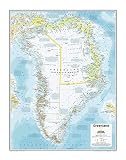
- BUILD GLOBAL AWARENESS: Perfect for the classroom! This map is the perfect tool to help students truly conceptualize the world geographically.
- CLASSIC MAP FOR OFFICE OR HOME: Perfect size for a gallery wall collection - the rich colours will add a pop to any wall!
- QUALITY PRINT: Printed on thick paper suitable for display on your home, school or office wall.
- ICONIC CARTOGRAPHY: National Geographic's maps are the standard others are measured against. You can count on this product having the highest quality content and display in the industry.
- TRUSTED CONTENT: National Geographic prides itself on the calibre and rigour of its editorial process so that you can count on having accurate information on every map
How does this differ from measuring net vapor flux?
Local recycling and net surface vapor flux answer different questions. Recycling asks whether moisture leaving the snow can condense and return nearby. Net flux estimates the overall exchange across the surface over a stated period; deposition and sublimation can offset one another. A net estimate therefore does not, by itself, reveal how much local fog recycling occurred.
Do these 3 things before closing this tab:
1Clear out junk files and repair common Windows errors2Fix the driver behind crashes, sound loss and screen glitches3Repair Windows errors before they cause bigger problemsMethod also matters. In a 2001 analysis using Greenland Climate Network observations, Jason E. Box and Konrad Steffen reported that a bulk method assuming surface saturation underestimated condensation compared with a two-level profile method. Their two-level estimates included annual net vapor flux as low as −87 ± 27 mm at 960 m in western Greenland, and positive annual flux of up to +32 ± 9 mm at NGRIP and +6 ± 2 mm at Summit. These are estimates from that separate flux study, not measurements of the 2016 fog-recycling mechanism. [c004]
Rank #3
A separate 2014 study of the dry-snow zone modeled seasonal changes, with winter deposition and summer sublimation; in its modeled case, deposition mass gain was less than 2% of total accumulation. That result likewise concerns a distinct study and does not quantify Summit’s recycling mechanism. [c005]
Independent reader supportYour contribution helps us test, update, and keep practical guides available for everyone.Why does moisture recycling matter for ice and climate records?
Water vapor exchange affects how scientists interpret accumulation—the snow added to the ice sheet—and the stable-isotope signals preserved in Greenland ice cores. If moisture can be recycled near the surface, the relationship between atmospheric conditions, net accumulation, and the isotope composition recorded in snow may be more complex than a simple picture of vapor leaving the surface. The Summit study identifies implications for accumulation and ice-core interpretation, but does not quantify a future change or show that this mechanism offsets Greenland’s overall ice loss. [c003]
Quick Recap
Product prices and availability are accurate as of the date/time indicated and are subject to change. Any price and availability information displayed on Amazon at the time of purchase will apply.
Recommended Free Tools

