Yes. Concentrated sunlight can supply the high-temperature heat needed to turn water and carbon dioxide into syngas, which can then be converted into kerosene. Laboratory work has demonstrated the chemistry, and Synhelion reports that solar-derived fuel has reached airline operations. That is proof of a working pathway—not proof that it can yet supply a substantial share of aviation fuel or do so cheaply with low lifecycle emissions.
How does jet fuel from sunlight and air work?
This route uses solar heat to make fuel; it is not simply a conventional refinery powered by solar panels. Mirrors concentrate sunlight onto a reactor containing ceria, a material that can cycle between two chemical states. The process makes syngas—a mixture of hydrogen and carbon monoxide—which is then converted into liquid hydrocarbons.
As an Amazon Associate I earn from qualifying purchases.
- Source the inputs. Water and carbon dioxide are supplied to the process. The SOLAR-JET pathway specified carbon dioxide captured from air and water, according to the International Civil Aviation Organization’s SOLAR-JET project record.
- Use concentrated sunlight to heat ceria. At high temperature, ceria releases oxygen and develops oxygen vacancies. In subsequent reactions, water and carbon dioxide replenish the material, producing hydrogen and carbon monoxide. ETH Zurich describes this two-step redox cycle in its SOLARJET research overview.
- Turn syngas into fuel. Fischer–Tropsch synthesis converts the syngas into liquid hydrocarbons, including kerosene-range fuel. This is an established industrial process, although combining it with solar thermochemistry does not by itself establish the cost or efficiency of a commercial plant. The European Commission’s SOLAR-JET reporting describes the project’s fuel-production chain.
What has actually been demonstrated?
The EU-funded SOLAR-JET project ran from 2011 to 2015. The ICAO record dates the first synthesized solar jet fuel to April 2014. That milestone demonstrated the complete process chain at laboratory scale; it was not an industrial production run.
Do these 3 things before closing this tab:
1Scan for outdated or missing drivers - takes under a minute2Clear out junk files and repair common Windows errors3Fix the driver behind crashes, sound loss and screen glitchesThe European Commission’s project report gives the following reactor-efficiency results and modeled plant estimates:
#1 Best Overall

- Horizon puts renewable energy technology into the hands of our future scientists
- Solar Hydrogen Education Kit generates clean energy using the sun
- Renewable hydrogen is created using only solar energy and water
- Combining cutting-edge science, education and fun for all!
- Includes fuel cell, small electric motor, propeller blade, experiment manual and assembly guide
| Measure | Reported result | What it means |
|---|---|---|
| First-generation reactor energy-conversion efficiency | 1.7% | SOLAR-JET project reactor result; not the overall efficiency of a commercial fuel plant. |
| Second-generation reactor energy-conversion efficiency | 2.7% | A later reactor result from the project, also not a whole-plant efficiency figure. |
| Modeled baseline fuel cost | €2.2 per litre of jet fuel | A project model for a facility producing 1,000 barrels per day of jet fuel and 865 barrels per day of naphtha—not a current market price. |
| Modeled baseline emissions | 0.5 kg CO2-equivalent per litre | The same project model; not a verified lifecycle measurement of fuel now being produced. |
The modeled figures are historical project estimates, not a present-day price quote or a universal emissions factor. The report says results depend materially on the electricity source and on obtaining carbon dioxide from a renewable, non-fossil source. Its baseline also includes naphtha as a coproduct, so the allocation of emissions and costs between products matters when comparing the estimate with other fuels.
A later scale-up step was ETH Zurich’s rooftop mini-refinery, which its 2019 account said produced about 0.1 litre of fuel per day. That output showed the process operating in a field demonstration, not a supply level relevant to airline demand. ETH professor Aldo Steinfeld described the demonstrator as proof that “carbon-neutral hydrocarbon fuels can be made from sunlight and air under real field conditions.” The statement refers to that plant and does not establish commercial-scale output or lifecycle neutrality. (ETH Zurich’s 2019 account.)
Rank #2

- Horizon puts renewable energy technology into the hands of our future scientists
- Fuel Cell Car Science Kit uses a PEM fuel cell to combine electrolysis and power conversion
- Watch as oxygen and hydrogen gases are formed to power the car
- Combining cutting-edge science, education and fun for all!
- Includes PEM fuel cell and car, education manual and experiment guide
Is solar jet fuel carbon neutral?
Not automatically. Burning kerosene releases carbon dioxide, whether the fuel is fossil-derived or synthesized using sunlight. The potential climate benefit comes from the carbon source and the energy used to make the fuel: carbon recently captured from air or another renewable, non-fossil source can be recycled into fuel, while renewable energy can reduce emissions from production. If fossil-derived carbon or emissions-intensive electricity are used, the lifecycle result changes.
Recommended Free Tools
For that reason, reactor efficiency alone is not enough to judge climate performance. A meaningful comparison needs lifecycle emissions for the full plant, including electricity and heat, carbon capture, fuel synthesis, transport, coproduct treatment and combustion. The SOLAR-JET report’s modeled figure is not a substitute for independently verified lifecycle results from a current commercial operation.
Rank #3

- 6 COMPLETE SOLAR CAR STEM KITS FOR KIDS: Includes 6 individual Solar Car science kits for kids ages 8-12 with all parts and clear illustrated instructions. Perfect bulk stem toys for classroom group activities, science fairs, or party favors!
- ENCOURAGE STEM LEARNING: By building solar‑powered cars, kids can watch solar panels convert sunlight into kinetic energy, explore how basic circuits work, and discover the principles of gear transmission. This hand-on stem toys for ages 8-13 sparks curiosity in solar power and science engineering
- DEVELOPS MULTIPLE SKILLS: Assembling this STEM projects cultivates engineering thinking, creativity, hands-on ability, and problem-solving skills, while nurturing imagination and a lasting interest in science experiments. Perfect for classroom, homeschool, or weekend fun!
- EASY TO ASSEMBLE: No soldering, no special tools needed thanks to simple plug‑in circuit connections, kids can build independently. Step‑by‑step instructions make assembly quick and frustration‑free.
- DURABLE AND SAFE: Made of non-toxic plywood, smooth surface and rounded corner make your children safe when assembling these wood crafts. Ideal building kits for kids ages 8-12, and suitable for science classrooms in grade 2nd, 3rd, 4th and 5th.
Is it being used by airlines?
Synhelion says its DAWN plant in Jülich, Germany, uses renewable electricity converted into process heat above 1,200°C, stores heat to support continuous operation, and makes syngas before converting it to fuel using gas-to-liquid technology. The company reports that DAWN began producing fuel in late summer 2024 and was operating close to nameplate capacity by April 2025. These are company-reported operating milestones, not independent evidence of long-term output. (Synhelion’s plant information.)
In July 2025, Synhelion and SWISS announced delivery of 190 litres of synthetic crude, which was refined into certified Jet-A-1 for SWISS flight operations. That is a specific delivery milestone, not an annual production rate or evidence of a material share of the airline’s fuel supply. The announcement is available from SWISS and Synhelion.
Rank #4

- Fuel cell supplementary set for the photovoltaics equipment set
- For student experiments on fuel cells, solar energy, and hydrogen technology
- Parts are sized to fit nicely in the rugged storage container
- Contents includes: 1 solar module for fuel cell, 2 fuel cells
- Pack of 1
Synhelion says its neat sustainable aviation fuel meets ASTM D7566 FT-SPK specifications and that blended fuel is ASTM D1655 compliant. It also reports five-year offtake agreements with SWISS and Pilatus for fuel from an upcoming commercial plant. These are company statements about product specifications and agreements; they do not mean the fuel is available for consumers to buy. (Synhelion’s SAF product information.)
Could it replace conventional jet fuel?
Solar-derived kerosene could use existing aircraft and fuel infrastructure if it is produced to the applicable fuel specifications and used in approved blends. Compatibility is important, but it is only one part of replacement: the industry would also need enough fuel, affordable production and credible lifecycle emissions reductions.
Best Value
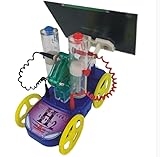
- Hydrogen Fuel Cell and Solar Power Generate Car
The evidence establishes a laboratory process, small demonstrations and early plant and airline milestones. It does not establish production at a scale that could replace a significant share of aviation fuel. The cited sources do not provide an audited current global production total for solar-derived jet fuel.
When comparing this pathway with other sustainable aviation fuels, check that the figures use consistent boundaries. In particular, distinguish full lifecycle emissions from reactor efficiency, demonstrated output from modeled or planned capacity, and current commercial costs from historical estimates. Carbon source, electricity mix, coproduct allocation and financing assumptions can all change the comparison.
Quick Recap
Product prices and availability are accurate as of the date/time indicated and are subject to change. Any price and availability information displayed on Amazon at the time of purchase will apply.

