GPU networking and power distribution can have a major effect on AI performance, CoreWeave executive Lukas Biewald said—but the report of his comments gives no benchmark or latency measurements to establish an orders-of-magnitude improvement. The useful takeaway is that a GPU cluster is a system: links, workload placement, power, cooling and storage all shape how effectively its processors work together.
What CoreWeave said—and what the claim establishes
In an interview at Fully Connected, reported by SiliconANGLE on October 2, 2026, CoreWeave senior vice president of AI initiatives Lukas Biewald said chip configuration could make a “massive difference,” including an “orders of magnitude difference depending on how you do the networking for the chips [and] how you do the power distribution.”
As an Amazon Associate I earn from qualifying purchases.
That is an executive’s reported observation, not a published controlled benchmark. The article provides no workload, cluster topology, baseline, measurement method or latency values. It therefore does not show that a particular wiring or power change will improve latency by a specific factor, or that the same result applies to every AI workload. SiliconANGLE’s account of the interview is the source for the claim.
Why networking can affect AI response time
GPUs often need to exchange data while working on a model. The route and bandwidth available for that communication, and whether the workload is placed so GPUs can use fast links, can affect how much time is spent moving data rather than computing. A cluster’s internal GPU-to-GPU fabric is distinct from the network used to connect systems or scale across racks; both are part of the architecture, but their effects depend on the workload and design.
#1 Best Overall

- Compatibility Warning: This male-to-male 8-pin PSU to 6+2-pin PCIe/GPU cable is compatible with Corsair Type 3, Type 4, and select other PSUs with matching pinouts. It’s NOT compatible with EVGA PSU, Corsair RM850X Shift series, or other PSUs with different pinouts. Modular 8-pin layouts vary by brand/series—physical fit ≠ electrical match. Always verify your PSU’s 8-pin connector shape and pinout diagram before purchase. Using an incompatible cable may cause power failure or hardware damage
- Reliable Power Solution: Connect an 8-pin (EPS/ATX) male PSU connector directly to a 6-pin or 8-pin PCIe/GPU slot on your motherboard or graphics card. The cable effectively converts EPS power to PCIe power for secure and efficient delivery. Ideal for setups requiring additional power-routing flexibility while preventing power-related system issues. Note: Pin 4 on the PSU side is intentionally unused, and Pin 5 on the GPU side is double-wired to ensure stable 12V output.
- Graphics Card Compatibility: Perfect for powering high-performance graphics cards, this cable features a 6+2 pin PCIe connector that can be used with both 8 pin and 6 pin GPU interfaces, making it a versatile solution for varying power requirements.
- Easy Installation: With a 2ft length, this cable offers ample reach to accommodate different system configurations without creating excess clutter. Its plug-and-play design ensures a hassle-free setup, helping you get your system up and running in no time.
- Robust Construction: Crafted with a braided cable sleeve and heat-shrink tubing, this power extension/conversion cord offers superior durability and protection. The robust build ensures a secure and stable connection that withstands wear and thermal stress, making it ideal for high-performance computing environments.
CoreWeave’s current Vera Rubin product page illustrates how tightly coupled these components can be. The company describes a liquid-cooled rack with 72 NVIDIA Rubin GPUs, 36 NVIDIA Vera CPUs, ConnectX-9 SuperNICs and BlueField-4 DPUs, within a 20.7 TB unified HBM4 memory domain. CoreWeave lists 260 TB/s of NVLink 6 Switch bandwidth within the rack, alongside Quantum-X800 InfiniBand and Spectrum-X Ethernet for scaling across GPUs. These are vendor specifications, not independent validation of Biewald’s latency statement. CoreWeave’s Vera Rubin infrastructure page also says its topology-aware scheduler keeps inference workloads on the NVLink fabric.
Power, cooling and useful compute
Power distribution is not a substitute for fast GPU links, and the interview report does not isolate its effect on latency. It is one of the constraints in making a large cluster operate as intended: the facility must deliver power and remove heat while supporting the installed systems. If power or cooling limits constrain operation, the cluster may not make full use of its compute resources. The size of any effect depends on the facility and workload; the available figures do not establish a universal latency gain from changing power delivery.
Rank #2

- 8 Pin PCIe Cable for EVGA Power Supply:PCIe 8 pin male end to plug into the power supply(Please make sure that the 8 pin port on your power supply is pcie 8 pin port , not cpu 8 pin port when to buy it.) and 8 pin(6+2) male end to plug into the video graphics card.(NOTE: the 8 pin end and 8 pin(6+2) male ends cannot be used interchangeably);
- Only designed for graphics vedio cards, it doesn't work with motherboards: Compatible with 6-pin & 8-pin graphics cards from regular manufacturers such as: ASUS/ASRock/Gigabyte/Radeon/Sapphire/NVIDIA Tesla/etc.(The 8 pin (6+2) ends could be used as 6 pin or 8 pin end by sliding on/off the 2 pin.);
- Compatibility: Compatible with Silverstone, EVGA semi-modular 650GQ/750GQ/850GQ/1000GQ 1600T2/1000T2/850T2/750T2 1600P2/1200P2/1000P2/850P2/750P2/650P2 1600G2/1300G2/1000G2/850G2/750G2/650G2/550G2 1000G3/850G3/750G3/650G3/550G3 NEX650G/NEX750G NEX750B/750B1 SUPERNOVO B2 850w 450B3/550B3/650B3/750B3/850B3 Supernova 850 GA 850BQ/750BQ 650GS/550GS (Doesn't work with 1000PS/850GS/1050GS), some types of Thermaltake & COUGAR PSU with 8 pin PCIe port. (NOTE: NOT Compatible with Corsair Power Supply), (Please refer to the compatible images on the product page for more compatible models).
- Parameter: Length(including connectors): 25-inch(63cm), Gauge: 1007-18AWG(standard tin-coating copper wire), Quantity: 2pcs, Hook loop strip*1pcs (only designed for graphics vedio cards, it will not work with motherboards);
- Attention Please: This cable was only designed for the brand and model as listed in the 3rd Point. (NOT Compatible with Corsair Power Supply) If you use other incompatible brand PSUs or types, it will definitely burn or damage the PSUs or graphics cards. Please carefully check the compatible types or contact us if you are not sure if it supports your power supply;
CoreWeave’s March 28, 2025 video transcript says traditional air-cooled facilities may face retrofit challenges, power constraints and inefficient resource use with modern GPU clusters. It also claims that “up to 65% of effective compute capacity embedded in gpus is lost to system inefficiencies.” That is CoreWeave’s vendor statement; the transcript supplies no independent study or methodology for the percentage. It should not be treated as a measured loss for every cluster. CoreWeave’s video and transcript provide the company’s account.
Quick wins for a faster PC:
Fix the driver behind crashes, sound loss and screen glitchesFind Drivers →Repair Windows errors before they cause bigger problemsFix Now →Vendor performance figures are not a topology benchmark
CoreWeave compares two rack systems on its Vera Rubin page. In the company’s stated DeepSeek R1 comparison at 150 tokens per second per user, it lists 80,000 tokens per second per megawatt for GB200 NVL72 and 800,000 for Vera Rubin NVL72—a vendor-stated 10× difference. The page also lists memory bandwidth of 8 TB/s versus 22 TB/s, total GPU memory bandwidth of approximately 576 TB/s versus 1,580 TB/s, and NVLink bandwidth of 130 TB/s versus 260 TB/s, respectively.
Rank #3

- Specific Designed for Corsair, Thermaltake and ARESGAME,not compatible with other Brands of modular power supplies.Power delivery specifications is 18 awg 300V 10A Tinned copper wire,safe and stable. Please check the Model Compatible. Compatible with Corsair Type 3 and Type 4 PSU, Not for EVGA PSU Replacement for your lost or damage cables
- Compatible with Corsair Modular Power Suplly: AX1600i(TITANIUM), AXi, AX(TITANIUM & PLATINUM), HXi, HX(PLATINUM & GOLD), RMi, RMX, RM, SF, CS-M, CX-M, TX-M
- Compatible with Thermaltake Modular PSU: RGB GOLD, RGB PLATINUM, ARGB GOLD, Toughpower TF1 GF1 PF1 GF3 SFX
- Compatible with ARESGAME Modular PSU: AGK750, AGK850, AGT1000, AGS750, AGS850
- NOTE: Not compatible with CORSAIR PSU: AX1200, AX(GOLD), HX(BRONZE & WHITE). Not compatible with other brands of modular power supplies
These are figures in a vendor comparison, not an independent test of network topology or power distribution. The systems differ in generation and specifications, and the page does not provide enough methodology in the cited material to reproduce the performance result. The comparison cannot prove that wiring or power delivery alone caused the throughput difference, or translate it into an equivalent latency change.
Why bursty inference makes infrastructure choices matter
The SiliconANGLE report also describes a business context in which capacity needs can rise and fall. LlamaIndex co-founder and CEO Jerry Liu said the company was then running about 75% inference and 25% training, processing millions of document pages daily for finance, legal and insurance customers, and did not own a GPU cluster. The report connects rented capacity with persistent but spiky demand. Those figures describe LlamaIndex at the time of the interview, not the broader AI market.
Rank #4

- Paracord Sleeves – Each 12V-2x6 cable is made with flexible paracord sleeves, offering a distinct look that makes any build stand out
- Low-Profile Cable Combs – Each individual cable stays neat and tidy with adjustable cable combs, which clamp around each strand to prevent them from getting twisted and looking messy. The combs can be manually positioned for easy cable management and a clean appearance
- Three Color Options – Choose from black, white, or white/black cables to either complement your build, or add some contrast for a distinctive look
- Easy Cable Routing – Simplify cable management with flexible individually sleeved cables and cable combs making it easier to bend and position the cables exactly where they need to be
- Better Internal Airflow – Efficient cable management means fewer cables blocking airflow, reducing internal temperatures and improving performance
For this kind of workload, both the amount of capacity available and how well the system handles communication and bursts can matter. The example helps explain why infrastructure operators focus on the whole stack; it does not demonstrate a particular latency benefit from a particular network or power design.
What to ask when evaluating an AI GPU cluster
There is no like-for-like provider or topology comparison in the cited material, so it does not identify a winning design. A practical evaluation should establish the conditions under which a system will serve your workload:
Quick Recap
Best Value
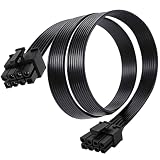
- Compatible with Corsair Type 3 & Type 4 PSU ONLY Designed for Corsair Type 3 and Type 4 modular power supplies with matching PCIe pinout. Not compatible with Corsair Type 5, EVGA, or other PSU brands. Please verify your PSU model before purchase.
- 8 Pin PSU to 6+2 Pin GPU Connection Connects the modular PSU 8-pin PCIe port to graphics cards with 6-pin or 8-pin connectors. Ideal as a replacement or backup GPU power cable.
- Stable Power Delivery with 18AWG Wire Built with 18AWG wire construction for reliable conductivity and stable power connection during gaming, workstation, and custom PC builds.
- Flexible 25.5 Inch Cable Routing The flexible cable length allows easier routing inside PC cases and helps create a cleaner internal layout.
- Verify Pinout Before Installation This modular PSU cable is not universal. Always compare your original cable connector and PSU pin layout before installation to ensure proper compatibility.
- Workload and latency target: Specify the model, request pattern, concurrency and the response-time measure that matters to users.
- Interconnect and communication: Ask which GPU-to-GPU fabric is used, what bandwidth is available, and how the design scales beyond a single rack.
- Placement and scheduling: Determine how the platform keeps communicating GPUs together and what happens when capacity is shared or demand spikes.
- Power and cooling envelope: Confirm that the facility can support the cluster’s power and thermal requirements under the operating conditions you need.
- Storage and data movement: Check whether input and model data can reach the GPUs at the rate the workload requires. CoreWeave says its AI Object Storage can deliver up to 7 GB/s per GPU; that is a vendor-stated capability, not a general result for all configurations.
- Interoperability and capacity: Establish how the environment fits with existing tools and other cloud providers, and whether capacity is available when required. Biewald characterized CoreWeave as following standard Nvidia-recommended networking protocols and working alongside customers’ other clouds; this is his characterization, not an independent comparison of provider compatibility.
- Cost per useful output: Compare cost against the completed work or service level you need, rather than relying on a peak throughput figure detached from your workload.
Product prices and availability are accurate as of the date/time indicated and are subject to change. Any price and availability information displayed on Amazon at the time of purchase will apply.

