Quick wins for a faster PC:
Repair Windows errors before they cause bigger problemsFix Now →Fix the driver behind crashes, sound loss and screen glitchesFind Drivers →Clear out junk files and repair common Windows errorsFree Scan →Short answer: computational crystal structure prediction (CSP) is useful enough to guide experiments, screen polymorphs and suggest materials, but it is not an oracle. Reliability depends on the target, how candidate structures are generated, the accuracy of energy ranking, treatment of flexibility and disorder, available computing, and experimental validation.
What crystal structure prediction actually does
CSP starts with a chemical composition or a defined molecule and asks which arrangements of its atoms or molecules could form a periodic crystal. The software generates plausible packings, optimizes their geometries, estimates their relative energies and returns a ranked list. Low-energy structures are candidates for stable forms; structures at nearby local minima may represent metastable polymorphs.
As an Amazon Associate I earn from qualifying purchases.
That ranking answers a thermodynamic question, not the whole crystallization question. A structure can be low in calculated energy yet fail to appear experimentally because nucleation, solvent, temperature, impurities, pressure, cooling rate or molecular kinetics favor another form. Conversely, an experimentally observed polymorph may not be the global minimum under the conditions used in a calculation. A prediction therefore guides experiments rather than replacing them.
Do these 3 things before closing this tab:
1Fix the driver behind crashes, sound loss and screen glitches2Repair Windows errors before they cause bigger problems3Scan for outdated or missing drivers - takes under a minuteThe field covers related but distinct problems. Molecular CSP deals with organic molecules, salts and cocrystals, where shape, intermolecular interactions, conformational flexibility and disorder create a very large search space. Inorganic structure-generation models often work from compositions, symmetry and desired properties, and may use different representations and validation criteria.
#1 Best Overall

- FAST-GROWING CRYSTALS IN 6 COLORS - Grow blue, red, purple, green, yellow, and glow in the dark crystals! Crystal chemistry has never been so fast (grows in 3 - 4 days), fun, and colorful, making this the perfect educational activity or gift!
- GROWING IS EASY – Easy-to-follow instructions and the 2 included silicone growing chambers make growing your crystals easier than ever!
- NIGHT LIGHT DISPLAY – Show off 5 of your favorite home-grown crystals in the USB-powered (cable included) light-up display! This fun kids STEM activity can help inspire a lifelong love of science and learning.
- INCLUDES REAL CRYSTAL SPECIMENS – Start or expand your rock collection with 4 real gemstone specimens: rose quartz, fluorite, blue calcite, and quartz geode. Learn about the gemstones in the kit with the included full-color Learning Guide.
- AMAZON EXCLUSIVE - Blue Marble has developed this product exclusively for Amazon.
How a typical molecular CSP workflow works
- Define the target. Specify the molecular graph or composition, protonation and charge state, likely stereochemistry, possible tautomers, and whether hydrates, solvates, salts or cocrystals are in scope. An incorrect input chemistry can make every subsequent calculation irrelevant.
- Generate candidate packings. Programs vary molecular positions, orientations, unit-cell dimensions, space groups and, where appropriate, conformations. Random and systematic searches are both used; database-derived packing rules can supply additional proposals. The Chemistry World feature by James Mitchell Crow, published 15 April 2025 and updated 24 April 2025, reports that random generation may produce 105 to 107 candidates. Those figures describe the feature’s reported examples, not a universal requirement.
- Relax inexpensive candidates. An empirical force field or machine-learned potential rapidly optimizes bond geometry, lattice parameters and intermolecular contacts. Duplicates and obviously unstable structures are removed before more expensive calculations.
- Refine and rerank. Promising structures are recalculated with a higher-accuracy method, commonly periodic density functional theory (DFT), sometimes with dispersion corrections. The purpose is to distinguish energy differences that a cheaper model cannot resolve.
- Cluster and interpret. Geometrically equivalent structures are grouped, and the remaining energy landscape is examined for families of polymorphs, likely disorder and packing motifs. A short energy gap means several forms may be experimentally accessible.
- Test experimentally. Powder or single-crystal diffraction, thermal analysis and controlled crystallization determine whether a predicted form can be made and whether it remains stable. Experimental conditions and characterization are part of the prediction workflow, not an optional afterthought.
Even the simplest crystal can involve at least 12 degrees of freedom, according to the Chemistry World feature. Molecular flexibility, multiple molecules in the asymmetric unit and several chemical components increase that number sharply. Graeme Day summarized the issue: “The first challenge is that this search space is huge.”
Why ranking crystals is harder than finding them
Closely spaced energies
Different packings can differ by fractions of a kilojoule per mole. Such a small separation is comparable to errors caused by the treatment of dispersion, thermal effects, conformational strain and basis-set or functional choices. A force field can identify sensible structures yet put them in the wrong order, while a high-level calculation may be accurate but too slow to apply to millions of candidates.
Cost grows across the workflow
The feature reports Graeme Day’s estimate that DFT energy calculations can cost 103 to 105 times more than force-field calculations. The practical response is a funnel: evaluate many candidates cheaply, then spend quantum-chemical resources on a small, diverse and physically plausible subset. Hardware, parallelization, convergence failures and the number of candidates all affect elapsed time.
The Tool Desk
Outbyte Driver Updater FREEFix the driver behind crashes, sound loss and screen glitchesFind Drivers →Outbyte PC Repair FREEClear out junk files and repair common Windows errorsFree Scan →Flexibility, disorder and multiple components
A rigid, neutral molecule is easier than a flexible drug candidate, ionic salt or cocrystal. Every rotatable bond creates additional conformers that may pack differently. Partial occupancy, solvent molecules and orientational disorder can make a single idealized periodic structure an imperfect representation of the real crystal. A workflow that omits relevant conformers or components cannot recover them through better ranking alone.
Crystallization is kinetic as well as thermodynamic
The lowest calculated lattice energy is not guaranteed to be the first, most abundant or most persistent form produced in a laboratory. Solvent-mediated pathways, nucleation barriers and transformation rates determine what researchers actually isolate. Predictions should therefore be compared with crystallization histories and followed by targeted searches for both stable and metastable forms.
Rank #2

- 5 CRYSTAL-GROWING ACTIVITIES – This ultimate crystal kit lets kids safely grow five unique types of crystals: a mini crystal, a dinosaur-shaped crystal, a glow-in-the-dark crystal, 2 crystal trees, and awesome underwater crystals!
- GLOW-IN-THE-DARK CRYSTAL – Grow a luminous crystal that shines in the dark, making science fun even after the lights go out.
- UNDERWATER CRYSTALS – Kids will love watching 4 vibrant crystals grow right before their eyes in a safe, immersive underwater environment!
- CRYSTAL TREES & DINOSAUR – Grow a sparkling crystal-covered dinosaur figure and 2 colorful crystal trees for an eye-catching display.
- ALL-INCLUSIVE EDUCATIONAL SCIENCE KIT – Includes crystal solutions, crystal-growing stones, display container, dinosaur mold, tree forms, safety gear, kid-friendly instructions & an educational Learning Guide filled with cool facts about crystals!
How accurate is CSP today?
There is no single current accuracy percentage that applies to all CSP. Results vary with chemical class, target complexity, candidate-generation coverage, ranking method and whether the test is retrospective or prospective.
The seventh CSP blind test, reported in Acta Crystallographica Section B in 2024, included seven chemically varied targets: among them a cocrystal, a polymorphic agrochemical, a flexible drug candidate and a salt. Many groups reproduced observed structures for the small flexible agrochemical, while few succeeded on higher-complexity systems. This pattern demonstrates uneven performance rather than a universal success rate.
Free tools Windows power users keep installed
One-click scans. No signup required.
The 2007 blind-test breakthrough remains an important historical lesson. A team using DFT correctly predicted all four targets in that test, showing how improved energy ranking can resolve candidates that cheaper methods leave ambiguous. It is evidence from that particular blind test, not a present-day benchmark for every molecule.
A 2025 Nature Communications study describes a hierarchical workflow that combines systematic packing searches and machine-learning force fields with periodic DFT for final ranking. Its authors report reproducing experimentally known forms in a validation set of 66 molecules containing 137 experimentally known polymorphic forms, and they discuss blind prediction and possible undiscovered low-energy forms. That result belongs to the authors’ method, dataset and scope; it does not establish equivalent performance for all CSP implementations.
Comparing the main computational strategies
| Approach | Candidate generation | Energy ranking | Strengths | Typical limitations |
|---|---|---|---|---|
| Force-field screening | Random or systematic packing search | Empirical molecular mechanics | Fast enough to examine very large candidate sets | May mis-rank near-degenerate structures and unusual intermolecular interactions |
| DFT-led CSP | Usually a filtered set from a broader search | Periodic quantum-chemical calculation | More reliable treatment of electronic interactions and close energy differences | High computational cost; convergence and method choices still matter |
| Hierarchical machine-learning workflow | Systematic search, often assisted by learned potentials | Machine-learned screening followed by periodic DFT | Balances scale with higher-accuracy final ranking | Model quality depends on training data and chemical coverage; final validation remains necessary |
| Database-derived or topological rules | Rules inferred from known crystal structures | Descriptors and physical heuristics, sometimes with limited energy calculations | Can reduce the number of expensive calculations and expose recurring packing motifs | Rules may fail outside the chemical space represented by the training structures |
| Inorganic generative models | Generative proposals constrained by composition, symmetry or properties | Model-based filtering followed by calculated and experimental checks | Can search broad inorganic design spaces for target properties | Not directly equivalent to molecular polymorph prediction; synthesis and property confirmation are still required |
Can machine learning make CSP faster?
Machine learning is most useful when it reduces the number of expensive evaluations without hiding uncertainty. A learned force field can approximate energies and forces during initial relaxation, allowing a search to explore more structures than a purely quantum workflow. Periodic DFT can then be reserved for final ranking, calibration and candidates that are close in energy.
Rank #3

- GROW VIBRANT COLORED CRYSTALS - Grow crystals in 3 amazing colors: blue, purple, and green. With this engaging and educational science experiment for kids, chemistry has never been so fun and colorful!
- NIGHT LIGHT DISPLAY - Show off your crystals on the patent-pending light-up display. With 7 single color modes, rainbow color mode, and 3 brightness levels to choose from, your crystal treasures will shine!
- COMPLETE SCIENCE KIT – Contains all you need! Growing powder, clear seed rocks, growing chamber, light-up display, and easy-to-follow instructions. Our uniquely flexible growing chamber allows you to easily remove your crystals for display without damage!
- START A ROCK COLLECTION – This kit comes with 3 real gemstone specimens, including a geode, green fluorite, and blue calcite, along with a detailed learning guide explaining how crystals grow and more! Makes an excellent STEM gift for boys and girls.
- AWARD-WINNING PRODUCTS - Blue Marble, winner of the Toy Association's prestigious Toy of the Year Award, proudly develops products that foster education, imagination, and creativity, with a U.S. support team to ensure a stellar experience!
CrystalMath, described by Galanakis and Tuckerman in a Nature Communications paper published 11 November 2024, uses simple topological and physical descriptors to derive rules from crystal-structure data. The Chemistry World feature reports a demonstration in which it predicted five known polymorphs in 32 hours for a challenging case. That is an encouraging, specifically reported example, not a general runtime guarantee or a proven replacement for energy calculations.
Recommended Free Tools
Mark Tuckerman describes the motivation this way: “But when you start to ask the right questions, you see that there are patterns, which obey fairly simple rules – from which we could come up with a scheme to predict crystal structures on your laptop.” The practical interpretation is that learned structural regularities can narrow a search; they do not remove the need to test whether a proposed structure is energetically and experimentally credible.
Gregory Beran has offered a measured outlook: “I feel like there haven’t yet been clear home runs where machine learning has shown a transformative impact – but I think it’s coming.” That distinction matters. Machine learning can improve throughput, but a model trained on known crystals may be least reliable for precisely the unusual compositions or packing motifs that make discovery valuable.
What CSP can contribute to real materials programs
Pharmaceutical polymorph risk
Different polymorphs can change density, dissolution, hygroscopicity, melting behavior, mechanical properties and storage stability. CSP can identify plausible competing forms early, prioritize crystallization experiments and flag a narrow energy landscape in which late-appearing polymorphs deserve attention. It cannot by itself establish a drug’s clinical performance, guarantee a manufacturing route or prove stability under every storage condition.
Porous and functional molecular crystals
For porous crystals and other functional materials, predicted packing can suggest channels, networks or dense arrangements worth synthesizing. Researchers still need to measure surface area, uptake, conductivity, optical behavior or other target properties because small structural changes can alter the result substantially.
Rank #4
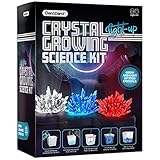
- GROW RED, BLUE AND CLEAR CRYSTALS AND MAKE THEM GLOW: Let your child feel like a real chemist mixing the special ingredients and watching the crystal grow, day by day. And when you're done, display it on the light-up display for all to admire! Follow along with the beautifully illustrated 12-page booklet describing how crystals are formed.
- LET IT GLOW: Growing the crystals is only half the fun. Turn your newly formed crystals into a piece of art by placing them on the included LED Light-up Display and watch the lights burst through the complex crystal formations. It's a truly magical sight at night. (Powered by an included Micro-USB cable).
- KIT INCLUDES: USB Powered LED Light-up Display, Micro-USB Cable, 3 Growing Cups, 3 Crystal Powder Bags (Red, Blue, Clear), 3 Crystal Starters, Mixing Stick, Tweezers, and a gorgeous 12-page instruction and learning guide. Includes everything needed for the young scientist to grow the crystals with ease, and gain a deeper understanding of them.
- FOOL-PROOF SATISFACTION GUARANTEED: This kit has been designed from the ground up to help kids grow beautiful crystals with confidence. With premium ingredients, innovative tools, and a comprehensive step-by-step instruction booklet that adults and children can easily understand and follow, it’s a fun, hands-on activity the whole family can enjoy.
- A FUN AND EDUCATIONAL GIFT FOR ALL AGES: It's not often that a science project can be fun and engaging, but this kit achieves both! It fascinates children as soon as they pull it out of the box and is a perfect STEM project. It fosters a love for science and crystallography in a fun and exciting way.
Inorganic materials discovery
MatterGen, reported in Nature in 2025, is an adjacent example: a diffusion model generates inorganic structures subject to composition, symmetry and property constraints. The paper reports synthesis of one generated material whose measured property was within 20% of the target. This is a specific proof-of-concept result and should not be presented as evidence that general molecular polymorph prediction has been solved.
Independent reader supportYour contribution helps us test, update, and keep practical guides available for everyone.How to choose or evaluate a CSP workflow
Before accepting a method’s headline result, ask six questions:
- What is the target domain? Organic molecular crystals, salts, cocrystals and inorganic solids have different failure modes.
- How are candidates generated? Check whether the search is random, systematic, database-derived, generative or a combination, and whether relevant conformers and components are included.
- How are energies ranked? Identify the force field, machine-learned potential, DFT functional, dispersion treatment and any staged refinement.
- What is the scale and cost? Record candidate count, compute time, hardware, parallelization and the fraction receiving high-accuracy calculations.
- Is complexity represented? Look for explicit treatment of flexibility, disorder, salts, cocrystals, solvates and multiple molecules in the asymmetric unit.
- How was it validated? Prefer blind predictions and prospective synthesis over retrospective reproduction alone. Note benchmark size, chemical diversity and whether predicted structures were experimentally confirmed.
A practical decision process for researchers
- Define the scientific decision. Decide whether the goal is polymorph-risk assessment, a specific property, a new composition or an explanation of an existing diffraction pattern.
- Set the chemical scope. Enumerate protonation states, tautomers, stereoisomers, conformers, counterions, solvent molecules and possible stoichiometries before launching a search.
- Use a staged budget. Allocate inexpensive calculations to broad coverage and reserve DFT or equivalent accuracy for candidates that are both diverse and close in predicted energy.
- Inspect an energy window, not only rank one. Include low-energy alternatives whose separation is comparable to method uncertainty. They may be metastable, kinetically favored or experimentally accessible under different conditions.
- Plan experiments around uncertainty. Vary solvent, temperature, concentration and cooling or evaporation history when the calculations show several plausible forms.
- Close the loop. Compare diffraction and thermal data with predictions, update the model or input assumptions, and report failures as well as successes. A missing predicted form may indicate incomplete generation, an inadequate energy model or a kinetic barrier.
Common failure modes and how to interpret them
- The observed crystal is absent from the list: candidate generation may have omitted a conformer, space group, stoichiometry or disordered representation.
- The lowest-energy prediction is not observed: kinetics, solvent effects, temperature or an inaccurate energy model may dominate the experimental outcome.
- Several structures are effectively tied: treat the result as a set of hypotheses and prioritize experiments that discriminate among them.
- A machine-learning model looks exceptionally confident: check whether the target lies outside the model’s training distribution and require an independent high-accuracy calculation.
- A retrospective benchmark is excellent: verify whether structures were predicted blind, whether the benchmark includes difficult salts and flexible molecules, and whether successful reproduction required information unavailable before the experiment.
Is CSP ready for mainstream materials research?
Yes, as a decision-support layer; no, as an autonomous substitute for crystallization and characterization. The strongest current practice is hybrid: broad low-cost generation, learned or empirical screening, accurate periodic ranking, explicit uncertainty and targeted experiments. Evidence from blind tests shows that simple and moderately flexible targets can be tractable while cocrystals, salts and highly flexible molecules remain much harder. Recent machine-learning and topological approaches improve speed and coverage, but their claims remain tied to particular datasets, descriptors and validation studies.
For a materials team, the sensible adoption threshold is not a universal accuracy percentage. It is whether the workflow states its chemical scope, exposes near-degenerate alternatives, fits the available compute budget and has a validation plan capable of discovering when prediction and experiment disagree. Used that way, CSP can make mainstream research more focused and less wasteful while preserving the experimental checks that determine which crystal actually exists.
Quick Recap
Product prices and availability are accurate as of the date/time indicated and are subject to change. Any price and availability information displayed on Amazon at the time of purchase will apply.

