Free tools Windows power users keep installed
One-click scans. No signup required.
Can sound help a machine collect more water from air? Ankith Burki, a seventh grader at BASIS Independent Silicon Valley in San Jose, tested that idea with a small thermoelectric atmospheric water generator. The Society for Science reports that his prototype collected 117 percent more water during low-frequency sine-wave trials than during silent trials. That is a result from his described student experiment—not proof that sound can improve commercial water generators or provide a practical drinking-water supply.
What Ankith Burki built and tested
Burki’s project, titled “Investigating the Effect of Low-Frequency Sound in Enhancing the Efficiency of Water Generation in Thermoelectric Atmospheric Water Generators,” used the Peltier effect. In a thermoelectric material, an electric current moves heat from one side to the other, cooling one surface. When that surface cools air below its dew point, water vapor can condense into droplets for collection.
As an Amazon Associate I earn from qualifying purchases.
The Society for Science says Burki’s prototype lowered temperature by 7.5°C. He compared water collected in silent conditions with water collected while a speaker played low-frequency sound in sine and triangle waveforms.
Quick wins for a faster PC:
Fix the driver behind crashes, sound loss and screen glitchesFind Drivers →Repair Windows errors before they cause bigger problemsFix Now →The reported trial setup
- Five silent trials, each lasting four hours.
- Ten additional four-hour trials with low-frequency sound, using sine and triangle waveforms.
- Water collected was measured under each condition.
The Society’s profile reports 117 percent more collected water in the low-frequency sine-wave condition. The available description does not give the exact sound frequencies or amplitudes, ambient humidity and temperature, airflow, energy consumption, water-quality results, or the underlying measurements. Those details matter when assessing whether the finding can be repeated or applied to other machines and environments.
#1 Best Overall

- HANDS-ON WATER FILTRATION: Kids can build their own water filtration and distillation plant, providing a practical understanding of how clean water is produced and the science behind water purification.
- SOLAR POWER DISINFECTION: The kit teaches children how to disinfect water using solar power, promoting renewable energy concepts and demonstrating sustainable practices in water resource management.
- COMPREHENSIVE EXPERIMENTATION: Includes a detailed booklet with suggested experiments and activities, allowing for a variety of hands-on learning experiences that reinforce the principles of clean water science.
- ENVIRONMENTAL AWARENESS: Features alarming water facts that educate children about environmental issues and the importance of protecting clean water resources, fostering a sense of responsibility toward the planet.
- PERFECT FOR ALL SETTINGS: The kit includes clear instructions and all necessary materials, making it simple for children to conduct experiments safely and effectively. STEM powered learning.
What the 117 percent result does—and does not—show
The result is a promising observation from one student prototype and its reported trials. It does not establish that sound will produce the same increase in another device, climate, or test setup. Nor does it show that the collected water was safe to drink, that the prototype could provide a dependable supply, or that the approach would work at commercial scale.
To evaluate those possibilities, a replication would need to report and control conditions such as humidity, ambient temperature, airflow, electrical power, sound frequency and amplitude, and the method used to measure collected water. The Society’s project summary does not provide those figures, so the reported percentage should be read as specific to Burki’s described experiment.
Independent reader supportYour contribution helps us test, update, and keep practical guides available for everyone.How the project reached a national STEM final
The Society for Science named Burki one of 30 finalists in the 2026 Thermo Fisher Scientific Junior Innovators Challenge. The Society’s September 16 announcement scheduled the finalists’ event in Washington, D.C., for October 23–28, 2026; those dates are future plans as of October 7, 2026, not completed event results. The finalist page says each finalist receives $500, while the announcement describes more than $100,000 in prizes overall.
Recommended Free Tools
The Society’s profile also notes Burki’s Indian Carnatic classical vocal music and his interest in becoming an environmental engineer. That biographical context does not establish that musical training caused or shaped the experimental finding.
Quick Recap
Best Value
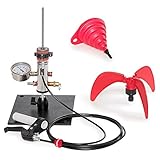
- Easy to assemble metal water rocket launcher with a 125 PSI safety valve. Rocket will NOT fly straight without an aerodynamic nose cone made from a second soda bottle and use only 1 cup (200 ml) of water.
- Kit includes StratoLauncher IV, StratoFins, tilting ball head, pressure gauge, alloy QRelease + fill funnel. Watch assembly video on this listing at the end of the pictures.
- StratoLauncher IV Deluxe will propel a 2 liter plastic (PET) soda pop bottle over 350 ft. in the sky. Watch the last minute of the assembly video for launch procedure.
- Supports most .5L, 1L, 1.25L, 1.5L, 2L soda bottles @ air pressures as low as 15 PSI up to 120 PSI.
- Kit is fully upgradeable, expandable, & can be accessorized into a complete launching system for STEM.
Rank #4

- 12 experiments and building projects
- Harness mechanical energy from water to do physical work
- Generate electricity to light an LED
- Learn the physics of water turnies
- Discover why hydropower is a promising source of energy
Rank #3
- Classroom lab activity focusing on environmental testing for pollution
- Students will learn how environmental scientists test the air and water for contaminants
- Materials for 30 students working in groups
- Kit includes supplies for nine different environmental tests students can conduct in their local area
- Kit instructions and safety data sheets included
Sources
- Society for Science: 2026 Thermo Fisher Scientific Junior Innovators Challenge Finalists
- Society for Science: September 16, 2026 finalist announcement
- India Today’s account of the project
Product prices and availability are accurate as of the date/time indicated and are subject to change. Any price and availability information displayed on Amazon at the time of purchase will apply.

