Free tools Windows power users keep installed
One-click scans. No signup required.
Buying a functioning butcher shop is usually faster to revenue and may require less total capital than building one, but only when the lease, cash flow, equipment, licenses, staff and customer relationships survive the change in ownership. Starting from scratch gives you control over the concept and layout, yet it makes you fund the entire build-out, cold chain, opening inventory, regulatory process and customer ramp before the first sale. The right choice depends on your available cash, operating experience, desired processing scope and the quality of the specific shop for sale.
Buy versus build: the practical difference
A new shop begins with no operating history. You must find a suitable site, obtain approvals, install food-grade infrastructure, buy equipment, recruit and train staff, establish suppliers and persuade customers to visit. Revenue generally starts only after those tasks are complete.
As an Amazon Associate I earn from qualifying purchases.
An established shop may already have a compliant layout, refrigeration, processing equipment, supplier accounts, trained butchers, recipes, a recognizable name, wholesale customers and point-of-sale records. Those assets can shorten the path to revenue and give a lender evidence of demand. They also come with inherited obligations: an unfavorable lease, obsolete equipment, owner-dependent relationships, unresolved inspection issues or weak margins can make the purchase more expensive than a new build.
Do these 3 things before closing this tab:
1Repair Windows errors before they cause bigger problems2Scan for outdated or missing drivers - takes under a minute3Clear out junk files and repair common Windows errors| Decision axis | Start from scratch | Buy an established shop |
|---|---|---|
| Initial capital | Build-out, equipment, deposits, inventory and working capital are all new expenditures. | Purchase price plus working capital, closing inventory and immediate upgrades. |
| Time to revenue | Site selection, permits, construction, hiring, training and customer acquisition delay opening and the sales ramp. | Operations can continue through closing if the transition, licenses and staff retention are handled correctly. |
| Control | Full control over layout, brand, menu, equipment and operating systems. | Inherited layout, lease, brand, systems, product mix and contractual obligations. |
| Evidence of demand | Forecasts and market research are the main evidence. | Historical sales, margins, customers, suppliers and inspection records can be tested. |
| Regulatory risk | All approvals and inspection setup are new. | Existing status may help, but permits commonly require transfer, reapplication or reinspection. |
| Equipment risk | You choose specifications, but installation and commissioning are your risk. | Equipment is already installed, but deferred maintenance and near-term replacement can create a large capital call. |
| People risk | You recruit and train from zero. | Skills and relationships may transfer, while owner dependence can destroy the value you paid for. |
| Financing | A startup loan or equity must fund the ramp before reliable cash flow exists. | Acquisition financing can be underwritten against demonstrated cash flow, subject to lender rules and verification. |
How much does it cost to start a butcher shop?
Published estimates vary because a retail counter that buys inspected primals is a very different business from a facility that slaughters, fabricates, cures or smokes meat. Location, ownership or lease choice, equipment condition, product scope and the size of the opening cash reserve drive the result.
#1 Best Overall

- Commercial-Quality Meat Grinder for Home Kitchens: Stainless steel build and a powerful 0.5 HP motor deliver pro-level grinding at home. Ideal for small to medium batches and perfect for anyone needing a reliable grinder they can use again and again
- Versatile, Quiet, Built to Last: This electric grinder processes about 7 lbs of meat per minute for burgers, sausage, pet food, and bulk meal prep. Not for bones. Noise-dampening design for quieter performance
- Full Setup & Easy to Clean: Includes three plates, knife, stomper, and stuffing tubes for sausage making. Permanently lubricated motor and stainless steel parts allow for smooth operation. Disassembles easily for cleaning
- Grinding Possibilities: Our grinder is ideal for processing game if you are a hunter, chef, or buying bulk meat. You can prep everything from burgers and sausages to making pet food out of scraps that would otherwise be wasted
- Stand Behind Our Products: We offer a five-year factory warranty on our meat grinder and lifetime customer support for any questions you may have. Additionally, we carry replacement parts for a large variety of our products, past and present
| Scenario | Published amount | What the figure means |
|---|---|---|
| Typical U.S. startup | $150,000–$350,000 | IdeaCrystal’s 2026 directional estimate, not an audited quote. Its largest categories are refrigeration ($25,000–$70,000), lease build-out ($30,000–$100,000) and working capital ($30,000–$90,000). |
| Lean, second-generation retail entry | $60,000–$100,000 | IdeaCrystal’s 2026 estimate assumes used refrigeration and cutting equipment, a food-retail space with drainage and ventilation already in place, retail-only sales, and buying primals instead of processing whole carcasses. |
| Low-end practical ballpark | $20,000–$45,000 | WebstaurantStore’s 2025 range. Treat it as a low-end guide that may exclude a full modern build-out, extensive refrigeration or substantial working capital; the source notes that location, property choice and equipment mix create wide variation. |
The lowest figure is not a safe default budget. A shop can open with used equipment and a ready-made food space, yet still fail when a compressor breaks, payroll is due before sales stabilize or opening inventory is larger than expected. Build a monthly cash model rather than choosing a single headline number.
What belongs in a greenfield budget
- Site and occupancy: lease deposit or property down payment, legal review, utility deposits and site work.
- Food-grade construction: washable walls and ceilings, drainage, plumbing, electrical capacity, ventilation, floor finishes, grease and wastewater provisions, lighting and fire work.
- Cold chain: walk-in cooler or freezer, refrigerated display cases, prep refrigeration and backup capacity. Refrigeration is a $25,000–$70,000 category in IdeaCrystal’s 2026 estimate, but the exact specification can move it outside that range.
- Processing and retail equipment: band saw, grinder, slicer, tenderizer, sausage stuffer, smoker or curing equipment if offered, vacuum-packaging machine, scales, POS hardware and shelving.
- Opening supplies: meat inventory, packaging, labels, knives, sharpening, cutting boards, cleaning chemicals, protective clothing and waste containers.
- People and launch: recruiting, training, payroll before break-even, utilities, insurance, professional fees, marketing and contingency funds.
- Approvals: business registration, zoning review, health approval, retail-food or meat-establishment licensing, inspections and any wastewater or fire approvals required at the address.
For a complete financial picture, the U.S. Small Business Administration advises counting at least one year of monthly expenses. Add a small miscellaneous cushion as well; SBA’s break-even guidance suggests adding “say 10%” for expenses that cannot be predicted.
Why the lean estimate can work
The $60,000–$100,000 lean case is achievable only when several expensive problems have already been solved by the premises. A second-generation food-retail site can provide drainage and ventilation, while used equipment reduces the initial purchase. Retail-only sales avoid the additional controls and throughput needed for slaughter or extensive processing. Buying inspected primals also avoids the capital and operational complexity of handling whole carcasses. If any of those assumptions is false, budget toward the higher range.
How much does it cost to buy an established butcher shop?
Dealflow OS’s 2026 analysis places typical total acquisition cost at $400,000–$2.5 million, before considering the particular shop’s cash flow, lease, inventory and equipment. The same analysis recommends reserving an additional $50,000–$150,000 for working capital, inventory at closing and immediate equipment upgrades.
For shops reporting $500,000–$3 million in annual revenue, Dealflow OS describes an indicated valuation range of 2.5–4 times seller’s discretionary earnings (SDE). A shop with $300,000 of SDE would therefore indicate roughly $750,000–$1.2 million before adjustments for debt, inventory, lease terms, owner dependence, equipment condition and the quality of the reported earnings. This is an analytical multiple, not a guaranteed market price.
Rank #2
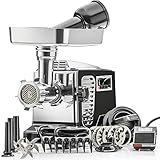
- The STX International Turboforce II (Patented Air Cooled) Complete Home Grinding Package features a Heavy Duty 2000 Maximum Watt Electric Grinder and Features a High Capacity Meat Tray that easily holds over 3 Lbs. of meat.
- The Patented Quad Air Induction Cooling System Features a Locked Motor Wattage of 2000 Watts and a Circuit Breaker for Safety. This grinder is a Size No.12 Grinder, Not a Size No.5 or No.8 Like Smaller Grinders, 2-1/2 -Inch Diameter Output for Ground Meat and 2-Inch Diameter Feed Tube.
- Combining the Meat Auger with AVI (Advanced Variable Intake) Technology and the High Volume Feeder Tray which easily allows for grinding 220 to 260 Lbs of Meat per Hour Depending on the Size of Grinding Plate used and the Type of Meat being ground. This Grinder can Also Easily Handle Soft Bones such as Chicken, Rabbit, Squirrel, and Quail Bones.
- This Turboforce II 4000 Series Grinder also Includes: 1-Polished Aluminum Grinding Head and High Capacity Meat Tray, 1 - Foot Pedal, 3 - 304 Grade Stainless Steel Cutting Blades, 5 - Sizes of Grinding Plates, 1 - Sausage Stuffing Plate, 3 - Sizes of Sausage Stuffing Tubes (1/2", 5/8" & 3/4"), 1 - Kubbe/Kibbe Making Attachment & 1 - Easy to Use Palm Meat Pusher/Stuffer, a pair of Meat Claws & Burger-Slider Press.
- Mercantile Station 2, LTD. is Based in the Center of the Continental United States, with Knowledgeable Staff On-Hand and Ready to Assist with any Questions or Concerns that may arise. STX International is a Mercantile Station 2, LTD. Brand that offers a 3-Year Warranty! Terms May Apply. Please Scroll Down this Page for More Information on this Product!
Clarify what the seller means by SDE. Reconcile it to tax returns, bank deposits, POS reports, payroll, rent, utilities, inventory movements and owner add-backs. A high reported SDE that disappears when an owner’s labor is replaced by a paid manager is not equivalent to durable cash flow.
What you may actually acquire
An established shop is valuable only to the extent that its assets and relationships transfer to you. Put every promised item in the purchase agreement and verify ownership, condition and transferability.
What’s actually slowing this PC down?
Pick the symptom - the matching free tool is one click away.
- Premises and lease: assignment rights, remaining term, renewal options, rent escalations, permitted use, exclusivity, personal guarantees and landlord consent.
- Physical assets: walk-in refrigeration, display cases, grinders, saws, slicers, smokers, vacuum packers, scales, POS hardware, shelving and vehicles. Obtain age, serial numbers, service records and liens.
- Regulatory standing: current licenses, inspection reports, correction notices, certificates and any pending applications. Existing approval does not automatically transfer to a new legal entity.
- People: butcher skills, wage rates, tenure, employment status, planned retention and whether key workers will stay after the seller leaves.
- Commercial relationships: supplier pricing and credit terms, wholesale accounts, recipes, product specifications, customer records, loyalty data and documented sales channels.
- Intangibles: name, signage, website, phone number, social accounts, domain, packaging designs and training materials, subject to a written assignment.
Customer loyalty can belong to the selling owner rather than the storefront. Ask how much revenue comes from the owner’s personal ordering, sales calls, delivery route or reputation, and require a defined transition period if those relationships matter.
How to finance a butcher shop acquisition
Financing should be based on verified cash flow and a realistic post-closing budget, not on the seller’s asking price alone. Start with a sources-and-uses schedule that separates the purchase price from inventory, fees, working capital and capital repairs.
- Define the transaction: Decide whether you are buying assets or the legal entity. List equipment, inventory, intellectual property, contracts, deposits and assumed liabilities.
- Build a post-closing cash model: Include debt service, owner compensation, replacement labor, rent increases, utilities, insurance, maintenance, spoilage and taxes. Model at least a base case and downside case.
- Verify earnings: Reconcile several years of tax returns, bank deposits, POS sales, payroll filings, supplier invoices and inventory counts. Investigate every add-back in SDE.
- Price immediate capital needs: Obtain service opinions or replacement quotes for refrigeration, electrical systems, floors, plumbing and other critical infrastructure. Put those costs into the uses schedule.
- Prepare a lender package: Provide the purchase agreement or letter of intent, historical financial statements, tax returns, lease, equipment list, licenses, inspection records, your resume and a detailed opening balance sheet.
- Negotiate protection: Use seller representations, an inventory count at closing, a holdback or escrow for undisclosed liabilities, a non-compete where enforceable, and seller training or transition services.
- Keep a reserve: Fund the additional $50,000–$150,000 range identified by Dealflow OS when the shop’s condition and working-capital cycle justify it; do not spend every dollar on the purchase price.
Attorneys and accountants should review the structure, tax treatment, licenses, contracts and liabilities. SBA specifically recommends examining licenses and permits, zoning, environmental concerns, contracts, leases, financial statements, tax returns, inventory and more than one valuation method with professional help.
Rank #3

- 【Rugged Powerhouse】ARINOO #12C meat grinder with a high-torque 1.0HP, 110-volt 100% pure copper motor normal rated up to 650W, Peak power 1100W,and an oversized meat hopper that can hold large amounts of prepared meat for grinding. It's a true workhorse that can power through large tasks seamlessly.
- 【Grinding Possibilities】 Our electric meat grinder is ideal for processing game if you are a hunter, chef, or buying bulk meat. It's designed for large batches home butchering, or small farm processing.You can prep everything from burgers and sausages to making pet food out of scraps that would otherwise be wasted.this grinder allows you to process a wide range of meats, including beef, pork, lamb, mutton, venison, and deer.
- 【What's Included】The commercial grinder machine, 2 stainless steel plates: 6mm, 8mm, along with a meat stomper, 2 stainless steel knifes, three plastic stuffing tubes.
- 【Easy to Clean】All parts of the meat grinder are detachable and can be washed directly with water, making it quick and easy. After washing, simply wipe dry and store in a well-ventilated, dry place to help extend the lifespan of the machine.
- 【Stand Behind Our Products】 We offer a 5 year factory warranty on our meat grinder heavy duty and lifetime customer support for any questions you may have. Additionally, we carry replacement parts for a large variety of our products, past and present.
Break-even: the model both paths need
Use separate schedules instead of one blended food-cost percentage. A butcher shop’s economics depend on yield, trimming loss, spoilage and labor time as much as on the advertised price per pound.
- Fixed costs: rent, salaried management, insurance, base utilities, software, licenses, accounting and debt service.
- Variable costs: meat purchases, packaging, payment processing, hourly labor tied to production, delivery and selling fees.
- Operating leakage: shrink, spoilage, trim loss, failed batches, discounts, returns and unsold prepared products.
- Capacity assumptions: yield by primal, average selling price per pound, labor minutes per pound, weekly throughput and display-case turnover.
- Owner replacement: a realistic wage for cutting, ordering, sales, scheduling and compliance work that the current owner performs.
SBA states the formula as: Break-even point (units) = fixed costs ÷ (sales price per unit – variable cost per unit). For a butcher shop, define the unit consistently—such as a pound, package or order—and use a weighted mix when products have different margins. Run downside cases for slower sales, a compressor failure, wage increases, a lost wholesale account and a delayed permit.
USDA Economic Research Service reported approximately 450 cattle-equivalent head per year as a break-even model result for a very small processing plant in a 2012 analysis. That is not a universal requirement for a retail butcher shop and should not be used to size a shop that only buys inspected primals.
Independent reader supportYour contribution helps us test, update, and keep practical guides available for everyone.Licenses, certifications and processing scope
The exact approvals depend on the address, jurisdiction and products. A retail-only shop buying inspected primals generally has a simpler operating model than a plant that slaughters animals, fabricates carcasses, cures or smokes products, or sells across state lines.
Confirm before signing a lease
- Zoning and permitted food use for the specific address.
- Local business registration and seller’s permit requirements.
- County or city health approval and retail-food license.
- Meat-establishment licensing or inspection if your jurisdiction requires it for the proposed processing.
- Building, plumbing, electrical, ventilation, fire and wastewater approvals.
- Rules for labeling, allergens, temperature control, employee hygiene, sanitation and recordkeeping.
- Federal, state and local rules for slaughter, custom-exempt work, inspected processing and interstate sales.
USDA ERS distinguishes custom-exempt, small inspected and regional inspected models and finds that more sophisticated services require substantially higher volumes. Decide your scope—retail cuts, sausage, smoking, curing, delivery, wholesale or slaughter—before choosing equipment or promising products. Ask the relevant regulator which licenses transfer, which require a new application, and whether a pre-opening or change-of-ownership inspection is required.
The Tool Desk
Outbyte PC Repair FREEClear out junk files and repair common Windows errorsFree Scan →Outbyte Driver Updater FREEFix the driver behind crashes, sound loss and screen glitchesFind Drivers →Rank #4

- Commercial-Quality Meat Grinder for Home Kitchens: Stainless steel build and a powerful 1.5 HP motor deliver pro-level grinding at home. Ideal for large batches and perfect for anyone needing a reliable grinder they can use again and again
- Heavy-Duty Performance: Electric grinder handles beef, pork, poultry, lamb, venison, and raw chicken bones. This machine processes up to 17 lbs of meat per minute and has a noise-dampening design for quieter performance
- Full Setup & Easy to Clean: Includes three plates, knife, stomper, and stuffing tubes for sausage making. Permanently lubricated motor and stainless steel parts allow for smooth operation. Disassembles easily for cleaning
- Grinding Possibilities: Our grinder is ideal for processing game if you are a hunter, chef, or buying bulk meat. You can prep everything from burgers and sausages to making pet food out of scraps that would otherwise be wasted
- Stand Behind Our Products: We offer a five-year factory warranty on our meat grinder and lifetime customer support for any questions you may have. Additionally, we carry replacement parts for a large variety of our products, past and present
Due diligence on an established shop
Financial checks
- Compare tax returns, profit-and-loss statements, bank deposits, POS exports and sales-tax filings.
- Test gross margin by category and investigate unexplained changes in meat cost, yield, labor or spoilage.
- Count inventory with a written method and agree on how perishable, obsolete or slow-moving stock is valued at closing.
- Identify wholesale customers that represent more than 20% of sales. Dealflow OS flags that concentration as a material risk because one lost account can change debt-service capacity.
Lease, people and compliance checks
- Have the landlord confirm assignment, renewal rights, rent, permitted use and any required upgrades.
- Review inspection reports, correction notices, pest-control records, wastewater issues, workers’ compensation history and insurance claims.
- Interview key employees privately about retention, pay, schedules, safety and their relationship with the owner.
- Check supplier contracts, credit terms, exclusivity, minimum orders and whether pricing survives a change in ownership.
Equipment checks
Refrigeration deserves special attention. Dealflow OS warns that aging systems can create a major capital call within 12–24 months. Obtain maintenance logs, temperature records and a qualified inspection of compressors, evaporators, electrical panels, door seals, floors and drains. Price a planned replacement rather than assuming a repair will preserve the asset.
When building is the better choice
Choose a new build when the available shops have unfixable leases, poor compliance histories, contaminated or unsuitable premises, owner-dependent revenue, or equipment that needs replacement immediately. Building also makes sense when your concept requires a layout, brand, product mix or processing scope that existing shops cannot accommodate. The trade-off is a longer pre-revenue period and no historical sales record to support the forecast.
When buying is the better choice
Favor an acquisition when the shop has a transferable lease, clean inspection history, reliable staff, documented margins, serviceable refrigeration, diversified customers and supplier terms that remain available after closing. The purchase can be capital-efficient because you are acquiring installed infrastructure and an operating customer base instead of recreating them. Do not pay for “turnkey” value until each component is verified in writing.
A decision test before committing
- Calculate the all-in cost of the new build, including a year of monthly expenses and a contingency.
- Calculate the acquisition’s purchase price plus inventory, fees, working capital and every near-term repair or replacement.
- Normalize both options for the owner’s labor, realistic wages, debt service and spoilage.
- Compare the time until stable positive cash flow, not merely the opening date.
- Reject either option if the downside case cannot cover payroll, rent, utilities, debt service and required maintenance.
- Proceed only after licenses, lease rights, equipment condition, staff retention and customer concentration are documented.
The best deal is not automatically the cheaper headline number. It is the path that leaves enough cash to operate safely through the ramp, maintain the cold chain and absorb a bad month without cutting food-safety or payroll obligations.
Recommended Free Tools
Quick Recap
Product prices and availability are accurate as of the date/time indicated and are subject to change. Any price and availability information displayed on Amazon at the time of purchase will apply.

