You can use n8n to keep a vector-store index of Notion and Airtable content refreshed: backfill each source, normalize its pages or records into documents, and use change events or scheduled polling to update the index. The routine can be automated, but it is not literally maintenance-free. Missed events, deleted content, permissions, API limits, retries, and stale vectors still need a recovery and monitoring plan.
How the sync is supposed to work
A RAG sync copies source content into a searchable index; it does not make the vector store the authoritative copy. When a user asks a question, a retriever searches indexed documents for relevant passages and provides them to a model or question-and-answer chain. n8n describes vector stores as holding vectorized information and retrievers as fetching relevant documents for those workflows.
As an Amazon Associate I earn from qualifying purchases.
Think of “AI memory” here as an external, searchable knowledge index, not a model that permanently remembers every source change. Keep Notion and Airtable as the systems of record. The index should be rebuildable from them.
Core workflow
- Read: Fetch pages and blocks from the authorized Notion content and records from the intended Airtable bases or tables.
- Normalize: Turn each source item into readable text plus stable source identity and useful metadata.
- Index: Insert new documents or update the existing indexed documents associated with those identities.
- Retrieve: Connect the vector store to a retriever or an AI agent so queries can search the indexed content.
- Reconcile: Periodically compare eligible source items with indexed items and repair missed updates, deletions, or stale entries.
n8n documents a built-in Notion node for searching data sources, retrieving blocks and pages, and creating or updating pages; it can also be used as an AI tool. Its Pinecone Vector Store node documents inserting, retrieving, and updating vector documents, as well as connecting a store to an agent or a retrieval chain. Available node operations can change, so check the current node documentation for the capabilities supported by your installed n8n version.
#1 Best Overall

- Sturdy Construction: Our Lined Spiral Journal Notebook is built to last with a sturdy metal twin-wire binding and a tough hardcover. The water-resistant cover shields your notes from damage, while the double-wire design allows for easy folding and flat laying.
- High-Quality Paper: Crafted from 100 GSM thick, ink-friendly paper, our notebook prevents ink bleed-through and ghosting. It accommodates various pens, including ballpoint, gel, and fountain pens. Each page features a day header for effortless date tracking.
- Organized and Functional Design: With 140 lined pages and a 6-page blank table of contents, our notebook offers ample space for note-taking and easy referencing. An inner pocket keeps miscellaneous items secure, and an elastic closure band ensures the notebook stays closed when not in use.
- Versatile Usage: Suitable for office, school, and home environments, our notebook is perfect for journaling, note-taking, drawing, goal setting, Bible, and planning. It's a thoughtful present for friends, family, classmates, and colleagues.
- Medium-Sized Portability: Measuring 5.7 inches x 7.9 inches, our medium notebook strikes the perfect balance between portability and functionality. Its sturdy construction and aesthetic design make it an ideal companion for all your writing endeavors.
Set up access and choose the indexed content
Authorize Notion and Airtable deliberately
Use n8n credentials rather than placing secrets in workflow text, expressions, or node output. Notion uses bearer-token authentication, and the connection must be granted access to the pages or data sources you intend to index. For Airtable, authorize only the needed bases and scopes. A token that can read every workspace item when the workflow needs only one base creates unnecessary exposure.
Decide which content is allowed to leave each source before embedding it. The content will pass through the embedding provider and the selected vector-store provider, so review their current privacy, retention, and processing terms for your deployment. The cited product documentation establishes integration capabilities, not provider-specific privacy guarantees.
Define inclusion rules before the first run
Choose which Notion pages or data sources and which Airtable bases, tables, views, or records belong in the knowledge base. Apply those rules consistently during both the initial backfill and later updates. If content falls out of scope—for example, because a record no longer matches the chosen view—the workflow needs to remove or mark its old vector as ineligible, not merely stop reading it.
Give every indexed item a stable identity, such as a source platform plus its page or record ID. Store that identity in vector metadata along with the source URL, last-updated time, and selected fields that help filter retrieval. These are implementation recommendations, not a vendor-prescribed schema. Stable identity is what lets an update replace the right document and gives reconciliation a way to find stale entries.
Rank #2
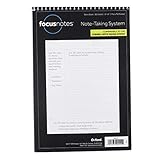
- Note, cue & summary columns organize your notes for future review
- Based on study techniques from the widely used Cornell Note-Taking System
- Helps build study skills for retention and academic success
- 6" x 9"; Top-wire bound; 80 sheets
- Proudly made in the USA
Run a complete initial backfill
Do not assume one API response contains the entire source. Both platforms paginate their results; a workflow that indexes only the first response can appear to succeed while silently omitting content.
| Source | Pagination behavior | Backfill requirement |
|---|---|---|
| Notion | List responses can include has_more and next_cursor. The API introduction describes a default page size of 100 and a maximum of 100. |
Request subsequent pages with the returned cursor until no further results remain. Fetch the page or block content needed to build each document. |
| Airtable Web API | A response returns up to 100 records and uses an offset when another page is available. |
Continue with each returned offset until the response has no further page. Apply the same inclusion rules used for incremental updates. |
Notion’s API introduction includes an example using Notion-Version: 2026-03-11. Use the version supported by your integration and check Notion’s current API documentation when configuring requests; do not assume an example version is automatically right for every n8n deployment.
For each fetched item, extract the text a person would need to retrieve—not just an opaque ID or title. Notion content may require retrieving page blocks and their content; Airtable documents may be assembled from selected record fields. Keep the source ID and URL attached to every document, even if you split a long item into multiple chunks. If you chunk an item, use a deterministic chunk identity derived from the source identity and chunk position or content version, so reprocessing does not create duplicates.
Recommended Free Tools
Choose how changes trigger updates
| Approach | How it works | Trade-off |
|---|---|---|
| Webhook or change event | A source signals that content changed; n8n then fetches the authoritative current item and updates or removes its indexed documents. | Can reduce the delay and request volume of frequent polling, but needs a reachable receiver where required, event handling, and a recovery path for missed or failed processing. |
| Scheduled polling | A scheduled workflow checks for changed items or re-reads a defined scope, then indexes differences. | Simpler to reason about when events are unavailable, but freshness depends on the schedule and repeated reads consume API capacity. |
| Hybrid | Use events for targeted refreshes and a scheduled reconciliation for drift and missed changes. | Adds workflow components, but avoids treating event delivery as the only source of correctness. |
Notion events
Notion’s documentation says, “Webhooks let your connection receive real-time updates from Notion.” A webhook can report an event such as a page change; the receiver should then fetch the current resource from Notion before indexing it. The documented example describes a secure HTTP POST with a page ID, event type, and timestamp, followed by an API fetch. It says the event may arrive “Within a minute,” which is not a guarantee of end-to-end indexing latency. The webhook endpoint must be publicly reachable and SSL-secured.
Rank #3

- 【Premium Quality】 The Nextnoid leather journal for men is crafted with a durable, luxurious PU leather cover, offering up a premium feel and look. Made with 120 GSM thick paper, it's a notepad that prevents bleed-through for every kind of writing need.
- 【Versatile Design 】These lined journaling notebooks for work features 160 pages with 7mm spaced lines, ideal for planning, note-taking, journaling, and organizing tasks. Its 180° lay-flat design and ribbon bookmark will give you unmatched convenience, bringing ease of use to both professionals and students needing a quality work notebook.
- 【Organized And Functional 】The Nextnoid daily mens journal for writing includes two content pages to help you organize your thoughts and notes efficiently. It's perfect for every kind of note taker, making it a must-have tool for daily productivity.
- 【Stylish And Professional 】Available in multiple colors, this vegan leather a5 notebook is designed to be sleek and professional, suitable for any setting. The sturdy hardcover journal brings durability, while the classic design adds elegance to your writing experience.
- 【Smooth Writing Experience】With 120 GSM thick, no-bleed paper, these lined journal notebook is ideal for use with all types of pens and markers. The high-quality paper and binding make it a reliable choice for daily use, whether at work, school, or home.
Airtable events and incoming automation webhooks
Airtable’s Webhooks API can report changes to records, fields, or view membership. Treat those notifications as change signals, not as complete replacement content: fetch the current record or relevant source data before updating the index.
Do not confuse that outgoing Webhooks API with an Airtable automation that accepts an incoming webhook from another system. Airtable warns that anyone with the unique incoming webhook URL can trigger the automation, so protect it as a secret. Either mechanism still needs error handling and a way to detect changes that were not successfully indexed.
Build the n8n workflows
Use separate workflows or clearly separated branches for the initial backfill, event-driven changes, and reconciliation. They may share the same normalization and indexing logic. This separation makes it easier to re-run an import without confusing it with live event processing.
What’s actually slowing this PC down?
Pick the symptom - the matching free tool is one click away.
Initial import
- Start the workflow with a manual trigger for a controlled first run, or another appropriate trigger for a repeatable import.
- Fetch source pages: use the Notion node’s relevant search or retrieval operations, and Airtable’s record retrieval. Continue each platform’s pagination until the source scope is exhausted.
- Normalize each item into readable text and metadata. Include a platform name, stable source ID, source URL, update timestamp, and only the fields needed for retrieval and filtering.
- Index documents in the chosen vector store using a stable identity and its supported insert or update behavior. Avoid creating a fresh unrelated vector ID on every run.
- Record run status so operators can see what completed, what failed, and which source items need retrying.
Incremental refresh
- Receive a source event or start a scheduled check.
- Identify the affected source item using the event’s ID or the polling result.
- Fetch current source data from Notion or Airtable. Do not assume the event payload contains all content needed for indexing.
- Reapply inclusion and normalization rules so incremental updates produce the same document shape as the backfill.
- Update or replace indexed documents associated with the stable source identity. If content is no longer eligible or has been deleted, remove its vectors or mark them so retrieval excludes them.
- Retry transient failures with backoff and route permission, schema, or repeated failures to an error path that can alert an operator.
n8n documents the Pinecone Vector Store node’s Insert Documents and Update Documents modes, along with retrieval modes. Pick the behavior that matches your vector-store setup. Confirm that an update replaces the intended IDs and that your metadata filters exclude removed or obsolete content; do not assume every vector database handles IDs, batches, or deletion in the same way.
Rank #4

- 【LINED JOURNAL NOTEBOOK】: Measuring 5.9" x 8.5", this A5 notebook is the ideal compact size for portability in a bag or briefcase, yet offers ample writing space. The crisp 7mm lined pages promote neat handwriting, making it excellent for school notebooks, college ruled notebook needs, work notebook, dream journals, or as a daily planner.
- 【HARDCOVER LEATHER JOURNAL】: Experience timeless elegance with a vagen leather cover, featuring a beautiful embossed design. This hardcover journal offers refined protection for your writing, making it a sophisticated leather bound notebook or journal for both professional settings and personal reflection, suitable for women and men.
- 【180° LAY FLAT DESIGN & PREMIUM LINED PAPER】: Lay the notebook completely flat for easy writing in any setting—whether at your desk, in a café, or on the go. The 160 pages of 100 GSM lined paper (7mm spacing) offer a smooth writing experience, ideal for journals, work notes, school assignments, or Bible study notes, with minimal ink bleeding or feathering.
- 【FUNCTIONAL DESIGN FOR ORGANIZATION】: Stay organized effortlessly with 3 colored silk ribbon bookmarks to track multiple sections like bible study, work projects, or personal entries. Secure your journal with 2 elastic bands and utilize the integrated elastic pen loop to always have your writing tool ready. A truly functional writing journal.
- 【THOUGHTFUL GIFT FOR MEN & WOMEN】: This hardcover notebook excels in any scenario. Use it as a professional notebook for business meetings, a travel journal for adventures, a dedicated bible journal for notes and reflections, a dream diary, a daily gratitude journal, or a reliable college ruled notebook for students. Choose from 4 interior options (lined, dotted, blank, or graph paper) to match personal styles – whether bullet journaling, sketching, or business note pads.
Respect Airtable limits and distinguish its APIs
Airtable’s Web API returns up to 100 records per page and is subject to a documented limit of 5 requests per second per base. The Help Center terms accessed October 7, 2026 state monthly allowances of 1,000 API calls for Free and 100,000 for Team; Business and Enterprise API calls are described as unlimited subject to rate limits. These plan terms can change, so verify the current limits for your plan before designing a poll schedule or estimating a backfill.
A high-volume workflow can exceed a rate limit or monthly allowance if it repeatedly fetches unchanged records or fans one source change into many requests. Avoid unnecessary reads and writes, respect throttling responses, use backoff for transient failures, and use batching only where the relevant endpoint supports it. The Airtable documentation states that third-party integrations must handle rate limits appropriately.
Airtable Sync API is not general-purpose RAG sync
Airtable’s Sync API is a one-way CSV-ingestion feature for importing data into Airtable. It is not the same as reading Airtable’s Web API to build an external vector index, and it does not by itself provide a two-way sync between Airtable and a RAG store. The documentation lists it for Business and Enterprise Scale and specifies a personal access token with data.records:write and schema.bases:write.
Do these 3 things before closing this tab:
1Fix the driver behind crashes, sound loss and screen glitches2Clear out junk files and repair common Windows errors3Scan for outdated or missing drivers - takes under a minute| Sync API constraint | Documented value |
|---|---|
| CSV rows | 10,000 |
| Columns | 500 |
| Request body | 2 MB |
| Rate limit | 20 requests per five minutes per base |
These are Sync API constraints, not limits for every Airtable Web API operation. Airtable’s integrated sync frequency may be as often as every five minutes and may take longer; a destination base that is inactive can stop syncing. Neither behavior promises instant or uninterrupted freshness.
Best Value

- Plan, Digitize, Erase, Re-Plan: Write to-do lists, notes, and goals on reusable paper with the Pilot Frixion Pen. Digitize plans using the Rocketbook app and organize in the cloud. When done, simply wipe the pages clean with a damp cloth and reuse.
- 7 Versatile Page Templates: Plan for life and work with Monthly & Weekly Calendar, To-Do List, Goal Tracker, Idea List, and both Dotted and Lined Notebook Pages. Diverse for everything from project management to fitness tracking to household planning.
- App-Enabled for Digital Organization: The Rocketbook app allows you to scan and upload your plans & lists directly to cloud platforms like Google Drive, Dropbox, OneNote, etc. The app-connection ensures your notes are accessible from anywhere.
- High-Quality & Durable Materials: Premium reusable paper, durable spiral binding, and a waterproof cover. The flexible design allows it to lay flat for comfortable writing and planning sessions, whether you're at home, school, or the office.
- Eco-Friendly and Reusable: Replaces the need for traditional paper planners. Designed for sustainability, combining the convenience of 7 reusable page types with the ability to digitize and erase, allowing you to streamline tasks and reduce waste.
Handle deletions, failures, and index drift
Propagate deletion and exclusion
Updates are only half of synchronization. When a source page or record is deleted, loses access, or no longer meets the inclusion rules, an old vector can remain searchable unless the workflow removes it or marks it inactive. Where direct deletion cannot be confirmed reliably, use a tombstone or active-status metadata filter and make reconciliation identify and clean up obsolete entries.
Make retries safe
Event processing can fail after the source changes but before indexing completes. Record enough execution state to retry the affected source item. A retry should be idempotent: processing the same source version twice must not create duplicate active documents. Use backoff for transient API or provider errors; route persistent permission, schema, or credential errors to an operator rather than retrying indefinitely.
Reconcile independently of events
Run a scheduled full or scoped reconciliation to compare eligible source identities with indexed identities and update stale content. A reconciliation can also find missed webhooks, deletions, revoked access, and workflow runs that stopped partway through. Select its scope and cadence based on source volume and API quotas; a full scan can be expensive, particularly under Airtable’s per-base and plan limits.
Monitor the operational signals
- Backfill and reconciliation completion, including the number of source items read and indexed.
- Failed or repeatedly retried executions, plus the source IDs involved.
- Webhook or polling delay and the age of the most recent successful update.
- API throttling, quota consumption, credential failures, and permission errors.
- Deletion and exclusion processing, so stale content is not quietly left searchable.
- Vector-store update and retrieval behavior after changes to chunking, metadata, or embedding configuration.
What “zero-maintenance” can realistically mean
It can mean that routine imports and updates happen automatically, with retries, failure alerts, and a documented recovery route. It cannot mean that credentials never expire, APIs never change, permissions never shift, quotas never bind, events never fail, or index quality never needs checking. Before relying on the index, decide who owns credential rotation, workflow and provider upgrades, backups, quota monitoring, and reconciliation.
There is no basis here for promising a particular indexing latency, retrieval accuracy, or reliability percentage for a combined n8n, Notion, Airtable, and vector-store workflow. Those outcomes depend on configuration, source volume, providers, and operational choices; measure them in your own deployment.
Quick Recap
Implementation checklist
- Authorize only the Notion pages/data sources and Airtable bases the workflow needs; keep secrets in n8n credentials.
- Complete the initial backfill by following Notion cursors and Airtable offsets until each scope is exhausted.
- Use the same inclusion, normalization, and stable identity rules for backfills and incremental refreshes.
- Fetch authoritative source content after change events rather than indexing event payloads as complete records.
- Define what happens when content is deleted, excluded, or no longer accessible.
- Respect Airtable API limits and plan allowances, and distinguish its Web API from the one-way Sync API.
- Make retries safe, alert on persistent failures, and run scheduled reconciliation.
- Review current API versions, node capabilities, plan terms, and provider data-handling terms before deployment.
Product prices and availability are accurate as of the date/time indicated and are subject to change. Any price and availability information displayed on Amazon at the time of purchase will apply.

