There is no single best boat anchor. Match the anchor’s geometry to the bottom you expect to encounter, then size it for your boat’s displacement, windage, weather exposure and anchoring duration. Fluke (Danforth-style) anchors are efficient in sand and hard mud; plow or scoop anchors handle varied bottoms and can reset after a wind shift; claw anchors are broad-use options; grapnels catch rock and structure; and mushroom anchors are specialized for moorings or very small craft in soft bottoms.
The anchor is only one part of a reliable system. Scope, chain, rope, shackles, attachment points, stowage and your ability to verify the set determine whether the boat stays put.
As an Amazon Associate I earn from qualifying purchases.
Why the bottom matters as much as the boat
An anchor holds by either burying into the seabed or snagging a solid feature. Sand, mud, clay, grass, rock and submerged timber therefore reward different shapes. A design that buries well in sand may skate across hard clay, clog with vegetation or release when the load reverses. A snagging anchor can feel secure until the tine pulls free or the boat’s rode changes angle.
Before anchoring, identify the likely bottom from a chart, local knowledge, depth sounder or observations from nearby boats. Treat an unknown bottom as a variable, not as proof that the first set is good. After deployment, verify that the boat remains on a steady bearing relative to fixed objects ashore; a false set can look normal until wind or current increases.
#1 Best Overall

- KEEP YOUR BOAT SECURE IN CHALLENGING BOTTOMS: 15 lb weight and integrated flukes help the Navy Anchor dig into sand and mud for dependable holding power.
- RECOVER ANCHORS WITH LESS EFFORT: Reverse-action shank design helps free and retrieve a fouled Navy Anchor more easily when conditions become challenging.
- PROTECT YOUR VESSEL FROM DAMAGE: Black PVC-coated finish helps resist rust while reducing scratches and scuffs on boat surfaces.
- ATTACH LINES QUICKLY AND CONFIDENTLY: Large eye opening allows easy connection to anchor rope, chain, or rode for convenient setup.
- RELY ON DURABLE MARINE CONSTRUCTION: Solid cast iron construction provides strength, durability, and reliable performance for boating applications.
West Marine’s 2026 guide says modern anchors can develop holding forces from 10 to 200 times their own weight. That broad range is not a guarantee for a particular model or seabed: penetration, scope, rode configuration and loading direction control the result.
Anchor types compared at a glance
| Anchor type | Best-supported use | Main limitations | Stowage and handling |
|---|---|---|---|
| Fluke / Danforth-style | Sand and hard mud; high holding power for its weight | Deep mud, grass and rock; can release after a direction reversal | Stores flat, but its stock and flukes can foul in a locker |
| Plow / scoop | Mixed conditions such as sand, mud and some vegetation; situations requiring a reset | Bulkier; performance varies by model and bottom | Usually better on a bow roller or bowsprit than in a flat locker |
| Claw | General use across common bottoms; quick setting and resetting | Hard clay and heavy grass can defeat it | Normally paired with a bow roller or windlass |
| Grapnel | Small craft over rock, wreckage or submerged timber | Holds by snagging and can become difficult to retrieve | Compact, but tines require careful handling |
| Mushroom | Permanent moorings and buoys when appropriately large; limited soft-bottom use by very small boats | Small versions have little holding power and are unsuitable for overnight or storm anchoring | Simple shape, but mooring systems must be engineered for the site |
Fluke and Danforth-style anchors
Two broad flukes pivot or angle into the seabed while a stock keeps the anchor aligned. This gives a fluke anchor high holding power relative to its mass and allows it to lie nearly flat when stored. Those characteristics make it a practical primary anchor for boats that spend most of their time in sand or firm mud.
Deep, soupy mud may not provide enough resistance for the flukes to develop their designed holding area. Grass can prevent penetration, and rock offers little material for the flukes to bury. The projecting stock and flukes can also catch on locker fittings or the bottom itself. If wind or current reverses, the anchor may trip out instead of rotating and re-burying.
Windows Errors? Fix Them Before They Spread
Repair common Windows errors and clear accumulated junk for a smoother, more stable PC - no reinstall needed.Free scan · no reinstallOutdated Drivers Are Slowing You Down
One free scan finds every outdated or missing driver and matches the right update for your exact hardware.Free scan · exact hardware matchDanforth’s current sizing table lists its S600 at 9 pounds for boats 17–27 feet long and states 600 pounds of holding power. The maker specifies that its recommendations assume normal wind, average currents and at least a 5:1 scope. Those figures are manufacturer specifications, not an independent comparison or a promise under storm loads.
Plow and scoop anchors
Plow and scoop anchors use a curved, digging surface that directs the point into the seabed as the rode loads up. They are commonly selected for boats that encounter sand, mud, mixed bottoms and some vegetation rather than one predictable anchorage. When wind or current changes direction, a well-set plow or scoop can rotate and dig in again instead of remaining fixed in its original orientation.
The trade-off is physical size. The curved shank and broad profile consume more locker space than a flat fluke anchor, and many models are intended to sit on a bow roller or bowsprit. Confirm that the roller supports the anchor’s shank and tip through the full retrieval arc; an anchor that cannot be launched cleanly is not a practical safety device.
Results still depend on the specific model and bottom. A “scoop” label does not eliminate the need to test the set, especially in hard clay, shell, cobble or dense weed.
What’s actually slowing this PC down?
Pick the symptom - the matching free tool is one click away.
Rank #2

- Fits 8-16 ft Boats: This 5 lb boat anchor kit is perfect for pontoons, fishing boats, dinghies, and other vessels in the 8 to 16 ft range. It's a reliable choice for lake days, offshore fishing, or coastal cruising
- All-in-One Boat Anchor Kit: Includes a 5 lb galvanized fluke anchor, 6.5 ft steel chain, 2 D-ring shackles, and 100 ft of nylon rope; everything you need to secure your boat without extra purchases
- Strong Holding in Sand or Mud: The fluke anchor is designed to dig deep into sand or mud, while the weighted chain enhances grip. Keeps your boat stable even in strong currents or windy conditions
- Rust-Resistant Galvanized Steel: Made with hot-dipped galvanized steel, this boat anchor kit resists rust, corrosion, and wear—ideal for both saltwater and freshwater use over long periods
- Durable and Flexible Nylon Rope: The included 100 ft nylon rope offers excellent stretch resistance and tensile strength. It’s soft to handle yet tough enough for secure anchoring in changing conditions
Claw anchors
Claw anchors have a rounded, three-lobed form that tends to set quickly and can rotate as the loading direction changes. They are a broad-use alternative when a boat visits ordinary sand, mud and mixed bottoms and the owner values straightforward roller storage.
The shape is less effective where the seabed is exceptionally hard or covered by heavy grass. A claw may also catch between rocks rather than burying, making retrieval awkward. Check that the bow roller or windlass is rated for the anchor’s mass and that the flukes clear the hull and stem during launch.
Grapnel anchors
A grapnel uses several pointed tines to hook rock, reef, wreckage or submerged timber. That makes it useful for a small craft fishing or diving over structure where a burying anchor cannot penetrate. Its compact size and relatively low weight are convenient for dinghies and open boats.
Because the holding mechanism is a snag, not a buried surface, a grapnel is not a general-purpose overnight or storm anchor. Tines can wedge under ledges or wrap in lines and vegetation. Plan a retrieval method before setting one, and avoid deploying it where a fouled anchor could create a hazard to people or other boats.
Free tools Windows power users keep installed
One-click scans. No signup required.
Mushroom anchors
A mushroom anchor relies on its cap settling into very soft material and building suction or soil resistance over time. Large, engineered mushroom systems are used for moorings and buoys. Small portable mushrooms can work for a very small craft in soft mud during benign conditions.
A small mushroom has minimal immediate holding power and should not be treated as an overnight, high-wind or storm anchor. Mooring installations require a correctly sized anchor, chain, swivel and buoy system for the local bottom, depth, current and expected loads; a portable model cannot substitute for that design.
How to choose for your boat and expected bottom
Use the following decision sequence rather than selecting by boat length alone.
Rank #3

- Hold Your Boat Firmly in Place: This anchor combines the features of a traditional mushroom anchor with flukes for better bottom penetration; it’s one of our must-have boat accessories
- Durable & Works in a Variety of Waters: Designed for protected inland waters, the SeaSense River Anchor works effectively in strong currents and tidal waters, as well as sand, mud or weed bottoms; it’s made of one piece cast iron with black vinyl coating to help protect the gel coat
- Ideal for Pontoons & Bass Boats: These anchors can hold a small boat, kayak, jet ski, canoe and other small watercraft; take this equipment with you on the river, lake and beyond
- Save Time & Money, Have More Fun: Whether you’re a weekend boater or an experienced buyer, we keep your needs at the forefront of everything we do; every one of our products and parts is designed to work quickly and reduce costs
- Quality Marine Products That Make Sense: At SeaSense, we’ve been providing innovative marine and trailer products since 1984; we’ve rigorously tested and improved our catalog for decades to help deliver the best on-the-water experience possible
- List the bottoms you actually use. If most trips are on sand or hard mud, a fluke anchor may be efficient. If destinations vary, a plow, scoop or claw provides a broader operating envelope. For rock or structure, carry a grapnel only for the specific small-craft task it is designed to perform.
- Account for displacement and windage. A tall cabin, canvas, solar panels or dinghy increases aerodynamic load. Two boats of the same length can need different anchor sizes.
- Define the exposure and duration. A lunch stop in a protected cove is a different requirement from an overnight stay in open water or a forecast blow. Size up when the anchorage is exposed, the weather is uncertain or the boat catches substantial wind.
- Check the manufacturer’s chart. Use the chart for the exact anchor model, not a generic weight rule. Discover Boating and West Marine both describe length-and-weight ranges as starting guidance and advise selecting larger equipment for heavier or higher-windage boats.
- Confirm physical compatibility. Measure the locker or bow roller, check the shank and fluke clearance, and verify that shackles, chain, rope, cleat and windlass have compatible working loads.
For boats visiting markedly different bottoms, West Marine recommends carrying two different anchor styles. A common arrangement is a primary plow, scoop or claw for varied conditions plus a flat fluke anchor for sand or hard mud, provided both can be handled and stowed safely.
Recommended Free Tools
Sizing: why boat length is only a starting point
Anchor charts generally combine boat length with displacement, but the chart’s assumptions matter. West Marine’s June 8, 2026 guide calls its approximate ranges guidelines and recommends moving to a larger anchor in exposed anchorages, heavy weather or on boats with high windage. Discover Boating gives similar advice for boats heavier or more wind-catching than typical for their length.
| Input to evaluate | Why it changes the size decision | Action |
|---|---|---|
| Displacement | More mass creates greater inertia when the boat sheers or surges | Use the maker’s weight range for the actual loaded boat |
| Windage | Cabins, canvas and equipment increase aerodynamic drag | Move up a size when the boat presents an unusually large profile |
| Exposure | Open water and fetch produce stronger, less predictable loads | Choose the next larger size when the chart allows and stowage permits |
| Weather and duration | Overnight or deteriorating conditions allow more time for load changes | Do not use a calm-weather minimum as a storm specification |
| Rode and scope | A low, elastic pull helps the anchor remain buried | Size the entire ground tackle, not the anchor in isolation |
Scope, chain and rode configuration
Scope is the length of rode paid out divided by the vertical distance from the bow chock to the bottom. A longer horizontal component reduces the angle at the anchor and generally improves holding.
- 5:1: West Marine identifies this as a minimum for calm, protected conditions.
- 7:1: Its guide recommends this for open or overnight anchoring and for winds above 15 knots.
- 10:1: It recommends this for storm or exposed conditions when the swinging room is available.
These are West Marine recommendations, not universal rules. Depth, tide, traffic, swinging room and local regulations may limit the rode you can deploy. Include the distance from the bow chock to the waterline when calculating the vertical leg.
A rope-and-chain rode combines easier handling with chain’s weight and abrasion resistance. Chain helps keep the pull low and protects against chafe near the seabed; an all-chain rode is heavier and generally calls for a windlass. West Marine recommends a chain leader at least one boat length for a rope-chain combination. Match chain size, rope diameter, shackles and connectors to the anchor and the cleat or windlass, and inspect for corrosion, damaged links and worn eyes.
Do these 3 things before closing this tab:
1Clear out junk files and repair common Windows errors2Scan for outdated or missing drivers - takes under a minute3Repair Windows errors before they cause bigger problemsHow to deploy and verify an anchor
- Prepare the system. Secure the bitter end, inspect the shackle and swivel, and ensure the rode is flaked so it can run without tangles. Brief everyone on pinch points and retrieval roles.
- Approach into the prevailing force. Reduce speed and position the bow upwind or up-current, whichever dominates. Stop over the intended spot rather than dragging the anchor at speed.
- Lower the anchor. Pay it out under control; do not throw it, because a thrown anchor can foul the rode or injure someone. Let the anchor reach the bottom before paying out more rode.
- Pay out the planned scope. Use depth and bow height to calculate the target ratio, then lay out the rode while the boat moves slowly astern.
- Back down gradually. Apply reverse power in stages until the rode straightens. A properly set anchor should load without the boat continuing to move toward the intended direction of drift.
- Check fixed bearings. Choose a tree, building, buoy or charted object and observe whether its relative bearing changes. Repeat the check as wind and current change.
- Re-set when evidence is poor. If the boat keeps moving, the rode leads sideways unexpectedly or the bottom is uncertain, retrieve and try a different position, scope or anchor style.
Wind shifts, false sets and common failures
The boat drags after a wind shift
A direction reversal can trip a fluke anchor or expose a poorly buried anchor. Increase scope if room allows, back down again, and verify the new set. In a mixed-bottom area, changing to a design intended to reset may be more effective than simply adding weight.
The anchor will not bite
Hard clay, rock, dense grass and deep fluid mud can prevent penetration. Move to a patch with a more suitable bottom, clear weed from the anchor, or deploy the alternative anchor style carried for that environment. Never assume extra rope alone fixes a design mismatch.
Rank #4
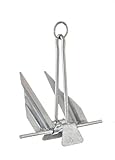
- Penetrates deep in a variety of seafloor compositions
- Slip ring shank makes it simple to retrieve stuck anchor
- Recommended for boats 15-19 feet in length
- Fluke Length: 9-1/16 inch
- Stock Width: 12-5/8 inch
The rode chafes or the bow roller loads unevenly
Inspect the lead from anchor to chock, add appropriate chafe protection, and confirm that the roller aligns with the direction of pull. Replace damaged rope or bent shackles before the next anchorage; a strong anchor cannot compensate for a weak connection.
The anchor is difficult to retrieve
Snagging designs can wedge in rock or timber, while flukes can foul on fittings. Pull from the direction opposite the setting load when possible, use the boat’s slow movement rather than engine power alone, and follow the anchor maker’s recovery instructions. Do not place crew over a loaded rode.
What published holding figures do—and do not—tell you
West Marine reports more than 5,000 pounds of load from a 21-pound Fortress FX37 in anchor tests it identifies as having been conducted in 2006. The date and test context matter: this is not a new test, not a guarantee for another anchor and not a prediction for every bottom.
The same guide states that doubling wind speed increases force on the boat and ground tackle fourfold. Use that relationship as an illustration of why a calm-weather set can fail when conditions rise rapidly; it does not replace a maker’s sizing chart or a prudent weather decision.
Danforth’s official sizing language says: “Boat size recommendations are provided based on normal wind conditions, average currents, and a minimum 5:1 scope ratio.” Read that qualification alongside the 9-pound, 17–27-foot and 600-pound S600 figures rather than treating them as universal specifications.
A practical selection for common boating plans
| Boating plan | Reasonable starting style | What to verify before relying on it |
|---|---|---|
| Mostly protected sand or firm mud | Fluke / Danforth-style | Fluke penetration, locker clearance and a tested set after backing down |
| Rivers, bays and coastlines with changing bottoms | Plow, scoop or claw | Reset behavior, roller fit and the manufacturer’s chart for loaded displacement |
| Small craft over rock or submerged structure | Grapnel | That snagging is appropriate, retrieval is manageable and conditions are benign |
| Permanent buoy or mooring installation | Engineered mushroom system where the bottom supports it | Site-specific engineering for depth, current, soil and storm loads |
Choose the anchor that matches the bottom you will actually use, then build the rest of the ground tackle around the same load assumptions. Verify every set, monitor the boat as conditions evolve and carry a second style when your cruising grounds span incompatible seabeds.
Quick Recap
Product prices and availability are accurate as of the date/time indicated and are subject to change. Any price and availability information displayed on Amazon at the time of purchase will apply.

