Black Hills Corp. says it will invest $1.8 billion from 2027 through 2029 to build 564 megawatts (MW) of company-owned natural-gas generation for Google’s planned data center in Cheyenne, Wyoming. The October 6, 2026 announcement describes a broader energy plan—not a single 1.8-gigawatt (GW) power plant—with service expected to begin in late 2027 and ramp to peak load in 2030.
What Black Hills announced
Black Hills said it signed definitive agreements effective September 30, 2026, to serve Google’s planned Cheyenne data center. The agreements—a Large Power Contract Services Agreement and a Generation Facilities Agreement—run through 2048, according to the company’s October 6 announcement.


As an Amazon Associate I earn from qualifying purchases.
The project remains planned. Signing definitive agreements is a significant step, but it does not establish that construction, permitting, financing, or service has been completed. Black Hills says it expects to begin service in late 2027 and ramp to peak load in 2030.
What’s actually slowing this PC down?
Pick the symptom - the matching free tool is one click away.
How the power figures fit together
The announcement uses several capacity figures for different parts of the plan. They should not be read as interchangeable measures: the planned data-center load is 1.8 GW, while the utility describes a 2.7 GW total resource mix that includes reserve margins.
#1 Best Overall
| Figure | What Black Hills says it represents |
|---|---|
| 1.8 GW | Planned data-center load. |
| 564 MW | Nameplate capacity of new company-owned natural-gas generation that Black Hills plans to build. |
| Up to 590 MW | Grid-connected energy service Black Hills says it will provide through company-owned generation and market energy. |
| Approximately 2.1 GW | Wyoming-based third-party contracted resources Black Hills says it will manage through a privately managed microgrid. |
| 26 MW | Market energy purchases and retail utility service under the applicable industrial tariff, as identified in the announcement. |
| 2.7 GW | Anticipated total resource mix, including reserve margins. |
The 564 MW is the planned capacity of new utility-owned generation; it is not the same figure as the up-to-590-MW grid-connected service or the approximately 2.1 GW of managed third-party resources. The release’s 2.7 GW total includes reserve margins, while the 1.8 GW figure describes the planned data-center load.
What the $1.8 billion would fund—and what Black Hills forecasts
Black Hills plans to invest $1.8 billion between 2027 and 2029 in the 564 MW of company-owned natural-gas generation. The company says it expects to finance the investment through project cash flow, debt, and other financing alternatives; it has not established a final financing mix in the announcement.
Rank #2
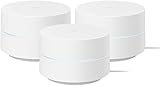
- COMPLETE MESH WIFI: Get everything you need in one box- 3 Google WiFi AC1200 routers for a clean, elevated setup that boosts signal performance and keeps your home organized.
- WHOLE HOME COVERAGE: The 3-pack mesh system provides fast, stable WiFi for homes up to 4,500 sq. ft., ensuring smooth streaming, gaming, and browsing in every room with no dead zones or drop-offs.
- SIMPLE APP SETUP & MANAGEMENT: Use the Google Home app to set up in minutes, manage connected devices, enable parental controls, and create guest networks — all from your smartphone.
- Intelligently works behind the scenes to make sure your Wifi remains fast so you can stream with speed
- RISK FREE PURCHASE: Not happy? Enjoy our 30-day return guarantee - buy with confidence knowing your satisfaction comes first.
Black Hills projects approximately $150 million of net income in 2030 and approximately $2.4 billion of unlevered free cash flow through 2048, net of the $1.8 billion in generation capital expenditures. It expects to begin earning a return on generation investment when construction begins in 2027, and anticipates microgrid management-fee revenue from late 2027. These are company projections, not realized results.
Free tools Windows power users keep installed
One-click scans. No signup required.
Who pays for the project?
Black Hills says the agreements and supporting regulatory mechanisms are structured so Google bears all costs associated with serving the planned data center over the project’s life, with no costs shifted to existing retail customers. That is the company’s description of the intended cost allocation; the announcement does not independently verify how costs will ultimately be allocated or implemented.
Rank #3

- Google Wifi is a scalable, flexible mesh Wifi system that blankets your home in reliable coverage and keeps buffering at bay; 1 Google Wifi point replaces your router and additional points expand your network to keep the connection fast in every room[1]
- Google Wifi gives you whole home coverage[1]; 1 Pack covers up to 1500 square feet and 3 Pack covers up to 4500 square feet; points work together to create a mesh network for more coverage
- Intelligently works behind the scenes to make sure your Wifi remains fast, so you can stream with speed[1]
- Simple setup in a few steps; use the Google Home app to create your network and get online in minutes[2]
- Parental controls let you manage screen time, restrict certain kinds of adult content, and pause Wifi to specific devices on your mesh network whenever you want
What has changed since the earlier project update?
In a June 10, 2026 update, Black Hills said Crusoe was no longer the development partner and that it was working directly with the potential large-load customer. The October announcement subsequently named Google as the planned customer and reported definitive agreements. Both updates are company statements; the sources cited here do not establish a separate statement or confirmation from Google. See the June project update.
Independent reader supportYour contribution helps us test, update, and keep practical guides available for everyone.Permits and remaining risks
Black Hills reported several regulatory milestones, but not that every approval or project condition is complete:
Rank #4

- A new type of connected system that replaces your router for seamless wifi coverage throughout your home, helping eliminate dead zones and buffering
- Network assist technology keeps your connection fast by always selecting the clearest channel and fastest band for your devices; WiFi throughput: 1200 MPBS.
- A simple app gets you set up quickly and allows you to see what's connected, prioritize devices, and pause the WiFi on kids' devices
- A single WiFi point covers up to 1,500 square feet, a set of three covers homes up to 4,500 square feet WiFi points work together so you can add more if you need additional coverage
- 24/7 phone support from google; 1 year warranty; material: plastic
- The Robinson substation Certificate of Public Convenience and Necessity was approved in May 2026.
- An industrial siting permit for the Cheyenne Prairie Generating Station expansion was filed in July, and an air-quality permit for that expansion was approved in August.
- A Large Customer Transmission Cost Adjustment Mechanism filing was made in June, and a South Cheyenne Transmission Expansion certificate filing was made in September.
- A Wyoming transmission-expansion certificate filing was planned for the fourth quarter of 2026.
Black Hills identifies regulatory approvals, contract conditions and termination rights, counterparty performance, project development, financing, and operations as risks to its expectations. The company’s second-quarter 2026 results provide additional company context, but the October announcement is the source for the project terms and figures described above.
Quick Recap
Product prices and availability are accurate as of the date/time indicated and are subject to change. Any price and availability information displayed on Amazon at the time of purchase will apply.

