For playing downloaded PS5 games, install a PCIe Gen4x4 M.2 NVMe SSD in the console’s expansion bay. USB extended storage is useful for keeping PS5 games, but Sony does not allow PS5 games to run directly from it; you must copy a game back to console storage or the internal M.2 SSD first. Among current tested options, the Samsung 980 Pro with heatsink is the strongest all-round choice, the Lexar NM790 with Heatsink offers the best budget capacity, the Samsung 990 Pro with heatsink is the high-end option, and the WD Black SN850P is the practical pick for an exceptionally large library.
Every internal drive must satisfy Sony’s interface, size, capacity and heat-dissipation requirements. The model name alone is not enough: check the exact capacity and heatsink bundle, because the installed drive must remain within a 25 mm × 110 mm × 11.25 mm envelope.
As an Amazon Associate I earn from qualifying purchases.
What kind of SSD can actually play PS5 games?
There are two different storage jobs, and confusing them is the most common buying mistake.
Internal M.2 SSD: install and play
An M.2 SSD installed in the PS5 expansion bay behaves as additional high-speed console storage. PS5 games installed there can be launched and played without being copied to the original console drive. This is the type of SSD to buy when the goal is to expand the number of games that remain ready to play.
#1 Best Overall

- Officially licensed M.2 SSD for PlayStation 5 consoles[4] so you can easily install and play with no concern of compatibility. [4]For PlayStation 5 system software compatibility, please visit the official WD_BLACK site.
- With capacities ranging from 1TB to 4TB[1], your PS5 console has the additional space to store up to 200 games[3] (8TB model) [1]1GB = 1 billion bytes and 1TB = one trillion bytes. Actual user capacity may be less depending on operating environment. [3] Number of games based on a 36GB average per game. The number of games will vary based on file size, formatting, other programs, and factors.
- Experience uninterrupted gameplay with a brand-new, optimized heatsink designed especially for the PS5 console for an easy, worry-free installation into the M.2 slot.
- Play directly from the drive and eliminate the need to transfer or delete games from your console with tested and approved storage for your PS5 console[4].
- Push the envelope of PCIe Gen 4 technology with read speeds up to 7,300MB/s[2], giving you seamless gameplay and incredibly short load times. [2]1 MB/s = 1 million bytes per second. Based on internal testing; performance may vary depending upon host device, usage conditions, drive capacity, and other factors.
USB extended storage: store, then copy
Sony Interactive Entertainment allows PS5 games to be moved to USB extended storage, but states that “PS5 games can’t be played directly from USB extended storage.” To play one, copy it back to the PS5’s console storage or its M.2 SSD. PS4 games can be played directly from USB extended storage.
Sony’s USB requirements are SuperSpeed USB 5Gbps or faster, 250GB minimum capacity and 8TB maximum capacity. Sony also warns that not every device is guaranteed to work and advises connecting the drive directly rather than through a USB hub. USB storage therefore makes a good archive or PS4-game drive, not a substitute for an internal M.2 expansion drive.
The four SSDs that make the most sense for a PS5
The following rankings and benchmark figures come from TechRadar’s testing, updated 15 June 2026. Quoted sequential speeds are manufacturer specifications; measured results are TechRadar’s own tests and should not be treated as Sony specifications.
Quick wins for a faster PC:
Fix the driver behind crashes, sound loss and screen glitchesFind Drivers →Clear out junk files and repair common Windows errorsFree Scan →| Drive | Best for | Capacities | Quoted speed | Tested result or endurance | Important qualification |
|---|---|---|---|---|---|
| Samsung 980 Pro with heatsink | Best overall and value | 1TB, 2TB | Up to 7,000 MB/s read; 5,100 MB/s write | 1,200 TBW; TechRadar measured about 6,783 MB/s | Strong endurance, good pricing in the review and a five-year warranty |
| Lexar NM790 with Heatsink | Best budget choice | 1TB, 2TB, 4TB | Up to 7,400 MB/s read; 6,500 MB/s write | 1,000, 1,500 or 3,000 TBW by capacity; 6,526 MB/s in TechRadar’s PS5 benchmark | No-DRAM HMB design; the review reports occasional minor stutters in demanding games |
| Samsung 990 Pro with heatsink | Best high-end performance | 1TB, 2TB, 4TB | Up to 6,900 MB/s read; 7,450 MB/s write | TechRadar measured 7,465.49 MB/s read and 6,887.68 MB/s write; about 10GB transferred in under four seconds | Expensive and capable of running hot |
| WD Black SN850P | Largest library and officially licensed option | 1TB, 2TB, 4TB, 8TB | Up to 7,300 MB/s read; 6,300 MB/s write | Heatsink included | TechRadar considers the 8TB version compelling for a very large library; 1TB and 2TB are weaker values |
Samsung 980 Pro with heatsink: the safest all-round recommendation
The 980 Pro combines the capacity most players need with a built-in heatsink, a quoted 7,000 MB/s read rate and 1,200 TBW endurance. TechRadar measured approximately 6,783 MB/s and highlighted its endurance, pricing and five-year warranty. Choose the 1TB model if you are expanding a smaller rotation of games; choose 2TB when you regularly keep several large releases installed.
Buy the version that already includes the heatsink. A bare drive requires a compatible heat-dissipation solution that still fits Sony’s maximum installed thickness.
Lexar NM790 with Heatsink: the capacity-per-dollar choice
The NM790 is available in 1TB, 2TB and 4TB versions and has the highest quoted read and write figures of the budget-oriented options in this group. TechRadar recorded 6,526 MB/s in its PS5 benchmark and copied more than 100GB in just under 45 seconds in its testing.
Rank #2
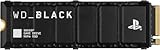
- Officially licensed M.2 SSD for PlayStation 5 consoles[4] so you can easily install and play with no concern of compatibility. [4]For PlayStation 5 system software compatibility, please visit the official WD_BLACK site.
- With capacities ranging from 1TB to 8TB[1], your PS5 console has the additional space to store up to 200 games[3] (8TB model) [1]1GB = 1 billion bytes and 1TB = one trillion bytes. Actual user capacity may be less depending on operating environment. [3] Number of games based on a 36GB average per game. The number of games will vary based on file size, formatting, other programs, and factors.
- Experience uninterrupted gameplay with a brand-new, optimized heatsink designed especially for the PS5 console for an easy, worry-free installation into the M.2 slot.
- Play directly from the drive and eliminate the need to transfer or delete games from your console with tested and approved storage for your PS5 console[4].
- Push the envelope of PCIe Gen 4 technology with read speeds up to 7,300MB/s[2], giving you seamless gameplay and incredibly short load times. [2]1 MB/s = 1 million bytes per second. Based on internal testing; performance may vary depending upon host device, usage conditions, drive capacity, and other factors.
Its no-DRAM Host Memory Buffer design is the trade-off. TechRadar reports occasional minor stutters in demanding games. That does not make the drive incompatible, but players who want the most consistent behavior under heavy workloads may prefer a drive with a different controller and cache design.
Free tools Windows power users keep installed
One-click scans. No signup required.
Samsung 990 Pro with heatsink: for buyers who want the premium model
The 990 Pro targets buyers willing to pay more for top-end PC-class performance. The 1TB, 2TB and 4TB models are rated at up to 6,900 MB/s read and 7,450 MB/s write. TechRadar measured 7,465.49 MB/s read and 6,887.68 MB/s write and moved about 10GB in under four seconds.
Those figures are impressive, but they do not establish a universal game-loading advantage over less expensive compatible drives. TechRadar also notes that the 990 Pro is expensive and can run hot, so verify that the heatsink is installed correctly and that the drive remains within Sony’s thickness limit.
WD Black SN850P: the 8TB library specialist
The SN850P is offered in 1TB, 2TB, 4TB and 8TB capacities, with a heatsink included and quoted speeds of 7,300 MB/s read and 6,300 MB/s write. TechRadar identifies the 8TB model as the compelling choice when the priority is keeping an exceptionally large library installed. The same review considers the 1TB and 2TB versions weaker values, so select those capacities only when their current price is competitive.
Sony’s internal M.2 requirements
Sony’s current safety guidance specifies all of the following for an internal expansion drive:
- Interface: PCIe Gen4x4 NVMe, Key M.
- Capacity: 250GB to 8TB.
- Supported physical sizes: 2230, 2242, 2260, 2280 and 22110.
- Maximum installed envelope: 25 mm wide, 110 mm long and 11.25 mm thick, including the heatsink, heat-transfer sheet, brackets and any other heat-dissipation hardware.
- Not supported: M.2 SATA drives.
If the SSD does not include heat dissipation, Sony says to add a heatsink, heat-transfer sheet or both. The guidance warns that overheating can cause an operation failure. A drive that fits the bare M.2 slot can still be unsuitable after a thick third-party heatsink is attached, so measure the complete assembly rather than the SSD alone.
Rank #3

- Efficient Performance: With speeds reaching 5000MB/s, the PCIE 4.0 1TB NVMe SSD is perfectly compatible with the PS5, ensuring swift game launches for an immersive gaming experience
- Ample Storage Expansion: The S660 M.2 SSD offers storage capacities ranging from 500GB to 4TB, eliminating concerns about game storage. Effortlessly expand your gaming storage and indulge in a plethora of gaming delights
- Efficient Cooling Design: The unique heatsink design ensures the S660 NVMe 1TB SSD operates at low temperatures during prolonged and intensive usage, providing a reliable memory expansion for your PS5
- Versatile Connectivity: The S660 Internal SSD 1TB not only delivers optimal storage for the PS5 but also seamlessly connects to various platforms, including PC. It serves as a versatile solution, offering robust support for various scenarios
- Quality Assurance: Purchase the S660 NVMe 1TB SSD and enjoy a 5-year quality assurance. Our professional after-sales support team is always on call. Shop with confidence and enjoy lasting peace of mind
Sony also says that it does not guarantee every third-party M.2 device that meets the dimensional requirements. Meeting the published specification is the necessary baseline, not a promise that every model will behave identically.
1TB or 2TB: which capacity should you buy?
Choose 1TB when
- You normally play a small rotation and uninstall completed games.
- You want the lowest initial cost while adding meaningful expansion space.
- You are choosing the Samsung 980 Pro and want its value-oriented configuration.
- You plan to use a separate USB drive as an archive for PS5 games that are not currently active.
Choose 2TB when
- You keep several large PS5 releases installed at the same time.
- You share the console with other players or maintain multiple active games.
- You want to avoid repeatedly moving games between USB storage and the internal drives.
- The 2TB price is close enough to the 1TB version that the additional space is worth more than the saving.
Capacity does not change Sony’s compatibility rules. A 2TB drive still needs the same Gen4x4 interface, supported dimensions and heat dissipation as a 1TB drive. The practical decision is how often you want to archive and restore games, not whether one capacity is intrinsically faster.
When 4TB or 8TB is justified
Four terabytes makes sense for a large personal library and is available in the Lexar NM790, Samsung 990 Pro and WD Black SN850P families. Eight terabytes is available in the WD Black SN850P and is aimed at players who want to keep an unusually large collection installed. Check the complete installed thickness and the current price before choosing the largest capacity; high capacity does not automatically provide better value.
The Tool Desk
Outbyte Driver Updater FREEFix the driver behind crashes, sound loss and screen glitchesFind Drivers →Outbyte PC Repair FREEClear out junk files and repair common Windows errorsFree Scan →How to install an internal M.2 SSD
Use Sony’s model-specific safety instructions for the exact cover and bay position. The general procedure is:
- Back up anything important. Confirm that the drive’s capacity, interface and complete heatsink dimensions meet Sony’s specification before opening the console.
- Shut down completely. Turn the PS5 off rather than leaving it in Rest Mode, unplug the power cable and disconnect attached accessories. Allow the console to cool.
- Prepare the tools and drive. You need a Phillips screwdriver. If the SSD does not have heat dissipation, install a compatible heatsink and heat-transfer sheet according to that accessory’s instructions, staying under 11.25 mm total thickness.
- Open the expansion bay. Remove the appropriate console cover and the M.2 bay cover as shown in Sony’s safety guide. Do not force a panel; the cover should release using the model’s specified movement.
- Set the spacer. The bay supports several M.2 lengths. Move the mounting spacer to the hole matching the SSD’s 2230, 2242, 2260, 2280 or 22110 length.
- Insert the SSD. Slide the Key M connector into the slot at an angle, lower the free end onto the spacer and secure it with the supplied screw. The label and heatsink orientation must follow the drive and console instructions.
- Close the bay and console. Refit the M.2 cover and the outer console cover before reconnecting power.
- Format when prompted. Start the PS5 and follow the on-screen formatting guide. Formatting erases the new drive, so do not use a drive containing files you need.
- Set the installation destination if desired. In the PS5 storage settings, choose where new games and applications should be installed. You can move compatible games between console storage and M.2 storage later.
If the console does not detect the drive, power it off and check the connector seating, mounting screw, spacer position and heatsink clearance. Do not continue operating with a cover that cannot close normally.
What works with PS5 Slim?
For PS5 Slim, use an M.2 NVMe drive that meets Sony’s same published baseline: PCIe Gen4x4, Key M, 250GB to 8TB, a supported length and a complete installed size no larger than 25 mm × 110 mm × 11.25 mm. Select the exact heatsink bundle carefully, because the console evaluates the assembled drive, not just the bare SSD.
Rank #4

- [1TB] Exceptional performance up to 7400MB/s read, 6500MB/s write; 1000TBW
- 2x faster than PCIe Gen 3 SSDs
- Designed with a heatsink to keep your rig cool for better performance and power efficiency
- Up to 40% less power consumption than DRAM cache-enabled PCIe Gen 4 SSDs
- Host Memory Buffer (HMB) 3.0 activates the DRAM cache function of your device for a smoother transfer speed and seamless performance
The physical cover-removal sequence can differ by console revision, so follow the safety guide for your model rather than applying instructions from a different PS5 chassis. The four drives in the table should be considered only in the capacities and heatsink configurations that fit the Sony envelope.
Recommended Free Tools
Using a USB drive as a PS5 game archive
A USB extended-storage drive is useful when you want to retain PS5 games without occupying internal space. Format a compatible SuperSpeed USB drive through the PS5, move PS5 games to it when you are finished playing them, and copy a game back before launching it. Keep PS4 games on the USB drive if you want to play them without that restoration step.
- Use a drive rated for SuperSpeed USB 5Gbps or faster.
- Stay between Sony’s 250GB minimum and 8TB maximum.
- Connect it directly to the console; Sony advises against using a USB hub.
- Expect the first transfer and every restore operation to take time, especially with large games.
- Do not assume that a device works merely because it has the advertised capacity; Sony does not guarantee every third-party USB device.
This arrangement can make a smaller internal M.2 drive more practical: the internal SSD holds games you play regularly, while USB storage holds the rest. It cannot turn USB storage into a location from which PS5 games launch directly.
Independent reader supportYour contribution helps us test, update, and keep practical guides available for everyone.How to compare candidates beyond the headline speed
1. Confirm direct-play compatibility
Start by deciding whether you need to launch PS5 games from the drive. If yes, eliminate USB-only options and shop for an internal M.2 NVMe drive. If you only need an archive or direct PS4 playback, a compliant USB extended-storage drive may be sufficient.
2. Check the exact SKU
SSD families often have separate bare-drive and heatsink versions, and capacities can have different endurance ratings. Verify the model number, capacity and whether a heatsink is included before purchase. A listing that says “compatible with PS5” does not replace checking the complete dimensions.
What’s actually slowing this PC down?
Pick the symptom - the matching free tool is one click away.
3. Treat sequential speed as a ceiling, not a promise
The quoted read and write figures in the table are sequential specifications measured under vendor-defined conditions. TechRadar’s PS5 benchmark results provide a more relevant comparison, but they remain one publication’s test results. They do not prove that every game will load faster by the same amount, and no universal game-loading advantage has been established for these models.
Best Value
- [2TB] Exceptional performance up to 7400MB/s read, 6500MB/s write; 1500TBW
- 2x faster than PCIe Gen 3 SSDs
- Designed with a heatsink to keep your rig cool for better performance and power efficiency
- Up to 40% less power consumption than DRAM cache-enabled PCIe Gen 4 SSDs
- Host Memory Buffer (HMB) 3.0 activates the DRAM cache function of your device for a smoother transfer speed and seamless performance
4. Consider endurance and thermal behavior
Total Bytes Written ratings indicate the amount of data a drive is designed to write under its warranty specification; they are not a guaranteed lifespan in a particular console. The 980 Pro is listed at 1,200 TBW, while NM790 ratings vary from 1,000 to 3,000 TBW by capacity. The 990 Pro’s higher-end performance comes with TechRadar’s warning that it can run hot. Proper heatsink installation and clearance matter more than choosing a drive solely by its peak number.
5. Compare the complete cost
Retail prices and stock change quickly, and a stable price was not established for these models. Compare the exact capacity, included heatsink, warranty terms and regional availability at the time you buy. A cheaper bare SSD may cease to be cheaper after adding a correctly sized heatsink.
Troubleshooting common problems
The PS5 says the SSD is not detected
- Power down and unplug the console before opening it.
- Reseat the M.2 connector and make sure the retaining screw is securing the drive at the correct spacer position.
- Confirm that the drive is NVMe PCIe Gen4x4, not M.2 SATA.
- Check that the heatsink or heat-transfer sheet is not preventing the connector from seating.
- Verify that the drive’s capacity is within 250GB to 8TB and that its complete dimensions fit Sony’s envelope.
The drive is detected but the cover will not close
Do not press the cover into place. Remove the drive and measure the total installed thickness, including every thermal layer and the mounting hardware. Replace an oversized heatsink with one designed to stay within 11.25 mm.
A game will not launch from the USB drive
This is expected for PS5 games. Move or copy the game back to console storage or the internal M.2 SSD, then launch it from that location. PS4 games can run directly from compliant USB extended storage.
Performance seems inconsistent
Confirm that the heatsink is installed correctly and that the console is not being operated with blocked ventilation. Remember that benchmark results are not identical to every game’s behavior. TechRadar specifically notes occasional minor stutters with the NM790’s no-DRAM HMB design in demanding games; players who encounter that behavior may prefer a different compatible model.
A practical buying decision
| Your priority | Most suitable direction | Why |
|---|---|---|
| One dependable expansion drive for most players | Samsung 980 Pro with heatsink, 1TB or 2TB | Balanced capacity, endurance, tested performance and warranty support in TechRadar’s ranking |
| Lowest-cost route to 2TB or 4TB | Lexar NM790 with Heatsink | Broad capacity range and strong transfer results, with the stated possibility of minor demanding-game stutters |
| Premium specification and benchmark performance | Samsung 990 Pro with heatsink | Highest tested figures in this group, balanced against price and heat |
| Keep an unusually large library installed | WD Black SN850P 8TB | The capacity TechRadar identifies as compelling for a very large library, with a heatsink included |
| Archive PS5 games or play PS4 games from external storage | Compliant USB extended storage | Lower-cost, removable storage that still requires PS5 games to be copied back before play |
Bottom line
Buy an internal M.2 NVMe SSD if you want to play downloaded PS5 games without moving them first. The Samsung 980 Pro with heatsink is the best general recommendation; the Lexar NM790 with Heatsink is the budget-capacity alternative; the Samsung 990 Pro suits buyers prioritizing premium benchmark performance; and the WD Black SN850P 8TB is for the largest libraries. Whichever model you choose, verify the exact heatsink dimensions, use Sony’s installation procedure and reserve USB extended storage for archiving PS5 games or playing PS4 titles directly.
Quick Recap
Product prices and availability are accurate as of the date/time indicated and are subject to change. Any price and availability information displayed on Amazon at the time of purchase will apply.
Do these 3 things before closing this tab:
1Repair Windows errors before they cause bigger problems2Fix the driver behind crashes, sound loss and screen glitches3Clear out junk files and repair common Windows errors
