PC Slower Than It Used to Be?
A free scan shows the junk files, broken settings and background clutter dragging Windows down - then fixes them in one click.Free scan · Windows 10 & 11Crashes, No Sound, or Screen Glitches?
Random freezes, missing sound and display glitches usually trace back to one bad driver. Find and replace yours safely.Free scan · under a minuteStart with Dordle if Quordle feels like too much: it uses the same letter-color clues on two boards with seven shared guesses. Stay with Quordle for four boards and nine guesses, or move to Octordle for eight boards and 13 total guesses. If you want a different type of puzzle rather than more boards, try Absurdle, Waffle, Semantle, Contexto, Nerdle, Connections or Strands.
The right alternative depends on what you mean by “hard”: more simultaneous boards, fewer useful letter clues, an opponent that changes the target, or a completely different answer format. This guide separates those difficulty types so you can choose deliberately.


As an Amazon Associate I earn from qualifying purchases.
Quick comparison of Quordle alternatives
| Game | Boards or task | Guess or move limit | What every move does | Best fit |
|---|---|---|---|---|
| Dordle | Two hidden five-letter words | Seven guesses | Scores the guess on both boards | Easiest direct step up from a single-board game |
| Quordle | Four hidden words | Nine guesses | Places the guess on all four boards | Reference format for multi-board play |
| Octordle | Eight hidden five-letter words | 13 guesses total | Scores the guess on all eight boards | Largest tracking challenge among these direct multi-board games |
| Absurdle | One adversarial target | No fixed daily target in the cited guide | The target shifts to avoid your guesses | Players who enjoy uncertainty and changing assumptions |
| Waffle | Six words arranged in a grid | 15 swaps | Rearranges letters already shown | Visual solving without blind letter guessing |
| Semantle or Contexto | One hidden word located by meaning | No letter-color grid | Ranks guesses by semantic closeness | Vocabulary and association puzzles |
| Nerdle | One hidden equation | Limited daily guesses | Provides colored feedback for mathematical expressions | Number-focused players |
| Connections or Strands | Groups or themed word searches | Varies by game | Asks you to categorize items or find theme words | A different daily puzzle ritual |
Dordle.gg publishes the two-board, seven-guess rules for Dordle (2026). Quordle.uk and PC Gamer document four boards and nine guesses for Quordle (2026). Octordle Game documents eight boards and 13 guesses (2026). In Octordle, 13 means the entire puzzle, not 13 guesses for each board.
What makes a Quordle alternative feel similar?
Quordle’s defining mechanic is shared information. You enter one five-letter guess, and that same guess is evaluated against every board. Correct letters in the correct position, correct letters in the wrong position and letters absent from a board create separate clues. A move can therefore advance several answers at once, but it can also spend a valuable turn without helping the board that is closest to completion.
#1 Best Overall
When comparing alternatives, separate six variables instead of treating “harder” as a single rating:
- Simultaneous boards: two, four or eight answers increase the amount of state you must remember.
- Total guesses or moves: a generous-looking number may be tight when one move is shared by every board.
- Shared moves: in Dordle, Quordle and Octordle, each guess affects all boards at once.
- Clue type: some games reveal letter positions, while others use meaning, equations, categories or supplied letters.
- Access model: a game may offer one daily puzzle, unlimited play, an archive or several modes.
- Pressure type: tracking many partial answers is different from deducing a word with almost no letter information.
That distinction explains why Octordle can be the hardest direct multi-board option while Semantle or Contexto can feel less certain: Octordle gives you letter clues but eight places to track, whereas semantic games give you no letter-color grid at all.
Dordle: the best first alternative to Quordle
How Dordle works
Dordle is “Wordle times two”: two hidden five-letter words sit side by side, and every guess is played on both boards. Dordle.gg lists seven shared guesses. The same entry can reveal a useful letter on one board while merely eliminating a possibility on the other, so you learn to read two independent clue sets at the same time.
Quick wins for a faster PC:
Fix the driver behind crashes, sound loss and screen glitchesFind Drivers →Repair Windows errors before they cause bigger problemsFix Now →Scan for outdated or missing drivers - takes under a minuteDriver Scan →The reduced board count makes Dordle the most natural practice step before Quordle. You still learn the central skill of shared-guess management, but there are fewer rows, fewer partial patterns and fewer competing priorities to hold in mind.
A practical Dordle turn sequence
- Open with broad coverage. Choose a normal five-letter word containing common letters so the first move gathers information on both boards rather than committing to a narrow pattern.
- Use the second guess to scout. Unless one board already has an obvious solution, spend the next move on new letters. This reduces uncertainty on both halves of the puzzle.
- Work the board that is closer. Once one side shows a nearly complete pattern, solve it while the other board remains in view. A solved board still displays useful eliminated letters for the remaining side.
- Read both halves of the keyboard. Dordle’s split keyboard marks can differ by board. Check which letters are confirmed, misplaced or absent on each half before entering a guess.
- Reserve the final turns for confirmation. When a pattern allows several words, use the other board’s needs and your eliminated-letter information to choose a guess that tests more than one possibility.
These are practical recommendations published on the respective game pages, not independent win-rate tests. They are most useful as a way to organize attention, not as a guarantee that every daily pair will be solved.
Dordle modes and schedule
The public Dordle page lists a shared daily pair, with a new daily puzzle appearing at midnight, and an unlimited mode that supplies a fresh pair after completion. That combination suits two different habits: a short daily routine or repeated practice without waiting for the next reset.
Who should choose Dordle?
- Choose it when single-board play feels comfortable but four boards look intimidating.
- Choose it when you want to learn shared-guess planning with less tracking overhead.
- Choose it when you prefer a short session but still want more than one answer to solve.
Quordle: the four-board reference point
Quordle uses four hidden words and nine shared guesses, according to Quordle.uk’s comparison guide and PC Gamer’s 2026 coverage. Every guess is entered on all four boards. That makes Quordle a useful baseline: Dordle cuts the board count in half, while Octordle doubles it.
Rank #2
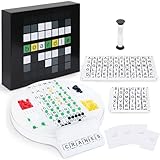
- Wordle Experience in a Board Game – Love Wordle? Boardle brings the same addictive 5-letter word challenge to your table, no screens required. Compete in real life word-guessing duels that capture the fun of the online game in a social, face-to-face format. (This game is unaffiliated with NYT/Hasbro Wordle.)
- Head-to-Head 2-Player Word Duel – Challenge a friend or partner in a battle of wits. Boardle is a 2-player board game where each player takes turns secretly writing a 5-letter word while their partner deciphers the other’s word through strategic guesses. It’s perfect for couples’ game nights or a quick round of competitive fun with a buddy.
- Fun for Family Game Night & Parties – Bring family and friends together with this fast-paced word puzzle game. Play one-on-one or form teams for group play. Boardle spices up parties, classrooms, and family game nights by getting everyone thinking and laughing as they race to crack the code.
- Build Vocabulary & Brainpower – More than just a game, Boardle is an educational word puzzle that helps expand vocabulary and sharpen spelling skills. Great for English learners and word enthusiasts, it’s an engaging tool for teachers or parents to make learning fun. (Screen-free brain teaser!)
- Premium Quality & Complete Set – Boardle comes with a durable game board, letter tiles, color-coded clue pegs, and even a sand timer for timed rounds – everything you need for endless play. High-quality components ensure longevity, and the sleek design makes it a great gift for puzzle lovers. (Ages 14+)
The central Quordle decision is whether to gather information or cash in a nearly solved board. An exploratory word can test several unused letters across all four answers; a direct solving word may secure one board but reveal little elsewhere. Because the guess limit applies to the whole puzzle, not separately to each answer, a sequence of safe-looking guesses can leave one stubborn board without enough turns.
Quordle is the right choice when you want the familiar four-board format rather than a gentler introduction or a much larger tracking challenge. It is also the clearest benchmark for judging the alternatives below: ask whether a game adds boards, removes letter clues or replaces word deduction entirely.
Octordle: the largest direct multi-board challenge
Rules and difficulty
Octordle hides eight five-letter words and gives you 13 guesses. Octordle Game states the rule explicitly: “Octordle hides eight five-letter words and gives you 13 guesses.” One guess appears on all eight boards, so the extra four guesses compared with Quordle do not scale one-for-one with the doubled board count. You must track eight patterns while deciding whether the next move should scout, solve or test a letter arrangement.
Octordle is therefore hardest on the tracking axis. It is not simply Quordle played twice: a letter that is useful on one board may be absent on another, and the keyboard can show different statuses from board to board. The puzzle rewards a clear visual routine more than a single clever opening word.
Do these 3 things before closing this tab:
1Fix the driver behind crashes, sound loss and screen glitches2Repair Windows errors before they cause bigger problems3Scan for outdated or missing drivers - takes under a minuteAn Octordle solving routine
- Scout with varied openings. Use opening words with different letters so the first several moves sample as much of the alphabet as possible across all eight boards.
- Mark board progress. After each guess, identify which boards have fixed positions, which have misplaced letters and which still need basic information.
- Finish nearly solved boards early. A board with one or two plausible completions can consume attention and cause avoidable errors if left until the final rows.
- Check per-board key markers. Do not assume a key’s color has the same meaning on every board. Read the marker belonging to the board you are solving before committing.
- Use late guesses for high-value tests. When several boards share an unresolved letter, prefer a word that tests that letter in useful positions while remaining legal for the other boards.
Octordle’s game-page strategy advice recommends scouting with different letters, finishing nearly solved boards and reading each board’s key markers. Those suggestions are practical guidance from the game pages, not a published performance benchmark.
Modes, storage and operator caveat
The public Octordle page lists daily, unlimited, sequence, rescue and archive modes. It says the game runs in a modern browser, requires no account and stores statistics in the player’s browser. Browser-local storage means stats can be affected by clearing site data, changing browsers or using a different device.
The cited Octordle Game page also identifies itself as an independent, fan-made puzzle and says it is not affiliated with other Octordle sites, Wordle or The New York Times. Several similarly named implementations exist, so check the operator and the exact rules on the page you open before assuming that its modes, statistics or daily schedule match another version.
Rank #3

- Guess the Secret Word: Inspired by the most popular online word game that broke the internet, 5-Letter Wordlet is the wordle style party game families and friends can enjoy together.
- Play All Day: With 5-Letter Wordlet, the fun never ends, as players aren't limited to one word puzzle a day like the online version. Unlimited play with dry erase guessing boards and markers means unlimited fun!
- Grab and Go Game: 5-Letter Wordlet's game boards are specifically designed to pick up and hold.
- Party Game Night: Make it a party game night with 5-Letter Wordlet, the wordle based game that is great for evenings with friends and family, game nights, or date nights.
- What's Inside: The 5-Letter Wordlet Word Party Game is loaded with 3 Dry Erase Guessing Boards, 3 Dry Erase Markers, 90 Guessing Chips, 200 Secret Words, and Instructions to get your game night started in five minutes or less
Who should choose Octordle?
- Choose it when Quordle’s four boards no longer create enough tracking pressure.
- Choose it when you enjoy maintaining several partial word patterns simultaneously.
- Choose it when unlimited, sequence, rescue or archive modes matter more than a single daily puzzle.
Alternatives that change the puzzle mechanic
Absurdle: an adversarial target
Absurdle keeps a single-word surface but changes the relationship between player and answer. Instead of committing to a fixed daily target, it shifts the target to avoid your guesses. The cited comparison describes no fixed daily target in its guide and characterizes Absurdle as hardest for confidence because the answer can keep changing in response to your play.
Choose Absurdle if your frustration with Quordle comes from predictable routines rather than too many boards. Your task is not merely to narrow one hidden word; it is to force an adversarial system into a smaller set of possibilities. That makes progress feel less stable than the colored feedback in Dordle, Quordle or Octordle.
Waffle: rearrange supplied letters
Waffle presents six words in a grid and gives you 15 swaps. Instead of entering blind guesses to discover letters, you drag and rearrange letters that are already shown. The challenge is visual: identify which letters belong in which positions and manage swaps efficiently.
Waffle is a strong choice when you like word deduction but do not want the uncertainty of guessing an unseen letter. Its move limit measures rearrangement efficiency, not the number of candidate words you can test.
Semantle and Contexto: solve by meaning
Semantle and Contexto hide one word and rank your guesses by semantic closeness. There is no letter-color grid, so a guess tells you how near an idea is in meaning rather than which character belongs in a position.
Free tools Windows power users keep installed
One-click scans. No signup required.
These games suit players who enjoy vocabulary, associations and conceptual exploration. They can feel harder than a letter puzzle because a near meaning does not reveal spelling, length or exact placement. If Quordle’s boards are difficult because you lose track of letters, semantic games replace that tracking burden with a much wider search through concepts.
Nerdle: equations instead of words
Nerdle uses a hidden equation and limited daily guesses. Feedback is colored, but the objects being tested are mathematical expressions rather than five-letter words. You must satisfy the equation’s arithmetic and formatting constraints while interpreting which numbers and operators are present or misplaced.
Rank #4
Choose Nerdle when the appeal of Quordle is systematic deduction rather than wordplay. Familiarity with equations matters more than vocabulary, and the answer space is governed by mathematical validity.
Connections and Strands: grouping and themes
Connections asks you to categorize items into groups, while Strands asks you to find words connected by a theme. Their limits and exact interactions vary by game. Both replace the repeated guess-and-color loop with a higher-level search for relationships.
These are better substitutes for a daily puzzle habit than for the specific Quordle sensation. Choose them when you want a change of mental task: classify clues, identify a theme and test whether the apparent pattern survives the remaining entries.
How to decide which game is hardest for you
Use the following difficulty map rather than a single ranking:
| If your challenge is… | Try… | Why |
|---|---|---|
| Managing more simultaneous word patterns | Octordle | Eight boards must be tracked under 13 total guesses. |
| Learning shared guesses with less pressure | Dordle | Two boards use the same clue system with seven guesses. |
| Playing the standard four-board format | Quordle | Four boards and nine guesses form the reference point. |
| Making deductions when the target changes | Absurdle | The adversarial target shifts to avoid your guesses. |
| Solving with minimal letter information | Semantle or Contexto | Feedback is semantic distance, not letter position. |
| Working from visible letters | Waffle | You rearrange supplied letters in 15 swaps. |
| Applying arithmetic constraints | Nerdle | The answer is an equation with colored feedback. |
| Finding relationships among clues | Connections or Strands | The core task is grouping or theme discovery. |
“Hard” is therefore conditional. Octordle creates the greatest simultaneous-board load among the direct alternatives listed here. Semantle and Contexto provide the least letter information. Absurdle creates the most uncertainty about whether your current target will remain valid.
Independent reader supportYour contribution helps us test, update, and keep practical guides available for everyone.A progression from one board to eight
- Start with Dordle. Practice reading two keyboards and deciding when an exploratory guess is worth more than an immediate solve.
- Move to Quordle. Add two more boards and learn to prioritize without allowing one difficult answer to consume every turn.
- Try Octordle. Apply the same habits across eight boards, using varied scouting words and explicit board-by-board notes.
- Switch mechanics if repetition is the problem. Pick Waffle for visual rearrangement, Semantle or Contexto for semantic search, Nerdle for equations, or Connections and Strands for categories and themes.
- Choose Absurdle when certainty itself is the problem. Its shifting target tests adaptation rather than routine pattern completion.
You do not have to follow that order. A player who dislikes shared guesses may prefer Waffle immediately, while someone who wants maximum multitasking can go straight to Octordle. The progression simply minimizes the number of new variables introduced at once.
What’s actually slowing this PC down?
Pick the symptom - the matching free tool is one click away.
Practical habits for shared-board puzzles
Separate information guesses from solving guesses
An information guess introduces letters that can clarify several boards. A solving guess commits to a candidate word because one board is close. Mixing those purposes without deciding which you need can waste a turn: a narrow candidate may help one board while teaching you almost nothing about the others.
Best Value

- PLAY WORDLE IN REAL LIFE WITH FRIENDS: Inspired by the popular digital version, Wordle: The Party Game features the same gameplay fans love, but players compete in real life to solve the Wordle
- THE WORD IS … PARTY: Swap solo play for social with this analog version of the Wordle game. Players take turns writing down a 5-letter Secret Word. The others try to guess it in the fewest tries to win
- UNLIMITED PLAY WITH DRY-ERASE BOARDS: No more waiting for a new Wordle game. Use the Wordle dry-erase boards and markers to play as many rounds as there are players. Replay again and again
- 4 WAYS TO WORDLE: Try the classic play or 3 variations. In fast mode, players race to solve the Wordle first. In timed mode, beat the clock—or receive more points. Or compete in groups with team mode
- FRIENDS & FAMILY GAME NIGHT: Break out this fun game for evenings with friends or family game nights. For ages 14 and up, it’s a great gift for adults, teens, Wordle fans, and word puzzle lovers
Keep board states independent
A yellow or green result belongs to the board that produced it. The same letter may be confirmed on one board and absent on another. Read each board’s row and keyboard markers separately before carrying a conclusion across the puzzle.
Protect the final turns
Shared limits make endgame management important. If one board has several plausible words, avoid spending the last available rows on guesses that test only a single obscure distinction unless the other boards are already secure. A broad legal guess can sometimes resolve multiple uncertainties at once.
Use unlimited and archive modes as training
Dordle’s unlimited mode and Octordle’s unlimited and archive options let you practice the process without waiting for the next daily reset. Treat practice as a way to improve board tracking and guess selection, not as evidence of a guaranteed daily success rate; the published sources do not provide comparable win-rate or player-population statistics.
Access, schedules and what is actually published
Dordle’s public page lists a daily pair that changes at midnight and an unlimited mode with a fresh pair after completion. Octordle’s public page lists daily, unlimited, sequence, rescue and archive modes, says no account is required and says statistics are stored in the browser. Quordle’s documented figures establish its four-board, nine-guess format, but the cited material does not establish a comparable set of modes or a player-statistics policy for every Quordle implementation.
Game names are reused by multiple sites, particularly for Octordle. Before relying on a daily schedule, archive, statistics screen or rule set, verify that you are on the operator whose rules you intend to play. The independent Octordle Game disclaimer is a reminder that a similarly named page may be a separate fan-made implementation.
Which Quordle alternative should you play?
Choose Dordle for the closest lower-pressure substitute: two boards, seven shared guesses and the same basic letter-feedback logic. Choose Quordle when four boards and nine guesses are the format you already enjoy or want to learn. Choose Octordle when the appeal is maximum simultaneous tracking: eight boards and 13 guesses for the entire puzzle.
For a fundamental change, choose Waffle to rearrange visible letters, Semantle or Contexto to chase semantic closeness, Nerdle to solve equations, Connections or Strands to find groups and themes, or Absurdle to play against a shifting target. Those games are not simply easier or harder versions of Quordle; they test different reasoning skills.
Recommended Free Tools
Quick Recap
Product prices and availability are accurate as of the date/time indicated and are subject to change. Any price and availability information displayed on Amazon at the time of purchase will apply.

