There is no single best lens for fall foliage photography: choose a wide angle for a sweeping view or a strong foreground, a standard lens for a natural-looking all-purpose frame, and a telephoto for distant leaves and compressed layers. A zoom can cover more than one role, but the right choice depends on your camera’s mount and sensor format as well as the scene.
Choose a lens by the frame you want
| Lens type | Best for | What it does to the composition |
|---|---|---|
| Wide angle | Expansive forests and mountains, nearby trees, or a foreground leaf with scenery behind it | Includes more of the scene and emphasizes the distance between close and far objects. An overly broad view can also bring distracting elements into the frame. |
| Standard | General scenes, snapshots, and a versatile walk-around view | Offers a natural-looking middle ground with few obvious perspective effects. A standard zoom lets you adjust framing without changing lenses. |
| Telephoto | Distant foliage, isolated branches or leaves, selected patches of color, and layered scenery | Narrows the view, makes tight framing easier, and can make distant layers appear closer together. Longer focal lengths also make camera shake more noticeable. |
What counts as wide, standard, or telephoto?
These labels are approximate, and the same focal length can frame a scene differently on cameras with different sensor formats. Tamron’s autumn-foliage guide uses about 35mm or less for wide, about 35–80mm for standard, and about 80mm or more for telephoto. Nikon gives format-specific examples: on FX, wide is about 14–35mm and standard about 50–60mm; on DX, wide is about 10–24mm and standard about 35mm. These are examples, not universal cutoffs. For an explanation of how focal length and format affect framing, see Nikon’s focal-length guide and Tamron’s autumn foliage guide.
As an Amazon Associate I earn from qualifying purchases.
When a wide-angle lens works best
Use a wide angle when the surroundings are part of the story: a colorful hillside, a forest beneath a mountain, or a tree whose height you want to emphasize. A nearby leaf or branch can create a foreground subject and add depth to the landscape behind it. Move closer to that foreground element and compose deliberately; simply widening the frame can introduce visual clutter.
Do these 3 things before closing this tab:
1Fix the driver behind crashes, sound loss and screen glitches2Repair Windows errors before they cause bigger problems3Scan for outdated or missing drivers - takes under a minuteSony’s foliage guide illustrates wide compositions at 11mm and 18mm. It also describes f/8–f/11 as a way to keep a broad landscape in focus, not as a mandatory setting. Those focal-length examples are not universal: check the camera format when comparing framing. See Sony’s guide to photographing autumn foliage.
#1 Best Overall

- LENS ATTACHMENT: Easily screws on to the front of your lens, and instantly expands the field of view for breathtaking wide-angle photography. Features a detachable macro lens for extremely high-resolution close-ups of small objects.
- LENS COMPATIBILITIES: Popular 58MM Lens models including Canon EF-S 18-55mm f/4-5.6 IS STM, Canon EF-S 55-250mm f/4-5.6 IS STM, Canon EF 75-300mm f/4-5.6 III USM, Canon EF-S 18-55mm f/3.5-5.6 IS STM, Canon EF 85mm f/1.8 USM, Canon EF 50mm f/1.4 USM, Nikon AF-P DX NIKKOR 70-300mm f/4.5-6.3G ED VR, Nikon AF-S NIKKOR 50mm f/1.8G, Nikon AF-S NIKKOR 50mm f/1.4G, Olympus M.Zuiko Digital ED 40-150mm f/4-5.6 R, Lumix G X Vario 12-35mm f/2.8 II, Fujifilm XC 16-50mm f/3.5-5.6 OIS II
- Compatible with the following cameras when paired with a 58mm thread size lens: Canon EOS Rebel T7, T7i, T6i, T6, T6s, T5i, T5, T4i, T3i, T100, SL3, SL2, SL1, 90D, 80D, 77D, 70D, 1100D, 700D, 650D, 600D, 550D, 7D Mark II, 6D Mark II, 5DS, 5D Mark II, 1D Mark II, M3, M5, M6, M10, M50, M100, M200, R, and RP.
- NOTE: PLEASE VERIFY YOUR CAMERA'S LENS THREAD SIZE BEFORE ORDERING. This Wide-Angle is compatible with 58MM lenses only. Lens sizes vary regardless of camera brand or model. Your camera's lens thread size will be marked somewhere on the lens barrel or printed underneath your lens cap. This number is always preceded by a ''Ø'' (diameter) symbol. For example: Ø58 = 58mm lens thread size.
When to choose a standard lens
A standard focal length is a useful starting point when you want the scene to look familiar rather than dramatically expanded or tightly selected. It suits general views and walk-around photography, especially when you are not sure which composition you will find. Tamron points to around 50mm for varied scenes and suggests a zoom spanning wide through standard as a beginner-friendly option. Treat that focal length as guidance, not a fixed rule for every sensor format.
When a telephoto lens is the better choice
Choose telephoto when the leaves you want are far away, you cannot safely or practically approach a branch, or a broad view contains too much visual clutter. A longer lens can isolate a patch of color, make a small part of a large landscape the subject, and soften the background. It can also make separate tree lines or mountain layers appear more compressed.
Rank #2

- Ultra-wide-angle zoom lens opens the door to creative wide-angle video and still imagery for Canon EOS APS-C camera users.
- Focal range of 10-18mm (16-29mm equivalent) is great for shooting in tight spaces so the subject and background can be captured in a single frame.
- Wide angle of view works beautifully for vlogging and selfies without the need of a long selfie stick.
- Completely new optical design, optimized for mirrorless — outstanding image quality throughout the image, from center to periphery
- Maximum magnification of 0.23x in AF mode and 0.5x in MF mode for impressive close-up video and still images of small objects.
Sony describes telephoto lenses as a way to defocus the background and organize a busy view. Nikon Ambassador Mike Mezeul II likewise uses long lenses to compress landscape layers and recommends tripod support for certain long-lens compositions. A tripod is a useful aid in those situations, not a requirement for every telephoto photograph. Read Sony’s foliage guide and Nikon’s guide to super-telephoto landscape photography.
Quick wins for a faster PC:
Scan for outdated or missing drivers - takes under a minuteDriver Scan →Clear out junk files and repair common Windows errorsFree Scan →Fix the driver behind crashes, sound loss and screen glitchesFind Drivers →Can one zoom lens cover fall foliage?
Yes. A zoom that spans wide through telephoto can let you switch from a broad landscape to a distant detail without swapping lenses. It is a practical choice when you want to travel light or respond quickly to changing compositions; it does not make every focal length or camera system interchangeable.
Rank #3
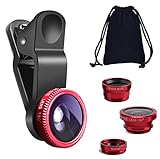
- THE FISHEYE LENS: Offers You a Wide Hemispherical Image. Professional HD Lens with Advanced Optical Glass Give You Clear Shots Every Time, Reducing Glare and Reflection. Top-Grade Aluminum Construction Increases The Durability of The Product and Let The Lens kit Be Your Partner of Photography
- THE MACRO LENS: Can be used seperately, The Macro Lens for Taking Extreme Close-Up Pictures of Tiny Objects in Details. suggest keeping 1-2 cm distance from your object to take more clear pictures
- THE WIDE ANGLE LENS: The Macro Lens and the Wide Angle Lens are attached together upon receival ! The wide lens should be used together with macro lens. The Wide-Angle Lens Projects a Substantially Large Ranges, Such Group of People, Buildings and Landscape. Enjoy a Fantastic World
- PORTABLE AND DETACHABLE: Easy to Install & Remove. Let Your Trip Much Easier with This Lens, Clip on to all Major Smartphones and Tablets with a Single Lens Rear Camera
- UNIVERSAL DESIGN: The Lenses Can Work on Most Types of Mobile Phones Whose Camera Lenses are Not Bigger Than 13 mm Diameters, Such as iPhone, iPad, Samsung and Other Smart Phones and Even Tablet
For example, Sony’s U.S. autumn guide lists the FE 24-105mm F4 G OSS (SEL24105G), a Sony E-mount lens described as covering 24mm wide angle through 105mm medium telephoto. Sony also lists an APS-C SEL18135 with a stated 35mm-equivalent range of 27–202.5mm. These are Sony examples, not universal recommendations. Before buying, verify the camera mount, sensor-format coverage, and regional availability; Sony notes that some models may not be sold in all regions. Product details are in Sony’s autumn foliage guide.
Independent reader supportYour contribution helps us test, update, and keep practical guides available for everyone.Set aperture and shutter speed for the scene
For broad landscapes
A smaller aperture, such as f/8–f/11, is a starting point when you want a broad landscape to stay in focus. Tamron gives the same range as guidance for foliage photography. The right setting still depends on the depth of field you want and the light available.
Rank #4

- Mount: Screws onto the front of your camera lens filter thread, making your original lens even more versatile.
- Fit: Compatible with Canon EF-S 18-55mm F4-5.6 IS STM, Canon EF-S 55-250mm f/4-5.6 IS STM, Canon EF 75-300mm f/4.0-5.6 III, Canon EF 70-300mm f/4-5.6 IS USM, Canon EF 50mm F1.4 USM, Canon EF 85mm F1.8 USM, Nikon NIKKOR 70-300mm f/4.5-6.3, Nikon AF-S Nikkor 50mm f/1.8G, Nikon AF-S Nikkor 50mm F1.4G, Olympus M.Zuiko Digital ED 40-150mm F4-5.6 R, G X Vario 12-35mm F2.8 II ASPH Power OIS, Fujifilm XC 16-50mm F3.5-5.6 OIS, Fujifilm XF 18-55mm F2.8-4 R LM OIS
- Camera: Compatible with Canon Nikon Sony Dslr & Mirrorless Camera Lens sizes vary regardless of camera brand or model
- Note: PLEASE VERIFY YOUR CAMERA LENS THREAD SIZE BEFORE ORDERING. Lens sizes vary regardless of camera brand or model. Your camera's lens thread size will be marked somewhere on the lens barrel or printed underneath your lens cap. This number is always preceded by a "φ" (Diameter) symbol. For example: φ58 = 58mm lens thread size.
For close leaves and soft backgrounds
For a close leaf against a blurred background, Tamron suggests starting around f/2.8–f/4. A wider aperture can make the background less distinct, but the usable depth of field becomes shallower, so focus carefully on the detail you want sharp.
For foliage moving in wind
Leaves and branches can move during an exposure. Tamron offers 1/50–1/200 sec. as a shutter-speed guide and advises using faster speeds when trees sway. The needed speed depends on how much the foliage is moving and whether you want that motion frozen.
Quick Recap
Optional tools for reflections and camera shake
- Circular polarizing filter: Canon says a polarizer can reduce reflections from foliage and deepen color in bright sunlight. It is an optional tool for suitable light, not a requirement. Match the filter thread size to the lens. See Canon’s fall foliage photography guide.
- Tripod or steady support: Longer focal lengths make camera shake more noticeable. Support can help with long-lens landscape compositions, including the layered scenes discussed by Nikon Ambassador Mike Mezeul II, but whether you need it depends on the situation.
Product prices and availability are accurate as of the date/time indicated and are subject to change. Any price and availability information displayed on Amazon at the time of purchase will apply.

