The best home theatre speakers are the ones whose channel layout, placement and receiver support fit your room. For most people, a complete 5.1 package is the safest starting point. Choose 5.1.2 or 5.1.4 when overhead effects matter and your ceiling supports them; choose 7.1 only when you have usable space beside and behind the seating. An integrated Atmos soundbar is the simplest installation, while separate passive speakers offer the clearest upgrade path.
Start with the layout, not the brand
Home theatre systems are described with numbers that identify channels rather than sound quality. In Dolby notation, the first number is the count of conventional ear-level speakers, the second is the number of subwoofers, and the third (when present) is the number of height speakers. A 5.1.2 system therefore has five ear-level speakers, one subwoofer and two height speakers.
As an Amazon Associate I earn from qualifying purchases.
| Layout | What it contains | Best fit | Main limitation |
|---|---|---|---|
| 2.1 | Left, right and one subwoofer | Music, television and small rooms where surround effects are not a priority | No center dialogue channel or discrete surround effects |
| 5.1 | Front left, center, front right, two surrounds and one subwoofer | The conventional surround starting point for most rooms | No overhead effects and less even bass coverage than a dual-subwoofer system |
| 5.1.2 | 5.1 plus two height speakers | Atmos effects when rear-speaker space is limited | Requires a compatible receiver and suitable ceiling or upward-firing modules |
| 5.1.4 | 5.1 plus four height speakers | A stronger Atmos bubble in a dedicated or larger room | More speakers, wiring and receiver channels |
| 7.1 | Seven ear-level speakers, one subwoofer | Rooms with clear space to the sides and behind the main seats | Can be difficult when seating is against a back wall; no height layer |
| 7.1.4 | Seven ear-level speakers, one subwoofer and four height speakers | Large rooms with a receiver and installation capacity for a full Atmos layout | Highest installation complexity and equipment cost among these common layouts |
A higher channel count is useful only when the room, seating and electronics can support it. Do not buy extra speakers that must be placed in corners, directly beside a listener or behind a sofa pressed against the wall.
The Tool Desk
Outbyte PC Repair FREEClear out junk files and repair common Windows errorsFree Scan →Outbyte Driver Updater FREEScan for outdated or missing drivers - takes under a minuteDriver Scan →Which type of home theatre system should you buy?
Separate passive speakers and an AV receiver
This is the most flexible route. You select a center, front left and right speakers, surrounds, subwoofer and (if wanted) height speakers, then connect them to an AV receiver. The receiver supplies amplification, decodes surround formats and determines how many channels can operate at once. You must budget for speaker cable, stands or brackets, and the receiver if they are not already included.
#1 Best Overall

- 5.1.2ch Surround Sound System: A 5.1.2-channel system featuring up-firing speakers, surround sound, and a powerful subwoofer creates lifelike, multidimensional audio. Feel the Sky Around You—raindrops falling from above, helicopters circling overhead, thunder rumbling in all directions. Sound isn’t just around you, it engulfs you, as if the ceiling disappeared. This is Dolby Atmos: not just heard, but felt.
- Up-Firing Drivers with Neodymium Core: The up-firing channels use neodymium internal magnets and 18-core large voice coils to enhance height precision and vertical throw. This aerospace-grade configuration ensures better high-frequency dynamics, delivering focused and elevated sound images that unlock the true potential of Dolby Atmos.
- 360° SurroundX Audio: SurroundX technology combines two rear surround speakers and dual up-firing Atmos drivers to build a true 360° sound field. Powered by intelligent spatial algorithms, the system precisely positions audio around and above you—enhancing Dolby Atmos with a more natural, three-dimensional soundstage. Note: Not compatible with DTS.
- Lossless Audio Transmission: Unlock full Dolby Atmos performance with HDMI eARC, supporting up to 37Mbps bandwidth for lossless 5.1.2-channel audio. Compared to regular ARC, eARC delivers richer detail and better surround effects with no compression. With CEC, your TV and soundbar work as one—power, volume, and input sync automatically for effortless control.
- Advanced App Control: Customize every detail of your audio experience with the Ultimea App. Fine-tune your surround sound with 13-step level adjustment (-6 to +6), optimize with a 10-band graphic EQ, and choose from 121 preset sound settings. Enjoy seamless OTA updates that unlock new features and keep your system performing at its peak.
Separate components make upgrades practical: you can add a subwoofer, replace the center channel or add height speakers without discarding the entire system. They also demand the most planning because each speaker needs a sensible position and a cable route.
Integrated soundbar package
An Atmos soundbar package combines the front channels in one enclosure and commonly adds a wireless subwoofer and rear speakers. It is useful when you cannot run cables through walls or do not want several large cabinets. The trade-off is less placement flexibility and a less independent upgrade path than a receiver-based system.
A current example cited in a 2026 home-theatre buying guide is the Samsung HW-Q990F, an 11.1.4 package consisting of a soundbar, subwoofer and two rear speakers. Its channel label describes the system’s processing and drivers; it does not prove that it will sound best in every room. The same guide warns that room shape and placement can make an integrated system unsuitable, so treat this as an example of the category rather than a universal pick.
Upward-firing modules versus installed ceiling speakers
Dolby identifies two ways to create height sound: overhead speakers installed in or on the ceiling, and Atmos-enabled upward-firing speakers that reflect sound from the ceiling. Installed overhead speakers provide more predictable localization but require mounting, cable runs and permission to alter the room. Upward-firing modules are easier to add to a conventional system, but their result depends heavily on the ceiling.
Choose 5.1, 5.1.2 or 7.1 by room and seating
When 5.1 is the sensible default
Choose 5.1 when you have one main seating row, limited space behind the sofa, or a receiver that supports only the conventional surround layer. The center speaker anchors dialogue, the front pair handles music and effects across the screen, and the two surrounds provide side or rear ambience. It is a complete format rather than a compromise, and it leaves a clear path to adding height channels later if the receiver supports them.
Rank #2

- Simplified 5.1ch Dolby Atmos Setup: Enjoy immersive 4D sound with real Dolby Atmos and 5.1-channel audio. Five built-in speakers, including two side-firing drivers, create wide surround without rear speakers. Precision DSP ensures <0.5 ms latency for smooth, theater-like sound. Setup takes less than 1 minute.
- Voice Clarity Enhancement: VoiceMX technology uses advanced DSP algorithms to isolate and enhance vocal frequencies in real time. Dialogue remains crisp and easy to follow by separating speech from background effects and music, even at low volumes or during intense scenes.
- 300W Output with 6-Driver System: Featuring five precision-tuned full-range drivers and a dedicated wired wooden subwoofer, the system delivers up to 300W of peak power for bold, room-filling sound. With a frequency response of 45 Hz–18 kHz and a maximum SPL of 99 dB, it reproduces everything from subtle nuances to explosive cinematic effects.
- 18 mm High-Excursion Driver: Powered by BassMX technology, the wired wooden subwoofer features a 18 mm high-excursion driver, a 5.3L tuned cabinet, and a high-density magnetic circuit. This design delivers deeper, tighter bass with greater air displacement and enhanced low-frequency performance—bringing more realism to every scene.
- HDMI eARC for True Dolby Atmos: HDMI eARC supports up to 37 Mbps of bandwidth, unlocking the full potential of lossless Dolby Atmos 5.1-channel audio. Compared to standard ARC, eARC delivers richer surround effects and greater detail. CEC integration allows the TV and soundbar to work together with unified control.
When 5.1.2 is better than 7.1
A 5.1.2 Atmos layout adds two height channels without requiring two additional ear-level speakers behind the listener. It can suit a room where the main seats are close to the back wall but there is a workable ceiling. You still need an Atmos-capable receiver or processor and compatible content and playback equipment. Two height speakers are Dolby’s minimum for overhead sound.
When 7.1 earns its extra channels
Move to 7.1 when the room has usable wall space beside and behind the seating, the listeners are not pressed against the back wall, and the receiver can power and process seven ear-level channels. The extra pair can make pans around a broad seating area smoother. If the sofa touches the rear wall, those speakers may be too close to listeners to create a balanced field; a well-positioned 5.1.2 system can be the better choice.
Windows Errors? Fix Them Before They Spread
Repair common Windows errors and clear accumulated junk for a smoother, more stable PC - no reinstall needed.Free scan · no reinstallOutdated Drivers Are Slowing You Down
One free scan finds every outdated or missing driver and matches the right update for your exact hardware.Free scan · exact hardware matchWhen 5.1.4 or 7.1.4 makes sense
Four height speakers create a more continuous front-to-back overhead movement than two. Consider 5.1.4 in a dedicated room where you can place two height speakers toward the front and two toward the rear. A 7.1.4 layout adds the full ear-level expansion as well, but requires more receiver channels, wiring and physical space. Confirm channel capacity before buying any package advertised with a four-channel height layer.
Check the room before ordering
Measure the listening area
- Measure the room’s length and width, then mark the main listening position rather than assuming the sofa location is ideal.
- Record the distance from the screen to the seats and the space behind and beside the seats. Those clearances determine whether rear surrounds or a 7.1 layout are realistic.
- Note doorways, windows, fireplaces and furniture that could block a speaker or force it to sit at ear level.
- Measure ceiling height and identify whether the surface is hard and reflective or covered with acoustic tile, fabric or heavy treatment.
Evaluate the ceiling for upward-firing Atmos speakers
Dolby specifies a reflective ceiling 2.3–4.3 metres (7.5–14 feet) high for best performance from upward-firing Atmos-enabled speakers. A very high, angled, open-beam or heavily absorptive ceiling can weaken the reflection and make overhead effects less precise. If your ceiling falls outside that range or is not reflective, installed overhead speakers are the more predictable option; if installation is impossible, use a conventional 5.1 system rather than paying for height channels that cannot work properly.
Consider the seating sweet spot
Speaker angles are designed around a main listening area. A single central row is easier to balance than several rows or seats spread across a wide open-plan room. If some seats sit immediately beside a surround speaker, lower its level during calibration or reconsider the layout so no listener is overwhelmed.
Rank #3
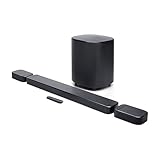
- DETACHABLE WIRELESS SURROUND SOUND: No wires, no hassle—just lift the speakers off each end of this sound bar and place them behind you. True 7.1-channel wireless surround sound in seconds. Easy setup, immersive audio, done.
- 780W POWER & WIRELESS SUBWOOFER: Feel every explosion, drop, and bass line in your chest. This sound system pumps out 780W max with deep, thundering low end from a 10" wireless subwoofer—your couch will never feel the same.
- DOLBY ATMOS & DTS VIRTUAL:X: Hear a plane soar overhead. Feel a crowd rush past. This Bluetooth soundbar delivers 3D immersive audio with Dolby Atmos and DTS Virtual:X—sound that moves all around you, not just in front of you.
- MULTIBEAM 3.0 SOUNDSTAGE: Wherever you sit, you're in the sweet spot. MultiBeam 3.0 projects high fidelity sound across the whole room for a wide, cinematic soundstage that makes every scene—and every song—feel bigger.
- PUREVOICE 2.0 DIALOGUE CLARITY: Never rewind to catch a whispered line again. PureVoice 2.0 automatically optimizes dialogue based on scene and volume—so every word cuts through clearly, even during the loudest action sequences.
Place every speaker correctly
Front left and right
Place the front pair at the left and right edges of the display, aimed toward the main listening position. Keep their tweeters near ear height when seated and maintain similar distance from the listening position so the receiver’s calibration does not have to compensate for extreme differences.
Quick wins for a faster PC:
Clear out junk files and repair common Windows errorsFree Scan →Fix the driver behind crashes, sound loss and screen glitchesFind Drivers →Center channel
The center carries most movie and television dialogue. Put it directly above or below the display, centered with the screen, and angle it toward ear height if it sits in a cabinet. Do not hide it behind a solid door or place it far below the screen; those positions can make voices sound detached from the picture.
Surround speakers
Place surrounds to the sides or slightly behind the main listening position, at or a little above seated ear height. In a 5.1 layout they create the side and rear ambience; in a 7.1 layout the additional pair occupies the rear area. Avoid placing a surround directly behind a listener’s head or flush against a side wall at very close range.
Height speakers
For installed height channels, position two speakers toward the front of the seating area for a 5.1.2 layout. Four-speaker layouts add a rear pair. Upward-firing modules should sit on the front speakers or on their specified bases so the drivers have a clear path to the ceiling.
Subwoofer
Bass is not strongly directional, so the subwoofer has more placement freedom than the other speakers. Start near the front wall, then try another wall or corner if bass sounds boomy or weak at the seats. A practical method is to place the subwoofer temporarily at the main seat, play a bass-heavy passage, and walk around the room; locations where bass sounds even are candidates for the final position. Use the receiver’s calibration after moving it.
What’s actually slowing this PC down?
Pick the symptom - the matching free tool is one click away.
Rank #4

- An all-in-one home theater package - The YHT-4970U comes with a Dolby Atmos AV Receiver (Yamaha RX300A), a 5.1 speaker package (two front channel speakers, a center channel speaker, two surround channel speakers, and a powered subwoofer), plus a subwoofer cable and speaker wire all in one box.
- Step into lifelike sonic worlds - Dolby Atmos and DTS Virtual:X for deeply dimensional, lifelike sound that draws you into every moment of your favorite entertainment, plus crystal-clear dialogue so you can hear every word.
- Stunning visual realism - Supports ultra-high definition 4K/120 and 8K/60 video, high-performance HDMI switching, advanced Dolby Vision and HDR10+ dynamic range technologies, HDMI eARC/ARC and next-gen gaming features like ALLM and VRR.
- Room Correction - Experience perfect sound in any room. An included setup microphone measures your room’s acoustics and speaker characteristics, allowing the receiver to automatically optimize sound performance.
- Easy streaming with Bluetooth Multipoint - Stream all your favorite music, podcasts and audiobooks wirelessly. Built-in Bluetooth Multipoint lets you pair two source devices and instantly switch between them.
Confirm receiver, format and package compatibility
- Channel capacity: The receiver must have enough amplified and processed channels for the layout. A 5.1.4 package needs more height-channel capacity than a 5.1.2 system; a 7.1.4 layout needs more again.
- Atmos decoding: Dolby Atmos playback requires an Atmos-capable AV receiver or preamp/processor plus a compatible player or streaming path and Atmos content. A speaker labelled “Atmos” cannot create the format by itself.
- Included components: Check whether the box contains the center, surrounds, subwoofer, height modules, speaker stands, mounting hardware and cables. Many “speaker systems” do not include a receiver.
- Impedance and power: Match the speakers’ impedance and recommended amplifier range to the receiver’s specifications. Do not assume a receiver can safely drive every large multi-speaker package at reference volume.
- Connection plan: Count HDMI inputs, eARC support and available speaker terminals before ordering. Plan cable routes and ventilation around the receiver.
Dolby describes Atmos as a format capable of carrying up to 128 simultaneous independent audio objects. That is a property of the mix format, not a statement that a home system has 128 speakers or that every room will reproduce every object equally well.
Independent reader supportYour contribution helps us test, update, and keep practical guides available for everyone.Budget for the complete installation
Compare the total working system, not the price of the speaker boxes alone. Add the receiver or processor, subwoofer, stands, wall brackets, cable, in-wall plates, installation labour and any extra height channels. An integrated package may cost more than a basic soundbar but less than buying a receiver and a full passive set separately; a passive package may cost less initially yet require additional hardware.
Keep an upgrade reserve if you are unsure about the final layout. Starting with a quality 5.1 system and adding two height speakers later can be more economical than buying a large package that your room cannot place correctly. Prices and package contents change by country and retailer, so verify the exact regional bundle and current stock before paying.
Installation and calibration checklist
- Place the display and main seats first, leaving clear paths beside and behind the seats.
- Position the front three speakers around the screen, then place surrounds and height speakers according to the chosen layout.
- Run speaker cable with enough slack for final aiming; label both ends before connecting.
- Connect each speaker to the receiver’s matching terminal and verify polarity, with positive and negative terminals consistent across the system.
- Connect the subwoofer with its line-level cable and set its onboard crossover and volume near the receiver manufacturer’s recommended starting position.
- Select the actual speaker layout in the receiver menu, enable Atmos processing only when the receiver and source support it, and set speakers to “small” if the receiver’s bass-management guidance calls for that configuration.
- Run the receiver’s room-calibration routine from the main seat and the other intended seats, then check distances, levels and crossover values manually.
- Play a dialogue scene, a moving-effects scene and music. If dialogue is weak, verify the center connection and raise its level modestly; if bass is uneven, move the subwoofer and recalibrate.
Common mistakes and fixes
Buying channels that cannot be placed
Symptom: Extra speakers end up behind the sofa, in a corner or beside one listener. Fix: return to a 5.1 or 5.1.2 layout that matches the available walls and ceiling.
Assuming an Atmos label guarantees overhead sound
Symptom: Upward-firing effects are faint or appear to come from the front speakers. Fix: check ceiling height, reflectivity and module orientation against Dolby’s 2.3–4.3 metre guidance; use installed overhead speakers or omit the height layer if the room cannot support the reflection.
Best Value

- 5.1CH SURROUND SOUND: Hear cinematic surround sound and deep bass with 3 front-firing speakers, two rear speakers, and included subwoofer.
- SOUND STRAIGHT FROM CINEMA: Get the best streaming experience with support for Dolby Atmos and DTS:X.
- CLEAR DIALOGUE: Catch every word in the scene with dedicated center channel speaker.
- ROOM FILLING SOUND: Multi Stereo enhances your listening experience by playing the same sound from all speakers, creating a room-filling sound boost.
- BRAVIA THEATER AND BRAVIA TV, THE PERFECT PAIR: Pair with compatible BRAVIA TVs to control the soundbar from the TV menu and take advantage of Voice Zoom 3 for enhanced dialogue.
Forgetting the receiver
Symptom: A speaker package arrives without a way to power it or decode the desired format. Fix: verify the receiver’s amplified and processing-channel count, Atmos support and connector requirements before purchase.
Putting the center inside furniture
Symptom: Dialogue sounds muffled or comes from below the screen. Fix: move the center above or below the display with a clear grille and angle it toward the seats.
Expecting a second subwoofer to solve every bass problem
Symptom: Bass is loud in one seat and missing in another. Fix: first try different subwoofer positions and run calibration. A second subwoofer can even out bass across a wider seating area, but it also requires another output or compatible connection and additional cost.
A practical decision path
- Choose 5.1 if you want dependable surround, have limited installation tolerance or cannot place speakers behind the seats.
- Choose 5.1.2 if overhead effects are important, the receiver supports Atmos and the ceiling suits overhead or upward-firing speakers.
- Choose 7.1 if you have clear side and rear space and want a wider ear-level sound field without installing height channels.
- Choose 5.1.4 or 7.1.4 only after confirming receiver capacity, four usable height positions and a realistic cable or mounting plan.
- Choose an integrated soundbar package when minimal wiring and a compact front stage matter more than component-by-component upgrades.
For any model-specific “top pick,” look for a current independent review or clearly identified hands-on test that states the region, package contents and listening conditions. Channel labels and manufacturer capability claims do not establish sound quality in your room.
Quick Recap
Product prices and availability are accurate as of the date/time indicated and are subject to change. Any price and availability information displayed on Amazon at the time of purchase will apply.

