For most current Android phones, buy a USB-C to USB-C cable with a clearly stated power rating, then pair it with a USB-C adapter whose output matches your phone. Use USB-A to USB-C only when you need to keep an older USB-A adapter; on Pixel phones, Google says that arrangement charges more slowly than a USB-C adapter and USB-C cable. A cable’s headline wattage does not override the phone’s charging limit, the adapter’s output profile or the phone maker’s fast-charging protocol.
What “cable charger” means
“Cable charger” combines two separate parts: the cable that connects to your phone and the wall adapter that converts mains power to USB power. They operate as a system. The cable determines connector compatibility, supported current and (for USB-C cables in a compliance program) the marked power capability. The adapter determines the available voltage, current, charging protocol and how much power remains when other ports are in use. The phone negotiates what it will actually accept.
As an Amazon Associate I earn from qualifying purchases.
That is why a 240 W cable does not make a phone charge at 240 W, and why replacing only a cable may not increase charging speed. Google states that Pixel charging speed varies with the charger and cable, and that some other cables or adapters might not work with Pixel phones. For any speed claim, check the exact model’s official specifications rather than relying on the cable package.
The best cable type for common Android setups
| Phone-side connector | Adapter-side connector | When it fits | Speed and limitations |
|---|---|---|---|
| USB-C | USB-C | Modern USB-C wall adapter, laptop charger, car adapter or power bank | Usually the most flexible choice for current Android phones. Actual speed is limited by the phone, adapter profile and cable rating. |
| USB-C | USB-A | Existing older wall adapter, computer port, vehicle port or power bank with USB-A output | Works when the adapter and phone support the arrangement. Google says Pixel phones charge more slowly this way than with a USB-C adapter and USB-C cable. |
| USB-C | Proprietary or non-USB output | Only where the phone maker explicitly supplies or specifies that accessory | Do not assume compatibility from a similar-looking plug; follow the phone manufacturer’s requirements. |
Google’s Pixel guidance lists both “USB-C to USB-C cable” and “USB-A to USB-C cable.” It specifically notes: “This charges your phone slower than a USB-C power adaptor with a USB-C cable.” That statement is Pixel guidance, not a universal speed rule for every Android model. Other manufacturers can require different cable ends, adapter classes or proprietary fast-charge systems.
#1 Best Overall
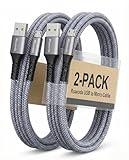
- [END THE FRAYING CYCLE] Original plastic cords inevitably split at the connector. We engineered an extended strain relief joint encased in a space grey aluminum shell and high-density nylon braid. Withstands 25,000+ bends without tearing.
- [SECURE CLICK-LOCK FIT] Tired of loose Micro USBs falling out? Precision stainless steel pins lock firmly with an audible click. The stepped connector bypasses thick rugged cases. Zero dropouts during intense gaming or constant recording.
- [ZERO LATENCY PLAY & CHARGE] Built with a 22 AWG copper core and double-layer shielding to block interference, delivering stable 2.4A power for lag-free gaming. The aluminum housing actively dissipates heat to prevent battery degradation.
- [PET-PROOF & TANGLE-FREE ARMOR] Is your setup a graveyard of chewed wires? This heavy-duty braided jacket resists sharp pet teeth. Toss it into a crammed backpack—it unrolls perfectly straight without knotting, built for daily abuse.
- [24/7 CONTINUOUS POWER] Flawlessly powers outdoor security cameras and dash cams continuously without unexpected power drops. Revives PS4 controllers and classic Androids. Backed by a 3-year responsive care plan for complete peace of mind.
How to choose a cable step by step
- Identify the phone port. Most new Android devices use USB-C, but confirm the exact model. A cable cannot compensate for a damaged, loose or non-USB-C port.
- Inspect the adapter output port. Choose USB-C to USB-C when the adapter has a USB-C receptacle. Choose USB-A to USB-C only when the adapter has USB-A and you intend to keep using it.
- Read the phone’s charging specification. Look for the maximum input power, supported USB Power Delivery (PD) or Programmable Power Supply (PPS) profile, and any manufacturer-specific fast-charge requirement. The maximum printed on a cable is not the phone’s maximum.
- Read the cable rating. Prefer a cable that states its power capability and, when relevant, current rating. A clearly labeled cable makes it easier to verify that it can carry the power your phone-and-adapter combination is designed to negotiate.
- Check whether a cable above 3 A is needed. Google’s 30 W USB-C Charger guide says that output currents higher than 3 A are enabled only with a cable rated above 3 A, such as a 5 A cable with an e-marker. This requirement belongs to that charger guide; it is not a universal rule for all Android phones or all 30 W adapters.
- Choose a practical length and construction. Select enough length to reach a desk, bedside table or vehicle mount without tension. Avoid a cable so long that it becomes difficult to route or store, and avoid designs that force a sharp bend at either connector.
- Verify the seller’s claims. USB-IF markings describe cables that went through its compliance program. A marketplace listing that merely says “certified” without a verifiable program marking is not equivalent evidence.
USB-C to USB-C versus USB-A to USB-C
USB-C to USB-C
Use this as the default for a USB-C adapter. It keeps the connector type consistent, is the arrangement Google highlights for faster Pixel charging, and is suitable for USB-C PD ecosystems when the phone and adapter support PD. The cable still needs an adequate current and power rating; USB-C at both ends does not automatically identify the cable’s capabilities.
USB-IF’s cable guidance describes USB-C to USB-C cables in its compliance program with 60 W or 240 W power-capability markings. Those marks tell you the capability category assigned to the cable; they do not mean a connected phone accepts that wattage, and they do not prove that an unverified retail listing passed the program.
USB-A to USB-C
This is the practical choice for an older adapter, car socket or computer that exposes USB-A. It can charge a USB-C Android phone, but the available protocol and power may be lower than with a modern USB-C adapter. Pixel documentation explicitly warns of slower charging compared with a USB-C adapter and USB-C cable. For another Android brand, consult that model’s support page before assuming the same behavior.
Rank #2

- 5 Pack 6FT Charging Cords: Includes five 6-foot cords for home, office, car, travel, bedside, and backup use.
- 3A Fast Charging and Sync: Supports up to 3A charging and 480Mbps data transfer with compatible devices and USB A adapters.
- Braided for Daily Use: Nylon braided material helps resist bending, pulling, and tangling for everyday charging needs.
- Wide Type C Compatibility: Compatible with iPhone 17 16 15 series, Samsung Galaxy S10 S9 S8, Note 10 9 8, LG V50 V40 G8 G7, and other Type C devices.
- USB A to Type C Connection: Works with standard USB A wall chargers, car chargers, power banks, laptops, and charging stations.
Do not use an adapter simply because the plug fits. The adapter must provide a compatible output, and the phone must accept the resulting charging mode. A cable with USB-C on the phone end does not turn a basic USB-A port into USB PD.
Understanding cable wattage, current and markings
| Marking or specification | What it tells you | What it does not tell you |
|---|---|---|
| 60 W | USB-IF’s described power-capability marking for a USB-C to USB-C cable category in its compliance program | That the phone will draw 60 W, or that the cable is certified when the mark cannot be verified |
| 240 W | USB-IF’s higher power-capability marking for the relevant USB-C to USB-C cable category in that program | That a phone, adapter or charging session supports 240 W |
| Above 3 A / 5 A with e-marker | A higher-current cable class; Google gives a 5 A e-marked cable as an example for currents above 3 A on its 30 W charger | A universal requirement for every Android phone or every adapter |
| Data-rate label | For most cable types in USB-IF’s program, an indication of supported data capability | Charging speed or phone compatibility by itself |
USB-IF explains that USB Power Delivery can support power levels up to 240 W under the described specification and is designed to coexist with standard USB Battery Charging implementations. That is ecosystem context, not a promise about smartphone charging speed. A phone may be limited by its battery-management system, thermal conditions, firmware or a manufacturer’s negotiated profile long before the cable’s maximum is reached.
An e-marker is an identification chip used in certain USB-C cables so the source and sink can determine cable capabilities. When a setup requires more than 3 A, the adapter may refuse that current unless the cable reports an appropriate rating. If your phone maker or adapter documentation calls for a 5 A e-marked cable, use one that explicitly states that feature rather than inferring it from a high wattage printed on the package.
Rank #3
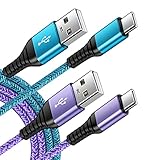
- 【Wide Compatibility 】:Type C Charger for Samsung Galaxy S26 Ultra S26+ S26,S25 S24 S23 S23+ S23 Ultra,S22 S22+ S22 Ultra, A17 A16 A36 A15 A14 5G,A13 A33 A53 A54 A10e A15 A35 A55 A25 A11 A12 A20e A20 A20s A21 A21s A30 A30s A31 A32 A40 A41 A42 A50 A50s A51 A52 A70 A72 A80 A90/A71 5g/S20 FE/Galaxy S21+ 5G/S21 Ultra 5G/S20 FE 5g/S20 5G/S20 Plus 5G/ S8 S9 S10 Plus S10e/Note 9 10/Note 20 Ultra/Z Fold 6 5 4 3 2/Z Flip 6 5 4 3 2;Google Pixel 9 8 7 Pro 6 6 Pro 6a 5a 5/4XL/4/3XL/3/2XL.
- 【Fast Charge & Sync】: Type C Charger Cord Fast Charge Output power up to 5V/3A, ensured by high-speed safe charging. The USB 2.0 supports data transfer speed can reach 480Mbps, data transfer and power charging 2 in 1 Type C Cable. USB A to C type c charger cord with Qiuck Charge Wall Charger for Fast Charging.
- 【Extra Long】: With the 6ft type c charging cable, you can lie on the sofa and use your devices while charging at the same time. More convenient on traveling, office, car, power bank, several cell phones, Pods, share to families.
- 【Durable USB C Charger Cord】: Made of reinforced SR design using TPE material can withstand 10,000+ bending tests, which effectively protects s21 charger from breaking. Premium metal zinc alloy connectors made Nylon Braided samsung fast charger cable usb c phone cable without tangle.
- 【What You Get】: 2 * 6FT Type C Cord, 7x 24 Hours friendly customer service, 12-month warranty. If you have any questions, please feel free to contact us.
Choosing the wall adapter that matches the cable
Check the adapter’s output profile
Read the small output table on the adapter or its official specification. It should identify supported voltage and current combinations, whether USB PD or PPS is available, and the maximum output on each port. The phone can select only a profile that both the adapter and phone support. A cable rated for 240 W cannot create a missing PPS or PD profile.
Quick wins for a faster PC:
Fix the driver behind crashes, sound loss and screen glitchesFind Drivers →Clear out junk files and repair common Windows errorsFree Scan →Account for shared ports
Multi-port adapters often advertise a maximum for the unit, not the amount available to every port simultaneously. When another device is connected, the adapter may redistribute power. Check the per-port and combined-output figures. If your phone slows when a second device is plugged in, that can be normal power allocation rather than a faulty cable.
Keep the 30 W example in context
Google’s safety and regulatory guide for its 30 W USB-C Charger identifies a maximum PPS output of 30 W and says currents above 3 A are enabled only with a cable rated above 3 A, such as a 5 A e-marked cable. Use those figures only for that charger’s documented setup. They do not establish that every Android phone needs a 5 A cable, nor that every 30 W adapter behaves identically.
Rank #4
![Micro USB Cable, 2 Pack [6FT, 6FT], Fast Charging Cable, High Speed Data Transfer Cable, Android Phone Cable for Samsung Galaxy S7 Edge S6 S5 and More, Trustable, MYFON](https://m.media-amazon.com/images/I/41fjZqEOTmL._SL160_.jpg)
- [More Trustable] All our products come from a factory which focus on cables manufacture since 2002.
- [More Popular] Welcome to be one of our millions users in the whole world.
- [High Speed] USB 2.0 Cable. Supports 2amp charging current & 480-Mbps transmission speed.
- [What you get] 2pcs 6 ft micro USB cables. Data transfer and power charging 2 in 1.
- [Compatible] Most Android and Windows phones, tablets and many other devices, such as GPS devices, batteries, bluetooth speakers, wireless keyboards, cameras, camcorders, game consoles, hard drives, e-readers, printers.
What Android compatibility guidance does—and does not—guarantee
The Android 17 Compatibility Definition strongly recommends USB Type-C and USB PD implementation details in the circumstances it describes. It is guidance for device makers and compatibility testing, not a guarantee that all Android phones expose the same connector behavior, charging protocol or maximum speed. Older phones, budget models and region-specific variants can differ.
Use the exact model number when reading a manufacturer’s support page. “Android phone” is too broad for a precise fast-charging claim. Confirm whether the phone requires a proprietary adapter, whether PD/PPS is supported, and whether a particular cable current rating is specified.
The Tool Desk
Outbyte PC Repair FREEClear out junk files and repair common Windows errorsFree Scan →Outbyte Driver Updater FREEScan for outdated or missing drivers - takes under a minuteDriver Scan →Length, flexibility and durability: practical selection criteria
- Length: Choose the shortest cable that reaches comfortably without pulling on the phone. A bedside setup may need more reach than a desk, while a car mount benefits from a cable that does not loop across controls.
- Connector strain relief: Look for a flexible transition where the cable meets each plug. A rigid or sharply bent transition concentrates stress at the most frequently damaged point.
- Jacket material: Braided or flexible polymer jackets can suit different environments, but neither construction proves a power rating or certification. Treat mechanical design and electrical capability as separate checks.
- Storage: Coil loosely rather than folding tightly at the connector. Do not pinch the cable under furniture or close it in a door.
- Replacement timing: Replace a cable when insulation splits, shielding is exposed, connectors wobble, charging cuts in and out, or the phone reports an accessory problem.
Buying checklist
- Phone connector confirmed as USB-C.
- Adapter connector confirmed as USB-C or USB-A.
- Phone’s documented maximum input and fast-charge protocol checked.
- Cable power capability clearly printed or specified by the manufacturer.
- Current rating above 3 A and a 5 A e-marker selected only when the phone-and-adapter documentation calls for it.
- Adapter output profile and shared-port limits checked.
- Length suits the intended location without tension.
- USB-IF compliance markings treated as evidence of the cable program category, not as a guarantee about the connected phone.
- No visible damage, contamination or bent connector.
Setup procedure for a new cable and adapter
- Unplug the adapter before inspecting the cable and phone ports.
- Confirm that the plug orientation and connector type match; never force a connector.
- Insert the cable into the adapter first, then connect it to the phone. Seat both ends fully without twisting.
- Check the phone’s charging indicator and, where available, its estimated charging message. A slower rate can reflect the adapter profile, battery temperature, state of charge or a shared port.
- After several minutes, feel for abnormal heat. Warmth can occur during charging, but stop if the plug, adapter or phone becomes unusually hot, smells of burning or shows physical damage.
- Route the cable so it is not pinched, bent sharply or used as a handle for the phone.
Troubleshooting slow or failed charging
The phone charges, but slowly
- Compare USB-A to USB-C with USB-C to USB-C. Pixel documentation specifically identifies the USB-A arrangement as slower than a USB-C adapter and cable.
- Read the adapter’s output profile and confirm that it includes the phone’s required PD/PPS or other documented mode.
- Check whether another device is using a shared adapter and reducing the available output.
- Verify the cable’s current and power rating. A high-current mode may be unavailable when the cable is not rated above 3 A.
- Allow the phone to cool and remove heavy workloads; thermal management can reduce charging power.
The phone says the accessory is unsupported
Disconnect the cable, inspect both connectors for debris or damage, and try a known-compatible cable and adapter specified for the phone. Google cautions that other cables or adapters might not work with Pixel phones. Do not defeat a warning by repeatedly forcing the plug or continuing to use a visibly damaged accessory.
Best Value

- IN THE BOX: (1) 6-foot USB 2.0 cable with A Male to Micro B connectors
- COMPATIBILITY: USB-A printers and hard drives; Micro-B Android phones and tablets
- PERFORMANCE: Supports up to 480 Mbps data transmission speed; charging capability up to 2100 mA
- USES: Ideal for charging Android phones and tablets or connecting PC peripherals such as hard drives, printers, and more
- DURABLE DESIGN: Gold-plated connectors resist corrosion for signal purity; thin and flexible cable with compact connector head works with nearly all cases
Charging stops or cycles on and off
Test another outlet and another compatible adapter, then gently move the cable near—not inside—the connector to identify strain-related interruptions. If charging changes when the cable is moved, replace it. Persistent interruptions with multiple compatible accessories may indicate a phone-port or battery fault that requires the manufacturer’s service process.
The phone warns about moisture
Unplug immediately and let the port and cable dry naturally in a ventilated place. Do not insert objects, apply external heat or continue charging while moisture is present. Google warns that charging when moisture is present can cause fire, electric shock, injury or property damage.
Safety and care
Google’s charger guidance says that using damaged cables or chargers, or charging when moisture is present, can cause fire, electric shock, injury or damage to the device or other property. Stop charging if an accessory is damaged or the phone displays a charging-accessory warning.
Do these 3 things before closing this tab:
1Fix the driver behind crashes, sound loss and screen glitches2Clear out junk files and repair common Windows errors3Scan for outdated or missing drivers - takes under a minuteKeep the phone, cable and adapter ventilated; do not cover an adapter with bedding or place it where heat cannot escape. Pull the adapter from the socket by its plug rather than by the cable. Avoid twisting, pinching and tight bends, and keep liquids away from the charging area. These practices protect both the electrical contacts and the cable’s internal conductors.
Bottom-line buying decision
Choose a labeled USB-C to USB-C cable for a USB-C adapter when your Android phone supports that arrangement. Match its current and power capability to the phone-and-adapter documentation, and select a cable above 3 A only when the specified setup requires it. Keep a USB-A to USB-C cable for older ports, accepting that Pixel phones charge more slowly in that configuration. Treat 60 W and 240 W markings as cable capability information—not as a phone-speed promise—and replace any accessory that is damaged, wet or intermittently disconnecting.
Quick Recap
Product prices and availability are accurate as of the date/time indicated and are subject to change. Any price and availability information displayed on Amazon at the time of purchase will apply.

