Recommended Free Tools
For most short domestic and intra-European journeys, check a direct train before you check a flight. A central station, no airport-style security queue and simpler boarding can make rail competitive—or faster—once every part of the journey is counted. If rail does not fit the route, compare a direct coach, a shared car, a ferry on water routes, or cycling and local public transport for the shortest distances.
There is no universally best replacement for flying. The sensible choice depends on your exact origin and destination, date, number of travelers, luggage, accessibility requirements, service frequency and budget. Compare the complete door-to-door trip rather than the time in the air.
As an Amazon Associate I earn from qualifying purchases.
Why a short flight is not automatically the quickest option
A flight’s advertised duration covers only the airborne segment. A realistic comparison starts when you leave your origin and ends when you reach your final address. Add the trip to the airport, the recommended arrival time, check-in and security, boarding, possible runway or baggage delays, the journey from the destination airport and any connecting public transport.
Rail stations are often in or near city centres. A train can therefore leave later, arrive closer to your destination and avoid several airport procedures even when its timetable shows more time between departure and arrival. The European Commission’s climate guidance puts the practical rule plainly: “Consider taking the train if you are only travelling a few hundred kilometres or less.” That is a decision prompt, not a guaranteed travel-time result; a route with slow trains or several connections can still favour another mode.
#1 Best Overall

- Extra Shoe Bag & Wet Pocket: Large carry on backpack for women includes a bonus shoe bag to keep shoes separate from clothes and prevent dirt from spreading in your bag. The wet pocket of suitcase school backpack for travel purse is ideal for storing swimsuits, toiletries, helping keep the rest of your items dry. The thoughtful design makes the travel laptop backpack for shcool women perfect for travel, everyday use. The travel backpack with water bottle pocket fits a Stanley 30 oz (900ml) cup
- Roomy Capacity & Multi-Pocket: Dimensions 16.8*11*7 inch, Light Weight 0.79 Kg(1.74 lb), has 3 main large compartments and 9 allocated inner and side pockets. Makes your item organized and easier to find. College laptop bookbag backpack with laptop compartment holds a 15.6 inch laptop and a 12.9 iPad, pink travel backpack providing a dedicated space for your pen, textbooks, wallet, clothes, shoes, bottle and other travel essentials. At the same time,travel backpack carry on is water resistant
- Flight Approved Laptop Backpacks: 180 degree zipper closure helps you pass through the security check quickly. Airplane travel essentials for women fits overhead and under the seat. Carry on backpacks for traveling on airplane also meets airline carry-on requirements, applicable for airlines such as Easy Jet, Spirit, Jet Blue, Frontier, United
- Be Handbag or Backpack: The womens travel backpack for airplane designed with padded adjustable shoulder strapsand 2 padded handles make it easy to transform this weekender backpack for school from hand bag to backpack. Luggage Strap of work bookbag for women provides a more flexible carrying experience. Two padded grab handles are set on top and side of the personal item travel backpack. Note: when used as a handbag, you can thread the shoulder strap through the luggage strap for convenience
- Widely Used: Hybrid Conversion(School Bag/Duffle Bag/Bookbag/Travel Bag/Teacher Backpack/Nurse Backpack). Large backpack bookbag for women can be used in several different ways, served as daily college backpack, traveling backpack for women work bag. Carry on luggage backpack is perfect for weekender, travel, college, daily use, and is also the best birthday gifts for women daughter. The backpack purse for women can be cute school backpack for girl, perfect for back to school gift for girlfriend
For every option, record the same starting point and finishing point. Include local buses, taxis, parking walks, station transfers and waiting time. A two-hour flight can become a half-day itinerary after those additions, while a direct train or coach may have a more predictable city-centre arrival.
The quick decision framework
- Define the trip. Write down the exact origin, destination, date, departure window, travelers, luggage, bicycles, mobility needs and whether an overnight journey is acceptable.
- Search a direct train first. Check the full timetable, connection times, station access, fare conditions and what happens if a connection is missed. International trips may involve more than one operator, so verify whether the itinerary is sold as a protected connection or as separate tickets.
- Add the flight’s complete time and cost. Count airport transfers, arrival lead time, security, boarding, baggage fees, destination transfer and the risk of a remote airport.
- Check a direct coach. Compare the total fare, terminal location, luggage and bicycle rules, rest stops, accessibility information, frequency and the operator’s record for delays on that route.
- Model a shared car. Divide fuel or charging costs among the people actually traveling, then add tolls, parking, congestion charges, rental or vehicle costs and the value of the driver’s time. Include a safe plan for breaks.
- Test a ferry only for a genuine water crossing. Include travel to the port, check-in rules, sailing frequency, crossing time and transport after arrival.
- Use cycling and local transit for short, practical distances. Check route safety, weather, realistic daily distances, luggage capacity, equipment and local rules before committing.
- Recheck before paying. Schedules, fares, disruption policies and accessibility arrangements change. Confirm details with the relevant operator or a reputable comparison service.
How the alternatives compare
| Option | Where it usually fits | Main advantages | Important checks | Environmental evidence |
|---|---|---|---|---|
| Direct train or high-speed rail | Short and medium corridors with frequent service | Central stations, quick boarding and the possibility of working or sleeping en route | Directness, connection protection, station access, fare conditions, luggage and bicycle rules | Rail is among the lowest-emission passenger modes in the EEA’s EU-27 comparison |
| Intercity coach | Routes where rail is expensive, infrequent or absent | Broad coverage and low per-passenger emissions when well occupied | Travel time, rest stops, terminal location, comfort, accessibility, luggage and delay history | Buses and coaches are the most efficient road passenger mode in the EEA comparison, with efficiency affected by occupancy |
| Shared car or electric car | Several travelers, rural destinations and door-to-door itineraries | Flexible departure, direct access and easy handling of luggage or equipment | Occupancy, fuel or charging, tolls, parking, congestion, charging availability and driver fatigue | Sharing improves the per-passenger comparison; solo driving is generally less favourable |
| Ferry | Journeys where a water crossing directly replaces a flight | Can carry people, cars and bicycles while avoiding an airport | Port transfers, sailing frequency, vessel type, crossing time and onward transport | Waterborne transport is generally efficient, but averages differ sharply by vessel type |
| Cycling plus local public transport | The shortest journeys and first- or last-mile links | No airport process, low operating cost and flexible local access | Safe routing, weather, daily distance, lights, helmet, luggage and country-specific rules | Recommended by European consumer guidance for shorter journeys where practical |
Train: the default alternative to test
When rail is likely to win
Rail is strongest on a corridor with a direct or simple frequent service, especially when both stations are central. The European Consumer Centre Network describes the train as “the most environmentally friendly way to travel around Europe.” For a short trip, that environmental advantage often arrives with practical benefits: fewer formalities, a larger usable cabin and the ability to walk around or work during the journey.
High-speed rail is particularly useful on busy city pairs. The European Commission’s 2021 mobility strategy set a target to double high-speed rail traffic across Europe by 2030, but that is a policy target rather than a promise that every route already has frequent high-speed service. Check the timetable for your date rather than assuming a fast train exists.
Free tools Windows power users keep installed
One-click scans. No signup required.
How to compare a train with a flight
- Measure the trip from your home or hotel to the departure station and from the arrival station to the final address.
- Use the train’s scheduled departure and arrival, then add a realistic station buffer. Do not substitute the airport’s recommended arrival time without checking the station’s boarding rules.
- For the flight, add airport access, check-in, security, boarding, baggage collection and the destination transfer.
- Compare the fare that includes the luggage, seat, bicycle and change flexibility you need. A cheap rail ticket with severe restrictions may not be equivalent to a flexible flight ticket.
- For a connection, identify who protects it. A single through-ticket may provide rebooking rights that separate tickets do not.
International and overnight rail
Cross-border itineraries can combine operators, currencies and ticket rules. Allow more time when a change is not protected, and check whether a bicycle or large bag must be reserved on each segment. On longer short-haul corridors, a night train can replace a hotel night; compare the sleeper or couchette fare with accommodation and the value of arriving early.
Coach or intercity bus: coverage when rail does not
A direct coach is often the strongest road-based substitute for a short flight. It can reach towns without a rail line and may run from a terminal closer to your origin than an airport. The EEA identifies buses and coaches as the most efficient road passenger mode in its comparison, although the result varies with use and occupancy.
Rank #2

- 【Versatile & Airline-Approved】Sized at 18 × 14 × 8 inches, this carry-on backpack fits perfectly under the seat or in the overhead bin. Approved by Spirit, Frontier, JetBlue, and other budget airlines, it's the ideal personal item for hassle-free air travel.
- 【Spacious & Organized】With 40L a capacity, 4 compartments, and a lot of pockets, designed to allow you to easily separate and organize your travel personal items, this travel backpack can accommodate 3-7 days worth of travel items.
- 【3 Extra Packing Cubes & Wet Pockets】This carry-on bag includes 3 extra packing cubes – 2 storage bags and a shoe bag – as well as a built-in wet compartment pocket. Perfect for storing wet clothes, towels, and toiletries, these packing accessories ensure your belongings remain dry and prevent any leaks or moisture from affecting your other items.
- 【Durable & Comfortable】Built to withstand the challenges of travel, this carry on backpack is made from tear-resistant, water-resistant, and abrasion-resistant materials. It also has adjustable shoulder straps, a padded back panel, and shoulder straps, ensuring comfort during long trips; a travel essential.
- 【Secure & Practical】This large travel backpack features a suitcase-style opening for easy access to your belongings at security checkpoints. There's also a padded electronics compartment and umbrella/water bottle pockets on the side. A luggage strap is attached to the back.
What to check before booking
- Terminal location: A low fare from a peripheral terminal can lose its advantage once you add local transport.
- Stops and reliability: Count scheduled rest stops and inspect the route’s typical delay pattern if the operator publishes it. A coach sharing congested roads has less timetable control than a segregated rail line.
- Luggage and bicycles: Confirm the number, size and price of checked bags, cabin bags and bicycles. Rules can differ by vehicle and departure.
- Accessibility: Ask about boarding assistance, lifts, wheelchair spaces and the notice required for a mobility device.
- Comfort: Check seat layout, toilet availability, power outlets and whether an overnight service is realistic for you.
Compare a coach’s actual arrival point with the city centre, not merely its city name. A direct coach with one long stop may still be preferable to a flight requiring two airport transfers, but a delayed service can matter more when you have a fixed appointment.
Shared car and electric car: flexibility at a group scale
Driving is most compelling when several people are traveling to a rural or dispersed destination. One vehicle can serve the whole itinerary, carry bulky luggage and stop where scheduled services do not. Its door-to-door flexibility is the main practical advantage, not an automatic speed or environmental win.
Calculate the real cost
- Fuel, or electricity and any charging fees.
- Tolls, congestion charges and border fees.
- Parking at the destination and at overnight stops.
- Rental, insurance or vehicle-use costs if the car is not already available.
- Local transport you would otherwise need after arriving.
- The driver’s time, breaks and the possibility that fatigue requires an overnight stop.
Divide trip costs by the number of passengers who actually share the car. The same journey can look very different for one driver and for four travelers. A full car also spreads the trip’s impacts across more people; the EEA comparison indicates that occupancy is a decisive part of the passenger result.
What an electric car changes—and does not prove
An electric car powered by renewable electricity has no tailpipe carbon dioxide while driving. That statement does not establish a universal lifecycle advantage for every vehicle, electricity mix or manufacturing process, and no single comparison should be inferred without those details. For planning, confirm charging availability along the route, charging time, payment methods, weather effects on range and whether the destination has reliable charging.
Ferry: a substitute only when the geography works
A ferry can be an excellent replacement for a flight when the water crossing is the direct route between the same practical endpoints. It is less useful when the ports are far from the cities or when infrequent sailings force a long wait. Compare the whole itinerary, including road or rail to the port and onward transport from the arrival terminal.
Rank #3

- Extra Shoe Bag & Wet Pocket: Mens travel backpack includes a bonus shoe bag to keep shoes separate from clothes and prevent dirt from spreading in your school backpack for men. The wet pocket of carry on backpack for men flight approved is ideal for storing swimsuits, toiletries, helping keep the rest of your items dry. The thoughtful design makes the large travel laptop backpack for men perfect for travel, business, work, everyday use
- Roomy Capacity & Multi-Pocket: Dimensions 16.8*11*7 inch, Light Weight 0.79 kg(1.74 lb), Womens travel backpack has 3 main large compartments and 9 allocated inner pockets and side pockets. Makes your cruise essentials organized and easier to find. College backpack with laptop compartment holds a 15.6 inch laptop and a 12.9 iPad, backpack suitcase for mens travel bag Providing dedicated space for your wallet, clothes, shoes, bottle etc. At the same time, small backpack men is water resistant
- Flight Approved Laptop Black Travel Backpack: 180 degree zipper closure helps you pass through the security check quickly. lightweight backpack for travel fits overhead and under the seat. Laptop backpack 15.6 inch also meets airline carry-on requirements, applicable for airlines such as Easy Jet, Spirit, Jet Blue, Frontier, United. Recommended age range: 5 years old and up
- Be Handbag or Backpack: Women's backpack travel designed with padded adjustable shoulder straps and 2 padded handles make it easy to transform this weekender backpack travel bags for men from hand bag to backpack. Luggage Strap provides a more flexible carrying experience. 2 padded grab handles are set on top and side of large backpack for men travel.Note: when used as a handbag, you can thread the shoulder strap through the luggage strap for convenience
- Widely Used: Mens backpack for traveling on airplane can be used in several different ways, served as weekend backpack, professional business backpack for men travel, travel bookbag for men, mens laptop backpack for school, laptop backpack for men, laptop bookbag for men, college bookbag, travel essential. Travel backpack airline approved can be dirt resistant large college backpack with laptop compartment for men, perfect back to school brithday travel gifts bag for men women best friend
Ferry questions to answer
- How many sailings run on your date, and what is the check-in deadline?
- How long is the crossing, and does the timetable account for loading and unloading?
- Can you bring a car, bicycle, child equipment or large luggage, and at what charge?
- What happens when weather or a mechanical issue cancels a sailing?
- Which onward bus, train or taxi serves the port after arrival?
- Is the vessel a roll-on/roll-off ferry or another type of passenger ship?
The last question matters for emissions. The EEA’s maritime passenger averages include roll-on/roll-off ferries and should not be generalized to every vessel. Other vessel types, including cruise ships, can have much higher emissions. Treat a ferry as route-specific rather than as proof that all water travel is low-carbon.
Cycling and local public transport for the shortest trips
For a journey short enough to ride safely and comfortably, cycling can remove airport and station transfers altogether. Local trains, trams and buses can extend the practical range without requiring a car. A combined bike-and-transit itinerary is often more realistic than attempting to cycle every kilometre.
Plan the ride, not just the distance
- Choose a route with safe surfaces, legal access and alternatives if weather changes.
- Set daily distances according to your fitness, terrain, luggage and time available, rather than a generic target.
- Carry a helmet and working front and rear lights; check additional equipment required by each country.
- Verify whether the train, tram or bus accepts a bicycle, whether a reservation is required and how bikes are stored.
- Plan water, food, repairs, charging for electronic devices and secure overnight storage.
- Use established cross-border resources such as EuroVelo routes where they match your direction, then verify local conditions.
The European Consumer Centre Network recommends checking safety equipment and country-specific rules and planning realistic daily distances. Weather, darkness and unfamiliar roads can turn a nominally short ride into an unsafe itinerary, so a public-transport backup is sensible.
Emissions: use averages as direction, not as a trip calculator
The EEA’s EU-27 comparison places rail and waterborne transport among the lowest-emission passenger modes per kilometre. Buses and coaches are the most efficient road passenger mode in that analysis, while passenger flights and cars are the least efficient on average. The agency cautions that these are averages, not a calculator for one itinerary. They are principally well-to-wheel or well-to-wake estimates based on 2014–2018 data, and aviation results vary with distance.
Occupancy can change the order for a particular trip. A full coach or shared car spreads impacts across passengers; a nearly empty vehicle does not. Electricity generation, vehicle size, route length, congestion and the number of transfers also matter. Use the figures to identify modes worth investigating, then compare the actual service and passenger load you can reasonably expect.
The Tool Desk
Outbyte PC Repair FREEClear out junk files and repair common Windows errorsFree Scan →Outbyte Driver Updater FREEFix the driver behind crashes, sound loss and screen glitchesFind Drivers →Rank #4

- Expandable & Large Capacity: This extra large travel backpack with expandable feature offers you more packing capacity. Unzipping to get 45L storage then can easily hold packing cubes, make-up bag, outfits, camera bag and gear, etc. It fits overhead bin while on state of standard carry on size, is suitable for men, women, weekend traveler, or occasional vacationer. This versatile luggage backpack also meets airline carry-on requirements for airline such as Easy Jet, Spirit, Jet Blue
- Convertible Design: Dimensions 19*13*8inch, Lightweight 1Kg(2.2lb) The carry on backpack is designed with hideaway padded shoulder strap which can be easily stored away in zippered back panel, transforming this vacation backpack from carry-on duffle to briefcase style and provide you a more flexible carrying experience. A luggage strap on the back is designed to fit on luggage/suitcase, for easier carry on international travel or cruise
- Easy to Carry: The luggage backpack is light to carry due to its adjustable shoulder strap, comfortable air-mesh ventilated back panel. 2 padded grab handles are set on the top and the side of the travel backpack, making it easily to take the bag from an overhead bin. The gift choice for Thanksgiving Day, Christmas, New Year, Valentine's Day, also available as travelers gifts
- Built for Travel: Front compartment is for little gear such as phone, earphone. The large inside pocket has internal compression elastic straps. The padded straps include a sternum strap that can be adjusted upward or downward, set to go across your chest, relieving the weight from your shoulder. 4 external compression straps keep contents from sloshing around and can get an inch or 2 more of vertical space also reduced stress on the zipper
- Heavy-duty: This large travel backpack is made of water resistant lightweight polyester with lockable zipper heads. Could be survived in different temperatures. With sturdy zipper and decent stitching, this backpack won't show any defects when on the go, ensuring you an unforgettable weekend getaway. Does your partner like to travel? It's also a practical Christmas and New Years gift for your parents, traveler
Transport produces around 24.6% of EU greenhouse-gas emissions according to EEA analysis, and the European Commission says over 70% of transport emissions in Europe come from road transport. Those system-level figures explain why replacing short car or air trips with collective travel matters, but they do not predict the footprint of your individual ticket.
Between 2014 and 2018, the EEA reported a 12% improvement in aviation passenger efficiency and a 13% improvement in rail passenger efficiency. Improvements do not erase the difference between modes or make an individual flight carbon-neutral. European consumer authorities have challenged airline carbon-offset and “carbon-neutral” claims; treat an offset label as a separate claim to scrutinize, not as cancellation of the flight’s physical emissions.
Independent reader supportYour contribution helps us test, update, and keep practical guides available for everyone.Cost, time and comfort trade-offs by traveler type
Solo traveler on a city-to-city route
Start with rail and coach. A solo car rarely benefits from cost sharing, and parking can erase any fare advantage. Choose the flight only after adding airport transfers and processing time. If the rail fare is high, a direct coach may offer a lower total price at the cost of a longer ride.
Family or group with luggage
Price a shared car against the sum of individual tickets, including parking and tolls. Rail may still be easier if the destination has scarce parking or if adults can work while children move around the train. Check family seating, luggage limits and bicycle or pushchair rules before buying.
Rural or dispersed destination
Compare a car’s door-to-door route with a train or coach plus the final local connection. A nominally cheap ticket can become impractical when the last bus runs before arrival. If driving, plan breaks and a return journey that does not leave one person responsible for unsafe fatigue.
Best Value
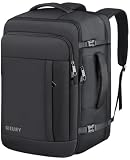
- 【50L Max Capacity — Enhanced Back Panel Padding】Expandable design boosts storage up to 50L, solving the “not enough space” problem for 3–7 day trips. Easily fits outfits, shoes, jackets & travel essentials without overstuffing. Features high-density foam cushioning for extended comfort during long-term wear, reducing back fatigue.
- 【TSA Flight Approved — No More Airport Hassle】Designed to fit overhead and underseat on major airlines carry on requirements. The lay-flat 180° laptop section speeds you through TSA without removing your device. Converts from backpack to suitcase mode, and the luggage strap keeps your hands free during long airport lines.
- 【Shoe Compartment — Ergonomic Shoulder Straps】Bottom shoe compartment fits size 5–12 shoes and keeps dirty items separated from clean clothes. Can also be used for toiletries, wet items, or gym gear—solving messy packing issues. Wide padded straps with contoured design evenly distribute weight across shoulders, minimizing pressure points.
- 【Laptop Compartment—Smart Organization】Dedicated 17” laptop pocket, spacious dual-zip main compartment, and multiple interior pockets create a clutter-free packing experience. No more digging for chargers, documents, or small essentials.
- 【Built for Heavy Use—Durable & Travel-Proof】Crafted with water-repellent material, strong metal zippers, and reinforced stitching. Built to handle daily commutes, weekend getaways, and international trips.
Traveler with mobility or sensory access needs
Ask each operator for the precise assistance process before purchase. Verify step-free access at both stations or terminals, boarding ramps, accessible toilets, seating, luggage handling and the notice period for a wheelchair or other device. A theoretically short route is not a good alternative if a required transfer cannot be made reliably.
Traveler carrying a bicycle or specialist equipment
Check reservations and packing rules on every leg. Some trains require a dedicated bicycle space; coaches may limit bikes to a small number; ferries may be easier for a complete bicycle but still require a booking. Compare the equipment fee and handling risk with renting at the destination.
Common mistakes and how to avoid them
- Comparing only scheduled flight time: Add every airport and city transfer.
- Using a national average as a personal emissions result: Treat EEA figures as directional and account for occupancy and vehicle or vessel type.
- Assuming “direct” means central: Check the exact station, terminal or port and the final local connection.
- Buying separate international tickets without a buffer: Allow for delays or purchase a protected through itinerary.
- Ignoring luggage rules until the platform: Confirm size, weight, bicycle and equipment conditions before payment.
- Choosing a car without pricing parking and fatigue: Include both money and the driver’s recovery time.
- Treating every ferry as equivalent: Check vessel type and sailing reliability, not just the route map.
- Planning a cycling distance by map alone: Account for terrain, weather, safety, luggage and daylight.
- Assuming today’s timetable is permanent: Recheck schedules, disruption policies and accessibility arrangements close to departure.
What the European policy direction means for travelers
The European Commission’s 2021 mobility strategy targets carbon-neutral scheduled collective travel for journeys under 500 kilometres by 2030 and aims to double high-speed rail traffic across Europe by the same year. These are policy objectives, not guarantees about a specific route today. They do indicate where service expansion and investment are intended to go: more collective options for the distances at which flying is easiest to replace.
An OECD survey sample reported that cars dominated long-distance leisure travel at 56%, followed by trains at 12%, buses at 10% and planes at 10%. The result describes that survey sample, not every country or traveler. It also shows why improving rail, coach and local connections can have a larger effect than persuading people who have no practical alternative.
A reusable booking checklist
- Origin and final destination, not just the nearest airport code.
- Date, departure window and tolerance for delays.
- Number of travelers and whether a car’s costs will be shared.
- Luggage, bicycle, child equipment or specialist equipment.
- Accessibility assistance, step-free transfers and required notice.
- Door-to-door duration for train, coach, car, ferry, cycling and flight.
- Fare plus local transfers, parking, tolls, charging and baggage fees.
- Connection protection, change rules and disruption policy.
- Weather, rest breaks and a safe fatigue plan for driving or cycling.
- Current timetable and operator confirmation immediately before departure.
For most journeys of a few hundred kilometres or less, a direct train is the first comparison worth making. A coach fills coverage gaps; a shared car wins on group flexibility and rural access; a ferry works when the water crossing is genuinely direct; cycling and local transit suit the shortest safe routes. The best alternative is the one that meets your complete door-to-door needs, not the one with the shortest headline segment.
Quick Recap
Product prices and availability are accurate as of the date/time indicated and are subject to change. Any price and availability information displayed on Amazon at the time of purchase will apply.

