The Tool Desk
Outbyte Driver Updater FREEFix the driver behind crashes, sound loss and screen glitchesFind Drivers →Outbyte PC Repair FREEClear out junk files and repair common Windows errorsFree Scan →There is no single best algaecide for every above-ground pool. The practical choice is usually between two chemistries: copper-based products and quaternary ammonium compounds (“quats”), with polymeric quats (polyquats) as the most important subtype. Which one fits your pool depends on your algae problem, your water chemistry habits, and whether staining or foaming is the bigger risk for you. The product label, not a general “pool safe” claim, should make the final decision.
Two chemistries with different trade-offs
The U.S. Centers for Disease Control and Prevention, in the 2024 Model Aquatic Health Code Annex, describes copper-based products and quats as the two main non-halogen algaecide groups. Some products combine both. The table below compares the points that most often decide a purchase.
As an Amazon Associate I earn from qualifying purchases.
| Factor | Copper-based algaecide | Quat or polyquat algaecide |
|---|---|---|
| Staining | CDC warns that misuse can cause staining. Proper pH control reduces that potential. | CDC states that quats do not stain pool surfaces. |
| Foaming | CDC contrasts copper products with simple quats, which commonly foam. | Simple quats can foam when overdosed, especially in pools with water features. CDC says polyquats do not cause foaming under those conditions, even when repeatedly used at the maximum label dose. |
| Algae coverage | Can be used against several algae types. CDC notes particular effectiveness against mustard and green algae. | Varies by product. Check the algae listed on the label. |
| Water chemistry | Use depends on pH control to limit staining potential. | Dosing and compatibility depend on the specific product label. |
Read the table as a set of conditional statements, not a verdict. A copper product is not automatically a staining product, and a quat is not automatically a foaming product. The distinctions below explain when each risk actually matters.
Recommended Free Tools
Staining versus foaming: how to weigh them
Copper and staining
Copper staining is a misuse problem. The CDC annex attributes the risk to improper use and says that controlling pH helps minimize it. If you run copper algaecide in a pool that is regularly out of balance, you are accepting a higher staining risk than the product itself implies. Keeping water chemistry steady is the simplest way to reduce it.
#1 Best Overall

- Pool Algae Treatment: Our Pool Algaecide and Clarifier is specially formulated to treat existing algae while providing long-lasting defense against stubborn growth, ensuring that your pool remains clear and algae-free for an extended period of time.
- Maintain Crystal Clear Water: Kills and prevents all types of swimming pool algae (green, mustard, black algae) for crystal clear swimming pool water.
- Non-Foaming Formula: Spend less time maintaining and more time enjoying your pool with this Swimming Pool Algaecide and Clarifier, which features a non-foaming formula.
- Suitable for Use in All Types of Pools: This product is proven to meet the needs of every pool owner, as it is compatible with all types of pools, including saltwater pools. You can trust our product to deliver exceptional performance and keep your pool water clean and clear.
- For best results, add to the deepest end of the pool with the filter running. Circulating pool water when applying chemicals helps disperse chemicals throughout the pool for maximum coverage
Quats and foam
Simple quats commonly foam when they are overdosed, and the risk rises in pools with water features such as fountains or waterfalls that agitate the surface. Polyquats are described differently. The CDC annex says polyquats do not cause foaming under those conditions, even when repeatedly used at the maximum label dose. The manufacturer of HASA-CIDE, a polyquat, makes a related warning: overuse can cause foaming or cloudiness, increase chlorine demand, leave organic residues, and contribute to nitrate buildup and recurring algae. Those are manufacturer statements, not findings from an independent comparison.
Matching a product to your pool
Start with the problem you have, then narrow the choice using the following questions.
Rank #2

- BENEFIT: Get long-lasting protection from extreme algae; This non-foaming algae control kills and prevents blooms of all algae types
- OUR STRONGEST ALGAE CONTROL: Kills, prevents and protects against regrowth of heavy green, black and mustard swimming pool algae for up to 3 months
- NON-FOAMING, FAST-ACTING: Add HTH Algae Guard Ultra directly to your swimming pool water and swim right away
- COMPATIBLE WITH ALL POOLS: This non-staining formula is great for all swimming pools including vinyl-lined and saltwater systems
- YOU'RE ALL CLEAR WITH HTH: For best results, use HTH Algae Guard Ultra every 3 months; Works great with HTH Shock products
- What algae is it? Confirm the algae named on the label. Green, mustard, and black algae are listed on different products, and no product should be assumed to cover all of them.
- Does the pool have a water feature? If yes, a simple quat carries a higher foaming risk when overdosed. A polyquat or copper product may be a better fit.
- Is staining the bigger concern? Quats do not stain according to CDC. Copper products can stain if misused, so pH control becomes a condition of use.
- Do you want to avoid copper? Search phrases such as “copper-free algaecide recommendation” reflect this preference. Non-copper options are quat or polyquat formulas, so check the label for each product’s active ingredient.
- Does the label make the claims you need? A product’s registered claims are what it is permitted to promise, so match the algae and pool type to the wording on the label.
Product examples from labels and manufacturer pages
The following examples show that commercially available products fit each chemistry. They are not a ranking, and none of them has been shown to outperform the others in an independent test.
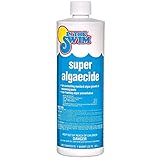
In The Swim Super Algaecide
The manufacturer describes this product as a copper-based formula for above-ground or in-ground pools and gives its own dosage directions. Those directions and the product’s current retail listing should be checked before purchase, because the manufacturer’s page is a marketing source rather than an efficacy test.
Rank #3

- 90 Day Algae Control - AquaDoc Double Whammy is a copper-based algaecide for pool designed to help prevent algae growth for up to 3 months when used as directed, supporting long-lasting algae control in balanced pool water.
- For Use Against Common Pool Algae - Formulated for use against blue-green, green, yellow, mustard, and black algae when used as directed. For severe algae, additional steps such as brushing, shocking the pool, adjusting pH to 7.2, and adequate filtration are recommended for best results.
- Non-Foaming, Non-Staining Formula - Designed not to foam or stain, helping maintain pool surface appearance. Suitable for all pool types, including inground and above ground pools. Dilute in a bucket of pool water before adding to pools with plaster finishes.
- Helps Reduce Chlorine Demand - Formulated to reduce chlorine demand when used as directed, working alongside your regular sanitizer as part of routine maintenance. Keep your chlorine or other sanitizer at its normal level; this algaecide supports your sanitizer, it does not replace it.
- Simple Dosing - Apply 16 fl oz per 10,000 gallons of pool water for algae prevention, or 32 fl oz per 10,000 gallons for severe algae. Always follow label instructions for complete directions.
HASA-CIDE
HASA describes HASA-CIDE as a 40% polyquat concentrate for swimming pools. The manufacturer says not to exceed recommended doses or use the product in place of routine sanitizer maintenance. This is a useful example of a polyquat, but its manufacturer warnings should be read alongside the label’s own directions.
AlgiTec 7.0
The EPA label for AlgiTec 7.0 lists copper triethanolamine complex at 24.75% as the active ingredient. It includes pool-use claim language, including language for above-ground pools, some of which is approved and some of which is optional. Optional bracketed wording should not be treated as a claim that applies to every retail version of the product. The label carries this caution: “CAUTION: Causes moderate eye irritation. Harmful if swallowed, absorbed through the skin or inhaled.” That wording applies to this product’s label, not to all algaecides.
Rank #4

- Fast-Acting Algae Treatment: Clorox Pool & Spa Swimming Pool Algaecide helps prevent and treat green pool algae quickly and controls algae growth in pools keeping it crystal clear.
- Non-Foaming Formula: It effectively eliminates algae growth and offers longer-lasting protection for your pool without any foaming.
- Effective Kill & Preventative Treatment: Clorox Pool&Spa Swimming Pool Algaecide effectively kills existing algae and prevents future growth, ensuring a pristine pool environment.
- Suitable for All Pools: This non-foaming formula suits all types of pools, including saltwater pools.
- Clorox Pool App: Test like an expert anytime, anywhere with the Clorox Pool App. Solve common swimming pool problems and get personalized product and dosage recommendations.
BioGuard Banish
The EPA label for BioGuard Banish includes pool-use claims for green, mustard, and black algae. It also has optional non-foaming and non-staining language in bracketed form, which means those claims may not appear on every version. Check the registered label for the exact claims that apply to the package you are buying.
What’s actually slowing this PC down?
Pick the symptom - the matching free tool is one click away.
Confirm the EPA registration and label
In the United States, a product that makes pest-control claims must be registered. The U.S. Environmental Protection Agency explains that under the Federal Insecticide, Fungicide and Rodenticide Act (FIFRA), “pesticide products must be registered with the Environmental Protection Agency (EPA) and bear EPA-approved labeling before they can be lawfully sold or distributed in the United States.” CDC notes that the vast majority, but not all, pool products on the market have current EPA registrations.
Best Value
- Effective Maintenance: Ideal for spring openings and routine care, reducing algae growth with a long-lasting copper-based formula
- Powerful Algae Control: Highly concentrated to eliminate yellow and mustard algae with small, easy-to-measure doses
- Stain Protection: Formulated with 23.5% copper triethanolamine and 7.1% chelated copper to prevent pool staining
- Swim-Ready Safety: Free of harmful chemicals, allowing immediate swimming after application
- User-Friendly Formula: Non-foaming, low-odor, and perfect for those sensitive to strong chemical smells
- Find the EPA registration number on the package and confirm it against the label you are buying.
- Do not rely on a “pool safe” or similar marketing phrase. It is not a regulatory claim.
- Know that a pool shock or oxidizer is not automatically an algicide. EPA says such products should carry this statement: “This product is neither a sanitizer nor algicide. For control of microorganisms in pool, spa, or hot tub water, or algae control, use an EPA registered product.”
How to apply an algaecide
Use these steps as a general sequence, then follow the exact dose and timing on your product’s label.
- Read the label and confirm the algae it targets and the pool volume it is dosed for. Calculate the amount from your actual water volume rather than estimating.
- Test and adjust the water before dosing. For copper products, bring pH into the range the label specifies, because pH control is the main way to limit staining.
- Confirm that your regular sanitizer routine is in place. An algaecide is not a substitute for sanitizing, as the HASA-CIDE manufacturer warns.
- Brush the walls, floor, and steps thoroughly. CDC’s 2024 annex states, “In practice, most algaecides are reasonably effective when applied according to their EPA accepted label directions and the application is coupled with frequent and thorough brushing.”
- Add the product as directed and run the filter for the time the label specifies.
- Retest the water and watch the surface. If foam appears after dosing, suspect overdosing first, especially with a simple quat in a pool that has a water feature.
Limits of this comparison
- No independent head-to-head trial of these products in above-ground pools was found. The product examples reflect label and manufacturer information only.
- Prices, stock, reviews, and retail terms were not verified and change frequently.
- Labels are version-specific and can be revised. Confirm the current label before you dose.
- The CDC guidance cited here is the 2024 Model Aquatic Health Code Annex, and the EPA regulatory points reflect the agency’s label guidance at the time of writing.
If you want a single shortlist, choose by chemistry first: a copper-based product if staining is not a concern and you can keep pH controlled, or a polyquat if you have a water feature or want to avoid copper. Then confirm the algae claim and EPA registration on the label of the exact product you intend to buy.
Quick Recap
Product prices and availability are accurate as of the date/time indicated and are subject to change. Any price and availability information displayed on Amazon at the time of purchase will apply.

