The best 3D scanner for a 3D printer is the one that matches your object size, required detail, surface, computer and workflow. Tom’s Hardware names the Creality Sermoon P1 its best overall consumer scanner, but its $3,299 launch price, color-texture limitations and declining frame rate on large objects make it a poor universal recommendation. For small parts, a dedicated small-format scanner such as the Revopoint MINI 2 is a more logical starting point; medium objects suit the MIRACO, while the Trackit is aimed at large objects. Treat those as use-case shortlists, not guarantees: verify the exact scan volume, mode, software compatibility and current bundle before buying.
What “best” means for a 3D-printer workflow
A scanner does not make a printable model simply by recording an object. It creates capture data that normally needs alignment, noise removal, hole repair, mesh editing and sometimes CAD reconstruction before it can enter a slicer. The right choice therefore depends on the complete job rather than a single headline accuracy number.
As an Amazon Associate I earn from qualifying purchases.
- Object size: a scanner optimized for miniature components is not efficient for a motorcycle panel or furniture part.
- Required detail and dimensional accuracy: decorative replicas, replacement covers and reverse-engineered mating parts have different tolerances.
- Surface: glossy, black, transparent or texture-poor materials can defeat optical tracking unless the scanner and preparation method support them.
- Portability and operation: standalone capture is convenient on a workbench or at a repair site; a tethered scanner can provide more computing power and a larger screen.
- Host computer: structured-light and infrared captures can require substantial RAM and GPU resources during alignment and meshing.
- Output workflow: confirm that the scanner’s software exports a format your mesh editor, CAD package and slicer can use.
- Total cost: include calibration targets, turntables, markers, a capable computer and any required software, not just the scanner body.
Shortlist by the job you need to do
| Typical job | Model to investigate first | Why it fits | Checks before purchase |
|---|---|---|---|
| General consumer and prosumer scanning, with occasional standalone work | Creality Sermoon P1 | NIR structured light plus blue laser, onboard operation, USB and Wi-Fi connectivity, and a reported minimum scan volume of 5 × 5 × 5 mm | Current regional price and bundle; performance on your object size; color-texture expectations; software export path |
| Small parts and fine details | Revopoint MINI 2 | Named as the small-format pick in a 2026 buying guide | Model-level scan volume, working distance, tracking method, surface preparation and current software support |
| Medium-sized objects with a portable workflow | Revopoint MIRACO | Named as the medium-object pick in the same guide | Supported scan modes, maximum object dimensions, battery or standalone limitations, and export formats |
| Large objects | Revopoint Trackit | Named as the large-object pick in the 2026 guide | Required tracking accessories, room for movement around the subject, alignment strategy and computer requirements |
| Beginner or mobile scanning | Creality CR-Scan Ferret Pro or Ferret SE | Creality positions the Ferret line for beginners and portability | Exact variant, regional bundle, supported phone or computer platform and connection method |
| Computer-tethered infrared capture | Shining 3D EINSTAR | Infrared VCSEL structured light with a published 0.1–3 mm point-distance range | Computer capacity, working distance, lighting, software version and whether the tethered setup suits your workspace |
The shortlist reflects named editorial picks and manufacturer specifications, not a guarantee that one model will outperform every alternative on your object.
Windows Errors? Fix Them Before They Spread
Repair common Windows errors and clear accumulated junk for a smoother, more stable PC - no reinstall needed.Free scan · no reinstallOutdated Drivers Are Slowing You Down
One free scan finds every outdated or missing driver and matches the right update for your exact hardware.Free scan · exact hardware matchCreality Sermoon P1: the named overall pick, with important trade-offs
Tom’s Hardware’s 2026 consumer guide calls the Sermoon P1 its best overall consumer 3D scanner. That is a defensible starting point for a buyer who wants one device covering small and medium work, but it is not an objective industry-wide winner. The same evaluation describes the scanner as expensive, reports that its color texture did not meet expectations, and notes that frame rate drops on large objects when using standalone NIR mode.
#1 Best Overall

- Wireless Scanning & Interactive Streaming: Built-in WiFi 6.0 enables on-the-go, structured light mobile scanning or real-time PC-to-mobile interactive scan streaming for seamless remote operations and more flexibility.
- Scan Challenging Surfaces Without Scanning Spray: Easily capture details on reflective or dark surfaces with 11 infrared laser lines, no scanning spray needed.
- Dual Scanning Modules: Boost scanning efficiency with INSPIRE 2's infrared structured light and multi-line laser scanning modes, making it easy to handle different materials, sizes, and environments.
- Accurate Models & Advanced Calibration: Create highly detailed models with an accuracy of up to 0.05 mm and precision of up to 0.03 mm. A high-precision calibration board boosts point cloud accuracy by 75%, ensuring consistent, precise data for 3D printing, reverse engineering, and detailed modeling.
- Outdoor Scans & Lightweight Design: Scan in outdoor environments with up to 20,000 lux lighting, ensuring reliable performance in shaded or semi-bright conditions. At only 190g, the INSPIRE 2 is lightweight, and its aerospace-grade aluminum alloy front panel offers increased durability and portability.
| Published or reported specification | Figure or capability | How to interpret it |
|---|---|---|
| Capture technologies | NIR structured light and blue laser | Different modes are intended for different surfaces and detail levels; choose the mode documented for your object. |
| Accuracy | Up to 0.02 mm | An “up to” specification is a best-case claim, not the accuracy of every scan or mode. |
| Resolution | 0.05–2 mm | The range indicates that selectable detail depends on the capture mode and conditions. |
| Minimum scan volume | 5 × 5 × 5 mm | This is a reported minimum volume, not a promise that every 5 mm feature will track reliably. |
| Capture rate | Up to 60 FPS | Large-object standalone NIR work can run at a lower frame rate, according to the review. |
| Texture | Color texture capture | The review found color texture performance below expectations, so inspect sample scans if appearance matters. |
| Operation and connection | Standalone, USB and Wi-Fi | Standalone use reduces dependence on a workstation; USB or Wi-Fi can support a computer-based workflow. |
| On-device editing | Mesh editing described as good | Basic cleanup can happen on the device, but complex repairs or CAD reconstruction may still require desktop software. |
| Launch price | $3,299 | This is the historical launch price reported by Tom’s Hardware, not a current offer. Check your region and bundle. |
Choose the Sermoon P1 when standalone convenience, multiple capture technologies and a broad consumer workflow justify the cost. Choose something else when your priority is inexpensive beginner scanning, a very small specialist field of view, or dependable color reproduction.
Pick the scanner around your object size
Small parts and fine features
Small gears, brackets, figurines and replacement knobs benefit from a short working distance and dense sampling. The 2026 buying guide names the Revopoint MINI 2 for this category. Before ordering, check the smallest feature the current software can track, the recommended distance from the object, whether markers are needed and how the scanner handles dark or reflective plastics. A scanner can quote high accuracy while still missing a narrow slot if the slot is below its practical point spacing or hidden from the camera.
Medium objects
Helmets, tools, appliance panels and similar items need enough field of view to reduce the number of passes without sacrificing registration. The guide names the Revopoint MIRACO for medium objects. Confirm whether its standalone workflow can complete the entire capture, how long a session can run, and whether the final mesh can be exported directly to the software you use for repair and slicing.
Large objects
Vehicle panels, furniture components and body-sized subjects require tracking over a larger area and room to walk around the object. The guide names the Revopoint Trackit for large work. Large scans are especially sensitive to drift: plan stable reference features, consistent lighting and a clear path around the subject. Check the required tracking accessories and the computer needed to align a large point cloud before treating the scanner as portable.
Accuracy, resolution, point distance and speed are different
Manufacturers and reviewers use several terms that are easy to conflate:
Rank #2
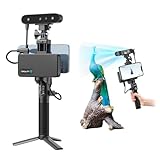
- 【High Accuracy & Fast Scanning】The Creality CR-Scan Ferret Pro 3D scanner delivers up to 0.1mm accuracy, 0.16mm resolution, and 30FPS scanning speed. It captures detailed dimensional data and complex shapes smoothly, creating highly realistic 3D models with ease.
- 【WiFi6 Wireless Transmission】Featuring advanced WiFi6, this handheld 3D scanner offers speeds 3x faster than WiFi5. The high bandwidth ensures stable, efficient data transfer for high-precision scanning and smoother workflow.
- 【Outdoor Scanning & Flexible File Export】Powered by upgraded optical technology and intelligent algorithms, the scanner delivers reliable performance in outdoor environments with ambient light up to 30,000 lux. Export models in OBJ, STL, or PLY formats for seamless integration with 3D printing, design, and reverse engineering workflows. For optimal results, avoid scanning highly reflective, transparent, or extremely dark surfaces.
- 【Anti-Shake Tracking】Equipped with one-shot 3D imaging, the Ferret Pro improves tracking accuracy and scanning success rates. Even with hand movements or quick object shifts, it ensures smooth, error-free scanning—perfect for beginners.
- Ferret Series Performance requirements: Windows: i5-Gen8 CPU or later Windows 10/11 (64-bit), RAM: >8GB, Software: >V2.3.0 Mac OS: M1/M2/M3/M4 series, macOS 11.7.7+ or Intel i5-Gen8+, RAM: >8GB Android: OS: Android 10.0+, RAM: >8GB, Connectivity: Wi-Fi 6, App: V2.0.2 iOS: Model: iPhone 11+, iOS 15+, RAM: >4GB
- Accuracy describes how close a measured result is to a known dimension. “Up to 0.02 mm” for the Sermoon P1 is a maximum published figure under stated conditions, not a universal tolerance.
- Precision or repeatability describes how consistently repeated scans agree with one another. A scanner can repeat a biased measurement very consistently.
- Resolution usually refers to the smallest separable detail or spacing in a particular mode. The Sermoon P1’s reported 0.05–2 mm range spans multiple settings.
- Point distance is the spacing between sampled points. EINSTAR publishes 0.1–3 mm, a range that changes with capture setup and distance.
- Speed can mean frames per second, points per second or a complete-object capture time. Compare only like-for-like modes and working distances.
Revopoint’s published comparisons list different accuracy and capture figures across models and modes. Read the working distance, field of view, lighting and surface assumptions next to each number. A headline “up to” value should guide questions, not substitute for a sample scan of your own part.
Surface, texture and lighting determine whether capture works
Optical scanners need enough reflected or projected pattern for their cameras to track. Transparent parts can let light pass through; glossy parts can produce saturated highlights; black parts can return too little signal; and a plain, textureless surface gives software few natural features for alignment. No single scanner is documented as capturing every difficult surface successfully.
The Tool Desk
Outbyte Driver Updater FREEScan for outdated or missing drivers - takes under a minuteDriver Scan →Outbyte PC Repair FREEClear out junk files and repair common Windows errorsFree Scan →- Use the mode recommended for the material in the model’s documentation. A blue-laser mode and an infrared structured-light mode may behave differently on the same object.
- Diffuse harsh reflections with a removable, scanner-safe matte treatment when the object allows it. Test a small area first and avoid coating parts that could be damaged.
- Add removable reference markers to large, repetitive or texture-poor surfaces so successive passes can register.
- Keep lighting stable. Moving sunlight or rapidly changing shadows can alter the pattern between passes.
- Rotate the object or scanner to expose undercuts. A clean view from one angle cannot recover geometry hidden behind a lip.
Texture capture is separate from geometric capture. A mesh can be dimensionally useful even when its color texture is disappointing, as the Sermoon P1 review illustrates.
Standalone versus computer-tethered scanning
Standalone operation
A standalone scanner can record and sometimes edit data without carrying a laptop around the object. This is useful for field measurements, workshops and quick previews. The trade-off is finite onboard storage, battery life and processing capacity. The Sermoon P1 supports standalone, USB and Wi-Fi operation, but its reported frame rate falls on large objects in standalone NIR mode.
Tethered operation
A computer-tethered scanner can use the host’s screen, storage and GPU during capture and alignment. It is often easier to inspect tracking quality while scanning, but the workstation becomes part of the purchase. Shining 3D’s published EINSTAR requirements include 32 GB of RAM on Windows and Mac configurations, alongside other operating-system and graphics requirements that can change with software releases. Check the current requirement page for your exact OS, GPU and driver before buying.
Rank #3

- EASY TO USE FOR BEGINNERS – Perfect for entry-level users, DIY creators, and 3D printing enthusiasts. Quick start, with simple practice giving optimal scan results.
- SMOOTH WIRELESS SCANNING – WiFi6-powered Ferret Pro ensures fast, stable scanning. Works with Windows, macOS, Android, and iOS for flexible cross-platform use.
- HIGH-PRECISION 3D MODELS – Capture detailed 3D models with full-color 24-bit scanning and anti-shake technology. Offers up to 0.1mm accuracy with full-color scanning. Ideal for objects from 50mm to 2000mm. Not suitable for very small or highly detailed items like jewelry or precision parts.cccc
- VERSATILE OUTPUT & ENVIRONMENT – Export in OBJ, STL, or PLY. Works reliably in most settings, including outdoor light (<30,000 lux). Avoid reflective, transparent, or very dark surfaces for best results.
- LIGHTWEIGHT & PORTABLE – Weighing just 105g, carry and scan anywhere—home, studio, or on the go. Compact, convenient, and ready for travel.
For either approach, reserve free disk space for raw frames, point clouds, intermediate meshes and backups. A scan that fits in the scanner’s memory may still produce a large project once several passes are aligned.
What’s actually slowing this PC down?
Pick the symptom - the matching free tool is one click away.
The scan-to-print workflow, step by step
- Define the print objective. Decide whether you need an appearance replica, a dimensionally functional replacement, a mold, or a reference mesh for CAD. Functional mating surfaces demand more checking than a decorative copy.
- Measure critical dimensions first. Record caliper measurements, hole diameters and overall lengths. These references let you detect scale or drift errors after scanning.
- Prepare the object and workspace. Remove loose dirt, stabilize moving parts, control reflections where appropriate and arrange even lighting. Place markers when the scanner’s tracking method calls for them.
- Select the capture mode. Choose the documented mode for the object’s size, material and detail. Set the recommended working distance instead of chasing a maximum specification.
- Capture overlapping passes. Move at a steady speed and keep overlap between views. Watch the live tracking indicator; pause and reacquire if alignment is lost rather than continuing with bad data.
- Register or align the passes. Use marker-based, feature-based or hybrid alignment supported by the software. Inspect seams and verify the measured references from step two.
- Remove noise and unwanted geometry. Delete the stand, turntable, hands and stray points. Keep a copy of the raw project before destructive cleanup.
- Build and repair the mesh. Merge aligned scans, fill only appropriate holes, smooth cautiously and preserve sharp edges. Automatic hole filling can invent geometry across openings that should remain open.
- Use CAD when the part must fit. A scan mesh is often best used as reference geometry. Rebuild planes, cylinders, threads and mating surfaces parametrically when tolerances matter.
- Scale and orient the model. Compare the final mesh or CAD body with your physical measurements, set units explicitly and orient the part for strength and support efficiency.
- Export and slice. Export a format accepted by your mesh editor or CAD tool, then export a watertight model to the slicer. Check wall thickness, manifold status, normals and overhangs before generating G-code.
- Validate with a test print. Print a small section or low-cost prototype first. Measure the result and adjust the CAD model or slicer settings instead of assuming scan accuracy transfers directly to printed dimensions.
Software, formats and compatibility checks
Ask these questions before paying:
- Does the scanner include software for capture, alignment, mesh generation and export, or are some functions separate?
- Can it export the formats your current tools accept, and does export preserve units and color texture where needed?
- Can you reopen a project later to add a pass or redo alignment?
- Does the software run on your operating system and graphics hardware, and are updates still supplied for that version?
- Can the workflow produce a watertight mesh, or will you need another application for hole repair and remeshing?
Compatibility is not only a file-extension question. Large scans can exceed the practical memory of a lightweight laptop, and a technically supported format may still lose scale, normals or per-vertex color during conversion.
Independent reader supportYour contribution helps us test, update, and keep practical guides available for everyone.How much should you budget?
The only dated price in the available specifications is the Sermoon P1’s $3,299 launch price reported by Tom’s Hardware. It is historical and should not be presented as today’s retail cost. Current prices, regional stock, bundles and included accessories change, so compare the exact listing you can buy.
Use a total-cost checklist rather than a scanner-only budget:
- scanner and the correct regional bundle;
- tripod, turntable, calibration target or tracking markers, if required;
- matte spray or other surface-preparation supplies for difficult finishes;
- computer, storage and backup capacity;
- software needed for mesh repair, CAD reconstruction or conversion;
- time for rescans, cleanup and test prints.
A lower-priced beginner scanner can be the better value when you mostly capture rough references, while a costly model can pay for itself when repeated reverse-engineering work depends on reliable tracking and less manual reconstruction.
Rank #4

- HIGH ACCURACY & FASTER: Boasting an impressive accuracy of up to 0.1mm, a resolution of 0.16mm, and a scanning speed of 30FPS, the Creality CR-Scan Ferret SE 3D scanner demonstrates outstanding performance in capturing extensive dimensional data and intricate details to shape highly realistic models smoothly and quickly
- ANTI-SHAKE TACKING: CR-Scan Ferret SE 3D scanner equipped with the new one-shot 3D imaging technology, this advanced feature enhances tracking efficiency and significantly increases the success rate of scans , ensures smooth, error-free scanning results even with shaky hands or rapid movements, ideal for beginners
- COLORFUL & VIVID TEXTURES: The CR Scan Ferret SE color 3D scanner built-in with the 2MP high-resolution color camera, captures intricate details and colored 3D models in their original colors, vividly bringing every intricate detail to life
- FLEXIBLE SCANNING RANGE: Provides a flexible scanning range of 150mm to 2000mm and a single capture range of up to 560*820mm, easily and efficiently handles the scanning of medium to large objects
- SCAN BLACK/METAL OBJECTS WITHOUT SPRAYING: The Ferret SE is optimized for scanning black or metal objects, it doesn't required you to use a white powder or spray to create a contrasting surface for black objects, much easier and faster to help you to finish your work
Common failure modes and fixes
The scan is the wrong size
Check units and scale against a caliper measurement before editing. If the ratio is consistent, correct the scale in the mesh or CAD tool; if dimensions vary across the object, investigate alignment drift instead of applying a global scale.
Passes do not align
Improve overlap, slow the motion, stabilize lighting and add markers to featureless areas. Restart from the last known-good frame rather than accepting a visibly twisted registration.
Edges and holes are missing
Capture from additional angles, move closer within the documented working distance and expose occluded surfaces. Do not rely on aggressive smoothing or hole filling to recreate functional geometry.
Glossy or black areas disappear
Try the scanner’s recommended alternate mode, diffuse reflections with a removable treatment and control ambient light. If the documentation does not support the material, plan a test before committing to the purchase.
The computer freezes during meshing
Reduce the capture area into separate projects, close other applications, update supported drivers and confirm RAM and GPU requirements. EINSTAR’s published 32 GB RAM minimum for Windows and Mac configurations shows why a basic office laptop may be unsuitable.
The mesh looks good but the print does not fit
Compare critical dimensions before slicing, rebuild mating surfaces in CAD and print a small validation piece. Scanner accuracy, mesh processing, printer calibration and material shrinkage all affect the final fit.
Buying checklist
- Write down the smallest and largest objects you will scan in the next year.
- Mark which parts need cosmetic likeness and which need measured fit.
- Identify reflective, dark, transparent or textureless surfaces in your project list.
- Compare accuracy, point distance and speed only within the same mode and working-distance conditions.
- Decide whether standalone capture or a tethered workstation suits your space.
- Match the software’s operating-system, RAM and GPU requirements to your actual computer.
- Confirm export formats, units, texture handling and mesh-repair options.
- Price the scanner, accessories, computer upgrades and software together.
- Check current regional stock, warranty, bundle contents and return terms.
- Plan a test scan of a representative object before scanning an irreplaceable part.
Verdict: which 3D scanner should you choose?
Start with the object, not the brand or the largest number on the specification sheet. The Sermoon P1 is the clearest named all-round consumer choice, with reported up-to-0.02 mm accuracy, multiple capture technologies and standalone connectivity, but its historical $3,299 launch price and documented color and large-object limitations make it a specialist purchase rather than a default answer. For small parts, investigate the MINI 2; for medium objects, the MIRACO; for large subjects, the Trackit; for a beginner portable setup, the Ferret Pro or SE; and for computer-tethered infrared work, EINSTAR. Whichever model you select, verify mode-specific performance, computer requirements and the complete scan-to-print software path on your own representative object.
Quick Recap
Product prices and availability are accurate as of the date/time indicated and are subject to change. Any price and availability information displayed on Amazon at the time of purchase will apply.
Free tools Windows power users keep installed
One-click scans. No signup required.

