The Tool Desk
Outbyte PC Repair FREEClear out junk files and repair common Windows errorsFree Scan →Outbyte Driver Updater FREEFix the driver behind crashes, sound loss and screen glitchesFind Drivers →An automated license plate reader (ALPR) is a camera system configured to detect and read visible license plates, attach a time and location to the read, and often save a vehicle image. A traffic camera is a broader category. It might provide live roadway video, record incidents, support a traffic-law violation, or include plate-recognition software. The labels can overlap, so the hardware, enabled analytics, deployment and agency policy—not the sign on the pole—determine what is actually collected and how it can be used.
ALPR and traffic cameras at a glance
The most important distinction is recognition versus general observation. An ALPR turns a plate image into searchable text and can associate that text with a place and time. A conventional traffic camera primarily supplies video; it may or may not analyze plates. Some road cameras combine both functions.
As an Amazon Associate I earn from qualifying purchases.
| Question | ALPR system | Traffic or surveillance camera |
|---|---|---|
| Primary function | Detect, photograph and read license plates with optical character recognition (OCR). | Provide video for traffic management, live monitoring, incident review or another stated purpose; plate recognition is optional. |
| Typical record | Plate text, a plate image, date and time, location and often a vehicle photograph. | Video or still images of a roadway and surroundings; the exact fields depend on the camera and analytics. |
| Search method | Searchable plate reads and map or timeline queries; some systems generate immediate hot-list alerts. | Live viewing or review of recorded footage; searchable plate data exists only when recognition software is enabled. |
| Common operational uses | Stolen- or wanted-vehicle alerts, investigations, locating a vehicle seen near an event, tolling and some red-light or speed programs. | Congestion and incident awareness, evidence after a crash or crime, traffic enforcement and integrated camera-network monitoring. |
| Retention and sharing | Set by the collecting agency, contract and local law; there is no single nationwide period. | Also varies by camera owner, purpose, storage system, access rules and applicable law. |
A camera installed beside a signal can therefore be an ALPR, a general video camera, or a hybrid. You have to establish which functions are enabled before drawing conclusions about the data.
What an ALPR camera records
The plate image and machine-readable text
An ALPR uses visible-light and, on many installations, infrared imaging to obtain a plate picture. OCR software converts the characters into a text string. The system can retain the original color and infrared plate images along with the text result. A read is normally associated with the date, time and geographic position where the vehicle was observed.
#1 Best Overall
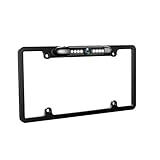
- HEAVY-DUTY LICENSE PLATE FRAME BACKUP CAMERA: Perfect for most of vehicles that use a standard US license plate. It is like a plate frame mounted on the license plate, holds the license plate securely without blocking the license plate info. Before buy, pls check your license plate size first. Not include Monitor.
- GUIDE LINE ON/OFF: Cut the Green Line, the Guide Line will be disappear. If Guide Line no disappear, please check your monitor if set with guide line
- WIDE VIEWING ANGLE: 170° viewing angle macro lens give you a wide viewing vision, high sensitive color CMOS image sensor. Lens angle physically 45° up and down adjustable on the camera, you can adjust the angle according to your needed
- MARINE GRADE WATERPROOF: Aluminum Zinc Material with IP-67 Standard waterproof , shockproof & dust-proof level, high performance in all-weather condition, Never be foggy or wet inside the camera even in a storm or serious rainy day
- TRUE COLOR NIGHT VISION No Purple : The License Plate Camera with 8LEDs, will supply you comfortable and clear image for night time and dark places. It with true color, no purple like infrared camera. The product is upgraded, it just rear camera now. Not Front Camera. If your image is reversed, pls check your monitor if set with mirror function
Systems described in a Marin County Sheriff’s Office policy can display a possible match to an officer, retrieve earlier reads with GPS-timestamped photographs and plot reads on a map. Those functions make a read more than a single snapshot: it can become an indexed event that is found again through a plate, date, map or alert query.
The vehicle and surrounding scene
The plate is the recognition target, but the camera’s field of view can include the rest of the vehicle, its occupants and nearby surroundings. Depending on the equipment and placement, an image may show:
- Vehicle color, make and model.
- Visible damage or unusual features.
- Bumper stickers or other identifying markings.
- The driver or passengers, when they are visible from the camera angle.
- Roadside buildings, other vehicles, pedestrians and the general scene.
These additional details are capabilities, not guaranteed fields in every deployment. A tightly aimed unit may capture little beyond the rear plate, while a wider view records considerably more context.
Hot-list comparisons and alerts
After OCR produces a plate string, software can compare it with a hot list. Lists may include stolen or wanted vehicles and other criteria chosen by the operating agency. A possible match can create a real-time notification for an officer. The alert is an investigative lead, not proof that the vehicle or its occupants are involved in a crime.
An ALPR read does not, by itself, contain a person’s name. Police can connect a plate to a registered owner or another individual through separate databases, records and investigative work. It is inaccurate to describe every ALPR event as a named-person record.
What a traffic or surveillance camera records
General roadway video
“Traffic camera” can refer to a municipal roadway feed, a camera used by a transportation department, a private camera shared with authorities or a surveillance camera connected to a larger network. Its core output may simply be live or recorded video showing lanes, intersections, vehicles and conditions.
Operators can use that video to watch congestion, identify a crash, direct emergency response or review what happened after an incident. Storage may be continuous, motion-triggered, event-based or limited to a short operational buffer, depending on the system.
Recommended Free Tools
Rank #2

- 【Continuous Upgraded 1080P AHD Backup Camera】After launching three car backup cameras, PixelMan further upgrade and launch the new reversing camera PMD2A-S. This car camera use the latest chip special for reversing camera made in Japan, this chip not only has excellent image output, but also has stunning performance under strong light and dark light. Strict in details and only make the best products is what PixelMan pursues. It is also essential to you, isn't it?
- 【Support HD and AHD switching】This upgraded back up camera even supports HD and AHD switching. Each optimization improves the definition, signal stability, waterproof performance, durability, installation, etc. Our vehicle backup camera can be switched to AHD signal output to achieve 1080P display (Under the premise that the screen supports AHD signal).
- 【1/2.7in AHD 1080P Large Chip Adopted in This Reverse Cam】The chip size determines the amount of reversing camera output pixels, compared with 1/4in chip used in ordinary backup cam, the most apparent feature is the enhanced brightness and color saturation besides of the sufficient clarity. The colors become more vivid and true, the increased brightness makes the images more clearly, meanwhile, the night vision effect also be enhanced, you can back the car easily without extra light at night.
- 【170° Wide Angle Optical Glass HD Lens】The lens is the core component of the reverse camera for car. The HD lens used in PMD2A-S wide angle backup camera is very different from ordinary lens in appearance, it has a larger aperture and a stronger sense of technology. High transmittance glass, fish eye appearance, F1.4 aperture, all these features directly determine the wide angle, maximum output pixels and night vision performance of the license plate camera.
- 【Back Up The Car Easily】Whether it is day or night, you can see almost everything behind the car when reversing, PixelMan camera for car reverse will let your driving easier and safer. Isn’t it what you need?
Optional analytics
Some cameras add infrared imaging, pan-tilt-zoom control or license-plate-recognition software. With recognition enabled, a camera that is otherwise described as a traffic or surveillance camera can produce plate reads similar to a dedicated ALPR. Other cameras may count vehicles, estimate speed or detect stopped traffic without identifying plates. The word “traffic” does not establish which analytics are active.
Enforcement cameras
Red-light and speed-enforcement installations are traffic-camera examples configured for a specific legal rule. They may capture a vehicle, location, time and event evidence needed for a citation. That purpose differs from an ALPR hot-list system, even though both can photograph a plate. Tolling systems can likewise use plate recognition to associate a vehicle passage with an account or payment process.
Where the categories overlap
ALPR equipment is often mounted on roads, at intersections or near traffic signals. Roadside placement does not make it a general-purpose traffic camera: the decisive feature is whether the system recognizes and indexes plates. Conversely, a pole-mounted traffic camera should not be called an ALPR unless plate-recognition capability is actually installed and operating.
Agencies can also combine feeds. A real-time crime center might display public roadway video, agency cameras and privately owned cameras in one interface. A network may include dedicated ALPR units, ordinary video cameras and enforcement cameras, each retaining different records and governed by different rules. Ask about each camera class rather than treating the network as one uniform database.
How police and other agencies use ALPR data
Immediate alerts
When a new read resembles a plate on a hot list, the system can notify an officer while the vehicle is still nearby. The alert can support a traffic stop or another investigative response, subject to agency procedure and applicable law. A match must be checked against the actual vehicle and current records before action is taken.
Historical investigation
Stored reads let investigators ask where a particular plate was recorded previously. A query can identify a vehicle seen near a crime scene at a specified time, find earlier or later sightings, or map a sequence of locations. The result shows where the system recorded the plate; it does not prove who was driving, why the vehicle was there or what happened inside the vehicle.
Travel-pattern analysis
Aggregating timestamped reads can reveal recurring routes, visits to particular areas or a vehicle’s apparent movement over time. The analytical value comes from many observations rather than one image, which is also why retention and access controls have significant privacy consequences.
Rank #3

- Super HD Day& Night Vision: Our HD Reverse Camera with new upgrade chips and glass lens, supply you HD true color, real time image at day and night. 9 Led lights will be Auto turn off in bright light areas
- Front/Rear View Camera & Guide Line On/Off: You can choose install the backup camera in front or back of your car, keep or move guide line. More flexible. Please Restart your radio again after you cut wire loops, then the image should be correct. IMPORTAT: Please Restart your radio again after you cut wire loops, then the image should be correct
- IP 69K Waterproof : Excellent waterproof design, better sealing technology, so that the backup camera can work good in extreme weather, no matter in Rain/Fog/Snow
- 149° Wide View Angle & Adjustable Lens: 149° wide view angle can meet your vision needs when driving or parking, adjustable camera lens allows you to find the best position, makes you drive safely
- Easy to Install: Easy to install, no need drilling in your car. 8M/26.2ft Long Video cable, also fit for long car, don’t need to buy a extra cable, save money. Fit for 12V Cars, Such as Pickup Truck, SUV, Minivan, Sedans, RV, Trailer and Sedans etc. Not include Screen
Cross-agency access
Sharing arrangements can allow an agency other than the collector to search or receive reads. The scope may be limited by policy, contract or law, but it is not safe to assume that data remains inside the department that installed the camera. The Electronic Frontier Foundation’s reporting on a 2016–2017 dataset found broad sharing among agencies using one vendor’s LEARN system; that finding describes the studied system and period, not every current ALPR network.
How traffic-camera footage is used
Live situational awareness
Transportation and public-safety staff can watch a live feed to spot congestion, debris, a disabled vehicle or a developing incident. In this mode, the key product is an operational view of the road, not a plate-index database.
Incident and evidence review
Recorded video can help reconstruct a collision, identify the sequence of a roadway event or provide images for an investigation. Finding a specific vehicle may require manually reviewing footage unless plate-recognition or another search index has been enabled.
Rule enforcement
A camera configured for red-light, speed or toll enforcement may capture an event under the rules of that program. Enforcement authority, notice, citation procedures and retention are jurisdiction-specific. The existence of a camera feed alone does not show that automated citations are being issued.
Integrated networks
Some agencies combine public feeds, private-camera footage and department systems in a shared monitoring environment. Integration can improve response time, but it also means that the access list, audit trail and sharing policy for the network matter as much as the capabilities of an individual camera.
Why an ALPR alert still requires verification
A plate can be misread because of glare, dirt, an obstructed character, an unusual plate design or a similar-looking neighboring plate. A hot list can also be outdated. In a documented Marin County Sheriff’s Office policy example, the system’s wanted-vehicle database was not real time. The policy states: “Once a license plate is detected by the ALPR system as being wanted or matching the Hot List, an officer must visually verify the license plate on the vehicle matches what was scanned by the ALPR system and confirm its wanted status through CLETS.”
That two-step check—visual comparison with the physical plate and confirmation through the current law-enforcement system—is an agency-policy example, not a universal rule. It illustrates the safe operational principle: an automated match is a prompt to verify, not a substitute for verification.
Rank #4
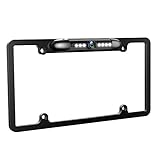
- Super HD Night Vision: Our License Plate Camera built in Latest Night Vision Nano Lens and sensor, provide 750 TV Lines,960*576 pixel pictures even in darkness, true color, no purple. AUTO-Lighting LED Lights Make Your Night Driving more Safety
- Front/Rear Camera & Guide Line On/Off: The backup camera default to Rear View with Guide Line; Cut the WHITE cable can be Front Camera; Cut the GREEN cable the Guide Line will disappear. You can choose install in front or Back to your car. IMPORTANT: Please Restart your radio again after you cut wire loops, then the image should be correct
- Wide Viewing Angle:170° viewing angle macro lens give you a wide viewing vision, Lens angle physically 45° adjustable on the camera, you can adjust the angle according to your needed, you can see all the blind spots behind the car
- Waterproof : Aluminum Zinc Material with IP-67 Standard waterproof , high performance in all-weather condition, Never be foggy or wet inside the camera even in a storm or serious rainy day
- Super Long RCA (AV) Cable: We supply 32.8 ft (10M) RCA Cable, you do not need to buy extra cable for cars, vans, and trucks (12V). Save Money. Wired Camera more reliable , more stable. The product is upgrading, for the install way, pls check the user manual. Thank you
Retention, access and sharing are policy questions
There is no universal ALPR retention period or traffic-camera data schema established by the available evidence. The answer for a particular system depends on its owner, purpose, storage design, local law, contracts and written policy. Important differences include whether the system saves only a plate read or also full-resolution video, whether all reads are retained or only alerts, and whether analysts can run historical searches.
A Marin County policy document dated 2021 and marked draft provides one example. It describes two-year retention, logged queries, an annual audit and limits on sharing with specified California agencies. It says the system is for official law-enforcement investigations or department-related civil or administrative action. Because the document is a draft example reproduced in a 2022 settlement exhibit, it should not be treated as proof of current practice in Marin County or elsewhere.
Do these 3 things before closing this tab:
1Repair Windows errors before they cause bigger problems2Fix the driver behind crashes, sound loss and screen glitches3Clear out junk files and repair common Windows errorsWhen evaluating any local system, look for explicit answers to these questions:
- Which cameras and analytic features are enabled—video only, OCR, vehicle attributes, speed, red-light or toll functions?
- What is saved: plate text, color and infrared images, full vehicle photographs, surrounding video, or all of these?
- Are reads checked against a hot list in real time, and which lists are used?
- Can authorized users conduct live searches, historical searches, map queries or both?
- How long are non-alert reads, alert records and video retained?
- Who may query the data, and are searches logged and reviewed?
- Which agencies, vendors or private partners can receive or search records?
- What procedure requires an officer to verify a possible match before taking action?
What the available scale figures do—and do not—show
Electronic Frontier Foundation and MuckRock reported more than 2.5 billion scans in records from 200 agencies using the LEARN sharing system. The scans were recorded in 2016 and 2017. In that defined dataset, 99.5% of plates scanned were not under suspicion at the time of collection.
Those figures demonstrate the potential scale of collection and the proportion of ordinary motorists whose plates can enter an ALPR system. They are not a current national total, a universal estimate of ALPR use or a measurement of every traffic-camera network. The agencies, vendor system and years in the analysis must stay attached to the numbers.
Independent reader supportYour contribution helps us test, update, and keep practical guides available for everyone.Privacy implications for drivers and passengers
Because ALPRs record passing vehicles rather than only suspects, an owner or driver can be included without any allegation of wrongdoing. A timestamped location record can later be searched, combined with other records or shared with another agency. Repeated reads can expose patterns such as a vehicle’s regular commute or visits to particular places.
Crashes, No Sound, or Screen Glitches?
Random freezes, missing sound and display glitches usually trace back to one bad driver. Find and replace yours safely.Free scan · under a minutePC Slower Than It Used to Be?
A free scan shows the junk files, broken settings and background clutter dragging Windows down - then fixes them in one click.Free scan · Windows 10 & 11Ordinary camera footage raises a different but related concern: a wide scene can include passengers, pedestrians, homes and other vehicles. If recognition software is added, the footage may gain a searchable plate index. If it is not added, investigators may still be able to identify a vehicle by manually reviewing images, but the system does not automatically produce a plate-text record.
Best Value

- The Excellent License Plate Backup Camera is compatible with a wide range of vehicles,such as cars, pickup trucks, SUVs, vans, RVs, minivans, and sedans. The back up camera functions effectively on most types of vehicles, whether they are old, new, or used.
- HD backup camera easy to install, operates with any 9-15V DC power,just need to connect reverse camera's power to revering light, then connect the reverse camera to your car DVD players, radios, monitors, or screens by 26ft AV cable. Rear view camera includes 26ft RCA video cable.
- Vehicle backup cameras equipped with the latest HD 1/3-inch image sensor and a 150° wide viewing angle lens are great for clearly checking those hard-to-see blind spots, making parking safer and simpler
- The YIMU backup camera for cars is 100% waterproof and shockproof, boasting an IP69K waterproof rating. Back up camera will never fog up or get wet, even during storms or on rainy days. Backup camera for car professional shockproof design ensures the camera operates safely for your vehicle.
- NIGHT VISION WITH 7 LEDS,YIMU Car Backup Camera built in 7 leds to provides you realistic and comfortable images for night time or dark space backing up than other infrared camera,true color,no purple.AUTO-Lighting LED lights make your night driving more safety.
Privacy protections therefore depend on more than whether a camera is called an ALPR. Retention limits, purpose restrictions, user permissions, query logging, audits, sharing controls and match-verification procedures determine how much reach the system has in practice.
How to check a real deployment in your area
- Identify the owner and purpose. Determine whether the camera belongs to a transportation department, police agency, toll operator, private property owner or a shared network.
- Request the current policy and system description. Look for camera locations, enabled analytics, data fields, retention schedules, user roles and sharing partners.
- Separate live feeds from stored records. Ask whether the system only displays video, stores video, creates plate reads or supports both live alerts and historical searches.
- Check the match procedure. Find out how operators confirm the physical plate and verify a current wanted status before a stop or other action.
- Review oversight. Look for query logs, annual or periodic audits, complaint procedures, access reviews and public reporting.
- Check the legal basis. Local statutes, public-records rules, retention laws and enforcement requirements may impose limits that differ from another jurisdiction’s policy.
Ask for the date and status of each document. A policy marked draft, an old contract or a page describing planned capability may not reflect the system operating today.
A practical comparison framework
Use these five dimensions when comparing two installations or assessing a proposed camera network:
What’s actually slowing this PC down?
Pick the symptom - the matching free tool is one click away.
| Dimension | Questions to ask | Why it changes the answer |
|---|---|---|
| Recognition versus video | Does software create plate text, or is the output only video and still images? | Recognition enables automated matching and structured searches; video-only systems generally require human review. |
| Live versus historical access | Can staff receive an immediate alert, search past reads, watch live video, or do all three? | Live alerts affect an encounter in progress, while historical search can reconstruct earlier movements. |
| Fields and images | Are plate images, full vehicle views, driver or passenger images, vehicle attributes and surrounding scenes retained? | More fields increase investigative usefulness and the amount of information about uninvolved people. |
| Operational purpose | Is the system for investigation, incident response, traffic management, tolling, red-light or speed enforcement? | Purpose determines workflows, legal authority, notices and the records likely to be produced. |
| Governance | How long are records kept, who can query them, are searches audited, and who receives data? | Governance determines the practical reach and accountability of the technology. |
Answers to the most common points of confusion
What does an ALPR camera record?
It records a plate image and an OCR-derived plate string, normally with the date, time and location. It may also save color or infrared images, a broader vehicle photograph and visible characteristics such as color, make, model, damage or stickers. The exact contents depend on the equipment and camera placement.
Are traffic cameras the same as license plate readers?
No. Traffic camera is an umbrella term for roadway and surveillance video systems. Some include plate-recognition software, but many do not. Confirm the enabled analytics instead of inferring them from the camera’s location or label.
How do police use license plate reader data?
They can receive hot-list alerts, search earlier sightings, map where a plate was recorded and analyze repeated reads for travel patterns. A read does not identify a person by name without linking it to other databases, and an alert should be verified under the agency’s procedure.
Does a plate read prove who was driving?
No. It establishes that a camera recorded a particular plate at a place and time. Determining the driver or connecting the vehicle to a person requires other evidence or databases.
Free tools Windows power users keep installed
One-click scans. No signup required.
Is there one national retention rule?
No. Retention, access, audit and sharing requirements vary by jurisdiction, agency, contract and purpose. The current local policy and applicable law are the controlling sources for a specific deployment.
Bottom line
An ALPR is a plate-focused recognition system that creates time-and-location records and can make them searchable or alert-driven. A traffic camera may collect only roadway video or may add plate recognition and enforcement analytics. To understand what a particular installation does, examine its enabled features, saved fields, search modes, retention period, authorized users, sharing partners and match-verification process. Those details—not the generic label “traffic camera” or “license plate reader”—determine the system’s real impact.
Quick Recap
Product prices and availability are accurate as of the date/time indicated and are subject to change. Any price and availability information displayed on Amazon at the time of purchase will apply.

