Yes—wired earbuds are still worth buying when a direct connection, very low latency, or freedom from earbud charging matters more to you than cable convenience. They are not automatically better sounding than wireless earbuds, and they can be awkward if your phone has no compatible audio port. The right choice depends on your device, connector, listening task, fit and tolerance for a cable.
This guide explains the trade-offs, how 3.5 mm, USB-C and Lightning connections differ, what adapters actually do, and how to check compatibility before spending money.
As an Amazon Associate I earn from qualifying purchases.
What wired earbuds still do well
Wired earbuds carry audio through a physical connection rather than a radio link. That simple arrangement remains useful in several situations:
Do these 3 things before closing this tab:
1Repair Windows errors before they cause bigger problems2Scan for outdated or missing drivers - takes under a minute3Clear out junk files and repair common Windows errors- Low-latency listening: A direct connection suits tasks where a delay is distracting, such as monitoring audio, playing games that require tight timing, or checking a recording.
- No separate earbud charging routine: Conventional passive wired earbuds do not need their own rechargeable battery for ordinary playback. You still need a powered source, and some USB-C designs contain electronics that draw power from the device, but there is no charging case to remember.
- Predictable operation: There is no pairing process, Bluetooth profile, wireless codec negotiation or radio connection to troubleshoot.
- Choice across price and design levels: The wired category includes inexpensive 3.5 mm and USB-C earbuds as well as specialist in-ear monitors. The connector alone does not determine quality; the particular model and your source setup do.
The cable is the central compromise. It can catch on clothing, limit movement and require an adapter on newer phones. If those inconveniences outweigh the benefits above, wireless earbuds are likely the more practical choice.
#1 Best Overall

- SUPERIOR COMFORT — Unlike traditional circular ear buds, the design of EarPods is defined by the geometry of the ear. Which makes them more comfortable for more people than any other ear bud–style headphones.
- HIGH-QUALITY AUDIO — The speakers inside EarPods have been engineered to maximize sound output and minimize sound loss, which means you get high-quality audio.
- BUILT-IN REMOTE — EarPods with USB-C plug also include a built-in remote that lets you adjust the volume, control the playback of music and video, and answer or end calls with a pinch of the cord.
- COMPATIBILITY — Works with all devices that have a USB-C port.
- INTEGRATED MICROPHONE — A built-in microphone precisely captures your voice while you’re on the phone, taking a FaceTime call, or summoning Siri — so you’re always heard loud and clear.
Do wired earbuds sound better?
Not as a blanket rule. Sound depends on the earbud’s acoustic design, fit, seal, tuning, source electronics and the way a wireless product is configured. A wired connection can avoid the compression and radio conditions associated with Bluetooth, but that does not make every wired model better than every wireless model.
Becky Scarrott, Audio Editor, wrote in a TechRadar article: “Even the best, most cutting-edge Bluetooth codecs of the moment still incur a degree of resolution loss, owing to various factors like your immediate environment, credentials of your source device, and which particular codecs are supported in the product you’re putting in, on, or over your ears.” That is her reported view about potential Bluetooth limitations, not a universal measurement proving that all wired earbuds sound better.
Use the connection as one selection criterion rather than a sound-quality guarantee. A well-fitting wireless earbud can sound more satisfying than a poorly fitting wired one, while a carefully chosen wired model can provide the tonal balance or isolation you want without relying on a wireless link.
Windows Errors? Fix Them Before They Spread
Repair common Windows errors and clear accumulated junk for a smoother, more stable PC - no reinstall needed.Free scan · no reinstallOutdated Drivers Are Slowing You Down
One free scan finds every outdated or missing driver and matches the right update for your exact hardware.Free scan · exact hardware matchWired versus wireless: the decision factors
| Priority | Wired earbuds may fit when… | Wireless earbuds may fit when… |
|---|---|---|
| Convenience and movement | You can route or manage a cable comfortably and the device port is easy to reach. | Freedom from a cable is your highest priority. |
| Battery dependence | You want ordinary passive playback without charging an earbud battery or case. | You accept charging and battery management for a cable-free experience. |
| Latency | Your task benefits from a direct connection and minimal link delay. | Your activity tolerates a wireless link. |
| Sound | You are choosing a specific model and source on their own merits; wired alone proves nothing. | You value the convenience of a compatible wireless product and its feature set. |
| Compatibility | Your device has the matching jack or supports the required USB-C/Lightning headset or adapter. | Your device supports the wireless product and its required features. |
SoundGuys’ February 28, 2026 comparison presents these as trade-offs rather than a universal winner. It also cautions that build quality matters, so assumptions that wired products are always cheaper or last longer are not justified.
Are wired earbuds still worth buying for a phone?
They can be, but start with the phone’s actual audio connection. A port’s shape does not by itself prove that every headset or adapter will work. Check the phone maker’s support documentation for audio support and, for USB-C, whether the phone expects a digital headset with its own converter or an analog signal from an adapter.
Phones generally fall into three relevant connection paths:
- 3.5 mm: Plug in a matching headset directly. This is the simplest path when the jack is present and enabled for audio.
- USB-C: Use USB-C earbuds designed for the device, or a USB-C-to-3.5 mm adapter that meets the device’s requirements. USB-C audio is implementation-dependent; two devices with the same-shaped port can behave differently.
- Lightning: Use Lightning earbuds or a Lightning-to-3.5 mm adapter intended for qualifying devices. Lightning accessories are not a general solution for USB-C phones.
If a phone has no compatible wired path and you do not want an adapter, wireless is the straightforward alternative.
Can I use 3.5 mm earbuds with USB-C?
Often, yes, with the right adapter—but compatibility is not automatic. A USB-C-to-3.5 mm adapter must translate the audio in a way your phone supports. Some adapters include a digital-to-analog converter (DAC); others may rely on an analog audio mode that a particular phone does not provide.
Apple documents a USB-C-to-3.5 mm adapter path for compatible devices. Samsung likewise documents connecting a 3.5 mm headset through USB-C and warns that some Galaxy devices require a DAC-compatible adapter. Therefore, match the adapter to the exact phone model and follow its support guidance rather than buying the first adapter whose plug fits.
What the DAC warning means
A DAC converts digital audio data into the analog signal a conventional 3.5 mm earbud needs. When the phone does not perform that conversion at the port, the adapter has to do it. A passive-looking adapter without the necessary electronics may produce no sound, intermittent sound or an accessory error. SoundGuys explains that USB-C playback can rely on the headphone’s internal DAC and amplifier; this is why USB-C earbuds and USB-C adapters cannot be treated as interchangeable with a simple 3.5 mm cable.
USB-C earbuds are not universally interchangeable
USB-C defines the connector, not a single guaranteed audio implementation. The SoundGuys discussion of Apple EarPods in 2026 and a TechRadar review both report compatibility limits on some Android devices. Treat every USB-C headset as device-dependent until the manufacturer confirms support.
Free tools Windows power users keep installed
One-click scans. No signup required.
Do wired earbuds work with my iPhone, iPad or other Apple device?
Apple lists separate accessory paths for USB-C and Lightning devices. Apple USB-C EarPods require an iPhone, iPad or other device with a USB-C connector. That identifies the connector requirement, but you should still confirm that your particular device supports audio through its USB-C port.
For qualifying Lightning devices, Apple documents Lightning EarPods and a Lightning-to-3.5 mm adapter. Do not use that guidance to assume a Lightning accessory will work with a USB-C device; the connector and audio implementation are different.
Rank #2
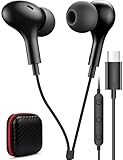
- USB C Headphones with Microphone for iPhone Duo,18 Pro,18 Pro Max,17 Pro Max,17 Pro,17,Air,17e,16e,16,16 Pro,16 Plus,16 Pro Max,15,15 Plus,15 Pro,15 Pro Max,for Samsung S26 S26+ S26 Ultra,S25 FE,S25,S25+,S25 Ultra,S24,for Google Pixel 11 Pro XL 10a 10,9a,9,8a,8,7a,7,Z Flip,Fold,S23 FE,S23,A17 A16,A26,A37 A36,A57 A56 A55 A53 A54,A33 A34 A35,S22,S21 FE,S21,S20,for Galaxy Tab,for OnePlus,for Macbook Pro,for iPad A16 10,Pro,Mini 6 7,Air 4 5 6,for Moto G Play 2026,for Nothing Phone,C audio device
- Secure Fit and Stereo Sound: Passive Noise Canceling In-ear design earbuds block the noise outside to achieve outstanding sound quality. The shape of the earbuds is unique and ergonomic, makes it a good looking accessories for your phone or other usb c devices, It will fits-nicely for long time comfortable wearing, Comes with 2 extra silicone tips S or L for your choices, NOTE: If the earbuds has No Sound when using on mobile, go to Setting-Developer Options, find Disable USB audio routing, Close this option
- Built-in Mic and Volume Control: Wired earphones with built-in mic and remote control allow you to answer or end call, play or pause song, skip next or previous song, adjust volume without picking up your phone while working out, driving a car, or on the go; Warm Tip: The default setting for audio Output and Input of some laptops or desktops are speaker, pls Go to Setting, find Sound, Input or Output, Select a Device for Sound Input or Output, then choose USB, to make the earbuds work
- Magnetic Design and Hands Free: This USB Type C Earphone allow you to wear it around neck when you take the earbuds off to prevent wire tangled; And you can always reach them easily when you need to put them on; Meanwhile, it comes with a carrying case to storage the earbuds, earbuds adapter or other small accessories, less mess in daily use; Warm tip: Put earbuds back to case when not using to avoid tangling, damages from moisture, dust, dirt, frequent bends, etc.
- Latest DAC Chip: Support digital input signals and converts standard resolution audio to ensure you can enjoy high fidelity lossless sounds quality; Warm tip: Try replacing the eartips to another pair that comes in the package if it is too tight or loose; And make sure you use the earbuds in an environment with good signal quality to avoid poor sound quality, signal interruption or noises during calls or listening; If you don't like in-ear design, try the other half in ear style without eartips
If you are moving between devices with different ports, an adapter may be more flexible than buying several earbud versions, but the adapter adds another connection that can loosen, snag or fail. Verify the exact model and operating-system support before relying on it for work or travel.
How to check compatibility before buying
- Identify the device port. Look up the exact phone, tablet, laptop or game device model and note whether it has 3.5 mm, USB-C, Lightning or no wired audio connection.
- Check the manufacturer’s audio statement. Confirm that the port supports headsets, not only charging or data. A connector’s physical shape is insufficient evidence.
- Choose the matching accessory type. Select 3.5 mm earbuds for a working jack, USB-C earbuds for a confirmed USB-C audio implementation, or Lightning earbuds for a qualifying Lightning device.
- If using an adapter, verify DAC requirements. For Samsung Galaxy devices in particular, Samsung says some setups need a DAC-compatible USB-C-to-3.5 mm adapter.
- Check controls and microphone support. Even when audio works, button controls or the microphone may depend on the device and headset wiring. Look for explicit support rather than assuming every function will be available.
- Confirm return terms. Compatibility can vary by device implementation. A return option protects you if the connector fits but the audio path does not.
Choosing by connector
3.5 mm earbuds
The 3.5 mm plug remains the most broadly familiar wired format. It is a sensible choice when your device has a functioning headphone jack and you want to avoid digital compatibility questions. The limitation is that many current phones omit the jack, forcing an adapter or a different connector.
Recommended Free Tools
USB-C earbuds
USB-C earbuds can carry digital audio and may include their own DAC and amplifier. That can make them convenient for a USB-C device without a headphone jack, but the electronics are part of the compatibility equation. A USB-C pair that works on one phone may not work fully on another, particularly across operating systems and manufacturers.
Apple documents USB-C EarPods for devices with USB-C connectors, while reviews have found that some Android devices present compatibility problems. Confirm support for your exact device before treating USB-C as universal.
Lightning earbuds
Lightning earbuds are intended for qualifying Lightning devices. Apple also documents a Lightning-to-3.5 mm adapter route. They are not a general-purpose option for USB-C hardware, and their usefulness decreases if your devices are moving to USB-C.
Fit, isolation and comfort matter more than the cable label
Two earbuds with the same connector can feel and sound very different. Fit affects comfort, perceived bass and how securely the earbuds stay in place. Isolation affects how much outside sound reaches you and how loudly you may need to play audio.
Review findings about Apple EarPods illustrate why model-specific evidence matters: observations about that model’s fit and isolation should not be generalized to every wired earbud. Look for reviews of the exact shape you are considering, and consider whether an open design, a sealed in-ear design or another fit suits your surroundings.
- For desk listening, a cable may be easy to route and fit may be the main concern.
- For walking or commuting, cable movement and outside noise can matter more than the connector.
- For monitoring or recording, stable fit and predictable latency deserve priority.
- For shared or changing devices, connector compatibility may outweigh small sound differences.
Common problems and practical fixes
Nothing happens when you plug in 3.5 mm earbuds
- Confirm that the device actually has an enabled headphone jack.
- Remove any case that prevents the plug from seating fully.
- Test the earbuds on another compatible source to separate an earbud fault from a device setting.
- Check whether the device routes audio to another output and select the wired headset if an audio-output control is available.
USB-C earbuds or an adapter are not recognized
- Recheck the exact device model and its support documentation.
- If using 3.5 mm earbuds through USB-C, use an adapter with the DAC capability your device requires.
- Try the adapter without an extension or hub, since each extra connection adds another possible failure point.
- Inspect the USB-C plug and port for debris or physical damage, then test with a known-compatible accessory.
Audio works but the microphone or buttons do not
Audio playback and headset controls are separate compatibility questions. Confirm that the earbud’s control and microphone standard is supported by the device. If the manufacturer lists only playback support, do not assume calls, volume buttons or inline controls will work.
The cable is uncomfortable or keeps catching
Try routing the cable under clothing, using a clip or selecting a different cable length and shape. If movement is central to your routine and cable management remains irritating, wireless earbuds may better fit that use even if wired playback itself works.
When wired earbuds are the better purchase
- You regularly monitor audio or perform timing-sensitive tasks.
- You dislike charging a separate earbud battery and case.
- Your main device has a convenient, confirmed wired connection.
- You switch between sources where pairing would be inconvenient.
- You have found a particular wired model whose fit and sound you prefer.
When wireless earbuds are the better purchase
- You move frequently and a cable interferes with your activity.
- Your phone lacks a compatible jack and you do not want to carry an adapter.
- You value wireless controls or features more than direct-connection latency.
- You are comfortable charging and replacing or servicing a battery-powered product over time.
These are preference and use-case decisions, not claims that one connection is universally superior.
The Tool Desk
Outbyte PC Repair FREEClear out junk files and repair common Windows errorsFree Scan →Outbyte Driver Updater FREEScan for outdated or missing drivers - takes under a minuteDriver Scan →A simple buying checklist
- Write down every device you intend to use, not just your primary phone.
- Record each device’s connector and whether its documentation confirms wired audio.
- Pick 3.5 mm, USB-C or Lightning only after that check.
- For USB-C-to-3.5 mm use, verify DAC compatibility, especially on Galaxy devices.
- Read fit and isolation comments for the exact model; do not transfer conclusions from another earbud.
- Decide whether your main priority is movement, battery independence, latency, sound characteristics or cross-device convenience.
- Keep a return option until the earbuds have passed playback, microphone, controls and comfort checks on every intended device.
The bottom line on wired earbuds in 2026
Wired earbuds remain a sensible, often highly practical choice when you want direct audio, low latency or no earbud charging routine. Their value is conditional: the connector must match the device’s audio implementation, and USB-C or Lightning accessories can require specific support or an adapter. They do not automatically sound better, cost less or last longer than wireless alternatives.
Choose the exact model for its fit, isolation and sound, then verify the exact connection path before buying. If your devices support the earbuds cleanly and the cable does not hinder your routine, wired earbuds are still worth buying. If movement and convenience dominate, wireless is likely the better match.
Quick Recap
Product prices and availability are accurate as of the date/time indicated and are subject to change. Any price and availability information displayed on Amazon at the time of purchase will apply.

