Free tools Windows power users keep installed
One-click scans. No signup required.
Usually, yes for ink: refillable tank printers tend to have a much lower ink cost per page than cartridge printers. They are not automatically cheaper overall, because the tank printer normally costs more upfront. The right answer depends on your models, local prices, print volume, color mix, paper and ownership period.
The most useful distinction is between running cost and total ownership cost. A tank printer can use inexpensive bottled ink yet still cost more overall if you print only occasionally and never recover its higher purchase price. A cartridge printer can be cheaper to buy, but its replacement cartridges may make every page substantially more expensive.
As an Amazon Associate I earn from qualifying purchases.
What “cheaper” means in this comparison
Printer cost per page (CPP) is “the amount it costs to produce one printed page,” according to HP’s explanation of CPP. That figure is usually an ink-only measure. It does not, by itself, include the printer, paper, electricity, maintenance or replacement parts.
Use two separate questions:
- Which printer has the lower operating cost? Compare ink and paper for the same pages.
- Which printer costs less over my ownership period? Add the purchase price and any applicable maintenance or replacement costs to those operating expenses.
Tank printers generally win the first question. The second requires a calculation for the exact models and prices available where you live.
#1 Best Overall

- INNOVATIVE CARTRIDGE-FREE PRINTING — High-capacity ink tanks mean no more dealing with lots of tiny ink cartridges; Epson’s exclusive EcoFit ink bottles make filling easy to keep you using this home office printer for longer
- CLEAR AND VIBRANT PRINT QUALITY ― Create memorable prints and projects; Unique Micro Piezo Heat-Free Technology allows wireless color printer to produce sharp text and impressive color photos and graphics on virtually any paper type
- ZERO CARTRIDGE WASTE — By using an Epson EcoTank printer you can help reduce the amount of cartridge waste ending up in landfills
- BUILT IN SCANNER AND COPIER ― All-In-One Epson EcoTank is more than a printer; High-resolution flatbed scanner and color display come together for easy document copying and navigation; Boost productivity with this printer, copier, scanner, and fax
- LESS FREQUENT INK REPLACEMENT — Replacement ink bottles don't have to be changed nearly as often as ink cartridges¹; Printer, scanner and copier lets you print up to 4,500 pages black/7,500 color² extra
How ink tank and cartridge systems differ
Ink tank printers
An ink tank printer has built-in reservoirs that you refill from bottles. The bottles contain a relatively large amount of ink, so the cost of each rated page can be low. You buy replacement bottles rather than a complete cartridge assembly.
Cartridge printers
A cartridge printer uses replaceable cartridges, commonly one black cartridge and separate cyan, magenta and yellow cartridges, or combined color cartridges. The printer often has a lower purchase price, but the ink supplied in each cartridge is more expensive per rated page.
The technology does not make every tank printer cheaper in every situation. Model design, bottle or cartridge yield, purchase price, print quality, speed and maintenance all matter.
Model-specific figures: a manufacturer example
HP’s comparison page illustrates the size of the possible difference, but these are HP’s own models, assumptions and displayed prices rather than a neutral market average. The page was accessed in 2026, and retail prices can change.
| Example | Displayed printer price | Ink cost per black page | Ink cost per color page |
|---|---|---|---|
| HP Smart Tank 5101 | $259.99 MSRP | 0.4 cents | 1.7 cents |
| HP ENVY 6055e with standard HP 67 cartridges | About $169.99 MSRP | 15 cents | 62 cents |
On those figures, the tank printer costs about $90 more to purchase. Its quoted ink cost is 14.6 cents lower for each black page and 60.3 cents lower for each color page. The comparison does not mean every tank printer costs 0.4 cents per black page or that every cartridge printer costs 15 cents; use the values for the exact consumables you will buy.
HP also gives a simple bottle example: a $30 bottle rated for 6,000 pages equals $0.005 of ink per page ($30 ÷ 6,000). That arithmetic excludes paper and does not establish the yield of every tank model. See HP’s cost-per-page explanation for the bottle and paper formulas.
Calculate ink cost per page yourself
Do not rely on a headline such as “thousands of pages included.” Convert the price and rated yield of each replacement supply into the same unit.
Windows Errors? Fix Them Before They Spread
Repair common Windows errors and clear accumulated junk for a smoother, more stable PC - no reinstall needed.Free scan · no reinstallCrashes, No Sound, or Screen Glitches?
Random freezes, missing sound and display glitches usually trace back to one bad driver. Find and replace yours safely.Free scan · under a minute- Find the replacement price. Record the current price of the bottle or cartridge for the exact printer model and region.
- Find the rated yield. Record the manufacturer’s page yield for that supply and color. Use black and each color separately when the information is available.
- Divide price by yield.
Ink cost per page = bottle or cartridge price ÷ rated page yield. - Match the print mix. Estimate how many of your pages are black-only and how many use color. A color-heavy workload can change the result dramatically.
- Include paper.
Paper cost per page = paper-pack price ÷ sheets in the pack. Add that amount to ink cost for a fuller per-page estimate.
For example, the $30 and 6,000-page bottle cited above produces $0.005 of ink per page before paper. If a 500-sheet paper pack costs $5, paper adds $0.01 per sheet, making the ink-plus-paper estimate $0.015 for that particular example. The paper price in this illustration is an input you must replace with your own price; it is not a claim about a universal paper cost.
Rank #2

- THE LAST PRINTER YOU'LL EVER NEED – Set it up once and print with confidence; no complicated maintenance, just easy, reliable printing you can count on
- FULLY LOADED WITH SAVINGS – Best for low-cost, high-volume printing—up to 3 years of HP Ink included; get up to 6,000 color or black pages right out of the box
- KEY FEATURES – Print, copy and scan, plus borderless prints, mobile and wireless printing
- MESS-FREE REFILL – Replenish ink with HP's easy-access, mess-free refill system; simply plug the ink bottles into this cartridge-free ink tank and let them drain—no squeezing, no spilling
- BEST PRINT QUALITY, PERIOD – Sharper text, richer colors, only with HP Smart Tank
Compare total cost over the period you will own the printer
For a realistic comparison, use a fixed period such as 12, 24 or 36 months and the same expected page count for both printers. A practical approximation is:
Total cost = printer purchase price + ink used + paper + applicable maintenance or replacement costs
Estimate ink used from your page volume and the relevant black/color CPP. Keep these inputs identical between the two candidates:
Quick wins for a faster PC:
Fix the driver behind crashes, sound loss and screen glitchesFind Drivers →Repair Windows errors before they cause bigger problemsFix Now →Scan for outdated or missing drivers - takes under a minuteDriver Scan →- Country, currency and price date
- Monthly pages and ownership period
- Black-versus-color page mix
- Paper type and paper price
- Print mode and any duplex assumptions
- Included starter ink and its rated yield
- Any maintenance or replacement cost that actually applies to the model
A printer with bundled ink can appear inexpensive during its first months. Count the included yield explicitly, then price the replacement supplies needed after that ink is used.
Find your break-even point
The tank printer’s higher purchase price is its initial “premium.” It breaks even when cumulative running-cost savings equal that premium. If monthly savings are positive:
Break-even months = extra tank-printer purchase price ÷ monthly ink savings
HP publishes the equivalent expression as: “Break-even months = (Smart Tank price − Cartridge printer price) ÷ (Monthly cartridge cost − Monthly Smart Tank ink cost)” on its comparison page. The formula is useful; the result is only as good as the model prices, page volume and print mix entered into it.
Illustration using the quoted black-page figures
Using the displayed prices above, the purchase premium is about $90. If you printed 50 black pages each month and used the quoted CPPs, the ink-only saving would be 50 × $0.146 = $7.30 per month, producing an illustrative break-even of about 12.3 months ($90 ÷ $7.30). This is an all-black calculation that excludes paper, maintenance, taxes, discounts and any difference in included ink.
Rank #3

- INNOVATIVE CARTRIDGE-FREE PRINTING — No more dealing with tiny, expensive ink cartridges; With this wireless printer each ink bottle set is equivalent to about 80 individual cartridges²
- LESS FREQUENT INK REPLACEMENT — Replacement ink bottles don't have to be changed nearly as often as ink cartridges¹; Color printer lets you print up to 4,500 black and white pages and 7,200 color³
- PRINT FOR LONGER — Up to 2 years of ink in the box⁴ (and with every replacement ink set) for fewer out-of-ink frustrations; This home printer keeps printing longer
- HIGH CAPACITY INK TANKS – Printer, scanner and copier utilizes Epson’s exclusive EcoFit ink bottles, making the refill process easy and worry-free
- ZERO CARTRIDGE WASTE — By using an Epson EcoTank printer you can help reduce the amount of cartridge waste ending up in landfills; Cartridge-free printer utilizes ink bottles for more convenience and less waste
At 150 all-black pages per month, the same quoted CPP difference would save $21.90 per month, or about 4.1 months to recover $90. A color-heavy workload could produce a different result because the quoted color difference is much larger. These are arithmetic illustrations, not a universal threshold or a prediction for every HP model.
Do not copy a single break-even number from a marketing page. HP’s page gives different example outcomes in different sections: its scenario table says 50 pages per month breaks even in six to seven months and 150 pages per month in about two months, while its FAQ says 30 pages per month takes three to four years and 50 pages per month takes six to seven months. The inconsistent examples show why your own model-level calculation matters more than a general claim.
When an ink tank printer is likely to be cheaper
Regular, moderate-to-high printing
If you print documents, schoolwork, photos or business material every month, the lower bottle cost has more opportunities to offset the initial premium. The more pages you print, the faster a genuine per-page saving accumulates.
Recommended Free Tools
Color-heavy work
Color cartridges can have a particularly high cost per rated page. If your normal workload uses substantial color, calculate color CPP separately rather than applying a black-page estimate to every sheet.
Longer ownership
Keeping the printer for several years gives recurring savings more time to exceed the upfront difference. Include the possibility that your needs or the printer may change before the planned period ends.
When a cartridge printer can be the better value
Very low or irregular volume
If you print only a few pages a month, the savings may take a long time to recover a tank printer’s higher price. A less expensive cartridge model can have the lower total cost during the period you actually plan to use it.
Large discounts on the cartridge printer
Use the price you can really pay, not a manufacturer’s suggested retail price that is no longer available. A temporary discount can increase the premium that a tank printer must recover—or remove it entirely.
Uncertain future use
If your printing needs could fall sharply, calculate a low-volume case as well as your best estimate. A break-even result that works only at a high monthly volume is risky if that volume is not dependable.
Rank #4
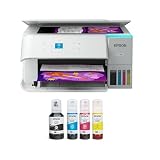
- STRESS-FREE PRINTING — Epson EcoTank comes with enough ink to print up to 6,600 pages black/5,500 color¹⁰ for fewer out-of-ink frustrations. Each replacement ink bottle set is equivalent to about 80 cartridges¹¹
- SIMPLE INK REFILLING — Supersized ink tanks and uniquely keyed EcoFit bottles make refilling ink simple—no mess, no stress and no ink bottle mix-ups
- THE WORLD’S #1 SELLING SUPERTANK PRINTER² — Epson invented EcoTank to revolutionize the way people print; we’ve sold 100 million EcoTanks worldwide⁷ and this is our 7th generation of cartridge-free printers
- ADVANCED PRODUCTIVITY FEATURES — Fast 15 black/8 color ISO ppm print speeds with zero warmup time, built-in scanner, 100-sheet paper tray, auto duplex printing and a 1.44" color display for easy navigation
- STUNNING PRINT QUALITY — High 4800 x 1200 dpi print resolution for exceptional photos and text; enjoy amazing image quality on a wide range of media
Why rated yields and savings claims need caution
A yield is a test-based estimate, not a promise that every user will get exactly that number of pages. Page content, coverage, paper, print frequency, settings and environmental conditions affect actual consumption. Epson states on its EcoTank calculator that quoted yields can vary with image, paper, print frequency and environmental conditions.
Manufacturers also choose the comparison products and prices. HP’s figures above are useful for showing the method, but they promote HP products. Epson’s calculator notes that one cited bottle comparison uses shipments data published in the first quarter of 2024; its total-cost methodology describes comparison inputs based on IDC tracker data from 2019. Those historic inputs should not be reused as current prices. Treat all displayed prices and savings claims as dated inputs to verify before buying.
Do not assume a bottle’s nominal capacity translates directly to your personal page count. A page with large photographs or dense graphics consumes more ink than a lightly covered text page. Compare like with like and retain the qualification next to every yield and CPP figure.
The Tool Desk
Outbyte Driver Updater FREEScan for outdated or missing drivers - takes under a minuteDriver Scan →Outbyte PC Repair FREEClear out junk files and repair common Windows errorsFree Scan →Ink cost is only one buying criterion
A printer that wins on CPP can still be unsuitable if it is too slow, produces the wrong quality, lacks the connections you need or cannot handle your paper. Compare:
- Print quality: text sharpness, graphics and photo output for your normal media.
- Speed: rated pages per minute and the time for the first page, especially for batches.
- Connectivity: USB, Wi-Fi, mobile printing and network support required by your devices.
- Paper handling: tray capacity, supported sizes, automatic duplexing and specialty-media paths.
- Reliability and maintenance: the manufacturer’s maintenance requirements and any replaceable components that affect ownership cost.
- Physical fit: footprint, reservoir visibility and access for refilling or cartridge replacement.
For example, Epson’s U.S. product page displayed a list price of $849.99 and a discounted price of $649.99 for the business-oriented EcoTank Pro ET-5850 when accessed in 2026. That example demonstrates why model and date matter; a business printer at that price is not a direct substitute for an entry-level home cartridge printer. Check the current ET-5850 specifications and price if it is one of the models you are evaluating.
A repeatable comparison checklist
- Choose two specific printers that meet your feature requirements.
- Record the actual purchase price, date and region for each.
- Record included ink and its rated black/color yield.
- Price every replacement bottle or cartridge and record its rated yield.
- Calculate black CPP, color CPP and paper cost per sheet.
- Estimate monthly pages and black/color mix in low, expected and high cases.
- Calculate 12-, 24- and 36-month totals, including applicable maintenance or replacement costs.
- Divide the tank printer’s extra purchase price by its monthly running-cost saving to estimate break-even months.
- Recheck the result using current retailer prices before ordering.
A simple spreadsheet with one row per supply and one column per scenario makes changing prices or page volume easy. Keep ink-only results separate from ink-plus-paper results so you do not accidentally present a partial operating cost as a complete ownership cost.
Common mistakes that produce a misleading answer
- Comparing MSRP with a sale price: use the prices available at the same time and in the same market.
- Ignoring starter ink: count the yield included in each box and then the replacement supplies required.
- Using black CPP for color pages: color consumption can be many times higher in the quoted examples.
- Leaving out paper: paper is a per-page cost, even though it is not ink.
- Assuming the rated yield is your guaranteed yield: actual coverage and conditions differ.
- Quoting one universal break-even volume: the threshold changes with price, print mix, yield and monthly pages.
- Choosing on ink cost alone: a cheaper page is not useful if the printer lacks the speed, quality, connectivity or handling you require.
Bottom line for your purchase decision
Ink tank printers generally have the lower ink cost per page because bottles hold more ink at a lower effective price. Cartridge printers generally have the lower upfront price. Buy the tank model when its calculated savings recover the price premium within the period and volume you realistically expect; choose the cartridge model when your printing is light, uncertain or the premium never pays back. Calculate from current, model-specific prices rather than treating a manufacturer’s example as a market-wide rule.
Quick Recap
Product prices and availability are accurate as of the date/time indicated and are subject to change. Any price and availability information displayed on Amazon at the time of purchase will apply.

