Freedom251 › Single Sign-On Software
Zoho Directory
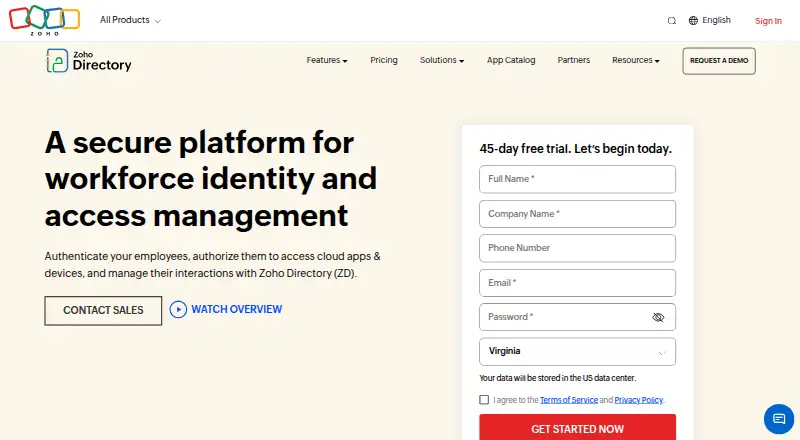
What Zoho Directory is
Zoho Directory helps organizations manage employee access to apps and devices through workforce identity and access management. It offers single sign-on, device authentication, and multi-factor authentication. IT admins can create and maintain user profiles in connected apps, and conditional access policies can account for location, IP address, device, platform, day, and time. The service supports integrations with Microsoft Active Directory, Azure AD, and LDAP, as well as SCIM lifecycle provisioning. Its library includes more than 350 pre-built app integrations, with examples such as Dropbox, Evernote, GitHub, Slack, Zendesk, Tableau, SurveyMonkey, and Trello.
Security features include anomaly monitoring, audit logs, and BYOK, which lets a business import and manage its own Key Encryption Key. Cloud LDAP supports encrypted LDAPS and StartTLS authentication without an on-premises LDAP server. Plans include onboarding support, 24×5 support, and integration assistance. The free plan costs nothing for 10 users, with three third-party cloud apps, two directory stores, and 10 device authentications. It also includes seven-day reports and audit logs, and Cloud RADIUS and Cloud LDAP for 10 users. A 45-day trial is available. Zoho Directory runs on Android, iOS, Linux, macOS, web, and Windows.
Who it suits
Zoho Directory suits IT admins managing workforce logins, app access, and device authentication across connected services. Employees and managers may also benefit from its secure login and access management features. Its platform coverage includes mobile, desktop, and web.
What it does well
- Offers single sign-on, device authentication, and multi-factor authentication.
- Conditional access can use location, IP, device, platform, day, and time.
- Lists more than 350 pre-built app integrations.
- Supports SCIM provisioning and Active Directory, Azure AD, and LDAP.
- Includes onboarding, 24×5 support, and integration assistance on all plans.
What to know first
- Free plan supports only three third-party cloud apps.
- Free plan is limited to 10 users and 10 device authentications.
- Free plan reports and audit logs cover seven days.
- Standard and Professional prices are not shown.
Limits
The free plan supports 10 users, three third-party cloud apps, two directory stores, and 10 device authentications. Reports and audit logs cover seven days, and Cloud RADIUS and Cloud LDAP are for 10 users. Standard and Professional offer broader limits; prices are not shown.
Plans
| Plan | Billed and limits | Price |
|---|---|---|
| Free | 10 users · 3 third-party cloud apps · 2 directory stores · 10 device authentications · 7-day reports and audit logs · Cloud RADIUS and Cloud LDAP for 10 users | Free |
| Standard | Billed annually or monthly; page does not show an amount · Unlimited users and apps · 2 custom domains · 5 custom fields · 5 conditional access policies with 2 conditions · 30-day reports · Cloud RADIUS and Cloud LDAP for 10 users | On request |
| Professional | Billed annually or monthly; page does not show an amount · Unlimited users and apps · 5 custom domains · 40 custom fields · 10 conditional access policies with all conditions · 10 directory stores · 90-day reports · Unlimited Cloud RADIUS and Cloud LDAP | On request |
As zoho.com lists them, read 30 Sept 2026. The maker's own page has the final word.
Getting started
- Open the Zoho Directory website.
- Choose the Free plan or begin the 45-day trial.
- Connect apps or directories, such as Active Directory, Azure AD, or LDAP.
- Set up authentication and conditional access for users and devices.
- Use the supported web, desktop, or mobile platform.
Zoho Directory gives IT teams a central way to manage employee access to apps and devices, with authentication, provisioning, and conditional access in one workforce identity platform. It suits organizations that need several ways to verify users and manage a mixed app estate. Its broad integration library is a strength, while the free plan’s small app and user caps constrain wider deployment.
Overview
Directory connects to Microsoft Active Directory, Azure AD, and LDAP, and supports SAML 2.0, OpenID Connect, and JWT. SCIM lifecycle provisioning and profile management in connected apps, including Asana, can help IT keep employee access aligned across services. The product homepage describes more than 350 pre-built integrations, including Dropbox, GitHub, Slack, Zendesk, Tableau, and Trello.
That breadth makes Zoho Directory a practical candidate for organizations with varied cloud apps. The free plan’s three third-party app allowance, however, means the library’s reach is mostly a paid-plan consideration for teams using more than a few non-Zoho services. Zoho apps do not count toward the free plan’s app limit. For a wider category comparison, browse Single Sign-On Software.
Key features
Authentication and conditional access
Single sign-on centralizes access to connected apps, while device authentication and multi-factor authentication provide additional verification options. MFA supports biometrics, time-based OTP, QR codes, authenticator apps, SMS OTP, and YubiKey hardware authenticators. This range gives organizations options for different login needs, though the facts do not establish how each method is administered or enforced.
Conditional access policies can use location, IP address, device, platform, day, and time. That gives administrators a way to make access decisions based on context rather than relying only on a login credential. Standard allows five policies with two conditions; Professional allows ten policies with all conditions.
Provisioning and oversight
Directory provisioning can create and manage profiles in connected applications, reducing the need to maintain each app profile separately. Anomaly Detection flags unusual or suspicious user behavior, and audit logs record critical administrator actions. These tools provide visibility into account activity, although report and audit retention varies by plan: seven days on Free, 30 on Standard, and 90 on Professional.
Encryption and LDAP access
BYOK lets businesses import and manage their own Key Encryption Key. Cloud LDAP supports LDAPS and StartTLS and can authenticate LDAP-based resources without an on-premises LDAP server. Those capabilities are relevant to organizations with encryption-key control requirements or LDAP resources to support; Free and Standard cap Cloud LDAP and Cloud RADIUS at ten users, while Professional makes both unlimited.
Pricing
Zoho Directory uses a freemium model, with a free plan and a 45-day trial. Standard and Professional have custom pricing, billed annually or monthly. All plans include onboarding support, 24×5 support, and integration assistance.
| Plan | What it includes | Best fit |
|---|---|---|
| Free — free | 10 users, three third-party cloud apps, two directory stores, ten device authentications, seven-day reports and audit logs, and Cloud RADIUS and Cloud LDAP for ten users. Zoho apps are unlimited. | A small team evaluating the service or managing a limited set of third-party apps. |
| Standard — custom pricing | Unlimited users and apps, two custom domains, five custom fields, five conditional access policies with two conditions, 30-day reports, and Cloud RADIUS and Cloud LDAP for ten users. | Organizations that need more users and apps but can work within the policy, domain, and directory-service limits. |
| Professional — custom pricing | Unlimited users and apps, five custom domains, 40 custom fields, ten conditional access policies with all conditions, ten directory stores, 90-day reports, and unlimited Cloud RADIUS and Cloud LDAP. | Teams needing broader policy controls, longer reporting retention, or directory services for more than ten users. |
Free’s ten-user ceiling and three third-party apps make it a narrow starting point, even though it includes both Cloud LDAP and Cloud RADIUS. Standard removes the user and app ceilings but retains a ten-user cap on those services and a more limited policy setup. Professional expands those controls and adds directory stores, but its custom price means buyers cannot compare its cost with a published rate before contacting Zoho.
Platforms
Zoho Directory supports Android, iOS, Linux, macOS, web, and Windows. This broad platform coverage suits workforces using a mix of desktop and mobile systems.
Who it's for
Zoho Directory is best suited to IT administrators coordinating access across connected apps and devices, particularly when conditional policies, several MFA methods, provisioning, and a large integration library matter. Employees get secure login options, while managers can use workforce identity visibility. Small organizations may find Free workable if they stay within ten users and three third-party apps; larger teams must choose a paid plan, and those comparing costs upfront may find the custom pricing a drawback.
Pros and cons
- Broad integration reach: More than 350 pre-built integrations can serve organizations with varied app stacks, though Free supports only three third-party cloud apps.
- Flexible authentication: SSO, device authentication, and six listed MFA factor types give teams multiple ways to manage login verification.
- Context-based access controls: Policies can consider six factors, while Professional supports all conditions and ten policies.
- Free plan has tight ceilings: Ten users, three third-party apps, ten device authentications, and seven-day logs restrict its usefulness beyond evaluation or a small deployment.
- Paid costs are hard to compare in advance: Standard and Professional use custom pricing, despite materially different limits.
Alternatives
Consider FusionAuth if a free, self-hosted community plan and core authentication features better match your needs. Choose miniOrange Identity and Access Management if its free customer identity plan with two to three social logins fits your use case. authentik is an option for teams seeking an open-source edition with OIDC, SAML, LDAP, SCIM, RADIUS, Kerberos, and proxy support.
Google Cloud Identity may suit buyers who prefer a published $6 a month annual price for its Premium plan, which includes enterprise security features, automated user provisioning, and Context-Aware capabilities. Ory offers a developer tier and a $770 a year production plan. Shibboleth is a free, open-source option. Auth0 Guardian has a free plan with 25,000 monthly active users, one custom domain, five organizations, and one enterprise connection. AWS IAM Access Analyzer is free for IAM policy validation and policy generation.
Verdict
Zoho Directory is a strong fit for organizations that want workforce access management with varied MFA, conditional policies, SCIM provisioning, and a wide integration library. Its free plan gives small teams a way to start, but its app, user, authentication, and log limits make it unsuitable for broad use. Look elsewhere if those free caps are too restrictive or if you need a published Standard or Professional price to make a buying decision.
Verdict
Choose Zoho Directory if you need workforce access management with multiple authentication methods, conditional access, and a broad pre-built integration library. Look elsewhere if the free plan’s three third-party app limit or 10-user cap does not fit, or if you need a listed price for Standard or Professional before deciding.
Questions
Is Zoho Directory free?
Yes. The Free plan costs nothing and includes 10 users, three third-party cloud apps, two directory stores, and 10 device authentications.
Is there a free trial?
Yes. A 45-day trial is available.
Which platforms does Zoho Directory support?
It supports Android, iOS, Linux, macOS, web, and Windows.
What authentication options does it offer?
It offers single sign-on, device authentication, and multi-factor authentication. MFA factors include biometrics, time-based OTP, QR code, authenticator apps, SMS OTP, and YubiKey.
Which integrations and directory connections are supported?
The product lists more than 350 pre-built app integrations. Directory integrations include Microsoft Active Directory, Azure AD, and LDAP; SCIM lifecycle provisioning is also supported.
What do the Standard and Professional plans include?
Both plans have unlimited users and apps. Standard includes two custom domains, five custom fields, five conditional access policies with two conditions, 30-day reports, and Cloud RADIUS and Cloud LDAP for 10 users. Professional includes five custom domains, 40 custom fields, 10 policies with all conditions, 10 directory stores, 90-day reports, and unlimited Cloud RADIUS and Cloud LDAP; neither plan's price is shown.
Facts from Zoho Directory's own pages
- Access policies
- Conditional access policies can use factors such as location, IP address, device, platform, day, and time. · zoho.com, 30 Sept 2026
- Authentication
- It offers single sign-on, device authentication, and multi-factor authentication. · zoho.com, 30 Sept 2026
- Cloud LDAP
- Cloud LDAP supports LDAPS and StartTLS for encrypted authentication and can authenticate LDAP-based resources without an on-premises LDAP server. · zoho.com, 30 Sept 2026
- Encryption control
- Zoho Directory supports BYOK, letting businesses import and manage their own Key Encryption Key. · zoho.com, 30 Sept 2026
- Free-plan limit
- The free version supports up to three third-party apps, while the page says there is no limit on the number of Zoho apps added. · zoho.com, 30 Sept 2026
- Integrations
- The product homepage describes a growing library of more than 350 pre-built integrations and names Dropbox, Evernote, GitHub, Slack, Zendesk, Tableau, SurveyMonkey, and Trello. · zoho.com, 30 Sept 2026
- Intended users
- The homepage describes features for IT admins, employees, and managers, including app access management, secure logins, and workforce identity visibility. · zoho.com, 30 Sept 2026
- MFA options
- Supported MFA factors include biometrics, time-based OTP, QR code, authenticator apps, SMS OTP, and YubiKey hardware authenticators. · zoho.com, 30 Sept 2026
- Provisioning
- Directory provisioning lets IT admins create and manage user profiles in connected apps, including Asana. · zoho.com, 30 Sept 2026
- Purpose
- Zoho Directory is a workforce identity and access management platform for managing employee access to apps and devices. · zoho.com, 30 Sept 2026
- Security monitoring
- Anomaly Detection monitors and flags unusual or suspicious user behavior, and audit logs record critical admin actions. · zoho.com, 30 Sept 2026
- Support
- The pricing page says all plans include onboarding support, 24×5 support, and assistance for integrations. · zoho.com, 30 Sept 2026
Where Zoho Directory stands on Freedom251
- Single Sign-On Software#20 of 34