Freedom251 › Supplier Onboarding Software
Zip
What Zip is
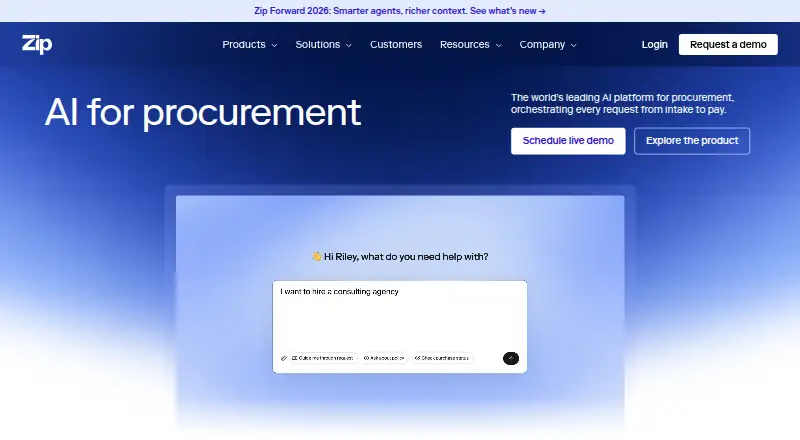
Zip is an AI platform for enterprise procurement that coordinates purchasing requests from intake through payment. Its products cover intake-to-procure, procure-to-pay, supplier onboarding, sourcing, risk orchestration, and AI contract orchestration. Intake-to-Procure turns plain-language employee requests into completed forms and routes them for approval. AI agents can validate requests and flag overpricing against market data. Procure-to-pay automates purchasing and payments, including purchase order and invoice management. The platform also lists approval workflows, supplier management, a supplier portal, and guided request intake. Zip says its marketplace offers more than 100 integrations across ERP, P2P, CLM, GRC, ITSM, and other systems; connection methods include templates, App Studio, Zip MCP, REST APIs, and flat-file imports. Zip MCP can bring procurement data into compatible tools with authentication and actions recorded in Zip’s audit trail. Zip says customer data is encrypted in transit and at rest, and supports SSO, SCIM provisioning, role-based permissions, and customer audit logs. Pricing is on request.
Who it suits
Zip is aimed at organizations ranging from startups to large enterprises, with solutions for procurement, finance, accounting, IT and security, and legal teams. It may suit teams seeking to coordinate purchasing and supplier workflows across multiple business systems.
What it does well
- Routes plain-language requests for approval.
- AI agents can validate requests and flag overpricing.
- Lists more than 100 integrations.
- Supports multiple integration methods, including REST APIs.
- Customers can opt out of AI functionality.
What to know first
- Pricing is available on request.
- AI agents and workflows are described, but no plan limits are listed.
Plans
| Plan | Billed and limits | Price |
|---|---|---|
| Zip AI procurement platform | Pricing not listed; request a demo | On request |
As zip.com lists them, read 5 Oct 2026. The maker's own page has the final word.
Getting started
- Visit https://zip.com/.
- Request a demo to discuss the platform and pricing.
- Choose integration methods such as pre-built templates, App Studio, REST APIs, or flat-file imports.
- Connect compatible tools through Zip MCP if needed.
- Configure employee request intake and approval routing.
Overview
Zip is an AI platform for managing enterprise procurement across requests, purchasing, suppliers, sourcing, risk, and contracts. It is best suited to organizations connecting several procurement workflows and business systems; teams seeking only a basic request form may find its scope excessive.
Guided intake, approval workflows, purchase orders, supplier management, and a supplier portal provide a broad operational foundation. Custom pricing means buyers should establish the cost and included scope for their needs before choosing it.
Key features
Zip turns employees’ plain-language requests into completed forms and routes them for approval automatically. Its intake agents can validate requests and flag prices that appear above market data, adding a review point for procurement teams. Those signals can help direct attention, but organizations still need to set their own approval standards.
Beyond intake, Zip covers purchase orders and invoice management, purchasing and payments, supplier onboarding, sourcing, risk orchestration, and AI contract orchestration. That range can connect processes used by procurement, finance, accounting, IT and security, and legal teams. It is a strong fit for organizations looking to coordinate those activities; smaller teams with limited purchasing needs may have little use for the wider platform.
Zip says its marketplace includes more than 100 integrations across ERP, P2P, CLM, GRC, ITSM, and other systems. Connection options include pre-built templates, App Studio, Zip MCP, REST APIs, and flat-file imports. This variety gives organizations several ways to bridge existing systems, though the right approach will depend on their technical environment.
Zip MCP brings procurement data into Claude, ChatGPT, Cursor, and other compatible tools. User authentication and logging in Zip’s audit trail help keep those interactions tied to access controls and oversight. Zip says customer data is not used to train models unless a customer explicitly permits it, and customers can opt out of AI functionality.
Security measures Zip describes include TLS 1.2+ encryption in transit, AES-256 encryption at rest, SAML-based SSO, SCIM provisioning, role-based permissions, and customer audit logs. It reports SOC 1 Type 2 and SOC 2 Type 2 audits, ISO/IEC 27001:2022 certification, EU-US Data Privacy Framework participation, and GDPR-oriented privacy practices. Its Enterprise Transformation Office, staffed by former enterprise procurement leaders, works with customers on change, adoption, and operational transformation—relevant for organizations whose challenge is implementation as well as software.
Pricing
Zip’s AI procurement platform uses custom pricing, with buyers asked to request a demo. No public amount or tier breakdown is provided, so it is not possible to compare entry and higher-cost plans or assess seat and usage limits from the published plan terms. Organizations should confirm which workflows, users, and services are included in a quote.
Platforms
Zip is available on the web and through an API. That combination suits organizations that want a browser-based procurement platform alongside programmatic connections to other systems.
Who it's for
Zip serves organizations from startups to Fortune 500 enterprises, with workflows aimed at procurement, finance, accounting, IT and security, and legal teams. Its broad coverage and integration options make it most compelling when several departments need coordinated procurement processes. A company that only needs lightweight purchasing requests may be better served by a narrower tool.
Pros and cons
Pros
- Broad workflow coverage: Intake, purchasing, supplier, sourcing, risk, and contract capabilities can support a connected procurement operation.
- Multiple integration paths: More than 100 marketplace integrations and options ranging from templates to APIs and flat files can accommodate varied systems.
- Enterprise controls and implementation support: Access controls, audit logs, reported certifications, and a procurement-focused transformation office address governance and organizational change.
Cons
- Custom pricing: Buyers must request a demo to understand cost, making straightforward budget comparisons difficult.
- Potentially more than a small team needs: The platform’s extensive workflow scope is less suitable when the requirement is only a simple request-and-approval process.
Alternatives
Flowie is worth considering for teams that want a free plan: it costs nothing, billed forever, and allows up to 24 documents per month (300 per year) with basic processing, all document types, one entity, and no workflows. It also has a free trial and supports API, self-hosted, and web platforms.
Vendorfi may suit teams focused on vendor lifecycle management and willing to work within a small free tier: its free plan includes three active vendors and two user seats, plus AI-powered alerts and insights and standard email support. It runs on the web; a Core plan is also offered at 299.99 USD.
ControlHub is an option for teams prioritizing purchasing approvals and requester capacity. Its Approvals Plan costs $249 a month and includes unlimited purchasing requests, unlimited requester users, and five advanced users, with an additional advanced user priced at $12. It offers a free plan and free trial, and supports Android, iOS, and web.
VendrNova is another paid, web-based alternative.
Zycus Contract Management is a paid, web-based alternative.
Coverbase may be appropriate for teams seeking a paid option with API and web platforms; its pricing is provided by quote, with no public amount shown.
Gainfront AgentFlow is a paid, web-based alternative with pricing available by demo request.
Lio is a paid, web-based alternative offering an Enterprise plan with pricing available on request.
For broader comparisons, explore Procurement Orchestration Software, Procurement Software, Purchase Request Software, and Supplier Onboarding Software.
Verdict
Zip is a strong candidate for organizations that need procurement, finance, IT, and legal teams to coordinate requests through purchasing, suppliers, sourcing, risk, and contracts, especially when those workflows must connect to existing systems. Its breadth, integration choices, and governance controls are the main reasons to choose it; look elsewhere if all you need is a simple request process or if a public price is essential to shortlisting.
Verdict
Zip brings intake, purchasing, supplier, sourcing, and contract workflows under one procurement platform. Its wide range of integration methods may matter to organizations connecting procurement across existing systems; pricing is on request.
Questions
How much does Zip cost?
Zip’s pricing is on request. Its listed plan directs buyers to request a demo.
What procurement workflows does Zip cover?
Its products include intake-to-procure, procure-to-pay, supplier onboarding, sourcing, risk orchestration, and AI contract orchestration.
Which platforms can I use to access Zip?
Zip lists web and API platforms.
What integrations does Zip offer?
Its marketplace lists 100+ integrations across ERP, P2P, CLM, GRC, ITSM, and other systems. Methods include templates, App Studio, Zip MCP, REST APIs, and flat-file imports.
Can Zip customer data be used to train models?
Zip says customer data is not used to train models unless the customer explicitly permits it. Customers can opt out of AI functionality.
Who founded Zip?
Rujul Zaparde, Lu Cheng, and Felix Meng co-founded Zip in 2020.
Facts from Zip's own pages
- Access controls
- Zip supports SAML-based single sign-on, SCIM provisioning, role-based permissions, and customer audit logs. · zip.com, 5 Oct 2026
- AI agents
- Its intake-to-procure product includes agents for request validation, price negotiation, and contract review. · zip.com, 5 Oct 2026
- AI data use
- Zip says customer data is not used to train models unless the customer explicitly permits it, and customers can opt out of AI functionality. · zip.com, 4 Oct 2026
- Audience
- Zip says it serves organizations from startups to Fortune 500 enterprises and lists solutions for procurement, finance, accounting, IT and security, and legal teams. · zip.com, 4 Oct 2026
- Capabilities
- Its listed products include intake-to-procure, procure-to-pay, supplier onboarding, sourcing, risk orchestration, and AI contract orchestration. · zip.com, 4 Oct 2026
- Company
- Zip says Rujul Zaparde, Lu Cheng, and Felix Meng co-founded the company in 2020. · zip.com, 5 Oct 2026
- Compliance
- Zip reports SOC 1 Type 2 and SOC 2 Type 2 audits, ISO/IEC 27001:2022 certification, and privacy programs covering GDPR and the EU-US Data Privacy Framework. · zip.com, 5 Oct 2026
- Founded
- Zip says Rujul Zaparde, Lu Cheng, and Felix Meng co-founded the company in 2020. · zip.com, 4 Oct 2026
- Headquarters
- San Francisco, CA · zip.com, 28 Sept 2026
- Intake
- Intake-to-Procure converts plain-language employee requests into completed forms and routes them for approval automatically. · zip.com, 4 Oct 2026
- Intake automation
- Zip converts plain-language employee requests into completed forms and routes them for approval automatically. · zip.com, 5 Oct 2026
- Integration methods
- Zip supports pre-built templates, custom integrations through App Studio, its MCP server, REST APIs, and flat-file imports. · zip.com, 5 Oct 2026
- Integrations
- Zip says its marketplace offers 100+ integrations across ERP, finance, procurement, sourcing, contract, risk, ITSM, collaboration, data, identity, and payments tools. · zip.com, 5 Oct 2026
- Intended customers
- Zip says it serves organizations from startups to large enterprises, including Fortune 500 companies. · zip.com, 5 Oct 2026
- Invoice processing
- Zip says its procure-to-pay product automates purchasing and payments, including purchase order and invoice management. · zip.com, 5 Oct 2026
- MCP
- Zip MCP brings procurement data into Claude, ChatGPT, Cursor, or other MCP-compatible tools, with user authentication and actions logged in Zip’s audit trail. · zip.com, 4 Oct 2026
- Product
- Zip describes itself as an AI platform for enterprise procurement, orchestrating requests from intake to pay. · zip.com, 4 Oct 2026
- Purchasing workflows
- The platform covers intake-to-procure, procure-to-pay, contract orchestration, sourcing, risk orchestration, and supplier onboarding. · zip.com, 5 Oct 2026
- Security
- Zip says customer data is encrypted with TLS 1.2 or higher in transit and AES-256 at rest, and sensitive data also receives application-layer encryption. · zip.com, 5 Oct 2026
- Support
- Zip describes an Enterprise Transformation Office of former enterprise procurement leaders that works with customers on change, adoption, and transformation. · zip.com, 4 Oct 2026
- Support and implementation
- Zip says its Enterprise Transformation Office includes former enterprise procurement leaders who work with customers on operational transformation. · zip.com, 5 Oct 2026
- What it does
- Zip describes itself as an AI platform for enterprise procurement that orchestrates requests from intake to pay. · zip.com, 5 Oct 2026
Where Zip stands on Freedom251
- Supplier Onboarding Software#29 of 38
- Procurement Software#27 of 32
- Purchase Request Software#23 of 25
- Procurement Orchestration Software#24 of 26