Freedom251 › Procurement Orchestration Software

Coverbase
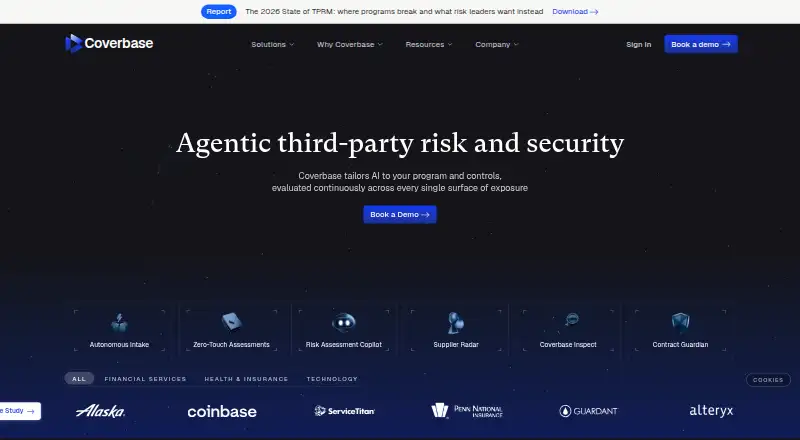
What Coverbase is
Coverbase is a third-party risk and procurement platform for managing supplier security and risk across the vendor lifecycle. Autonomous Intake researches suppliers across public attack surface, financials, OFAC, adverse media, and product data, then pre-fills an inherent risk questionnaire. Zero-Touch Assessments gather evidence from security, compliance, legal, financial, and registration sources without sending a questionnaire. Its Risk Assessment Copilot reviews questionnaires, contracts, and third-party evidence against custom controls, identifies exceptions, and generates follow-ups. Supplier Radar combines internal and external feeds to detect issues and carry incidents into assessments, contracts, and risk scores. Contract Guardian extracts obligations, SLAs, and breach terms, then monitors for deviations. Coverbase lists 179+ integrations and data sources, offers cloud, hybrid, or on-premises deployment, and documents import and export APIs plus an MCP server. Pricing is by quote, with no public amount listed.
Who it suits
Coverbase is aimed at procurement leaders, risk officers, and CISOs. Its stated industry focus includes finance, insurance, fintech, and healthcare, with deployment options for different regulatory needs.
What it does well
- Supplier research covers financials, adverse media, and product data
- Assessments collect evidence without sending questionnaires
- Lists 179+ integrations and data sources
- Supports cloud, hybrid, or on-premises deployment
What to know first
- Pricing is provided by quote
- No public price amount is listed
Plans
| Plan | Billed and limits | Price |
|---|---|---|
| Custom pricing | Pricing provided by quote; no public amount shown | On request |
| Custom enterprise subscription | Fees specified in signed Order Form; renewal terms are set in the Order Form · Enterprise TPRM, procurement and related services · trial access may be offered | On request |
As coverbase.com lists them, read 7 Oct 2026. The maker's own page has the final word.
Getting started
- Visit the Coverbase website.
- Contact Coverbase to request pricing.
- Choose cloud, hybrid, or on-premises deployment to suit regulatory needs.
- Work with Coverbase on its white-glove implementation; the company says teams can get up and running in one week.
- Use the web platform or API; contact [email protected] for support.
Coverbase is a third-party risk and procurement platform built for teams that must evaluate suppliers continuously, not just at onboarding. It suits procurement leaders, risk officers, and CISOs—especially in finance, insurance, fintech, and healthcare. Its lifecycle coverage is unusually broad, but buyers will need a quote and a clear deployment decision before they can judge the commercial fit.
Overview
Coverbase links supplier intake, evidence gathering, risk decisions, monitoring, and contract obligations in one operating model. That is a strong match for organizations where procurement, security, legal, and compliance share accountability for vendors. A company wanting only purchase-request routing or a basic supplier directory may find the platform’s risk-management orientation unnecessarily substantial.
Key features
Intake and assessment
Autonomous Intake researches a supplier’s public attack surface, financial position, OFAC exposure, adverse media, and product information, then uses those findings to pre-fill an inherent-risk questionnaire. This can give reviewers a more informed starting point and reduce repetitive supplier data entry. Zero-Touch Assessments go further by collecting evidence from security, compliance, legal, financial, and registration sources without sending the vendor a questionnaire. That is useful when supplier cooperation is slow, although internal teams still have to decide whether the evidence satisfies their control requirements.
Risk analysis and monitoring
Risk Assessment Copilot reviews questionnaires, contracts, and third-party evidence against custom controls. It identifies exceptions and produces follow-up actions, making it better suited to organizations with defined control frameworks than to teams seeking an entirely prescriptive workflow. Supplier Radar combines internal and external feeds, detects supplier issues, initiates outreach, and carries incidents into assessments, contracts, and risk scores. The connected record should make recurring reviews more actionable than a static annual assessment.
Contract oversight
Contract Guardian extracts obligations, service-level agreements, and breach terms from vendor contracts, then watches performance for deviations. This gives procurement and legal teams a way to connect contractual promises with operational risk instead of storing contract review separately. Approval workflows, policy controls, supplier onboarding, chat intake, single sign-on, and API access support a governed process rather than an ad hoc inbox.
Integrations, security, and API
Coverbase says it provides more than 179 integrations and data sources spanning identity, security, GRC, procurement, contracts, HR, and risk intelligence. Named GRC connections include ServiceNow, ProcessUnity, Aravo, and Archer, with additional API connectivity. Import and export APIs use REST with JSON over HTTPS, and documentation also describes an MCP server. The security program is SOC 2 Type II compliant and independently audited against the AICPA Trust Services Criteria for security, availability, and confidentiality. Data is encrypted with AES-256 at rest and TLS 1.2 or newer in transit, with GDPR and CCPA compliance stated.
Pricing
Coverbase uses custom pricing; no public amount is shown. That structure is understandable for a platform spanning risk, procurement, contracts, integrations, and deployment, but it prevents straightforward budget comparison and makes a sales discussion necessary.
Custom pricing
The quote-based plan is the only published option. It is the natural fit for organizations needing tailored controls, integrations, or regulated deployment. Buyers should clarify user and usage assumptions, implementation scope, renewal terms, and which capabilities are included in the quote before committing. There is no published free plan or trial to validate the workflow independently.
Platforms
Coverbase is offered through the web and an API. The company describes cloud, hybrid, and on-premises deployment, allowing regulated organizations to align hosting with their requirements. White-glove implementation is positioned as capable of getting teams running in one week, which may suit a business that wants guided rollout rather than a self-service setup.
Who it's for
Coverbase is aimed at procurement leaders, risk officers, and CISOs managing material third-party exposure. Its strongest case is in finance, insurance, fintech, and healthcare, where supplier evidence, control exceptions, contractual obligations, and ongoing incidents need to stay connected. Smaller teams with a handful of vendors or no formal control library may get more system than they can use.
Pros and cons
Pros
- Broad lifecycle coverage: intake, assessments, monitoring, and contract performance share one risk context.
- Reduced supplier friction: automated research and zero-touch evidence gathering can limit questionnaire burden.
- Configurable governance: custom controls, policy controls, approval workflows, and SSO support controlled operations.
- Integration depth: more than 179 integrations and named GRC connectors can fit an established enterprise stack.
- Deployment flexibility: cloud, hybrid, and on-premises options address different regulatory constraints.
Cons
- No public price: teams cannot compare cost or assess payback without requesting a quote.
- Enterprise-weighted scope: organizations needing simple procurement intake may find the risk and contract machinery excessive.
- Implementation is service-led: white-glove deployment favors guided projects over an immediately self-directed rollout.
Alternatives
Choose Procurement Orchestration Software when you want a broader category comparison before selecting a product.
Flowie is a better starting point for a small operation that wants a free plan, self-hosting, and up to 24 documents per month, though its free tier has basic processing and no workflows.
Vendorfi suits teams wanting a free web plan limited to three active vendors and two seats, with core lifecycle management and AI alerts.
ControlHub is the clearer choice when purchasing approvals are the priority: its $249 a month plan includes unlimited purchasing requests and requester users plus five advanced users.
VendrNova is a paid, web-based alternative.
Zip fits buyers seeking a paid API and web AI procurement platform through a demo-led process.
Zycus Contract Management is a paid web option focused on contract management.
Gainfront AgentFlow is a paid web alternative with pricing supplied through a demo.
Lio is a paid web enterprise option with pricing requested through a demo.
Verdict
Coverbase is a strong choice for regulated enterprises that want supplier risk, procurement activity, monitoring, and contract obligations handled as one connected program. Its main reason to choose it is the combination of automation, control customization, integration breadth, and deployment flexibility. Look elsewhere if you need transparent pricing, a free trial, or a lightweight procurement tool that can be adopted without an enterprise implementation conversation.
Verdict
Coverbase combines supplier intake, assessment, monitoring, and contract oversight with a broad integration set. Buyers should request a quote and consider which deployment model fits their regulatory needs.
Questions
How is Coverbase priced?
Coverbase uses a paid model, with pricing available on request.
What platforms does Coverbase support?
The listed platforms are web and API.
Which systems can Coverbase connect to?
The integrations page lists 179+ integrations and data sources. Named GRC connections include ServiceNow, ProcessUnity, Aravo, and Archer; API connectivity is also mentioned.
What deployment options are available?
The About page lists cloud, hybrid, or on-premises deployment depending on regulatory needs.
What security and data protection measures does Coverbase state?
Coverbase says its program is SOC 2 Type II compliant and independently audited against AICPA Trust Services Criteria for security, availability, and confidentiality. It also states AES-256 encryption at rest, TLS 1.2+ in transit, and GDPR and CCPA compliance.
Facts from Coverbase's own pages
- API
- Documentation describes import and export APIs plus an MCP server, and specifies REST with JSON over HTTPS for API requests. · docs.coverbase.com, 7 Oct 2026
- API format
- The documented API is REST and JSON over HTTPS at https://api.coverbase.app, with import and export surfaces. · docs.coverbase.com, 15 Oct 2026
- Assessments
- Zero-Touch Assessments gather evidence from security, compliance, legal, financial, and registration sources to assess vendors without sending a questionnaire. · coverbase.com, 7 Oct 2026
- Automated intake
- Autonomous Intake researches suppliers across public attack surface, financials, OFAC, adverse media, and product data, then pre-fills an inherent risk questionnaire. · coverbase.com, 7 Oct 2026
- Autonomous Intake
- Autonomous Intake researches suppliers using attack-surface, financial, sanctions, adverse-media and product information, then pre-fills inherent-risk questionnaires. · coverbase.com, 15 Oct 2026
- Autonomous RFP
- Autonomous RFP agents contact vendors, conduct question-and-answer and score responses against weighted customer rubrics. · coverbase.com, 15 Oct 2026
- Contract Guardian
- Contract Guardian extracts obligations, service levels and breach terms, monitors performance and flags deviations or renewal risks. · coverbase.com, 15 Oct 2026
- Contracts
- Contract Guardian extracts obligations, SLAs, and breach terms from vendor contracts and monitors performance for deviations. · coverbase.com, 7 Oct 2026
- Coverbase Inspect
- Coverbase Inspect uses read-only access and an AI agent to inspect vendor security settings, access controls and integrations. · soc2.coverbase.com, 15 Oct 2026
- Crunchbase executives
- Crunchbase lists Clarence Chio as co-founder and CEO and Kao Zi Chong as co-founder. · crunchbase.com, 15 Oct 2026
- Crunchbase funding
- Crunchbase shows two funding rounds and a Series A led by Canapi Ventures with five investors, but hides the dollar amounts. · crunchbase.com, 15 Oct 2026
- Data protection
- The security page states AES-256 encryption at rest, TLS 1.2+ in transit, and GDPR and CCPA compliance. · coverbase.com, 7 Oct 2026
- Deployment
- The company describes cloud, hybrid or on-premises deployment options depending on regulatory needs. · coverbase.com, 15 Oct 2026
- Documentation depth
- Public documentation includes product guides, API authentication and conventions, import/export, webhooks, workflows, MCP, integrations and field references. · docs.coverbase.com, 15 Oct 2026
- Encryption
- The security page states AES-256 encryption at rest and TLS 1.2 or newer in transit. · soc2.coverbase.com, 15 Oct 2026
- Implementation
- The homepage says implementations are white glove and that teams can get up and running in one week. · coverbase.com, 7 Oct 2026
- Integrations
- Coverbase advertises more than 179 integrations and data sources across identity, security, GRC, procurement, contracts, HR and risk intelligence. · coverbase.com, 15 Oct 2026
- Legal entity
- The terms identify Coverbase Inc. as a Delaware corporation with an address at 1374 Natoma St, San Francisco, California 94103. · coverbase.com, 15 Oct 2026
- Licence
- Coverbase retains intellectual-property rights in its services and grants customers a limited, non-exclusive access licence, indicating proprietary software. · coverbase.com, 15 Oct 2026
- Lifecycle coverage
- The platform links six lifecycle stages: intake, zero-touch assessment, risk copilot, continuous monitoring, inspection and contracts. · coverbase.com, 15 Oct 2026
- Limit: API disclosure
- Airframe says the public API documentation does not disclose rate limits, detailed audit logging, RBAC specifics or service-level details. · airframe.ai, 15 Oct 2026
- Limit: pricing transparency
- Airframe identifies opaque enterprise pricing as a procurement friction point and says buyers seeking transparent low-cost pilots may prefer alternatives. · airframe.ai, 15 Oct 2026
- Limit: small portfolios
- Airframe considers Coverbase a poor fit for very small vendor portfolios where spreadsheets or lightweight tools are sufficient. · airframe.ai, 15 Oct 2026
- Limit: supplier access dependency
- Airframe identifies supplier unwillingness to grant read-only inspection access as a potential disqualifier. · airframe.ai, 15 Oct 2026