Freedom251 › Web Application Security Scanners
ZeroThreat
What ZeroThreat is
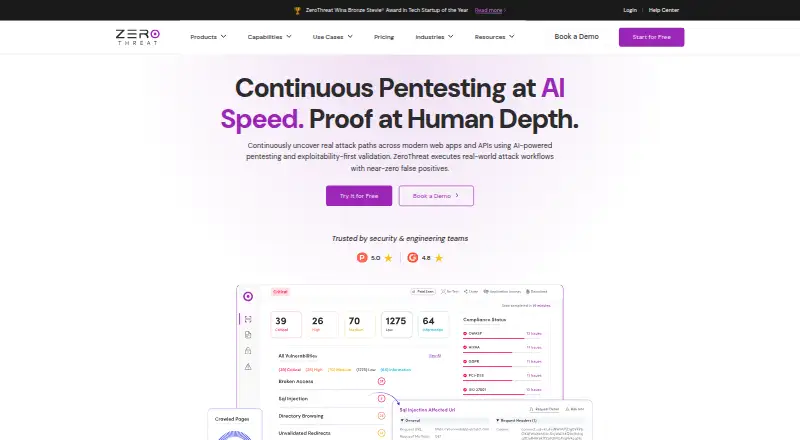
ZeroThreat is an AI-powered penetration-testing platform for web applications and APIs, available through web and API access. It continuously looks for vulnerabilities, attempts exploits, and validates findings with reproducible proof that includes request-and-response evidence and exact payloads. Web testing supports authenticated workflows, including SSO, MFA, and role-based access, plus rendering for React, Vue, and Angular single-page apps. API coverage includes REST, GraphQL, SOAP, and gRPC, including internal APIs and shadow endpoints. ZeroThreat states that it detects more than 130,000 vulnerabilities, including OWASP, CWE/SANS, Nuclei, and monthly updated CVE intelligence. Integrations span CI/CD, project management, and messaging tools, using connectors, APIs, or webhooks. On-premises deployment is listed as air-gap ready. The Free plan offers five scan credits on sign-up, valid for 15 days, then one scan credit per month for one target. Professional costs $100 a month; Pay Per Scan costs $125, paid once.
Who it suits
ZeroThreat presents use cases for enterprise security teams, DevOps and security teams, SaaS companies, developers, MSSPs, and startups. Its authenticated web testing, API coverage, and CI/CD integrations may suit teams that need recurring application security scans.
What it does well
- Findings include reproducible evidence and exact payloads.
- Supports authenticated web workflows, including SSO and MFA.
- Tests REST, GraphQL, SOAP, and gRPC APIs.
- Lists integrations with CI/CD, project, and messaging tools.
- On-premises deployment is listed as air-gap ready.
What to know first
- Free sign-up credits are valid for 15 days.
- Free plan is limited to one target.
- Professional costs $100 a month.
- Pay Per Scan costs $125, paid once.
Limits
The free plan provides five scan credits on sign-up, valid for 15 days, then one scan credit per month and one target per account. Its vulnerability-insights preview is limited. Professional costs $100 a month and allows target-based unlimited scans; additional targets cost $75 each.
Plans
| Plan | Billed and limits | Price |
|---|---|---|
| Free | 5 free scan credits on sign-up, valid for 15 days · 1 scan credit per month · 1 target per account · limited vulnerability-insights preview · web applications and APIs | Free |
| Professional | Monthly; additional targets @ $75 each; annual option saves 20% · Target-based unlimited scans · scheduled scans · 130K+ vulnerability coverage · unlimited retesting · 30-day target-URL cooling | $100 a month |
| Pay Per Scan | 5 credits; credits valid for 1 year; volume discounts up to 20% · Unlimited targets · 7-day unlimited retest window · point-in-time compliance reporting | $125, paid once |
As zerothreat.ai lists them, read 30 Sept 2026. The maker's own page has the final word.
Getting started
- Open zerothreat.ai and choose the free plan or a paid plan.
- Sign up for the free plan to receive five scan credits valid for 15 days.
- Use the Help Center's getting-started, quick-scan, or authenticated-scan documentation.
- Connect supported tools through native connectors, APIs, or webhooks.
- Run scans through web or API access; scans typically start within minutes.
ZeroThreat is an autonomous penetration-testing service for web applications and APIs. It is a strong fit for development and security teams that need authenticated, repeatable scans with evidence developers can act on. The main trade-off is capacity: the free allowance is brief and tightly capped, while paid plans tie economics to targets or scan credits.
Overview
ZeroThreat continuously searches for vulnerabilities, attempts exploitation, and validates the result rather than stopping at a detection. Its strongest practical differentiator is proof that can be reproduced: each finding can include request and response evidence plus the exact payload used. That gives a security reviewer a way to confirm impact and gives an engineer a more concrete remediation starting point.
The service is delivered for web and API targets, with a U.S.-based company behind it. Scan jobs generally start within minutes and finish in about 30 minutes to two hours, depending on the application. A Help Center covers setup, quick scans, authenticated scans, and login sequences.
Key features
Web testing handles authenticated workflows, SSO, MFA, role-based access, and browser-rendered React, Vue, and Angular single-page applications. This makes it more suitable than a basic unauthenticated crawler for modern applications whose meaningful functionality sits behind login or JavaScript navigation.
API testing spans REST, GraphQL, SOAP, and gRPC, including internal APIs and shadow endpoints. Coverage includes business-logic problems such as broken object-level and broken function-level authorization (BOLA and BFLA), not only conventional perimeter checks.
ZeroThreat says its library covers more than 130,000 vulnerabilities, drawing on OWASP, CWE/SANS, Nuclei, and monthly updated CVE intelligence. Authenticated scans, JavaScript crawling, scheduled scans, API scanning, and compliance reports are listed capabilities; scheduled scans and unlimited retesting are specifically included in Professional.
Integrations reach GitHub Actions, GitLab, Jenkins, Azure Pipelines, CircleCI, TeamCity, AWS CI/CD, Bamboo, and Travis CI, plus Jira, Asana, Slack, and Microsoft Teams. Native connectors, APIs, and webhooks provide deployment choices, while guided no-code setup is available alongside API or CLI customization. The stated security architecture includes IAM, MFA, network segmentation, TLS 1.3 in transit, Azure Key Vault encryption at rest, and continuous monitoring. ZeroThreat says it complies with GDPR, HIPAA, and PCI DSS, aligns controls with ISO 27001 guidance, and offers air-gap-ready on-premises deployment for data sovereignty.
Pricing
Free — free. Sign-up provides five scan credits valid for 15 days, then one scan credit per month. The account is limited to one target and a limited vulnerability-insights preview, although web applications and APIs are supported. This is useful for evaluating the workflow or running occasional checks, not for maintaining coverage across several assets.
Professional — $100 a month, billed monthly; an annual option saves 20%. It includes target-based unlimited scans, scheduled scans, more than 130,000-vulnerability coverage, unlimited retesting, and a 30-day target-URL cooling period. Additional targets cost $75 each. This is the logical plan for a team repeatedly scanning a stable set of applications; the per-target charge makes a broad, fast-changing portfolio more expensive.
Pay Per Scan — $125, paid once, billed as five credits. Credits remain valid for one year, volume discounts reach 20%, and the plan allows unlimited targets, a seven-day unlimited-retest window, and point-in-time compliance reporting. It better suits consultants or teams with irregular projects, though repeated scans can exceed the predictable cost of Professional.
Platforms
ZeroThreat supports web and API environments. On-premises deployment is described as air-gap ready, which is relevant when scan data must remain under an organization's control.
Who it's for
Enterprise security groups, DevOps and application-security teams, SaaS companies, developers, managed security providers, and startups are the stated audiences. Professional fits teams with recurring targets and CI/CD integration needs. Pay Per Scan is a better match for episodic assessments across many targets. The Free plan is primarily an evaluation path because its one-target cap and short initial credit window restrict ongoing use.
Pros and cons
Pros
- Reproducible exploit evidence: request/response records and exact payloads make findings easier to verify and remediate.
- Deep authenticated coverage: SSO, MFA, roles, login sequences, and JavaScript rendering address complex modern applications.
- Broad API scope: REST, GraphQL, SOAP, gRPC, internal, and shadow APIs are covered, including BOLA and BFLA.
- Workflow connectivity: extensive CI/CD, ticketing, and messaging integrations can feed existing delivery processes.
- Deployment controls: air-gap-ready on-premises deployment and stated enterprise security controls support sovereignty requirements.
Cons
- Very small free allowance: five credits expire after 15 days, followed by one credit monthly and one target per account.
- Professional scales by target: each additional target adds $75 per month, which can penalize larger portfolios.
- Pay Per Scan is costly for frequent use: $125 buys five credits, even though credits last a year.
Alternatives
For a broader shortlist, compare Web Application Security Scanners and API Security Testing Software.
Nuclei is free, open-source, and primarily a standalone CLI for Linux, macOS, Windows, or self-hosting; choose it when you want that model rather than a managed autonomous platform.
OWASP ZAP is free and open source across API, desktop, and self-hosted environments, making it a fit when community-contributed tooling matters.
Wapiti is another free, GPL-licensed open-source scanner for API, desktop, and self-hosted use.
Beagle Security offers a free lite test each month with surface reports and SSL/domain monitoring, while its Essential plan is $99.00 per month billed annually; choose it when monitoring is central.
Detectify Surface Monitoring suits teams focused on external-surface monitoring and annual platform plans.
Qualys External Attack Surface Management offers a 30-day no-cost CSAM with EASM trial for teams evaluating an enterprise exposure-management suite.
ImmuniWeb is aimed at organizations needing mobile application coverage alongside web and API options.
Pentest-Tools.com API Scanner starts its NetSec plan from $95 per month with five assets and combines API-related work with network and cloud scanning.
Verdict
Choose ZeroThreat if your team needs continuous web and API penetration testing, authenticated application coverage, and exploit evidence that developers can reproduce. Professional is the best fit for recurring scans on a defined target set; Pay Per Scan is more sensible for occasional, multi-target engagements. Look elsewhere if you need a genuinely open-ended free scanner or if your portfolio makes per-target subscription charges unattractive.
Verdict
ZeroThreat combines web and API testing with exploit validation and listed integrations for development workflows. Review the Free plan’s credit and target limits, or compare its paid scan options.
Questions
Is there a free plan?
Yes. The Free plan costs nothing and includes five scan credits on sign-up, valid for 15 days, followed by one scan credit per month for one target.
How much do the paid plans cost?
The Professional plan is $100 a month. Pay Per Scan is $125, paid once, billed as five credits; credits are valid for one year. The pricing note also says paid plans start from $25.
Which platforms does ZeroThreat support?
The listed platforms are web and API.
Can it scan authenticated applications and APIs?
Yes. Authenticated scans are supported, and web testing includes SSO, MFA, and role-based access. API scanning is supported across REST, GraphQL, SOAP, and gRPC.
What integrations are available?
Listed integrations include GitHub Actions, GitLab, Jenkins, Azure Pipelines, CircleCI, TeamCity, AWS CI/CD, Bamboo, Travis CI, Jira, Asana, Slack, and Microsoft Teams. Connections can use native connectors, APIs, or webhooks.
Who makes ZeroThreat, and where is it based?
The legal entity is ZeroThreat, Inc., a U.S.-registered corporation. Its headquarters are in the United States.
Facts from ZeroThreat's own pages
- API testing
- API pentesting covers REST, GraphQL, SOAP, and gRPC APIs, including internal APIs, shadow endpoints, BOLA, and BFLA. · zerothreat.ai, 30 Sept 2026
- Company identity
- The legal entity is ZeroThreat, Inc., a U.S.-registered corporation. · zerothreat.ai, 30 Sept 2026
- Coverage
- ZeroThreat states that it detects more than 130,000 vulnerabilities, including OWASP, CWE/SANS, Nuclei, and monthly updated CVE intelligence. · zerothreat.ai, 30 Sept 2026
- Deployment
- The homepage lists on-premises deployment as air-gap ready for full data sovereignty. · zerothreat.ai, 30 Sept 2026
- Documentation
- ZeroThreat provides a Help Center with getting-started, quick-scan, authenticated-scan, and login-sequence documentation. · help.zerothreat.ai, 30 Sept 2026
- Exploit validation
- The platform provides reproducible exploit proof with request/response evidence and exact payloads for findings. · zerothreat.ai, 30 Sept 2026
- Headquarters
- United States · zerothreat.ai, 23 Sept 2026
- Integration methods
- Integrations connect through native connectors, APIs, or webhooks, with no-code guided setup and API or CLI customization. · zerothreat.ai, 30 Sept 2026
- Integrations
- Integrations include GitHub Actions, GitLab, Jenkins, Azure Pipelines, CircleCI, TeamCity, AWS CI/CD, Bamboo, Travis CI, Jira, Asana, Slack, and Microsoft Teams. · zerothreat.ai, 30 Sept 2026
- Product
- ZeroThreat is an AI-powered autonomous penetration-testing platform that continuously discovers, exploits, and validates vulnerabilities across web applications and APIs. · zerothreat.ai, 30 Sept 2026
- Scan timing
- The pricing FAQ says scans typically complete in 30 minutes to 2 hours depending on the application, with scans starting within minutes. · zerothreat.ai, 30 Sept 2026
- Security controls
- The security architecture describes IAM, MFA, network segmentation, TLS 1.3 in transit, Azure Key Vault encryption at rest, and continuous monitoring. · zerothreat.ai, 30 Sept 2026
- Security standards
- ZeroThreat states that it complies with GDPR, HIPAA, and PCI DSS and aligns its security measures with ISO 27001 guidelines. · zerothreat.ai, 30 Sept 2026
- Use cases
- ZeroThreat presents use cases for enterprise security teams, DevOps and security teams, SaaS companies, developers, MSSPs, and startups. · zerothreat.ai, 30 Sept 2026
- Web testing
- Web-app pentesting supports authenticated workflows, SSO, MFA, role-based access, and Playwright rendering for React, Vue, and Angular SPAs. · zerothreat.ai, 30 Sept 2026
Where ZeroThreat stands on Freedom251
- Web Application Security Scanners#6 of 29
- API Security Testing Software#18 of 27