Freedom251 › Game Level Editors
YATME
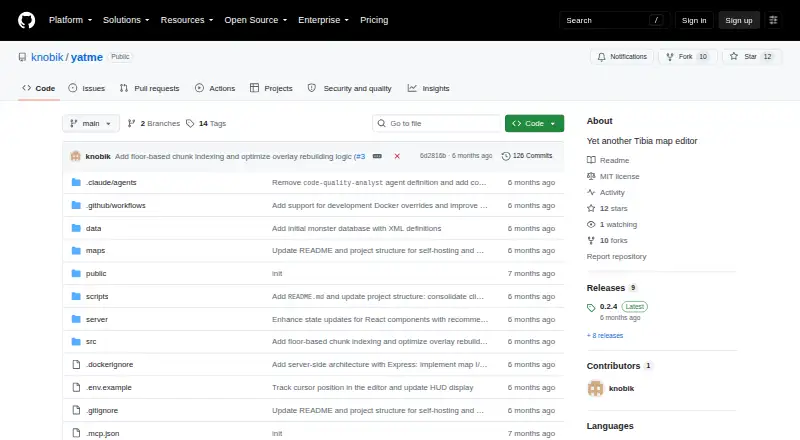
What YATME is
YATME is a browser-based OpenTibia map editor for Tibia 15.00+ client data. It renders and edits OTBM map files using sprite data extracted from the Tibia client, and includes tools for tilemaps and entity placement. The project describes its inspiration as Remere's Map Editor and presents itself for map development and administration, including hosting alongside an OTS server.
To use the editor, you need asset files from a Tibia 15.00+ client and an .otbm map; related sidecar XML files are optional. The project provides Docker Compose and Docker run instructions, with the editor available at localhost port 8080 by default. Its Docker setup mounts client assets read-only and map files read-write, allowing saved map changes. At first startup, sprite sheets are converted from .bmp.lzma to PNG, and the converted cache persists across container restarts. YATME is MIT licensed and can be run locally as well as self-hosted. For local development, the README lists Node.js 22 or later as a prerequisite. The project is built with React 19, PixiJS 8, TypeScript and Vite.
Who it suits
YATME suits OpenTibia map creators and administrators working with Tibia 15.00+ client assets and OTBM maps. It is a fit for people comfortable running a self-hosted browser editor with Docker, or setting it up locally for development.
What it does well
- MIT-licensed and free to use.
- Edits OTBM maps with tilemap tools and entity placement.
- Provides Docker Compose and Docker run instructions.
- Can be hosted alongside an OTS server.
- Converted sprite cache persists across container restarts.
What to know first
- Requires asset files from a Tibia 15.00+ client.
- Requires an .otbm map file to edit.
- Local development requires Node.js 22 or later.
Limits
YATME requires asset files from a Tibia 15.00+ client and an .otbm map file. Local development requires Node.js 22 or later.
Plans
| Plan | Billed and limits | Price |
|---|---|---|
| Free | MIT-licensed · self-hosted with Docker or run locally · requires Tibia 15.00+ client assets | Free |
As github.com lists them, read 4 Oct 2026. The maker's own page has the final word.
Getting started
- Get asset files from a Tibia 15.00+ client.
- Prepare an .otbm map file and, if needed, its sidecar XML files.
- Choose the Docker Compose or Docker run instructions in the project README.
- Mount client assets read-only and map files read-write in the Docker setup.
- Open the editor at localhost port 8080 by default.
- For local development, install Node.js 22 or later and follow the project instructions.
Verdict
Pick YATME if you need a self-hosted browser editor for OpenTibia maps and have the required client assets and OTBM files. Docker instructions provide a route to run it, and local development is also possible. Look elsewhere if you need an editor that does not depend on Tibia 15.00+ assets.
Questions
Is YATME free?
Yes. Its plan is listed as free, and the project is MIT licensed.
Which platforms does YATME support?
It is listed as self-hosted and web. The project also describes running it locally.
What files does the editor work with?
It renders and edits OTBM map files using sprite data from Tibia client assets. Related sidecar XML files are optional.
Does it require Docker?
The README provides Docker Compose and Docker run instructions, and also describes local running. Local development requires Node.js 22 or later.
What does the Docker setup need?
It needs Tibia 15.00+ client assets and an .otbm map file. The setup mounts assets read-only and map files read-write.
Who makes YATME?
The repository is hosted under the GitHub account knobik.
Facts from YATME's own pages
- Asset storage
- The Docker setup mounts Tibia client assets read-only and map files read-write so the editor can save changes. · github.com, 4 Oct 2026
- Deployment
- The README provides Docker Compose and Docker run instructions, with the editor available at localhost port 8080 by default. · github.com, 4 Oct 2026
- Inspiration
- The project says it was inspired by Remere's Map Editor. · github.com, 4 Oct 2026
- License
- The repository identifies the project as MIT licensed. · github.com, 4 Oct 2026
- Local development
- The README lists Node.js 22 or later as a prerequisite for local development. · github.com, 4 Oct 2026
- Maker information
- The repository is publicly hosted under the GitHub account knobik; the opened maker pages do not state a company name, headquarters, or founding date. · github.com, 4 Oct 2026
- Map files
- It renders and edits OTBM map files using sprite data extracted from the Tibia client. · github.com, 4 Oct 2026
- Purpose
- YATME is a browser-based OpenTibia map editor for Tibia 15.00+ client data. · github.com, 4 Oct 2026
- Required assets
- The editor requires asset files from a Tibia 15.00+ client, an .otbm map file, and optionally related sidecar XML files. · github.com, 4 Oct 2026
- Self-hosting
- The README describes hosting the editor alongside an OTS server for map development and administration. · github.com, 4 Oct 2026
- Sprite handling
- On first startup, sprite sheets are automatically converted from .bmp.lzma to PNG, and the converted sprite cache persists across container restarts. · github.com, 4 Oct 2026
- Technology
- The project is built with React 19, PixiJS 8, TypeScript, and Vite. · github.com, 4 Oct 2026
Where YATME stands on Freedom251
- Game Level Editors#27 of 28