Freedom251 › Vulnerability Management Software
WPSec
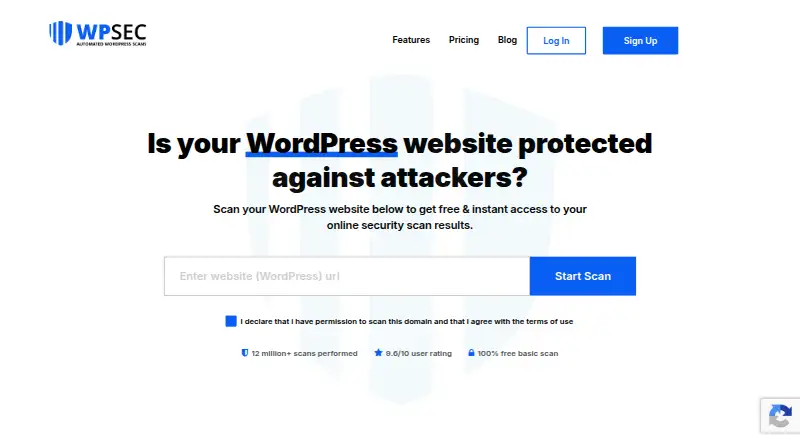
What WPSec is
WPSec is an online scanner for WordPress vulnerabilities, available through the web and an API. It checks websites against a vulnerability database using WPScan-based scanning and custom technology, and helps users identify outdated software. A dashboard tracks multiple WordPress installations, while reports explain findings and ways to address them. Scan schedules depend on the plan and can be monthly, weekly, or daily. WPSec also examines code from more than 118,000 plugins and scores plugin risk, including for plugins without a known vulnerability. Email and smartphone push notifications can flag security issues such as outdated or risky plugins and themes. The Free plan costs nothing and provides one scan location, up to 10 scan reports, and monthly scans. Premium costs €19 a month per website, with charges varying across higher website bands; it adds report exports, API, webhooks, CLI, AI/MCP integration, and stealth and WAF-bypass scanning. White Label costs €295 a month, billed €3400/year, and includes branded design and a separate isolated instance. The service is provided by Triop AB in Funäsdalen, Sweden.
Who it suits
WPSec suits people managing WordPress websites who want vulnerability checks, reports, and alerts. Premium offers additional exports and integration options for users who need them.
What it does well
- Dashboard tracks multiple WordPress websites
- Reports explain findings and possible responses
- Alerts can arrive by email or smartphone push
- Free plan includes monthly scans
What to know first
- Free plan allows one scan location
- Free plan includes up to 10 scan reports
- Premium pricing varies across website bands
- White Label costs €295 a month
Limits
Free is limited to one scan location, up to 10 scan reports, and monthly scans. Premium is billed per website, with per-site prices changing across higher website bands.
Plans
| Plan | Billed and limits | Price |
|---|---|---|
| Free | 84,900 known vulnerabilities · 1 scan location · Up to 10 scan reports · Monthly scans | Free |
| Premium | per website; €19 each for websites 1–2, then €6, €3, €2, and €1 each across higher bands · Daily, weekly, or monthly scans · Attack Surface analysis and CVE matching · PDF and JSON exports · API, webhooks, CLI · AI/MCP integration · Stealth and WAF-bypass scanning | €19 a month |
| White Label | €3400/year · Everything in Premium · Unlimited scans and reports · Branded design, logo, and domain · Separate isolated instance | €295 a month |
As wpsec.com lists them, read 10 Oct 2026. The maker's own page has the final word.
Getting started
- Open wpsec.com.
- Choose the Free plan or a paid plan based on scan frequency and features.
- Add a WordPress website as a scan location.
- Review findings and suggested ways to address them in the dashboard.
- Set up scheduled scans and issue notifications available with the selected plan.
WPSec is a cloud service focused on finding vulnerabilities, outdated software, and plugin risk across WordPress sites. It suits site owners, agencies, and small teams that need recurring oversight of one or several installations. Its WordPress-specific monitoring and remediation reports are useful, but the free tier is deliberately narrow and serious multi-site operations quickly move into paid pricing.
Overview
WPSec combines WPScan-based checks with custom scanning technology to compare WordPress websites against a vulnerability database and identify outdated components. A central dashboard tracks installations, while reports explain what was found and how to address it. That makes the service better suited to ongoing responsibility for several sites than to an isolated security check.
The product also examines code behind more than 118,000 plugins and assigns plugin-risk scores even when no known vulnerability exists. This broader signal can help prioritize investigation before a formal CVE match appears. The scope remains specifically WordPress, however, so organizations needing infrastructure-wide vulnerability management should choose a broader platform.
Key features
- Scheduled scanning: Depending on the plan, accounts can scan daily, weekly, or monthly. Free accounts are restricted to monthly scans, a cadence that may leave rapidly changing sites waiting too long for new findings.
- Reports and notifications: Reports pair findings with suggested remediation. Email and smartphone push alerts cover security issues, outdated plugins and themes, and risky components, making the service more actionable than a dashboard that requires constant manual checking.
- Risk and attack-surface analysis: Plugin-risk scoring extends beyond known vulnerabilities, while CVE matching on Premium helps connect findings to established vulnerability records. This combination supports prioritization, although it remains centered on WordPress code and extensions.
- Automation and exports: Premium adds PDF and JSON exports, an API, webhooks, CLI access, and AI/MCP integration with Claude and Cursor. Outgoing JSON webhooks can feed services such as Slack and Zapier, which is valuable for teams routing findings into existing workflows.
- Advanced scanning: Premium includes stealth and WAF-bypass scanning. These controls are aimed at operators who need more flexible assessment of protected sites, rather than casual site owners.
- Responsible disclosure: WPSec publishes a vulnerability-reporting program with safe-harbor terms and a PGP key. Support typically responds within three business days.
Pricing
| Plan | Price | What you get |
|---|---|---|
| Free | free | 84,900 known vulnerabilities, one scan location, up to 10 scan reports, and monthly scans |
| Premium | €19 a month | Billed per website: €19 each for websites 1–2, then €6, €3, €2, and €1 each across higher bands. Daily, weekly, or monthly scans; attack-surface analysis and CVE matching; PDF and JSON exports; API, webhooks, CLI; AI/MCP integration; stealth and WAF-bypass scanning |
| White Label | €295 a month, billed €3400/year | Everything in Premium, plus unlimited scans and reports, branded design, logo and domain, and a separate isolated instance |
The Free plan is suitable for one WordPress location where monthly visibility and ten reports are enough. It is not a fit for agencies or owners needing frequent checks or a longer reporting history. Premium is the practical choice for active monitoring, automation, and multiple sites; its per-website billing means costs rise with each installation, although higher bands reduce the marginal price. White Label targets service providers that need branded customer-facing delivery and isolation, not a single-site owner.
Platforms
WPSec is delivered as a cloud deployment with web and API access. That suits centralized monitoring and integrations without requiring a self-hosted installation.
Who it's for
Choose WPSec if your responsibility is primarily WordPress and you want scheduled checks, explanatory reports, risk scoring, and alerts in one service. Premium fits agencies, developers, and teams managing several installations or feeding findings into Slack, Zapier, or internal tooling. White Label is aimed at providers delivering branded scanning to customers. Look elsewhere if you need coverage of operating systems, endpoints, or mixed infrastructure beyond WordPress.
Pros and cons
Pros
- WordPress-focused vulnerability and outdated-software checks keep findings relevant to site operators.
- Plugin-risk scoring can highlight concerns even without a published vulnerability.
- Premium’s exports, API, webhooks, CLI, and AI/MCP support enable operational automation.
- White Label provides branding and an isolated instance for client-facing services.
Cons
- Free is limited to one location, ten reports, and monthly scans.
- Premium billing per website can become expensive as the monitored estate grows.
- Its WordPress-only scope does not replace broad vulnerability-management coverage.
Alternatives
For a wider vulnerability-management category view, browse Vulnerability Management Software.
Intruder is a better fit when you need infrastructure targets, cloud accounts, and desktop-platform support alongside web coverage; its free plan includes five infrastructure targets but excludes web apps.
ManageEngine Vulnerability Manager Plus suits organizations seeking a broader endpoint and on-premises vulnerability-management product with free and professional editions.
OWASP DevGuard is an alternative for teams considering an open-source security tool with API, desktop, self-hosted, and web platforms.
Nanitor is preferable when asset management across Linux, macOS, web, and Windows matters; its free plan covers ten assets and Standard offers unlimited assets for $6 a month.
Qualys External Attack Surface Management is aimed at external attack-surface work and offers a 30-day no-cost CSAM with EASM period rather than a permanent free plan.
OWASP DefectDojo fits teams wanting an open-source, self-hosted vulnerability-management platform with a free Community Edition.
Tanium Deploy is an enterprise deployment option requiring a Tanium license.
Cyberwatch Vulnerability Manager is a paid alternative with pricing provided through a demo request.
Verdict
WPSec is a strong choice for WordPress owners and service teams that value recurring scans, plugin-risk prioritization, clear remediation reports, and integration-ready Premium controls. Choose it when WordPress is the center of your security workload; choose another platform when you need broad infrastructure coverage or the Free plan’s monthly, single-location limits are too restrictive.
Verdict
WPSec combines WordPress vulnerability checks with reports, risk scoring, and alerts. The Free plan is limited to one location and 10 reports; Premium and White Label add broader capabilities at listed prices.
Questions
Is WPSec free?
Yes. The Free plan costs nothing and includes one scan location, up to 10 reports, and monthly scans.
How much does Premium cost?
Premium is €19 a month per website for websites 1–2. Per-site charges are €6, €3, €2, and €1 across higher bands.
What does White Label cost?
White Label costs €295 a month, billed €3400/year.
Which scan schedules are available?
The Free plan includes monthly scans. Premium supports daily, weekly, or monthly scans.
What platforms does WPSec support?
WPSec is available on the web and through an API. Its deployment model is cloud.
Who provides WPSec?
The site identifies WPSec as a service by Triop AB in Funäsdalen, Sweden.
Facts from WPSec's own pages
- Alerts
- WPSec offers email and smartphone push notifications about security issues, including outdated or risky plugins and themes. · wpsec.com, 10 Oct 2026
- Attack surface
- WPSec says it analyzes code behind 118,000+ plugins and scores plugin risk, including when no known vulnerability exists. · wpsec.com, 10 Oct 2026
- Company
- The site identifies WPSec as a service by Triop AB in Funäsdalen, Sweden. · wpsec.com, 10 Oct 2026
- Dashboard and reports
- Users can track multiple WordPress websites in a dashboard and receive reports explaining findings and how to address them. · wpsec.com, 10 Oct 2026
- Exports and access
- Premium includes PDF and JSON report exports, API, webhooks, CLI access, and AI/MCP integration with Claude and Cursor. · wpsec.com, 10 Oct 2026
- Free plan limit
- The Free plan includes one WordPress scan location, up to 10 scan reports, and monthly scans. · wpsec.com, 10 Oct 2026
- Headquarters
- Funäsdalen, Sweden · wpsec.com, 28 Sept 2026
- Integrations
- A WPSec article says outgoing JSON webhooks can integrate with third-party services such as Slack and Zapier. · blog.wpsec.com, 10 Oct 2026
- Product
- WPSec describes itself as an online security scanner for WordPress vulnerabilities that tracks installations and identifies outdated software. · wpsec.com, 10 Oct 2026
- Scan controls
- Premium includes stealth and WAF-bypass scanning. · wpsec.com, 10 Oct 2026
- Scanner
- Its scanner is based on WPScan and custom technology, and checks WordPress websites against a vulnerability database. · wpsec.com, 10 Oct 2026
- Scheduled scans
- Account scans can run daily, weekly, or monthly, depending on the selected plan. · wpsec.com, 10 Oct 2026
- Security disclosure
- WPSec publishes a vulnerability reporting program with safe-harbor terms and a PGP key for reporting issues. · wpsec.com, 10 Oct 2026
- Support
- WPSec says support typically responds within three business days. · wpsec.com, 10 Oct 2026