Freedom251 › Webhook Management Software
Webhooker
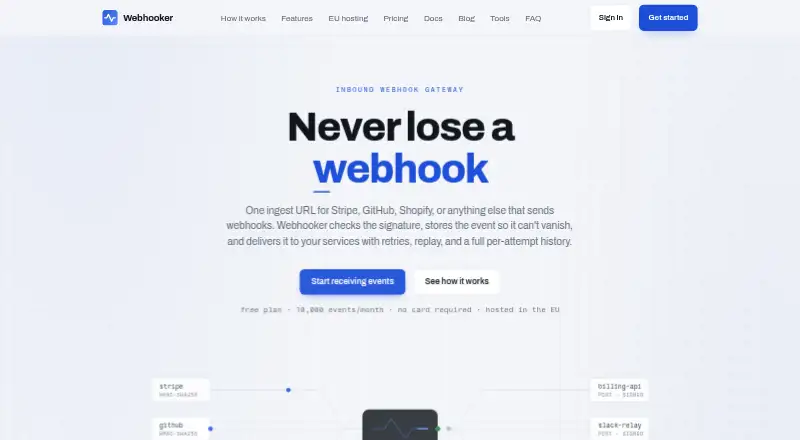
What Webhooker is
Webhooker is a cloud-based inbound webhook gateway that verifies, stores, and delivers events to services. It accepts HTTP POST webhooks from providers such as Stripe, GitHub, and Shopify, and checks source signatures using HMAC-SHA256 or SHA1; invalid signatures receive HTTP 401. Each destination gets six delivery attempts over about five hours, and failed events can be resent from a dead letter queue. Per-destination payload transformations, header injection, and outbound request signing are supported. A live event stream over SSE, delivery history, one-click replay, and in-app or email failure alerts help users follow processing. Delivery is at least once, so recipients should account for possible duplicates. The free plan costs nothing and includes 10,000 events per month, three sources, nine destinations, and 14-day retention. Pro costs €29 a month, and Team costs €99 a month. Webhooker says processing runs on Hetzner servers in Germany, with backups in EU data centers. Its CLI builds for Linux, macOS, and Windows forward incoming webhooks to localhost; a Management API supports dashboard operations over HTTP.
Who it suits
Webhooker suits teams that need to receive, verify, inspect, replay, and route inbound webhook events. Its free plan may suit smaller event volumes, while its paid plans add higher stated quotas and retention periods.
What it does well
- Verifies HMAC-SHA256 and SHA1 signatures
- Retries each destination up to six times
- Offers event history and one-click replay
- Free plan includes 10,000 events monthly
What to know first
- At-least-once delivery can produce duplicates
- Free plan retains events for 14 days
- Free plan allows three sources and nine destinations
Limits
The Free plan includes 10,000 events per month, three sources, nine destinations, and 14-day event retention. Pro includes 100,000 events per month, 50 sources, 250 destinations, 30-day retention, and five workspace members; Team includes 1,000,000 events per month, 200 sources, 1,000 destinations, 90-day retention, and 25 workspace members.
Plans
| Plan | Billed and limits | Price |
|---|---|---|
| Free | €0 / month · 10,000 events / month · 3 sources · 9 destinations · 14-day event retention · 120/min ingest rate | Free |
| Pro | €29 / month; €290 / year · 100,000 events / month · 50 sources · 250 destinations · 30-day event retention · 5 workspace members | €29 a month |
| Team | €99 / month; €990 / year · 1,000,000 events / month · 200 sources · 1,000 destinations · 90-day event retention · 25 workspace members | €99 a month |
As webhooker.eu lists them, read 9 Oct 2026. The maker's own page has the final word.
Getting started
- Open the Webhooker website and choose the Free, Pro, or Team plan.
- Configure an HTTP POST webhook source, such as Stripe, GitHub, or Shopify.
- Set up a destination service for event delivery.
- Configure signature verification and any destination transformations, headers, or outbound signing.
- Use the live event stream, delivery history, or alerts to follow processing.
- Optionally use the CLI to forward incoming webhooks to localhost or the Management API for dashboard operations.
Webhooker is a cloud gateway for accepting, checking, retaining and forwarding inbound webhooks. It is best suited to development and operations teams coordinating several providers and destinations that need inspection, replay and delivery controls. Its strongest case is recoverable, security-conscious routing; teams must still make consumers idempotent because deliveries are at least once.
Overview
Webhooker accepts HTTP POST webhooks from services including Stripe, GitHub and Shopify, then sends them to configured services. Per-source HMAC-SHA256 and SHA1 verification rejects invalid signatures with HTTP 401, creating a clear security boundary before application code processes an event.
Every destination receives six delivery attempts over approximately five hours. Failed events can be resent from a dead letter queue, while one-click replay supports reprocessing after a fix or investigation. This is a meaningful advantage over direct provider-to-application delivery, but the at-least-once guarantee means duplicate events are possible. Payment, order and other state-changing consumers need idempotency safeguards.
Key features
Routing and request control
Payload transformations can tailor one incoming event for different destinations. Header injection and outbound request signing help services that require their own credentials or a specific request format, reducing integration-specific code in each receiver.
Inspection and recovery
A live event stream over SSE, delivery history and failure alerts in the app or by email make delivery problems visible. Event inspection and replay are particularly useful when debugging provider payloads or recovering from a temporary outage. The Management API exposes dashboard operations over HTTP for automation, and the official CLI forwards incoming webhooks to localhost on Linux, macOS and Windows, which suits local development.
Data handling
Ingest, storage and delivery run on Hetzner servers in Germany, with backups in EU data centers. Event retention is 14, 30 or 90 days by plan, and paid plans include access to a data processing agreement. The separate log-retention figure is 30 days. These EU-hosting and retention choices may help teams with regional data requirements, while the right plan depends on how long investigations and replays must remain possible.
Pricing
| Plan | Price | Limits and inclusions |
|---|---|---|
| Free | €0.00 per month | 10,000 events/month, 3 sources, 9 destinations, 14-day event retention, 120/min ingest rate |
| Pro | €29.00/month or €290/year | 100,000 events/month, 50 sources, 250 destinations, 30-day retention, 5 workspace members |
| Team | €99.00/month or €990/year | 1,000,000 events/month, 200 sources, 1,000 destinations, 90-day retention, 25 workspace members |
The Free plan is a practical way to run a small number of integrations, but three sources and nine destinations leave little room for a growing estate. Pro is the more balanced choice for a team that needs substantially higher throughput, longer retention and shared access. Team is aimed at high-volume routing or broad multi-service operations, with a tenfold Pro event allowance and 25 members. Plans may exceed their monthly event quota by up to 20% without charge and do not bill overages, which softens occasional spikes but does not remove quota planning. Paid plans have custom pricing only where a plan is not shown; the published Pro and Team rates are the stated terms.
Platforms
Webhooker is delivered as a cloud service with API access on Linux, macOS and Windows, plus web access. Its CLI has builds for Linux, macOS and Windows and forwards incoming events to localhost. The Management API is suitable for HTTP-based dashboard automation.
Who it's for
Choose Webhooker when several third-party webhook sources feed multiple internal services and you need signature rejection, controlled retries, event history and replay in one gateway. It is also a fit for teams wanting EU-based hosting and a paid-plan data processing agreement. It is less suitable when consumers cannot tolerate duplicates, when self-hosting is mandatory, or when a small integration will remain below the Free plan's modest source and destination limits.
Pros and cons
Pros
- Strong delivery recovery: six attempts, dead-letter resends and one-click replay give operators concrete ways to recover failed events.
- Useful security controls: per-source HMAC-SHA256/SHA1 checks and HTTP 401 rejection stop invalid requests early.
- Flexible destinations: transformations, header injection and outbound signing accommodate differing receiver requirements.
- Clear scaling steps: Pro and Team raise event, source, destination, retention and member limits substantially.
- EU data location: German hosting, EU backups and paid-plan DPA support region-conscious deployments.
Cons
- Duplicate handling is required: at-least-once delivery shifts idempotency work to every consumer.
- Free limits are narrow: 10,000 events, three sources and nine destinations can constrain a growing integration setup.
- Retention varies by plan: the Free plan keeps events for 14 days, so longer investigations require Pro or Team.
- Cloud-only deployment: organizations requiring a self-hosted gateway need another product.
Alternatives
Hookdeck is worth choosing for a freemium service with a free trial, self-hosted support and a Developer allowance of up to 10,000 events with three-day retention and one user.
Dispatch suits teams wanting a free 10,000-event tier with two members and public projects, or a paid Team option, while its free plan keeps only three days of history and drops over-limit events at ingress.
Hookbridge is an alternative when message-based tiers from 1,000 free messages through 50,000 at Pro fit your volume model.
RelayHQ is better for very small setups needing three endpoints, 500 requests per month and 24-hour logs, but its free tier has no automatic retry.
Webhook Relay offers a free starter allowance of 150 webhooks per month, two destinations and one input.
Hookdeck Outpost is the choice for an Apache-2.0 open-source, self-hosted binary or Docker deployment.
WebhookX provides a free Community version and a Team plan at $39 per month.
Kiosk is a free, open-source PDF reader rather than a webhook gateway.
Verdict
Webhooker is a strong choice for teams that need verified inbound events, multi-destination controls and practical replay and recovery, especially with EU hosting. Look elsewhere if duplicate delivery is unacceptable, self-hosting is essential, or your traffic and integration count fit only a smaller, simpler free tier.
Verdict
Webhooker combines signature checks, retries, event inspection, and replay in a cloud gateway. Account for possible duplicate deliveries and compare the plan quotas and retention periods with your needs.
Questions
How much does Webhooker cost?
The Free plan costs nothing. Pro is €29 a month or €290 per year, and Team is €99 a month or €990 per year.
What does the Free plan include?
It includes 10,000 events per month, three sources, nine destinations, and 14-day event retention.
Which platforms are supported?
Webhooker lists API, Linux, macOS, web, and Windows. Its CLI has builds for Linux, macOS, and Windows.
How does Webhooker verify webhook signatures?
It supports per-source HMAC-SHA256 and SHA1 verification. Invalid signatures receive HTTP 401.
Does Webhooker retry and replay events?
Each destination gets six delivery attempts over about five hours, and failed events can be resent from a dead letter queue. One-click replay is also available.
Where does Webhooker host data?
Webhooker says ingest, storage, and delivery run on Hetzner servers in Germany, with backups in EU data centers. A data processing agreement is available on paid plans.
Facts from Webhooker's own pages
- API
- Webhooker documents a Management API for performing dashboard operations over HTTP. · docs.webhooker.eu, 9 Oct 2026
- Billing limits
- The pricing page says plans may run up to 20% over their monthly event quota at no charge and do not incur overage billing. · webhooker.eu, 9 Oct 2026
- CLI platforms
- The official CLI has builds for Linux, macOS, and Windows and forwards incoming webhooks to localhost. · webhooker.eu, 9 Oct 2026
- Delivery guarantee
- Webhooker provides at-least-once delivery, so consumers should expect possible duplicates. · webhooker.eu, 9 Oct 2026
- Hosting and data location
- Webhooker says ingest, storage, and delivery run on Hetzner servers in Germany, with backups in EU data centers. · webhooker.eu, 9 Oct 2026
- Monitoring
- It provides a live event stream over SSE, delivery history, one-click replay, and in-app or email failure alerts. · webhooker.eu, 9 Oct 2026
- Provider compatibility
- It accepts HTTP POST webhooks from services such as Stripe, GitHub, and Shopify. · webhooker.eu, 9 Oct 2026
- Purpose
- Webhooker is an inbound webhook gateway that verifies, stores, and delivers webhook events to your services. · webhooker.eu, 9 Oct 2026
- Retention and DPA
- Events are retained for 14, 30, or 90 days depending on plan, and a data processing agreement is available on paid plans. · webhooker.eu, 9 Oct 2026
- Retries and recovery
- Each destination gets six delivery attempts over about five hours, and failures can be resent from a dead letter queue. · webhooker.eu, 9 Oct 2026
- Signature checks
- It supports per-source HMAC-SHA256 and SHA1 verification and rejects invalid signatures with HTTP 401. · webhooker.eu, 9 Oct 2026
- Transformations and signing
- Webhooker supports per-destination payload transformations, header injection, and signing of outbound requests. · webhooker.eu, 9 Oct 2026
Where Webhooker stands on Freedom251
- Webhook Management Software#14 of 29