Freedom251 › Webhook Management Software

Hookbridge
What Hookbridge is
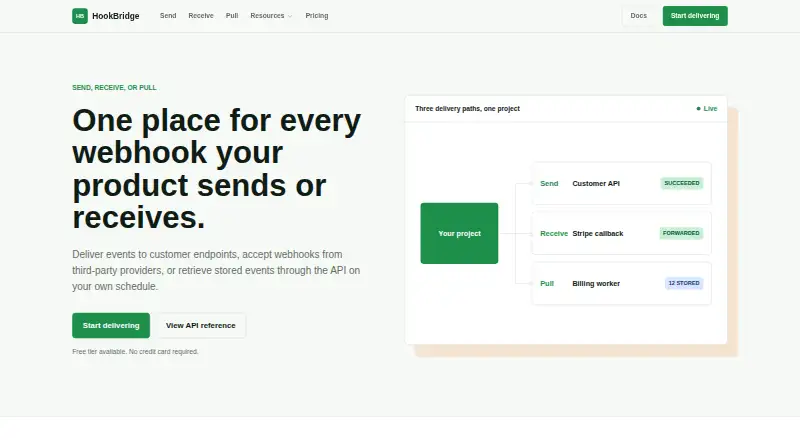
Hookbridge is a cloud service for software teams that send webhooks to customer endpoints, receive events from third-party services, or store incoming events for workers to retrieve through an API. Its send API queues a message and returns an ID while delivery proceeds outside the application’s request path. Outbound delivery retries use exponential backoff and jitter according to a configured schedule for retryable failures. Retained messages can be replayed from the console or API after delivery succeeds or fails. Security options include outbound HMAC-SHA256 signatures and inbound checks using HMAC signatures, static tokens, or IP allowlists. Hookbridge says it encrypts data in transit and uses access controls and monitoring; payload and delivery-log retention depends on plan and customer settings, with automatic purging after the configured window. Developers can use an HTTP API or SDK examples for Node.js, Python, Go, Ruby, and PHP. Tools include a CLI tunnel for receiving webhooks on localhost, a GitHub Action for testing handlers in CI, and a browser request inspector that requires no account. Plans include 1,000 messages free, 5,000 for $10 a month, 50,000 for $20 a month, and 250,000 for $100 a month.
Who it suits
It suits software teams handling outbound or inbound webhooks that need queued delivery, retries, or event replay. Developers can also use its SDK examples and webhook inspection tools.
What it does well
- Queues outbound messages outside the application request path.
- Retries use exponential backoff and jitter.
- Retained events can be replayed through console or API.
- Browser request inspector requires no account.
What to know first
- Free plan includes 1,000 messages.
- Retention depends on plan and customer settings.
- GitHub Action requires an account and API key.
- GitHub Action runs on Linux GitHub Actions runners.
Limits
The Free plan includes 1,000 messages. Starter includes 5,000 messages for $10 a month, Pro includes 50,000 messages for $20 a month, and Business includes 250,000 messages for $100 a month.
Plans
| Plan | Billed and limits | Price |
|---|---|---|
| Free | 1,000 messages | Free |
| Starter | 5,000 messages | $10 a month |
| Business | 250,000 messages | $100 a month |
| Pro | 50,000 messages | $20 a month |
As hookbridge.io lists them, read 7 Oct 2026. The maker's own page has the final word.
Getting started
- Open https://www.hookbridge.io/.
- Choose the free plan or a paid plan: Starter, Pro, or Business.
- Connect through the HTTP API or a listed SDK example.
- Use the CLI tunnel to receive webhooks on localhost, or the browser request inspector without an account.
- For CI handler testing, use the GitHub Action on Linux GitHub Actions runners with a Hookbridge account and API key.
Hookbridge is a cloud service for software teams sending webhooks to customer endpoints, receiving provider events, or routing incoming events to workers through an API. It suits teams that want delivery and recovery outside their application’s request path. Its strongest case is the combination of queued delivery, retries, replay, and verification; the right plan depends on message volume and retention needs.
Overview
A send request queues a message and returns its ID while delivery continues separately, avoiding a wait on the recipient endpoint in the calling application. Teams can also receive third-party webhooks or store incoming events for workers to retrieve through an API. The cloud deployment simplifies the choice for teams seeking a hosted service, but Hookbridge is not a self-hosted option.
Key features
Delivery and recovery
Outbound retries use exponential backoff and jitter, following a configured schedule for retryable failures. That helps teams handle temporary endpoint problems without putting delivery in the original request path. Retained messages can be replayed from the console or API after success or failure, supporting recovery and deliberate reprocessing. Replay is useful only while messages remain available: payloads and delivery logs are purged automatically after the configured retention window, which varies by plan and customer settings.
Verification and inspection
Outbound HMAC-SHA256 signatures and inbound checks using configured HMAC signatures, static tokens, or IP allowlists cover several common ways to verify webhook traffic. Event inspection adds a way to examine activity. These tools make Hookbridge a stronger fit for teams that need more than basic forwarding, though the service does not remove the need to set verification and retention policies appropriately.
Developer workflow
SDK examples for Node.js, Python, Go, Ruby, and PHP sit alongside an HTTP API. A CLI secure tunnel supports receiving webhooks on localhost, while a browser request inspector can be used without an account. For CI, a GitHub Action tests handlers on Linux GitHub Actions runners; it requires a Hookbridge account and API key. Stripe, GitHub, and Shopify are named as example inbound webhook providers.
Pricing
Hookbridge has a free plan and paid plans starting at $10/mo. The Free plan costs nothing and includes 1,000 messages, a useful starting allowance for evaluation or low-volume workloads. Starter costs $10 a month for 5,000 messages, a measured step up for small production use. Pro costs $20 a month for 50,000 messages, making it the more suitable published tier for teams with substantially higher volume. Business costs $100 a month for 250,000 messages, aimed at larger workloads. Business is the highest published tier, but teams should match its quota and their configured retention to expected event volume. Retention varies by plan and customer settings, so it matters alongside message allowance when replaying older events is important. The plans do not give a published seat allowance.
Platforms
Hookbridge supports API, Linux, macOS, web, and Windows. Its cloud deployment and local tunnel support a mix of hosted delivery and local development; the CI action is specifically for Linux GitHub Actions runners.
Who it's for
Hookbridge is a good fit for software teams that need asynchronous delivery to customer endpoints, inbound webhook handling, or an API queue for workers, especially when retries, replay, and signature checks matter. Its local tunnel and CI action also suit teams building and checking handlers during development. Teams that require self-hosting should look elsewhere, as should workloads whose message volume or desired retention does not fit the chosen plan.
Pros and cons
- Pros: Queued delivery returns a message ID before delivery completes, keeping endpoint latency out of the original request path.
- Pros: Scheduled retries and replay after success or failure provide distinct paths for handling temporary errors and reprocessing.
- Pros: Multiple inbound verification methods, outbound signing, and event inspection support teams that need to manage webhook security and diagnose activity.
- Pros: SDK examples, a local tunnel, and a CI action cover several stages of implementation and testing.
- Cons: Message allowances range from 1,000 on Free to 250,000 on Business, so teams need to account for volume when choosing a tier.
- Cons: Retention depends on plan and customer settings, and automatic purging limits how long messages remain replayable.
- Cons: The service is cloud-only, and using the GitHub Action requires an account and API key.
Alternatives
For a wider comparison, see Webhook Management Software. Choose Hookdeck if its free Developer plan’s 10,000 events, 3-day retention, one user, and included discarded-request allowance better match your starting workload. Kiosk is a free, open-source PDF reader, rather than a webhook-management alternative. Dispatch may fit teams seeking 10,000 free monthly events, three days of history, and two members, provided public projects and dropped over-limit events at ingress are acceptable. RelayHQ is worth considering when 500 monthly requests, three endpoints, and 24-hour log history are enough and its free plan’s lack of automatic retries is acceptable. Webhook Relay offers a free starter allowance of 150 webhooks per month and up to two destinations for smaller workloads. Webhooker may suit teams needing its free plan’s 10,000 monthly events, three sources, nine destinations, and 14-day retention. Hookdeck Outpost is an option for teams considering an Apache-2.0-licensed, self-hosted webhook service. WebhookX is another alternative.
Verdict
Choose Hookbridge if your team wants queued webhook delivery with retries, replay, and verification, plus tools for local and CI workflows. Its central advantage is keeping delivery and recovery separate from the application’s request path. Look elsewhere if self-hosting is essential or if the plan’s message allowance and retention do not suit your expected workload.
Verdict
Hookbridge combines webhook delivery, retry, verification, and replay features with tools for local and CI workflows. Compare the message allowances and retention settings for each plan with the events your team expects to handle.
Questions
Does Hookbridge have a free plan?
Yes. The Free plan costs nothing and includes 1,000 messages.
What do the paid plans cost?
Starter is $10 a month for 5,000 messages, Pro is $20 a month for 50,000 messages, and Business is $100 a month for 250,000 messages.
Which platforms does Hookbridge support?
Hookbridge lists API, Linux, macOS, web, and Windows.
Which SDKs are listed?
The site lists SDK examples for Node.js, Python, Go, Ruby, and PHP, alongside an HTTP API.
Can messages be replayed and inspected?
Retained messages can be replayed from the console or API after successful or failed delivery. Event inspection is available.
Which inbound webhook providers are named?
Stripe, GitHub, and Shopify are named as example providers.
Facts from Hookbridge's own pages
- CI limit
- The GitHub Action runs on Linux GitHub Actions runners and requires a Hookbridge account and API key. · hookbridge.io, 7 Oct 2026
- Delivery
- The send API stores and queues a message, then returns a message ID while delivery continues outside the application's request path. · hookbridge.io, 7 Oct 2026
- Developer tools
- Hookbridge offers a CLI secure tunnel for receiving webhooks on localhost, a GitHub Action for testing handlers in CI, and a browser request inspector that requires no account. · hookbridge.io, 7 Oct 2026
- Integrations
- The inbound webhook page names Stripe, GitHub, and Shopify as example providers. · hookbridge.io, 7 Oct 2026
- Privacy
- The privacy policy says Hookbridge encrypts data in transit, uses access controls and monitoring, does not sell personal data, and acts as a processor for customer webhook payloads and delivery logs. · hookbridge.io, 7 Oct 2026
- Product
- Hookbridge lets software teams send webhooks to customer endpoints, receive third-party webhooks, or store incoming events for workers to retrieve through an API. · hookbridge.io, 7 Oct 2026
- Replay
- Retained messages can be replayed from the console or API after successful or failed delivery. · hookbridge.io, 7 Oct 2026
- Retention
- Webhook payload and delivery log retention depends on the plan and customer settings, with automatic purging after the configured retention window. · hookbridge.io, 7 Oct 2026
- Retries
- Outbound delivery retries use exponential backoff and jitter, and retryable failures follow a configured schedule. · hookbridge.io, 7 Oct 2026
- SDKs
- The site lists SDK examples for Node.js, Python, Go, Ruby, and PHP, alongside an HTTP API. · hookbridge.io, 7 Oct 2026
- Security
- The service supports outbound HMAC-SHA256 signatures and inbound verification using configured HMAC signatures, static tokens, or IP allowlists. · hookbridge.io, 7 Oct 2026
- Support
- The site lists [email protected] as a contact address for inquiries and requests. · hookbridge.io, 7 Oct 2026
Where Hookbridge stands on Freedom251
- Webhook Management Software#7 of 29