Freedom251 › Webhook Management Software
RelayHQ
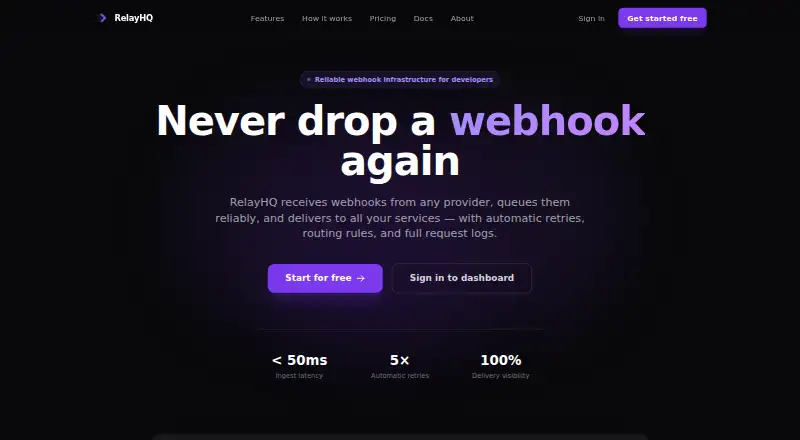
What RelayHQ is
RelayHQ receives provider webhooks, queues them, and delivers requests to configured services. Permanent inbound URLs can fan requests out to multiple destinations, while routing rules filter by JSON payload path or HTTP header and combine conditions with AND or OR logic. Failed deliveries can be retried up to five times with exponential backoff, and requests can be replayed from the dashboard. The service provides request logs and event inspection, plus a REST API that accepts bearer API keys or a valid session cookie. The Free plan includes a CLI local tunnel for development. RelayHQ names Stripe, GitHub, and Shopify as webhook sources and says setup takes under five minutes without managing infrastructure or message brokers. It runs on cloud infrastructure in US East (IAD). Its privacy policy says data is transmitted using TLS 1.2 or higher, API keys are hashed before storage, and passwords are hashed with bcrypt. The maker says it does not sell personal information or use webhook payloads for purposes beyond delivery to configured destinations. The Free plan allows three endpoints and 500 requests per month, but excludes automatic retries and routing rules.
Who it suits
The Free plan suits developers who need a local tunnel and a small webhook setup. Starter is positioned for indie developers and small production projects; Pro and Team target teams running production apps or needing organizational controls.
What it does well
- Permanent inbound URLs can deliver to multiple destinations
- Retries failed deliveries up to five times
- Requests can be replayed from the dashboard
- Free plan includes a CLI local tunnel
- REST API and event inspection are available
What to know first
- Free plan allows three endpoints and 500 requests monthly
- Free plan has no automatic retries or routing rules
- Free logs retain history for 24 hours
- Paid plans start at $23/mo billed annually
Limits
Free allows 3 endpoints, 500 requests per month, one destination per endpoint, 24-hour log history, a 256 KB body size, and 60 requests per minute; it has no automatic retries or routing rules. Starter begins at $23/mo billed annually and includes 10 endpoints, 50,000 requests monthly, 30-day log history, five retries, and five routing rules per endpoint. Pro and Team raise those limits and include longer retention; Team has one-year log history.
Plans
| Plan | Billed and limits | Price |
|---|---|---|
| Free | $0/mo · 3 endpoints · 500 requests/month · 1 destination per endpoint · 24-hour log history · 256 KB body · 60 req/min · no auto-retry · no routing rules | Free |
| Team | $199/mo; or $159/mo billed annually · Unlimited requests · unlimited seats · 1-year logs · SAML 2.0/Okta SSO · audit log · 10 MB body · custom rate limits · dedicated Slack support · 99.95% SLA · custom retention · invoice billing | $199 a month |
| Starter | $29/mo; or $23/mo billed annually · 10 endpoints · 50,000 requests/month · 3 destinations/endpoint · 30-day logs · 5 retries · conditional routing · Slack/email alerts · 1 MB body · 600 req/min | $29 a month |
| Pro | $79/mo; or $63/mo billed annually · Unlimited endpoints · 500,000 requests/month · unlimited destinations · 90-day logs · 5 seats · unlimited routing · 5 MB body · priority email support · 99.9% SLA | $79 a month |
As relayhq.org lists them, read 15 Oct 2026. The maker's own page has the final word.
Getting started
- Open the RelayHQ website.
- Choose the Free plan or a paid plan that fits your endpoint and request needs.
- Create permanent inbound webhook URLs and configure destinations.
- Use the REST API with a bearer API key or valid session cookie if integrating through the API.
- For local development, use the Free plan's CLI local tunnel.
RelayHQ is a managed webhook service for developers and teams that want to route and recover event deliveries without running the infrastructure themselves. It is strongest once a project needs retries, multiple destinations, and production controls; the free tier is a constrained starting point, not a full preview of those capabilities.
Overview
RelayHQ assigns permanent inbound webhook URLs, queues incoming requests, and can forward them to several configured destinations at once. The maker says setup takes under five minutes without operating infrastructure or configuring message brokers. That trade-off favors teams seeking managed delivery over teams that need to host the service themselves. Its listed hosting region is US East (IAD).
Stripe, GitHub, and Shopify are named as webhook sources. A REST API at api.relayhq.org accepts bearer API keys or a valid session cookie. The privacy policy says traffic is transmitted over TLS 1.2+, stored API keys are hashed, and passwords are hashed with bcrypt. The maker says it does not sell personal information or use webhook payloads for purposes beyond delivery to configured destinations.
Key features
Delivery and recovery
Paid plans retry failed deliveries up to five times with exponential backoff, and requests can be replayed manually from the dashboard. Those tools provide a useful path to recover from endpoint failures, but the Free plan has no automatic retries. Developers evaluating RelayHQ on Free should account for that gap: the plan will not demonstrate the paid recovery workflow.
Routing and inspection
Routing rules can match JSON payload paths or HTTP headers, with conditions combined using AND or OR. That gives teams a way to direct only relevant events rather than forwarding every request everywhere. Free has no routing rules; Starter allows five per endpoint, while Pro and Team remove the rule-count limit. Event inspection and request logs help with troubleshooting, though log history varies sharply by tier.
Local development
The Free plan includes a CLI local tunnel for development. It is useful for building against incoming webhooks without first deploying a destination, although Free’s one-destination-per-endpoint cap and 500-request monthly quota keep it firmly in small-scale territory.
Pricing
RelayHQ is freemium. Annual billing lowers the effective monthly price on paid plans, but the monthly billed prices are higher; the terms below make the difference clear.
| Plan | Price | What it includes |
|---|---|---|
| Free | free | 3 endpoints, 500 requests/month, 1 destination per endpoint, 24-hour log history, 256 KB body size, 60 req/min rate limit, and no automatic retries or routing rules. |
| Starter | $29 a month billed monthly, or $23/mo billed annually | 10 endpoints, 50,000 requests/month, 3 destinations per endpoint, 30-day log history, 5 retries, 5 routing rules per endpoint, 1 MB body size, and 600 req/min. |
| Pro | $79 a month billed monthly, or $63/mo billed annually | Unlimited endpoints and destinations, 500,000 requests/month, 90-day logs, 5 team seats, unlimited routing rules, 5 MB body size, priority email support, and a 99.9% uptime SLA. |
| Team | $199 a month billed monthly, or $159/mo billed annually | Unlimited requests, seats, and routing rules; one-year logs; SSO (SAML 2.0 / Okta); audit log; 10 MB body size; custom rate limits and retention; dedicated Slack support; and a 99.95% uptime SLA. |
Free is suitable for experimenting or a small development integration, but its 500-request cap, single destination, short log history, and lack of retries leave little headroom for production reliability. Starter is the first practical production tier: it adds retries and routing, more destinations, and a much larger quota, making it the fit for indie developers and small production projects. Pro costs more but suits teams running multiple production apps, with unlimited endpoint and destination counts, longer retention, five seats, and an uptime SLA. Team is for engineering organizations that need SSO, audit logs, custom limits, and dedicated support; its unlimited requests and seats also remove the principal Pro caps. No trial length is stated.
Retention is one of the clearest operational differences: 7 days on Free, 30 on Starter, 90 on Pro, and one year on Team. The plan summary gives Free 24-hour log history, while the privacy policy describes webhook log retention as 7 days; those measures are not equivalent, so users should not assume seven days of accessible Free logs. Paid prices also depend on billing term: the annual figures are monthly equivalents, not the monthly-billed rates.
Platforms
RelayHQ supports API, Linux, macOS, web, and Windows. Its cloud deployment means these platform labels do not make it a self-hosted option.
Who it's for
RelayHQ is a good fit for developers who want a managed layer between webhook providers and their own services, especially when they need retries, replay, or conditional routing. Starter matches smaller production projects; Pro makes more sense for teams operating several apps and needing more destinations and seats. Teams that require SSO, audit trails, custom retention, or a stronger stated uptime commitment have a clearer case for Team. It is less suitable for anyone who needs self-hosting or wants meaningful automatic-retry and routing capability at no cost.
Pros and cons
Pros
- Permanent inbound URLs and fan-out to multiple destinations support a managed webhook flow without requiring teams to configure message brokers.
- Five retries with exponential backoff, manual replay, and payload- or header-based rules address delivery recovery and selective forwarding on paid plans.
- Plan limits scale from a small Free quota to unlimited requests and seats on Team, with longer log retention and support options at higher tiers.
- The maker describes TLS 1.2+, hashed API keys and passwords, and restricted use of webhook payloads.
Cons
- Free omits the two capabilities most likely to justify a webhook manager—automatic retries and routing—and permits only one destination per endpoint.
- Starter is capped at 50,000 requests/month and five rules per endpoint, so busier or more complex projects may need the substantially pricier Pro tier.
- The stated hosting region is US East (IAD), and the service is cloud-hosted rather than self-hosted.
- Free’s plan history says 24 hours while the privacy policy retention figure is 7 days, making the usable log window unclear from those two statements alone.
Alternatives
Consider Hookdeck if its free Developer plan’s up-to-10,000 events and three-day retention better match a higher-volume evaluation, or if self-hosted support matters; RelayHQ’s Free tier has fewer monthly requests but includes a local development tunnel.
Kiosk is an open-source PDF reader, not a webhook-management substitute, so it is relevant only if the need is document reading rather than event delivery.
Dispatch is worth considering when a free allowance of 10,000 events/month and two members is more important than RelayHQ’s Free plan’s development tunnel; Dispatch’s free projects are public and over-limit events are dropped at ingress.
Hookbridge offers a lower-cost paid entry at $10 a month for 5,000 messages, making it an option to compare for smaller paid workloads against RelayHQ Starter’s larger quota and higher annual-billed price.
Webhook Relay is the alternative to examine if self-hosted support is important; its Free Starter plan allows 150 webhooks/month and up to two destinations, while RelayHQ Free allows more monthly requests but only one destination per endpoint.
Webhooker may suit a reader who prefers a stated allowance of 10,000 events/month, three sources, and nine destinations on its free plan; RelayHQ Free instead includes a CLI local tunnel but is capped at 500 requests/month.
Hookdeck Outpost is a self-hosted, Apache-2.0-licensed option distributed as a Go binary and Docker container, making it the more relevant comparison for teams that want to run the webhook system themselves.
WebhookX is another option to compare if a self-hosted platform is the priority; RelayHQ is managed cloud software.
For a broader comparison, see Webhook Management Software.
Verdict
RelayHQ is a sensible choice for developers and teams who want managed webhook delivery with retries, replay, and routing, and are willing to pay once those safeguards matter in production. Starter is the most defensible entry point for small production projects; Pro or Team makes sense when volume, team access, retention, or enterprise controls demand it. Look elsewhere if self-hosting is essential, or if the free tier must include automatic retries and routing rather than only basic webhook handling.
Verdict
RelayHQ handles webhook queuing, routing, retries, and replay, with a free tier for limited use. Its Free plan omits automatic retries and routing rules, while paid plans provide higher limits and additional capabilities.
Questions
Is there a free plan?
Yes. Free costs nothing and includes 3 endpoints and 500 requests per month.
What does RelayHQ cost?
The listed paid plans are Starter at $29 a month, or $23/mo billed annually; Pro at $79 a month, or $63/mo billed annually; and Team at $199 a month, or $159/mo billed annually.
Which platforms does RelayHQ support?
The listed platforms are API, Linux, macOS, web, and Windows.
Can failed webhook deliveries be retried?
Paid plans list up to five retries with exponential backoff. The Free plan has no automatic retries.
How long are webhook logs retained?
The listed retention is 7 days on Free, 30 days on Starter, 90 days on Pro, and one year on Team.
What integrations does RelayHQ name?
The site names Stripe, GitHub, and Shopify as webhook sources; events can be forwarded to configured destinations.
Facts from RelayHQ's own pages
- API
- RelayHQ documents a REST API at api.relayhq.org that uses bearer API keys or a valid session cookie. · relayhq.org, 5 Oct 2026
- API authentication
- Programmatic API calls use workspace-scoped bearer API keys, while the dashboard uses session cookies. · relayhq.org, 15 Oct 2026
- API scope
- The documented API covers workspaces, endpoints, destinations, routing rules, requests, delivery attempts, and API keys. · relayhq.org, 15 Oct 2026
- Automatic retries
- Paid delivery retries can run up to five times with exponential backoff. · relayhq.org, 15 Oct 2026
- Availability target
- The terms target 99.9% monthly uptime for the ingest layer, with higher SLA percentages on paid plans. · relayhq.org, 15 Oct 2026
- CLI operating systems
- The documentation says the CLI works on macOS, Linux, and Windows. · relayhq.org, 15 Oct 2026
- CLI package
- The official local-development CLI can be run with npx relayhq-cli or installed through npm. · relayhq.org, 15 Oct 2026
- CLI system requirement
- The CLI requires Node.js 18 or newer. · relayhq.org, 15 Oct 2026
- Credential storage
- API keys are hashed before storage and passwords are hashed with bcrypt. · relayhq.org, 15 Oct 2026
- Custom headers
- Destinations can receive configured authorization headers, API keys, or signatures. · relayhq.org, 15 Oct 2026
- Data retention
- The privacy policy lists webhook log retention as 7 days on Free, 30 days on Starter, 90 days on Pro, and one year on Team. · relayhq.org, 5 Oct 2026
- Delivery dashboard
- The dashboard shows HTTP status, response time, retry count, and delivery attempts in real time. · relayhq.org, 15 Oct 2026
- Documentation depth
- The documentation includes quick start, authentication, core concepts, API reference, CLI installation, CLI reference, and dashboard guides. · relayhq.org, 15 Oct 2026
- Founded
- The company timeline says RelayHQ was founded in 2025 and publicly launched in 2026. · relayhq.org, 15 Oct 2026
- Hosting region
- The About page lists US East (IAD) as the service region and names Fly.io, Vercel, Neon Postgres, and Upstash Redis in its stack. · relayhq.org, 15 Oct 2026
- Independent API example
- RelayHQ.dev shows webhook ingestion through a project endpoint formatted as POST /api/in/{project_id}. · relayhq.dev, 15 Oct 2026
- Independent auditability claim
- RelayHQ.dev describes a complete audit trail of events, delivery attempts, and system activities. · relayhq.dev, 15 Oct 2026
- Independent feature description
- A separate RelayHQ.dev page describes sub-second ingestion, preservation of all headers, and acceptance of any content type. · relayhq.dev, 15 Oct 2026
- Independent retry detail
- RelayHQ.dev describes configurable per-project retry policies with exponential backoff. · relayhq.dev, 15 Oct 2026
- Independent scalability claim
- RelayHQ.dev says its API and worker services can scale horizontally to handle millions of webhooks per day. · relayhq.dev, 15 Oct 2026
- Independent security detail
- RelayHQ.dev claims HMAC signature generation, idempotency support, and encrypted payload storage. · relayhq.dev, 15 Oct 2026
- Ingest latency
- RelayHQ advertises webhook acknowledgement below 50 milliseconds. · relayhq.org, 15 Oct 2026
- Integrations
- The site names Stripe, GitHub, and Shopify as webhook sources and describes forwarding events to services configured as destinations. · relayhq.org, 5 Oct 2026
- Intended users
- The maker describes Starter as for indie developers and small production projects, Pro for teams running multiple production apps, and Team for engineering teams needing SSO, audit logs, and SLAs. · relayhq.org, 5 Oct 2026
Where RelayHQ stands on Freedom251
- Webhook Management Software#12 of 29