Freedom251 › Biology Learning Software
Virtual Genetics Lab II
What Virtual Genetics Lab II is
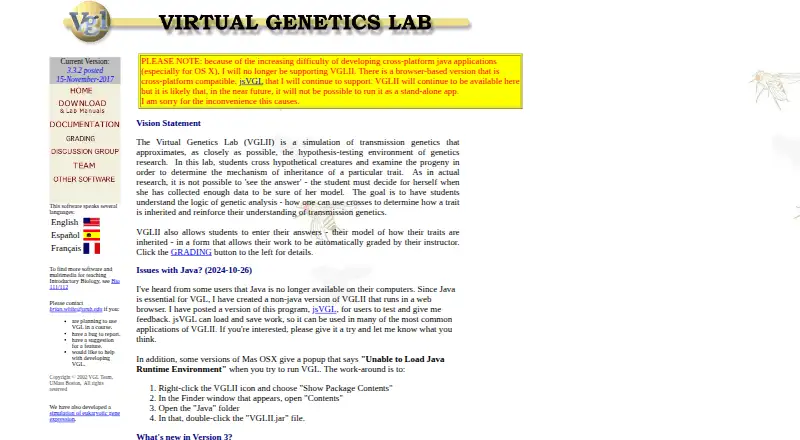
Virtual Genetics Lab II (VGLII) is a free simulation for students investigating how traits are inherited. Students cross hypothetical creatures and examine the offspring. Problems cover one to three genes, with traits modeled as autosomal or sex-linked and using simple dominance, co-dominance, or incomplete dominance; instructors can limit the available models. Model Builder lets students enter and save genetic models, while instructors can compare student answers with correct answers for grading. Version 3 includes chi-squared calculations in the Summary Chart, epistasis and complementation models, and Super Crosses with up to 2,000 offspring. Desktop downloads are listed for Windows, Mac OS X, and Linux/UNIX, and the download page says VGLII requires Java 7 or higher. The browser version, jsVGL, runs without Java and can load and save work. The maker says VGLII will no longer be supported, while support for jsVGL will continue. Some macOS versions may show an “Unable to Load Java Runtime Environment” message when starting VGLII; a workaround uses the app's VGLII.jar file.
Who it suits
VGLII is intended for biology learners studying inheritance, particularly at university level, and for instructors who want students to build and compare genetic models. The browser-based jsVGL option may suit users who prefer a version that runs without Java.
What it does well
- Models autosomal and sex-linked traits.
- Instructors can restrict available genetic models.
- Super Crosses can include up to 2,000 offspring.
- Model Builder supports saving student models.
- Browser version can load and save work.
What to know first
- Problems cover only one to three genes.
- VGLII requires Java 7 or higher.
- The maker says VGLII will no longer be supported.
- Some macOS versions may show a Java runtime error.
Limits
The free plan's problems cover one to three genes. The maker says desktop VGLII will no longer be supported, while support will continue for jsVGL.
Plans
| Plan | Billed and limits | Price |
|---|---|---|
| Virtual Genetics Lab II | Free; problems cover 1 to 3 genes | Free |
As vgl.umb.edu lists them, read 8 Oct 2026. The maker's own page has the final word.
Getting started
- Visit https://vgl.umb.edu/.
- Choose the browser version jsVGL or a desktop download.
- For desktop VGLII, use a system with Java 7 or higher.
- On macOS, use the maker's VGLII.jar workaround if the Java runtime launch message appears.
Virtual Genetics Lab II is a focused simulator for university genetics instruction. It is best suited to courses that assign inheritance problems and want students to build and assess genetic models. Its free price and configurable exercises are compelling, but the unsupported desktop edition makes the browser-based jsVGL the safer long-term choice.
Overview
VGLII lets learners cross hypothetical creatures, inspect offspring, and reason about how traits are transmitted. The format supports practice with observed inheritance outcomes rather than passive reading. Problems cover one to three genes, giving instructors a manageable scope for introductory and intermediate transmission-genetics work, but not a general-purpose environment for larger genetic systems.
The project was designed by four UMass Boston computer science master's students and Brian White. The maker says more than 3,500 biology students at UMass Boston had used it since 2003, indicating a substantial teaching history. That history does not remove the practical concern that VGLII itself is no longer supported.
Key features
Configurable inheritance models
Traits can be autosomal or sex-linked and can use simple dominance, co-dominance, or incomplete dominance. Instructors can limit the models available in an exercise, so a class can concentrate on the inheritance patterns currently being taught instead of confronting every possibility at once. The one-to-three-gene problem range keeps assignments focused, though it also limits advanced or highly complex scenarios.
Analysis tools
Version 3 adds chi-squared calculations in the Summary Chart, allowing students to evaluate whether observed offspring patterns fit an expected distribution. It also includes epistasis and complementation models, extending work beyond basic dominance. Super Crosses can generate up to 2,000 offspring, which is useful when a lesson needs a larger simulated sample to make ratios and deviations clearer.
Model Builder and assessment
Students can enter and save their own genetic models, turning the simulator into a problem-solving workspace rather than only a preset demonstration. Instructors can compare student answers with correct answers for grading. That combination is a strong fit for assessed laboratory or homework activities where the reasoning model matters as much as the final offspring results.
Pricing
Virtual Genetics Lab II costs nothing. The free plan covers problems involving one to three genes, with no paid tier or seat charge stated. It is therefore suitable for students, instructors, and classes that need a no-cost genetics simulator. The trade-off is product support: the maker says VGLII will no longer be supported, so a free licence does not come with an ongoing desktop maintenance commitment.
Platforms
VGLII is offered for Linux, macOS, Windows, and the web. Desktop downloads are listed for Windows, Mac OS X, and Linux/UNIX, and the desktop requirements call for Java 7 or higher, with operating-system coverage including Windows 9x and above, Solaris 8 and above, Linux, and Mac OS X 10.7 and above.
The browser edition, jsVGL, is a non-Java version that runs in a web browser and can load and save work. Because continued support is directed to jsVGL rather than VGLII, browser use is the more defensible deployment for institutions concerned about Java installation and future compatibility. Some macOS versions can display an “Unable to Load Java Runtime Environment” message when launching the desktop app; the maker provides a workaround using the app's VGLII.jar file.
Who it's for
University biology instructors can use VGLII for structured inheritance exercises, especially when they want students to construct models, analyze offspring, and submit work for comparison with correct answers. Students studying transmission genetics benefit from the combination of configurable crosses, statistical analysis, and saved models. It is less suitable for courses requiring more than three genes, a broad virtual-lab curriculum, or a desktop product with active vendor support.
Pros and cons
Pros
- Free for all users: the 0.00 USD plan removes licensing cost for classroom and individual study.
- Useful inheritance range: autosomal and sex-linked traits plus three dominance models support varied teaching objectives.
- Assessable workflow: Model Builder saves student models and lets instructors compare them with correct answers.
- Substantive analysis: chi-squared calculations, epistasis, complementation, and Super Crosses up to 2,000 offspring support quantitative investigation.
- Broad platform coverage: Linux, macOS, Windows, and a browser option accommodate mixed environments.
Cons
- Desktop support has ended: institutions adopting the installed app must accept a discontinued product.
- Java dependency: desktop use requires Java 7 or higher and can trigger a macOS runtime error.
- Bounded problem scale: exercises support only one to three genes, restricting more advanced modeling.
Alternatives
StarGenetics is the closest alternative for a free genetics simulator with web access and downloadable Linux, Windows, and Mac versions.
Choose 3D Organon instead for anatomy-focused 3D study, with a free Guest plan and a 74.50 USD-per-year Student subscription for desktop use.
Case It! is a free educational option spanning Android, iOS, macOS, web, and Windows.
BioDigital Human suits learners wanting 3D anatomy on Android, iOS, or the web; its free Personal plan allows 10 model views per month and five saved models.
PraxiLabs is a broader virtual-lab service with a free one-month plan covering three simulations and basic guidance.
BioMan Biology offers browser-based games, virtual labs, and learning activities free with ads, with a 49.00 USD-per-year ad-free Individual Teacher plan.
HHMI BioInteractive provides free life-science classroom resources and professional learning for high-school and undergraduate educators.
LabXchange is a free platform of educational resources for learners and educators worldwide.
Verdict
Choose Virtual Genetics Lab II when a university genetics course needs free, structured inheritance simulations with instructor-controlled models, quantitative analysis, and a grading workflow. Its focused one-to-three-gene scope is effective for core transmission-genetics assignments. Look elsewhere if continued desktop support, complex genetic modeling, or a broader catalog of virtual laboratories is essential; for this product, jsVGL is the more practical route.
Verdict
VGLII offers students a structured way to explore inheritance, with model-building and analysis features for instructors. The maker's continued support is for jsVGL rather than VGLII, so the browser version is an option to consider.
Questions
Does VGLII cost anything?
The Free plan costs nothing.
Which platforms are available?
VGLII desktop downloads are listed for Windows, Mac OS X, and Linux/UNIX. jsVGL runs in a web browser.
What genetic models can students use?
Traits can be autosomal or sex-linked and use simple dominance, co-dominance, or incomplete dominance. Instructors can limit the available models.
Can students save their work?
Students can enter and save genetic models with Model Builder. The browser version jsVGL can also load and save work.
Who made VGLII?
The maker says four UMass Boston master's students in computer science and Brian White designed and developed it.
Is VGLII still supported?
The maker says VGLII will no longer be supported and that support will continue for jsVGL.
Facts from Virtual Genetics Lab II's own pages
- Analysis features
- Version 3 includes chi-squared calculations in the Summary Chart, epistasis and complementation models, and Super Crosses of up to 2,000 offspring. · vgl.umb.edu, 8 Oct 2026
- Browser version
- The maker describes jsVGL as a non-Java version that runs in a web browser and can load and save work. · vgl.umb.edu, 8 Oct 2026
- Desktop availability
- The download page lists VGLII downloads for Windows, Mac OS X, and Linux/UNIX. · vgl.umb.edu, 8 Oct 2026
- Desktop requirements
- The download page says VGL requires Java 7 or higher and lists Windows 9x and above, Solaris 8 and above, Linux, and Mac OS X 10.7 and above. · vgl.umb.edu, 8 Oct 2026
- Genetic models
- Traits can be autosomal or sex-linked and can use simple dominance or co-dominance or incomplete dominance; instructors can limit the possible models. · vgl.umb.edu, 8 Oct 2026
- Known compatibility issue
- The maker says some macOS versions may show an “Unable to Load Java Runtime Environment” message when launching VGLII and provides a workaround using the app's VGLII.jar file. · vgl.umb.edu, 8 Oct 2026
- Maker and development
- The maker says VGLII was designed and developed by four UMass Boston master's students in computer science and Brian White. · vgl.umb.edu, 8 Oct 2026
- Model Builder
- Students can enter and save genetic models, and instructors can compare their answers with correct answers for grading. · vgl.umb.edu, 8 Oct 2026
- Problem limit
- The maker's comparison table says VGLII problems support one to three genes. · vgl.umb.edu, 8 Oct 2026
- Purpose
- VGLII simulates transmission genetics so students can investigate how traits are inherited by crossing hypothetical creatures and examining their offspring. · vgl.umb.edu, 8 Oct 2026
- Support
- The download page directs installation questions, troubleshooting requests, and bug reports to Brian White by email. · vgl.umb.edu, 8 Oct 2026
- Support status
- The maker says VGLII will no longer be supported and says it will continue supporting the cross-platform browser version, jsVGL. · vgl.umb.edu, 8 Oct 2026
- Use and audience
- The maker says VGLII had been used by over 3,500 biology students at UMass Boston since 2003. · vgl.umb.edu, 8 Oct 2026
Where Virtual Genetics Lab II stands on Freedom251
- Biology Learning Software#11 of 24