Freedom251 › AI Enterprise Search Software
Viglet Turing ES
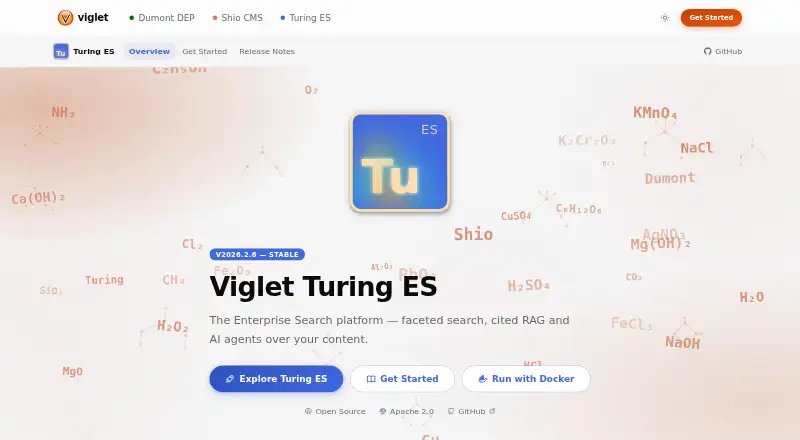
What Viglet Turing ES is
Viglet Turing ES is a free, open-source enterprise search platform that combines semantic navigation, content integration, and generative AI. Search features include facets, autocomplete, spotlights, targeting rules, result ranking, and per-site AI insights. For generative AI, it supports retrieval-augmented generation over indexed content, LLM instances, AI agents, tool calling, and MCP server integration. It works with Apache Solr, Apache Lucene, and Elasticsearch backends. Documented integrations include Adobe AEM and web crawlers, plus Dumont DEP connectors for databases, file systems, and WordPress. Listed LLM provider types include OpenAI, Anthropic, Gemini, Ollama, Amazon Bedrock, Cohere, Mistral, and Vertex AI. Deployment options include Docker, a standalone JAR, source builds, Docker Compose, and Kubernetes; the runtime requires Java 21. The maker says Turing ES is self-hosted on customer infrastructure, and documentation labels it Apache 2.0. The simple embedded-H2 setup is intended for local development and evaluation, not production. Authentication options include native sessions, OAuth2 social login, and Keycloak SSO; the integration proxy also rejects certain private or disallowed destinations as SSRF protection.
Who it suits
Turing ES suits organizations seeking self-hosted enterprise search with content integrations and generative AI capabilities. It may fit teams able to deploy and operate software requiring Java 21.
What it does well
- Free and open source under Apache 2.0.
- Supports Solr, Lucene, and Elasticsearch backends.
- Offers Docker, JAR, source, Compose, and Kubernetes deployment.
- Lists multiple LLM provider types.
- Provides native, OAuth2, and Keycloak authentication options.
What to know first
- Requires Java 21.
- Embedded H2 setup is not for production.
- Self-hosted on customer infrastructure.
Limits
The free plan is open source under Apache 2.0 and requires self-hosting. The documented embedded H2 setup is for local development and evaluation, not production.
Plans
| Plan | Billed and limits | Price |
|---|---|---|
| Viglet Turing ES | Open source · Apache 2.0 · Self-hosted | Free |
As viglet.org lists them, read 8 Oct 2026. The maker's own page has the final word.
Getting started
- Visit https://viglet.org/turing.
- Choose a documented deployment route: Docker, standalone JAR, source build, Docker Compose, or Kubernetes.
- Provide a Java 21 runtime.
- Configure a supported search backend and the content integrations you plan to use.
- Choose native sessions, OAuth2 social login, or Keycloak for authentication. The embedded H2 setup is for local development and evaluation.
Viglet Turing ES is an open-source enterprise search platform for organizations that want to connect content systems and generative AI to search. It suits teams able to run a Java-based service on their own infrastructure. Its breadth is compelling, but production users need a deployment beyond the embedded-H2 evaluation setup.
Overview
Turing ES combines semantic navigation, content integration and generative AI under the Apache 2.0 license. Self-hosting gives organizations control over where the service runs; in return, they operate the infrastructure and choose a production deployment approach. The documented options include Docker, a standalone JAR, source builds, Docker Compose and Kubernetes, with Java 21 required.
Key features
Search includes faceted results, autocomplete, spotlights, targeting rules, result ranking and AI insights for individual sites. That toolkit can support tailored discovery across sites and collections, making Turing ES more relevant to teams with varied content than to anyone seeking only a basic search box.
Teams can use Apache Solr, Apache Lucene or Elasticsearch as the search backend. Documented integrations cover Adobe AEM and web crawlers, alongside Dumont DEP connectors for databases, file systems and WordPress. Content connectors communicate with Turing ES through REST, giving teams several integration paths while leaving them responsible for fitting connectors and backend to their environment.
For generative AI, Turing ES supports retrieval-augmented generation over indexed content, LLM instances, AI agents, tool calling and MCP server integration. Documented provider types include OpenAI, Anthropic, Gemini, Ollama, Amazon Bedrock, Cohere, Mistral and Vertex AI. Answer citations are supported, which can help readers trace generated answers to indexed material.
Authentication options include native sessions, OAuth2 social login and Keycloak SSO using OAuth2 or OpenID Connect. With Keycloak enabled, Turing ES delegates authentication and validates access tokens as JWTs. REST API tokens are encrypted at rest, and the integration proxy blocks requests to private IP ranges, loopback addresses and disallowed schemes as SSRF protection. These controls suit teams with security requirements to address, though they still need to configure and operate the service.
Pricing
The Viglet Turing ES plan costs nothing. It is open source under Apache 2.0 and self-hosted, with no paid plan required to use the product. That makes it a fit for teams able to supply infrastructure and manage deployment themselves; the cost of operating that environment is theirs to handle.
The embedded-H2 simple setup is suitable for local development and evaluation only, not production. Production teams should select among the documented deployment options and provide an appropriate environment. The maker points users to GitHub for source code, issues and pull requests, and to the r/TuringES community for discussion.
Platforms
Turing ES supports API, Linux, macOS, web and Windows, and is self-hosted. Java 21 is the stated runtime requirement. The platform range and deployment choices are useful for teams with their own infrastructure, but do not remove the work of running the service.
Who it's for
Turing ES is a strong candidate for organizations that need enterprise search across connected content, want generative AI grounded in indexed material, and have the capacity to operate a self-hosted Java service. Teams already working with Solr, Lucene or Elasticsearch can choose among those backends. It is a weaker fit for buyers seeking a hosted service or a production-ready setup that avoids infrastructure decisions.
Pros and cons
Pros
- Apache 2.0 licensing and a free plan let teams self-host without a product license fee.
- Solr, Lucene and Elasticsearch backend support gives teams a choice of search engine.
- Content connectors and a broad set of documented LLM provider types create several paths for integrating existing systems.
- Keycloak token validation, encrypted API tokens and SSRF protections address important authentication and integration risks.
- Docker, JAR, source, Compose and Kubernetes deployment options accommodate different operating environments.
Cons
- Customers run Turing ES on their own infrastructure, so deployment and ongoing operation are their responsibility.
- The simple embedded-H2 setup is limited to development and evaluation, requiring production users to choose another documented approach.
- Java 21 is required, which may not suit teams that cannot support that runtime.
Alternatives
Consider Fess for a free Apache-licensed search option; consider OpenSearch for free Apache 2.0 software with no licensing fees. Korra offers a free plan capped at 100MB, while its Business plan uses custom pricing; it may suit buyers comparing a freemium option and a defined free tier. Elastic Search AI offers a free self-managed Elastic Stack plan and usage-based Serverless pricing, which may suit teams considering managed, usage-based deployment. GoSearch Analytics has a Pro plan at $20 per user/month with unlimited searches and GoAI conversations, private agents and AI answers, for teams that prefer a priced plan with those allowances. PipesHub offers a free, forever self-hosted Community Edition with Docker deployment, core indexing and search, and bring-your-own LLMs and embeddings. Onyx has a Business plan at $20 per user/month with annual billing, 40+ app connectors and community support, and a free plan and trial. Guru is another option for buyers considering an enterprise AI knowledge solution with custom pricing. Browse AI Enterprise Search Software for more options in the category.
Verdict
Choose Viglet Turing ES if your organization needs configurable enterprise search, connected content and AI capabilities on infrastructure it controls, and can operate a Java 21 service. The Apache 2.0 license, search backend choices and provider integrations make it a capable foundation. Look elsewhere if you need hosted operations or want to avoid choosing and managing a production deployment.
Verdict
Turing ES combines enterprise search, content connectivity, and generative AI in a self-hosted Apache 2.0 platform. Production teams should choose a documented deployment approach rather than the embedded-H2 evaluation setup.
Questions
How much does Viglet Turing ES cost?
The listed plan is free.
Is Viglet Turing ES open source?
Yes. It is listed as open source under the Apache 2.0 license.
Where can it be deployed?
It is self-hosted on the customer’s infrastructure. Documented options include Docker, a standalone JAR, source builds, Docker Compose, and Kubernetes.
Which platforms does it support?
The listed platforms are API, Linux, macOS, self-hosted, web, and Windows.
Which search backends and content integrations does it support?
Search backends include Apache Solr, Apache Lucene, and Elasticsearch. Documented content integrations include Adobe AEM, web crawlers, and Dumont DEP connectors for databases, file systems, and WordPress.
Which LLM providers are listed?
Provider types include OpenAI, Anthropic, Gemini, Ollama, Amazon Bedrock, Cohere, Mistral, and Vertex AI.
Facts from Viglet Turing ES's own pages
- API credential security
- REST API token values are encrypted at rest in the database. · docs.viglet.org, 8 Oct 2026
- API security
- The integration proxy rejects requests to private IP ranges, loopback addresses, or disallowed schemes as SSRF protection. · docs.viglet.org, 8 Oct 2026
- Authentication
- Authentication options include native sessions, social login through OAuth2, and Keycloak SSO with OAuth2/OpenID Connect. · docs.viglet.org, 8 Oct 2026
- Content connectors
- Documented content integrations include Adobe AEM and web crawlers, with connectors communicating with Turing ES through REST. · docs.viglet.org, 8 Oct 2026
- Content integrations
- The documentation lists AEM and web crawler integrations, and identifies Dumont DEP connectors for databases, file systems, and WordPress. · docs.viglet.org, 8 Oct 2026
- Data hosting
- The maker says Turing ES is self-hosted on the customer’s infrastructure. · viglet.org, 8 Oct 2026
- Deployment
- The installation guide documents Docker, standalone JAR, source builds, Docker Compose, and Kubernetes deployment options. · docs.viglet.org, 8 Oct 2026
- Deployment limitation
- The simple setup with embedded H2 is documented as suitable for local development and evaluation only, not production. · docs.viglet.org, 8 Oct 2026
- Generative AI
- It supports RAG over indexed content, LLM instances, AI agents, tool calling, and MCP server integration. · docs.viglet.org, 8 Oct 2026
- License
- The product documentation labels Turing ES open source under Apache 2.0. · docs.viglet.org, 8 Oct 2026
- LLM providers
- The documentation lists provider types including OpenAI, Anthropic, Gemini, Ollama, Amazon Bedrock, Cohere, Mistral, and Vertex AI. · docs.viglet.org, 8 Oct 2026
- Product
- Viglet Turing ES is an open-source enterprise search platform combining Semantic Navigation, content integration, and Generative AI. · docs.viglet.org, 8 Oct 2026
- Purpose
- Viglet Turing ES is an open-source enterprise search platform combining semantic navigation, content integration, and generative AI. · docs.viglet.org, 8 Oct 2026
- Runtime requirement
- The installation guide says Turing ES requires Java 21. · docs.viglet.org, 8 Oct 2026
- Search engines
- Turing ES supports Apache Solr, Apache Lucene, and Elasticsearch search backends. · docs.viglet.org, 8 Oct 2026
- Search features
- Its semantic navigation features include faceted search, autocomplete, spotlights, targeting rules, result ranking, and per-site AI insights. · docs.viglet.org, 8 Oct 2026
- SSO security
- With Keycloak enabled, Turing ES delegates authentication to Keycloak and validates access tokens as JWTs. · docs.viglet.org, 8 Oct 2026
- Support
- The maker’s homepage points users to GitHub for source code, issues, and pull requests, and to the r/TuringES community for discussion. · viglet.org, 8 Oct 2026
Where Viglet Turing ES stands on Freedom251
- AI Enterprise Search Software#10 of 26
- Enterprise Search Software#10 of 20