
Varnish Cache
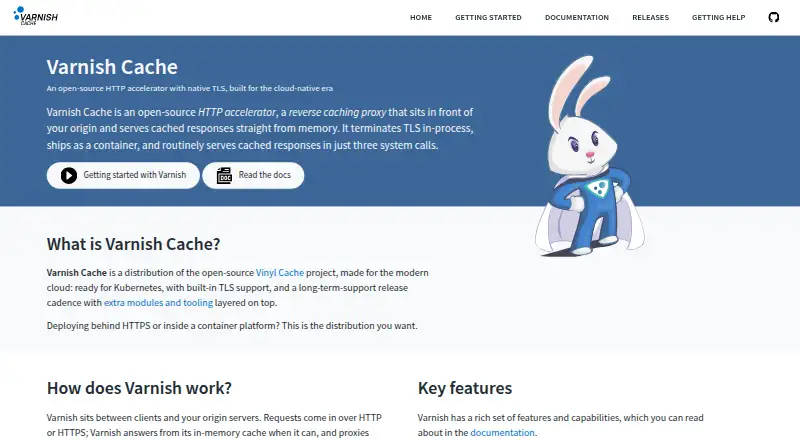
What Varnish Cache is
Varnish Cache is a free reverse caching proxy for Linux and self-hosted deployments. It serves cached responses from memory and forwards other requests to origin servers. You define its caching policy in Varnish Configuration Language (VCL), which compiles to native code. Cached objects follow standard HTTP cache headers and are removed when they expire. Varnish supports TLS termination within the process and TLS connections to dynamic origin backends. The project offers official container images and a Helm chart for Kubernetes, and documents installation on Debian, Ubuntu, Red Hat Enterprise Linux, and compatible distributions. For operations, varnishlog provides structured logging and varnishstat provides metrics. Varnish modules add functions callable from VCL. Its security guide describes controls at the command-line, CLI, VCL, and HTTP request levels. Varnish Cache is free, with a listed price of $0. The project identifies supported releases; unlisted releases are end-of-life and unsupported.
Who it suits
Varnish Cache suits teams running Linux or self-hosted services that need a configurable caching proxy. It may also suit deployments using Kubernetes or requiring TLS termination and operational logging or metrics.
What it does well
- Free plan listed as free
- VCL caching policies compile to native code
- Supports in-process TLS termination and dynamic backends
- Official container images and Kubernetes Helm chart
- Includes structured logs and metrics tools
What to know first
- Applications may need changes for a high cache hit rate
- Unlisted releases are end-of-life and unsupported
- Does not cache data unless it can determine caching is safe
Limits
The free plan is Varnish Cache for Linux and self-hosted deployment. Varnish does not cache data unless it can determine caching is safe, and applications may need configuration changes to achieve a high cache hit rate.
Plans
| Plan | Billed and limits | Price |
|---|---|---|
| Varnish Cache | Linux · self-hosted · BSD-2-Clause | Free |
As varnish.org lists them, read 2 Oct 2026. The maker's own page has the final word.
Getting started
- Open the Varnish website.
- Choose a documented Linux installation route for Debian, Ubuntu, Red Hat Enterprise Linux, or a compatible distribution.
- Alternatively, use an official container image or the Kubernetes Helm chart.
- Write caching policy in VCL and configure the service through its file-based configuration.
Verdict
Varnish Cache combines memory-based response caching with configurable policies, TLS support, and tools for logging and metrics. Check supported releases and assess whether your application needs configuration changes to reach its desired cache hit rate.
Questions
How much does Varnish Cache cost?
The listed Varnish Cache plan costs nothing.
Which platforms does it support?
The listed platforms are Linux and self-hosted deployment. Installation guidance covers Debian, Ubuntu, Red Hat Enterprise Linux, and compatible distributions.
Does Varnish Cache support TLS?
Yes. It supports TLS termination within the process and TLS to dynamic origin backends.
How are caching rules configured?
Caching policy is written in Varnish Configuration Language (VCL), which compiles to native code.
What support options are available?
The project points users to Discord, Stack Overflow, and LinkedIn. Commercial support is available through Varnish Software.
Facts from Varnish Cache's own pages
- Caching policy
- Caching policy is written in Varnish Configuration Language (VCL), which compiles to native code. · varnish.org, 2 Oct 2026
- Company
- Varnish Software was founded in 2010 as a spinoff of Redpill Linpro. · docs.varnish-software.com, 2 Oct 2026
- Containers
- Varnish provides official container images and a Helm chart for Kubernetes. · varnish.org, 2 Oct 2026
- Extensions
- Varnish modules (VMODs) are shared libraries whose functions can be called from VCL, and the project documents bundled and additional modules. · varnish.org, 2 Oct 2026
- Founded
- 2010 · varnish.org, 28 Sept 2026
- Headquarters
- Stockholm, Sweden · varnish.org, 28 Sept 2026
- HTTP behavior
- Cached objects follow standard HTTP cache headers and are evicted when they expire. · varnish.org, 2 Oct 2026
- Linux packages
- The project documents installation on Debian, Ubuntu, Red Hat Enterprise Linux, and compatible distributions. · varnish.org, 2 Oct 2026
- Logging and metrics
- The product includes varnishlog and varnishstat for structured logging and metrics. · varnish.org, 2 Oct 2026
- Notable limit
- The users guide says Varnish does not cache data unless it is sure doing so is safe, and notes that applications may need configuration changes to achieve a high cache hit rate. · varnish.org, 2 Oct 2026
- Purpose
- Varnish Cache is a reverse caching proxy that serves cached responses from memory and proxies other requests to origin servers. · varnish.org, 2 Oct 2026
- Security
- The security guide describes four control levels: command-line arguments, the CLI interface, VCL programs, and HTTP requests. · varnish.org, 2 Oct 2026
- Security updates
- The release page lists supported versions and says releases not listed there are end-of-life and unsupported. · varnish.org, 2 Oct 2026
- Support
- The project points users to Discord, Stack Overflow, and LinkedIn, and says commercial support is available through Varnish Software. · varnish.org, 2 Oct 2026
- TLS
- The product supports in-process TLS termination and TLS to dynamic origin backends. · varnish.org, 2 Oct 2026
Where Varnish Cache stands on Freedom251
- Caching Software#13 of 27
- Reverse Proxy Software#24 of 33