Freedom251 › Product Traceability Software
Trace-X
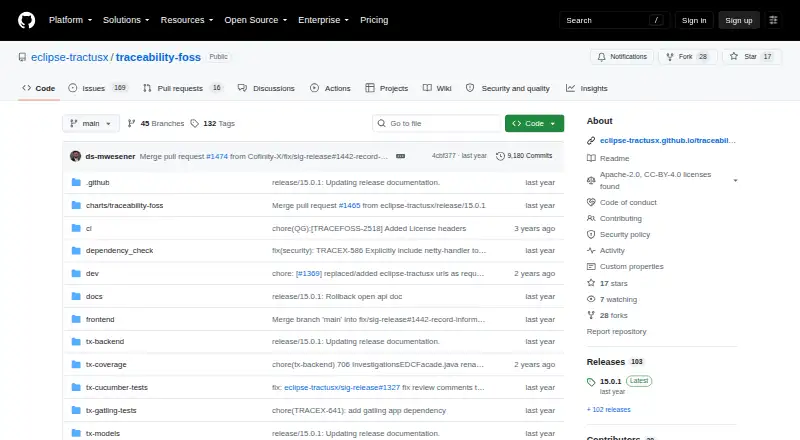
What Trace-X is
Trace-X is an open-source system for tracking parts across a supply chain. It is designed for companies ranging from small and medium-sized businesses to large original equipment manufacturers. The system can ingest information about serialized parts, batches, and their child components. Users can search and filter manufactured parts represented by as-built bills of material, as well as planned parts represented by as-planned bills of material. Part records include Asset Administration Shell descriptions and models for serial parts, batches, just-in-sequence processes, bills of material, and usage. A parts tree shows relationships between parts, while supplier and supply-chain views help users inspect the wider network. Trace-X also supports quality investigations exchanged between a company and supplier, and quality alerts sent from a company to its customers. Its stated aim is interoperable, standardized, data-sovereign traceability exchange within Catena-X, with access defined for participating companies and people. The web frontend is built with Angular and served through NGINX. REST endpoints are documented with the OpenAPI Specification, with a Swagger UI path. Deployment instructions use a Helm chart from the project’s chart repository. The software is free and open source, with API, Linux, self-hosted, and web listed as platforms.
Who it suits
Trace-X suits companies that need to follow serialized parts, batches, and component relationships across a supply chain, from SMEs to large OEMs. It is also relevant to organizations exchanging traceability data within Catena-X or coordinating supplier quality workflows.
What it does well
- Tracks serialized parts, batches, and their child components.
- Searches and filters planned and manufactured parts.
- Displays part relationships in a tree and supplier network.
- Supports quality investigations and customer quality alerts.
- Free and open source, with REST API documentation.
What to know first
- Local umbrella setup does not support sending or receiving quality notifications.
- Deployment instructions use a Helm chart from the project repository.
Plans
| Plan | Billed and limits | Price |
|---|---|---|
| Trace-X (open-source) | No paid plans or usage limits stated on the pages reviewed | Free |
| Open-source Trace-X | self-hosted deployment · no paid tiers stated | Free |
As github.com lists them, read 8 Oct 2026. The maker's own page has the final word.
Getting started
- Open the Trace-X project website on GitHub.
- Review the installation guide and Helm chart repository.
- Install the application using the documented Helm chart.
- Use the web frontend or documented REST endpoints and Swagger UI.
Trace-X is an open-source supply-chain traceability system for companies that need to follow parts from planned configuration through built products. It is a strong fit for teams prepared to run a self-hosted application and coordinate traceability data with suppliers. Its depth in part genealogy is a draw; the local umbrella deployment’s quality-notification constraint calls for care.
Overview
Trace-X ingests records for serialized parts, batches, and child components. Teams can search and filter manufactured parts represented by BoM AsBuilt and planned parts represented by BoM AsPlanned. Keeping planned and built records in view makes it useful for organizations that need to compare intended product structure with what was assembled.
A parts tree connects components to the larger product, while supplier-network and supply-chain views add business context. Asset Administration Shell descriptions and submodels cover SerialPart, Batch, JustInSequence, and planned and built BOM and usage models. This combination supports genealogy beyond a simple batch lookup, though it will be most relevant to companies that can work with these structured records.
The project aims to support standardized, interoperable, data-sovereign traceability exchange within Catena-X. It describes access as clearly defined and secure for participating companies and people. That makes the product a better match for supply-chain coordination than for a standalone inventory workflow.
Key features
Part tracking and supply-chain context
Serialization, lot and batch tracking, and product genealogy cover both individual parts and grouped production records. The tree view and supplier network help teams trace relationships and understand where a part sits in the supply chain.
Quality workflows and exchange
Trace-X’s feature set includes quality investigations sent to and received from suppliers, plus quality alerts sent to customers. These workflows can connect traceability with follow-up across company boundaries. However, the documented local umbrella setup excludes sending and receiving quality notifications because that requires another Trace-X instance. Organizations relying on that setup should account for this deployment limitation before treating the quality workflows as available end to end.
Web application and API
The browser frontend is built with Angular and served as static files through NGINX. Implemented REST endpoints are documented using the OpenAPI Specification, with a Swagger UI path for exploring the API. This offers a defined integration surface, while the application’s self-hosted deployment puts operational responsibility on the organization.
Pricing
Trace-X (open-source): free. The project is open source, with no paid plans or usage limits stated. The free plan is the only stated plan, so it suits organizations seeking to run the software without a subscription fee. The trade-off is that self-hosting and the required deployment setup remain part of the decision; the local umbrella setup also has the quality-notification limitation described above.
Platforms
Trace-X supports API, Linux, self-hosted, and web use. The Helm-chart installation documented by the project is aimed at teams able to manage an application deployment. Its static web frontend and REST API serve browser users and integrations, rather than offering a listed mobile platform.
Who it's for
The project targets companies from SMEs to large OEMs. It fits organizations that need serialized-part, batch, and component genealogy, want views across planned and built products, and have a reason to exchange traceability data with suppliers or customers. The breadth of records makes it relevant beyond lot-level tracking, but firms without the capacity to operate a self-hosted system or coordinate structured supply-chain data should look for a simpler hosted option.
For more options, browse Product Traceability Software.
Pros and cons
Pros
- Detailed product genealogy: Serialized parts, batches, child components, and planned and built BOM models help teams follow product structure rather than only lot identity.
- Supplier and supply-chain views: The parts tree and supplier network place records in their broader relationships.
- Open-source access: The stated plan costs nothing and has no stated usage limits.
- API documentation: OpenAPI-described REST endpoints and Swagger UI support teams planning integrations.
Cons
- Self-hosting is central to deployment: The documented installation uses Helm, so organizations must be prepared to operate the application.
- Local quality-notification gap: Sending and receiving notifications in the umbrella setup requires another Trace-X instance, limiting that setup for cross-company quality workflows.
- Catena-X orientation: Its stated exchange aim is tied to Catena-X, so it is less compelling for teams that do not need this kind of interoperable supply-chain coordination.
Alternatives
WHIMO is another free, open-source option, hosted by EFI or self-hosted, with Android and iOS as well as web and self-hosted platforms. Choose it when mobile platform availability matters more than Trace-X’s documented part and supply-chain views.
LotThread has a free Starter plan limited to one facility and three users, with materials and batch tracking, finished lots, and basic trace reports; Growth is $59 a month. It is a better fit for a small operation seeking a defined facility- and user-capped starting plan.
ReposiTrak Traceability Network gives retailers and wholesalers free network access, while supplier traceability is $59 a month. Choose it when free retailer or wholesaler access is the priority.
SusChain is free to run, modify, and distribute, with API, self-hosted, and web platforms. It is a relevant alternative for teams seeking a free, self-hosted traceability option.
FoodTraze is a paid, open-source product with Android, API, Linux, macOS, self-hosted, web, and Windows platforms. Consider it when that platform range is the deciding factor.
FoodLogiQ Traceability is a paid alternative with Android, API, iOS, and web platforms.
TagOne Enterprise is a paid alternative with Android, API, iOS, and web platforms.
TraceSense is a paid option whose stated plans include CMMS features such as asset maintenance, work orders, and reporting. Choose it when those maintenance workflows are the priority rather than Trace-X’s product genealogy focus.
Verdict
Choose Trace-X if your organization needs open-source part tracking with serialized and batch records, product genealogy, planned-versus-built views, and supplier context. Its strongest reason to choose it is that these traceability layers come together in a free system with an API and a Catena-X exchange aim. Look elsewhere if you need a hosted, low-operations product or depend on quality notifications in the local umbrella setup without deploying another Trace-X instance.
Verdict
Choose Trace-X if your organization needs open-source part tracking, product genealogy, and supply-chain views across planned and built components. Its quality workflows and Catena-X data exchange aim support company-to-supplier coordination. The documented local umbrella setup excludes quality notifications, which require another Trace-X instance.
Questions
How much does Trace-X cost?
The listed open-source plan costs nothing.
Is Trace-X open source?
Yes. The project describes Trace-X as open source.
Which platforms does it support?
The listed platforms are API, Linux, self-hosted, and web.
What can Trace-X track?
It can ingest serialized parts, batches, and child components, and show planned and manufactured parts.
Can companies exchange quality notifications?
The feature list includes quality investigations between a company and supplier, and quality alerts from a company to customers. Sending and receiving these notifications is outside the local umbrella setup and requires another Trace-X instance.
How is Trace-X installed?
The installation guide documents installing the application with a Helm chart from the project's chart repository.
Facts from Trace-X's own pages
- API
- Implemented REST endpoints are documented with the OpenAPI specification and exposed through a Swagger UI path. · github.com, 19 Oct 2026
- Backend requirements
- The documented backend prerequisites are JDK 21 and Docker Engine. · github.com, 19 Oct 2026
- Browser application
- The frontend is a TypeScript application based on Angular, with source files served statically through NGINX. · github.com, 8 Oct 2026
- Data exchange
- The project aims for standardized, data-sovereign, interoperable traceability-data exchange along the value creation chain within Catena-X. · github.com, 8 Oct 2026
- Data handling
- Trace-X can ingest data for serialized parts, batches, and their child components. · github.com, 8 Oct 2026
- Deployment
- The installation guide documents installing the application with a Helm chart from the project's chart repository. · github.com, 8 Oct 2026
- Ecosystem integration
- Catena-X identifies Traceability as a use case based on digital twins and shared data-space standards. · userjourney.catena-x.net, 19 Oct 2026
- Frontend local setup
- Local frontend development requires Node.js 18, Angular CLI and Yarn. · github.com, 19 Oct 2026
- Frontend technology
- The frontend is written in TypeScript with Angular and served as static files through NGINX. · github.com, 19 Oct 2026
- Independent product description
- Cofinity-X describes Trace-X as a live Catena-X solution for transparent, secure quality communication. · userguide.cofinity-x.com, 19 Oct 2026
- Installation
- Deployment instructions provide a Helm chart repository and a helm install command for Kubernetes. · github.com, 19 Oct 2026
- Installation limitation
- The installation guide says sending and receiving quality notifications is out of scope for its local umbrella setup because it would require another Trace-X instance. · github.com, 8 Oct 2026
- Intended users
- The project describes its audience as companies ranging from SMEs to large OEMs. · github.com, 8 Oct 2026
- Known backend limits
- The changelog records missing BPN validation, an incorrect 500 response for unauthenticated API access and unsorted parts and notification lists. · github.com, 19 Oct 2026
- Known frontend limit
- The changelog records an unhandled error when sorting an empty table. · github.com, 19 Oct 2026
- License
- Code is under Apache License 2.0 and non-code materials use CC BY 4.0. · github.com, 19 Oct 2026
- Limit: documentation access
- Cofinity-X says its general introduction omits technical implementation details and that deeper documentation is restricted to authorized users. · userguide.cofinity-x.com, 19 Oct 2026
- Limit: operating model
- Catena-X guidance says deploying your own connector requires deep in-house dataspace expertise and creates significantly higher operational burden. · userjourney.catena-x.net, 19 Oct 2026
- Part detail
- Manufactured-part details include Asset Administration Shell information and submodels such as SerialPart, Batch and JustInSequence. · github.com, 19 Oct 2026
- Part details
- The project lists Asset Administration Shell descriptions and submodels including SerialPart, Batch, JustInSequence, and planned and built BOM and usage models. · github.com, 8 Oct 2026
- Part views
- Users can list and view manufactured parts based on BoM AsBuilt and planned parts based on BoM AsPlanned, with filtering and search. · github.com, 8 Oct 2026
- Praise: blocking
- Cofinity-X lists real-time blocking notifications to isolate defective components before production or shipment. · userguide.cofinity-x.com, 19 Oct 2026
- Praise: data sovereignty
- Cofinity-X states that organizations control what data is shared, with whom and under which conditions. · userguide.cofinity-x.com, 19 Oct 2026
- Praise: investigations
- Cofinity-X says top-down investigations give suppliers a structured way to address incoming-part issues. · userguide.cofinity-x.com, 19 Oct 2026
Where Trace-X stands on Freedom251
- Product Traceability Software#2 of 27