Freedom251 › Data Preparation Software
timeseriesflattener
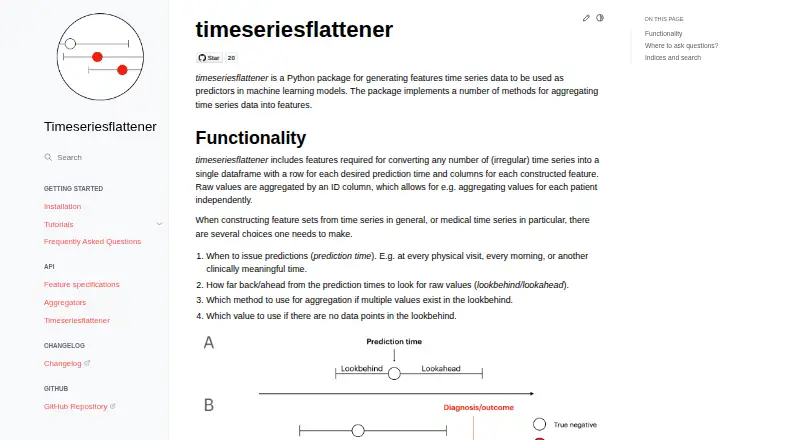
What timeseriesflattener is
timeseriesflattener is a Python package for turning irregular time-series observations into structured features for machine-learning predictors. It produces a dataframe with one row for each prediction time and columns containing constructed features, grouping observations by an ID column. Feature specifications define prediction times, lookbehind windows for predictors, and lookahead windows for outcomes. The documented aggregation choices include count, earliest, latest, maximum, mean, minimum, slope, sum, unique count, and variance. Its API describes temporal predictors, outcomes, boolean outcomes, static features, and time-delta features. A fallback value can be supplied when a relevant look window has no data. The package accepts pandas or Polars dataframes for prediction-time and static inputs. The documentation also demonstrates creating flattened predictors from pre-embedded text held in a dataframe with entity IDs, timestamps, and embedding columns. An introductory tutorial says n_workers can parallelize processing across multiple cores. Downloadable Jupyter notebook tutorials are available to run locally. The package is especially aimed at complicated, irregular time series used while training simple models. Installation is through pip, using the package name timeseriesflattener. It is deployed self-hosted, with bug reports and feature requests handled through GitHub Issues and general usage discussion through GitHub Discussions.
Who it suits
It suits Python users preparing irregular or complicated time-series data for machine-learning models, especially when working with pandas or Polars dataframes. Teams that need local notebooks, configurable time windows, and self-hosted processing can use its documented API.
What it does well
- Handles irregular time-series observations
- Supports pandas and Polars dataframes
- Offers many documented aggregation functions
- Defines predictor and outcome windows
- Allows fallback values for empty windows
- Tutorials include parallel processing
What to know first
- Requires Python and pip installation
- Runs as self-hosted software
- Designed around dataframe-based inputs
Getting started
- Install the package with pip install timeseriesflattener
- Prepare prediction-time or static data in pandas or Polars dataframes
- Define IDs, prediction times, and lookbehind or lookahead windows
- Select feature types and aggregation functions
- Run a downloadable Jupyter notebook tutorial locally
Verdict
Pick timeseriesflattener when you need configurable feature construction from irregular time series before training machine-learning models. Consider another option if you want a hosted service or a non-Python workflow rather than a self-hosted package installed with pip.
Questions
What does timeseriesflattener do?
It converts irregular time series into a dataframe with one row per prediction time and constructed feature columns, aggregating by an ID column.
Which dataframes are supported?
The API accepts pandas or Polars dataframes for prediction-time and static frames.
How is it installed?
The installation command is pip install timeseriesflattener.
Can it process text embeddings?
Yes. A tutorial demonstrates flattened predictors from pre-embedded text stored with entity IDs, timestamps, and embedding columns.
Does it support parallel processing?
The introductory tutorial says n_workers can parallelize operations across multiple cores.
Where are issues and questions handled?
Bug reports and feature requests go to GitHub Issues. Usage questions and general discussion go to GitHub Discussions.
Facts from timeseriesflattener's own pages
- Aggregations
- Documented aggregators include count, earliest, latest, maximum, mean, minimum, slope, sum, unique count, and variance. · aarhus-psychiatry-research.github.io, 4 Oct 2026
- Audience
- The introductory tutorial says the package is especially helpful for complicated and irregular time series when training simple models. · aarhus-psychiatry-research.github.io, 4 Oct 2026
- Dataframes
- The API accepts pandas or Polars dataframes for prediction-time and static frames. · aarhus-psychiatry-research.github.io, 4 Oct 2026
- Feature types
- The API documents temporal predictors, outcomes, boolean outcomes, static features, and time-delta features. · aarhus-psychiatry-research.github.io, 4 Oct 2026
- Install
- The official installation page instructs users to install the package with pip using `pip install timeseriesflattener`. · aarhus-psychiatry-research.github.io, 4 Oct 2026
- Missing values
- Feature specifications accept a fallback value for cases where the relevant look window has no data. · aarhus-psychiatry-research.github.io, 4 Oct 2026
- Output
- It converts irregular time series into a dataframe with one row per prediction time and columns for constructed features, aggregating values by an ID column. · aarhus-psychiatry-research.github.io, 4 Oct 2026
- Parallel processing
- The introductory tutorial says n_workers can parallelize operations across multiple cores. · aarhus-psychiatry-research.github.io, 4 Oct 2026
- Prediction windows
- Feature specifications let users set prediction times and lookbehind windows for predictors or lookahead windows for outcomes. · aarhus-psychiatry-research.github.io, 4 Oct 2026
- Pricing and trial
- The opened official documentation describes a Python package and installation instructions but states no price or free-trial terms. · aarhus-psychiatry-research.github.io, 4 Oct 2026
- Publication
- The package has a 2023 paper in the Journal of Open Source Software describing it as a Python package for summarizing features from medical time series. · joss.theoj.org, 4 Oct 2026
- Purpose
- timeseriesflattener is a Python package for generating time-series features used as predictors in machine-learning models. · aarhus-psychiatry-research.github.io, 4 Oct 2026
- Support
- The docs direct bug reports and feature requests to GitHub Issues and usage questions or general discussion to GitHub Discussions. · aarhus-psychiatry-research.github.io, 4 Oct 2026
- Text
- The text tutorial demonstrates generating flattened predictors from pre-embedded text represented as a dataframe with entity IDs, timestamps, and embedding columns. · aarhus-psychiatry-research.github.io, 4 Oct 2026
- Tutorials
- The documentation provides downloadable Jupyter notebook tutorials that users can run locally. · aarhus-psychiatry-research.github.io, 4 Oct 2026
Where timeseriesflattener stands on Freedom251
- Data Preparation Software#18 of 28