Freedom251 › Quality Assurance Software
Testrium
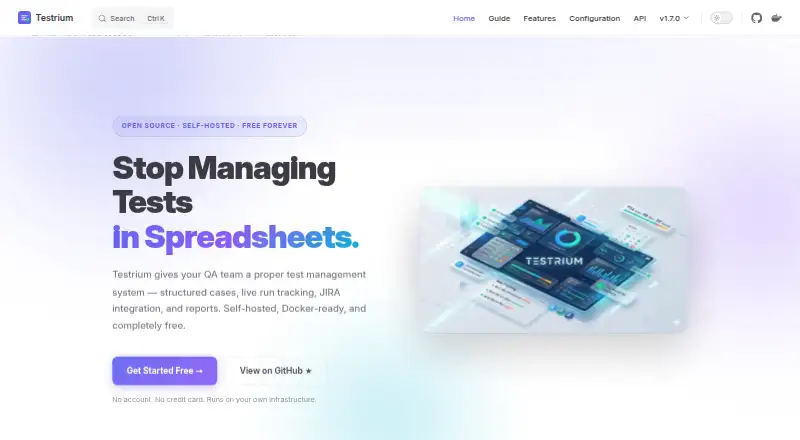
What Testrium is
Testrium is a free, self-hosted test case management system for organizing cases, running tests, tracking outcomes, and producing reports. Cases can include steps, expected results, priorities, and types, and can be imported from Excel or CSV. Test runs support individual or bulk execution and record progress, results, comments, and execution time. Reports are available in PDF and Excel, with charts, pass rates, and trend metrics. The JIRA integration can file bugs from failed runs, while the REST API supports environment-specific test data and posting or bulk-updating execution results. Documentation names Selenium, RestAssured, Playwright, and Cypress. Admin and User roles, project-level permissions, JWT authentication, and BCrypt password encryption are included. Teams host their data on their own infrastructure; the privacy policy says there is no telemetry, analytics, third-party data sharing, or communication back to Testrium servers. Docker Compose is recommended for setup, with deployment possible on a laptop, local server, or cloud VM. The free plan has no seat limits or feature paywalls. Docker deployment does not require Java or Node.js.
Who it suits
It suits QA engineers and managers, automation engineers, and development teams that want to manage cases and execution on their own infrastructure. It also fits teams seeking API support for automated test workflows.
What it does well
- Free plan has no seat limits or feature paywalls
- Imports test cases from Excel or CSV
- Produces PDF and Excel reports
- JIRA integration can file bugs from failed runs
- REST API supports automated execution updates
What to know first
- Teams must provide their own hosting
- No test planning or requirements linking
- Local development requires Java, Node.js, and Maven
Limits
The free plan is self-hosted, with no seat limits or feature paywalls. Testrium does not provide hosting; team data is stored on the operator’s own infrastructure.
Plans
| Plan | Billed and limits | Price |
|---|---|---|
| Free | Forever · Self-hosted · no seat limits · no feature paywalls | Free |
As testrium.github.io lists them, read 9 Oct 2026. The maker's own page has the final word.
Getting started
- Visit https://testrium.github.io/testrium/.
- Use Docker Compose, which the maker recommends for deployment.
- Choose a laptop, local server, or cloud VM for deployment.
- For local development, use Java JDK 17+, Node.js 18+, and Maven 3.9+.
- Use GitHub issues for questions and bug reports.
Testrium is a self-hosted system for managing test cases, runs, and results. It suits QA and development teams that can operate their own deployment. Its unlimited-seat free plan is appealing, but it does not cover test planning or requirements linking.
Overview
Testrium brings case organization, execution tracking, and reporting together. Cases support steps, expected results, priorities, and types, and teams can import them from Excel or CSV. Runs can be executed one at a time or in bulk, with progress, results, comments, and execution time recorded. That makes it a focused option for teams managing test execution rather than the full planning-to-requirements workflow.
Teams keep their data on infrastructure they operate: Testrium does not provide hosting, and its privacy policy says it uses no telemetry or analytics, shares no data with third parties, and does not communicate back to Testrium servers. Docker Compose is the recommended deployment method; it can run on a laptop, local server, or cloud VM. This control over data location comes with a real operational cost: the team must provide and maintain the environment.
Key features
Execution, reporting, and automation
PDF and Excel reports include charts, pass rates, and trend metrics, useful for sharing outcomes and following changes over time. The REST API fetches environment-specific test data and can post or bulk-update execution results. The documentation names Selenium, RestAssured, Playwright, and Cypress, making the API relevant to teams connecting automated runs to test management.
Integrations and access
The JIRA integration can file bugs from failed executions, which shortens the path from a test failure to an issue. Its API token is encrypted in the local database. Admin and User roles, project-level permissions, JWT authentication, and BCrypt password encryption provide basic controls for managing access. Teams needing test planning or requirements linking will need another tool or process; neither is part of Testrium’s scope.
Pricing
Testrium’s Free plan costs nothing, billed Forever. It is self-hosted, has no seat limits, and has no feature paywalls. There is no paid tier or cheaper plan with reduced capabilities to weigh against it, and no free trial is offered. The trade-off is that hosting and maintenance remain with the team. For Docker deployment, the maker says Java and Node.js installations are not required; local development calls for Java JDK 17+, Node.js 18+, and Maven 3.9+.
Platforms
Testrium supports API, Linux, macOS, web, and Windows, and is self-hosted. Docker Compose is the recommended setup. The Apache License 2.0 permits commercial use, modification, and redistribution subject to its conditions. For questions and bug reports, the maker directs users to GitHub issues.
Who it's for
QA Engineers, QA Managers, Automation Engineers, and Development Teams are the intended audience. It is a good fit for teams that want structured cases, tracked runs, reports, and automation connections without per-seat fees, and that are comfortable operating their own infrastructure. It is a weaker fit for teams seeking hosted service, test planning, or requirements traceability within the same product.
Pros and cons
- Unlimited seats and no feature paywalls: the free plan avoids user-count and feature-tier constraints.
- Practical automation links: the REST API supports environment-specific data and execution-result updates, with several common automation tools named in the documentation.
- Data stays on team infrastructure: the self-hosted model and stated privacy practices suit teams that want control over data location.
- Hosting is the team's responsibility: Testrium provides no hosted option, so deployment and upkeep are part of the decision.
- Limited process scope: it manages cases and runs but does not provide test planning or requirements linking.
Alternatives
Kualitee is worth considering if a hosted, freemium option is preferable: its Growth plan is free forever but limited to one project, 500 test cases, 200 defects, three users, and 20 AI credits per month per domain.
aqua may suit teams looking for a freemium alternative with a free trial and a Guest plan offering unlimited seats with read-only access.
Klaros-Testmanagement is another freemium test-management option to compare.
TestPlanIt is a close alternative for teams wanting self-hosting: its Self-Hosted plan is free forever, with unlimited users and projects and all features.
ThoroTest is another free, self-hosted option; its self-hosted plan supports SQLite or PostgreSQL.
TestBench is a paid alternative with a free trial.
TestLink is worth comparing if a free, GPL-licensed tool is preferred.
Tricentis Testim may fit teams focused on mobile and web testing; its free plan allows up to 1,000 runs per month, while paid pricing is customized.
Browse more options in Test Management Software.
Verdict
Choose Testrium if your QA or development team wants case management, execution, reporting, and automation connections without seat limits or feature paywalls, and can host the software itself. Look elsewhere if you need test planning, requirements linking, or a service that handles hosting for you.
Verdict
Testrium covers test cases, execution, reporting, and automation connections, with teams retaining their own data infrastructure. Its scope does not include test planning or requirements linking.
Questions
Is Testrium free?
Yes. Its Free plan costs nothing, billed Forever, with no seat limits or feature paywalls.
Which platforms does Testrium support?
Its listed platforms are API, Linux, macOS, self-hosted, web, and Windows.
Is Testrium open source?
It is released under the Apache License 2.0, which permits commercial use, modification, and redistribution subject to its stated conditions.
Does Testrium provide hosting?
No. Teams store data on their own infrastructure, and the maker recommends Docker Compose for setup.
Does it integrate with JIRA and automation tools?
The JIRA integration can file bugs from failed test executions. Its REST API supports test data and execution results; the documentation names Selenium, RestAssured, Playwright, and Cypress.
Who is Testrium for?
The maker identifies QA Engineers, QA Managers, Automation Engineers, and Development Teams as intended users.
Facts from Testrium's own pages
- Access control
- Testrium provides Admin and User roles with project-level permissions and uses JWT authentication and BCrypt password encryption. · testrium.github.io, 9 Oct 2026
- Automation
- Its REST API supports fetching environment-specific test data and posting or bulk-updating test execution results; the docs name Selenium, RestAssured, Playwright, and Cypress. · testrium.github.io, 9 Oct 2026
- Data location
- Testrium does not provide hosting, and its privacy policy says team data is stored on the operator’s own infrastructure. · testrium.github.io, 9 Oct 2026
- Deployment
- The maker recommends Docker Compose for setup and says Testrium can run on a laptop, local server, or cloud VM. · testrium.github.io, 9 Oct 2026
- JIRA
- The JIRA integration can file bugs from failed test executions and stores the API token encrypted in the local database. · testrium.github.io, 9 Oct 2026
- License
- Testrium is released under the Apache License 2.0, which permits commercial use, modification, and redistribution subject to its stated conditions. · testrium.github.io, 9 Oct 2026
- Privacy
- The privacy policy says Testrium has no telemetry, analytics, third-party data sharing, or communication back to Testrium servers. · testrium.github.io, 9 Oct 2026
- Product
- Testrium is a self-hosted test case management system for organizing test cases, executing runs, tracking results, and generating reports. · testrium.github.io, 9 Oct 2026
- Reporting
- Testrium generates PDF and Excel reports with charts, pass rates, and trend metrics. · testrium.github.io, 9 Oct 2026
- Requirements
- For Docker deployment, the maker says no Java or Node.js installation is required; local development lists Java JDK 17+, Node.js 18+, and Maven 3.9+. · github.com, 9 Oct 2026
- Support
- The maker directs users to GitHub issues for questions and bug reports. · github.com, 9 Oct 2026
- Test cases
- Users can create test cases with steps, expected results, priorities, and types, and import cases from Excel or CSV. · testrium.github.io, 9 Oct 2026
- Test execution
- Test runs support individual or bulk execution with progress tracking, results, comments, and execution time. · testrium.github.io, 9 Oct 2026
- Who it is for
- The maker identifies QA Engineers, QA Managers, Automation Engineers, and Development Teams as intended users. · testrium.github.io, 9 Oct 2026
Where Testrium stands on Freedom251
- Quality Assurance Software#10 of 29
- Test Management Software#19 of 48