Freedom251 › Photo Watermarking Software
Terma
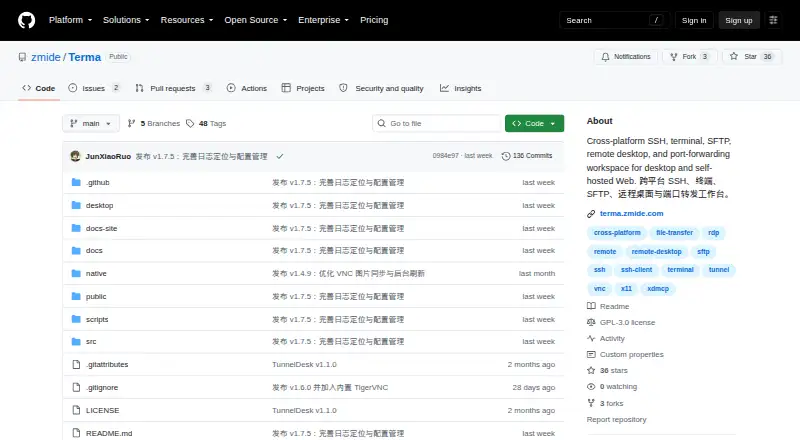
What Terma is
Terma brings remote access and administration tools into a single workspace for desktop and self-hosted Web environments. It combines SSH, terminals, SFTP, remote desktops, port forwarding, and batch commands, and also supports RDP, VNC, XDMCP, FTP/FTPS, Telnet, and serial connections. SSH sign-in can use passwords, private keys, or SSH Agent; an included wizard generates Ed25519 keys and deploys public keys. Terminal workspaces support multiple sessions, synchronized input across selected terminals, command snippets, and logs. SFTP tools cover file browsing, editing, transfers, permissions, compression, and synchronization between local and remote directories. Terma stores connections, forwarding rules, settings, and task state in SQLite, with backup and restore. It is free and open source under GPL-3.0, with desktop builds for Windows, macOS, and Linux and Web mode for Linux servers and Termux. It listens on loopback by default; LAN access calls for a Web password, and the maker warns against direct public Internet exposure.
Who it suits
Terma suits people who manage remote systems and want SSH, file transfer, terminal sessions, and other connection types in one workspace. It also offers a self-hosted Web mode for Linux servers and Termux.
What it does well
- Supports SSH, RDP, VNC, FTP/FTPS, Telnet, and serial connections.
- Terminal workspaces include synchronized input and command snippets.
- SFTP supports transfers, editing, permissions, and directory synchronization.
- Free and open source under GPL-3.0.
- Desktop builds and self-hosted Web mode are available.
What to know first
- Web access on a LAN calls for a Web password.
- The maker advises against direct public Internet exposure.
- macOS v1.7.5 packages are not code-signed or notarized.
Limits
The v1.7.5 macOS packages are not code-signed or notarized, and Gatekeeper may report that Terma is damaged or cannot be opened. XDMCP is unencrypted and intended only for a trusted LAN.
Plans
| Plan | Billed and limits | Price |
|---|---|---|
| Terma | GPL-3.0 licensed · desktop and self-hosted Web | Free |
As github.com lists them, read 11 Oct 2026. The maker's own page has the final word.
Getting started
- Open the Terma GitHub project.
- Choose a desktop build for Windows, macOS, or Linux, or use Web mode on a Linux server or Termux.
- Set a Web password if you plan to allow LAN access.
- Add a remote connection using a supported protocol and an available authentication method.
Overview
Terma is a free, GPL-3.0-licensed workspace for connecting to remote machines, working in terminals, and managing files. It suits administrators and technical users who handle several kinds of remote access; its range is useful, but Web deployment calls for careful network security.
Key features
Terma brings SSH, terminal sessions, SFTP, remote desktops, port forwarding, and batch commands into one workspace. That combination can simplify work across varied systems, especially when command-line access and file operations go hand in hand.
Connections and terminals
SSH supports password, private-key, and SSH Agent authentication. An Ed25519 wizard helps generate keys and deploy public keys, while host-fingerprint confirmation and warnings about changed trusted keys add safeguards against unexpected identity changes. RDP, VNC, XDMCP, FTP/FTPS, Telnet, and serial connections broaden its reach beyond SSH. XDMCP is unencrypted, so it belongs only on a trusted LAN.
Multi-session terminal workspaces, synchronized input, command snippets, and logs support repeatable work across connections. Synchronized input can save time when applying the same command to selected sessions, but it also raises the stakes of a mistake: a command may affect multiple machines at once.
Files and forwarding
SFTP covers browsing, editing, transfers, permissions, compression, and synchronization between local and remote directories. Terma also supports local and remote SSH forwarding, plus SOCKS5 dynamic forwarding, with templates and automatic reconnection options. These tools make the workspace more useful for routine administration, though the breadth is most valuable to people who actually use several of these capabilities.
Storage and security
Connections, forwarding rules, settings, and task state are stored in SQLite, with database backup and restore. Terma supports configuration encryption and says sensitive runtime data should be protected. Web mode listens on loopback by default; for LAN access, the maker recommends setting a Web password and advises against exposing the service directly to the public Internet. Access-token or Web-password authentication and private-network options such as Tailscale, ZeroTier, or WireGuard support more controlled access, but do not remove the need to configure the deployment carefully.
Pricing
Terma costs nothing under the Terma plan. The plan is GPL-3.0 licensed and includes desktop and self-hosted Web use. There is no paid tier or free trial; the free plan is the product, rather than a capped entry point that requires an upgrade. That makes it a straightforward fit for individuals and teams able to run and secure their own environment, but it is not a hosted service with a paid support or managed-use option.
Platforms
Desktop builds are available for Windows, macOS, and Linux. Web mode is supported on Linux servers and Termux, with mobile Web access described by the maker. The macOS release has a practical caveat: v1.7.5 packages are not code-signed or notarized, and Gatekeeper may warn that Terma is damaged or cannot be opened. Mac users should be prepared to handle that obstacle before choosing it.
Who it's for
Terma is a strong fit for technically confident users who manage remote machines across protocols and want terminal, file-transfer, and forwarding tools in one place. Its open-source license and self-hosted Web option suit people who value control over where the workspace runs. It is less suitable for users seeking a managed cloud product, or for anyone who cannot take responsibility for securing network access.
Pros and cons
- Pro: SSH, remote desktops, SFTP, forwarding, and several other protocols share one workspace, reducing the need to juggle separate tools for common remote tasks.
- Pro: SFTP synchronization, file operations, terminal logs, and multi-session features support practical administration workflows.
- Pro: The free GPL-3.0 plan covers desktop and self-hosted Web use without a paid-plan cap.
- Con: Web deployment requires deliberate security configuration; the maker warns against direct public-Internet exposure.
- Con: XDMCP is unencrypted, limiting it to trusted LAN use.
- Con: Unsigned, unnotarized macOS packages may trigger Gatekeeper warnings.
Alternatives
Terma is a remote connection workspace, while the alternatives below focus on photo watermarking. For a broader set of those tools, see Photo Watermarking Software.
- Watermarkly has a free batch-processing plan that adds its logo, plus 1-Year Access for $19.95 a year, billed annually and not renewing.
- eZy Watermark offers a free plan with templates, 300+ fonts, export to other apps, and high-resolution downloads, as well as a Premium plan.
- Watermark.ws has a free tier limited to one photo at a time, 1 GB storage, slow processing, and no custom fonts, alongside a Premium plan.
- wmk is a free, MIT-licensed Python CLI for Linux, macOS, and Windows, with no paid plans listed.
- DoWatermark offers browser-based free processing for batches of three images, with text and logo watermarks, saved presets, and no uploads, plus a one-time Pro plan.
- Overlay Studio is free for Android, iOS, and Web, with a 25-image batch limit that a supporter code raises.
- PictStamp is a free option for iOS and macOS.
- Watermark Maker offers a free mobile plan with text and logo watermarks, tiling, social export presets, small batches, and ads, plus a lifetime Pro purchase.
Verdict
Choose Terma if you want a free, open-source workspace that combines remote connections, terminal work, SFTP, and forwarding across desktop and self-hosted Web deployments. Its breadth is the main reason to choose it; its security responsibilities and macOS Gatekeeper friction are the strongest reasons to look elsewhere.
Verdict
Terma combines a broad set of remote connection and file-management tools in one free, self-hosted workspace. Its security guidance and macOS release limitation are worth considering before setup.
Questions
How much does Terma cost?
Terma is free. Its plan is listed as free.
Is Terma open source?
Yes. It is released under the GNU General Public License v3.0.
Which platforms does Terma support?
Desktop builds are available for Windows, macOS, and Linux. Web mode is supported on Linux servers and Termux.
Which connection protocols does Terma support?
It supports SSH, RDP, VNC, XDMCP, FTP/FTPS, Telnet, and serial connections.
Can Terma transfer and manage files?
Its SFTP tools support browsing, editing, transfers, permissions, compression, and synchronization between local and remote directories.
What should I know about Web access?
Terma listens on loopback by default. The maker advises setting a Web password for LAN access and warns against exposing it directly to the public Internet.
Facts from Terma's own pages
- Configuration security
- The README describes configuration encryption, protected runtime data, and access-token or Web-password authentication. · github.com, 11 Oct 2026
- Connection protocols
- It supports RDP, VNC, XDMCP, FTP/FTPS, Telnet, and serial connections in addition to SSH. · github.com, 4 Oct 2026
- Credential protection
- Terma supports configuration encryption and states that sensitive runtime data should be protected. · github.com, 4 Oct 2026
- Data storage
- Terma stores connections, forwarding rules, settings, and task state in SQLite and supports database backup and restore. · github.com, 4 Oct 2026
- Desktop platforms
- Desktop builds are available for Windows, macOS, and Linux. · github.com, 4 Oct 2026
- File management
- SFTP supports file browsing, editing, transfers, permissions, compression, and synchronization between local and remote directories. · github.com, 4 Oct 2026
- File transfer
- Its SFTP tools support browsing, editing, transfers, directory synchronization, and file operations such as compression and permission changes. · github.com, 11 Oct 2026
- Integrations
- The README names VS Code and custom editors for remote-file editing, and Tailscale, ZeroTier, or WireGuard as private-network options. · github.com, 11 Oct 2026
- License
- The repository states that Terma is released under the GNU General Public License v3.0. · github.com, 11 Oct 2026
- macOS release limitation
- The v1.7.5 release page says macOS packages are not code-signed or notarized and Gatekeeper may report that Terma is damaged or cannot be opened. · github.com, 4 Oct 2026
- Maker
- The maker’s GitHub organization says it was founded in 2017 and describes its work as network services and software development. · github.com, 4 Oct 2026
- Network security
- The README advises against exposing Terma directly to the public Internet and says XDMCP is unencrypted and intended only for a trusted LAN. · github.com, 11 Oct 2026
- Platforms
- Desktop builds are available for Windows, macOS, and Linux; Web mode is supported on Linux servers and Termux. · github.com, 11 Oct 2026
- Port forwarding
- It supports local, remote, and SOCKS5 dynamic SSH forwarding, with templates and automatic reconnection options. · github.com, 11 Oct 2026
- Product
- Terma combines SSH, terminals, SFTP, remote desktops, port forwarding, and batch commands in one workspace. · github.com, 4 Oct 2026
- Protocols
- The project lists RDP, VNC, XDMCP, FTP/FTPS, Telnet, and serial connections alongside SSH. · github.com, 11 Oct 2026
- Purpose
- Terma combines SSH, terminals, SFTP, remote desktops, port forwarding, and batch commands in one workspace. · github.com, 11 Oct 2026
- Release
- The latest release page opened is v1.6.4, dated September 7, 2026, and describes maintenance fixes and an updated SFTP transfer library. · github.com, 11 Oct 2026
- Security
- The service listens on loopback by default; the maker advises setting a Web password for LAN access and warns against exposing Terma directly to the public Internet. · github.com, 4 Oct 2026
- SSH
- It supports password, private-key, and SSH Agent authentication, plus host fingerprint confirmation and warnings when trusted host keys change. · github.com, 11 Oct 2026
- SSH authentication
- SSH authentication supports passwords, private keys, and SSH Agent, and includes an Ed25519 key-generation and public-key deployment wizard. · github.com, 4 Oct 2026
- Terminal features
- Terminals support multi-session workspaces, synchronized input across selected terminals, command snippets, and terminal logs. · github.com, 4 Oct 2026
- Use case
- The maker describes Terma as a remote connection workspace for desktop and self-hosted Web environments. · github.com, 4 Oct 2026
- Web access
- The service listens on loopback by default, and the README recommends setting a Web password for LAN access. · github.com, 11 Oct 2026
Where Terma stands on Freedom251
- Photo Watermarking Software#5 of 33