Freedom251 › Talent Intelligence Software

Talentware
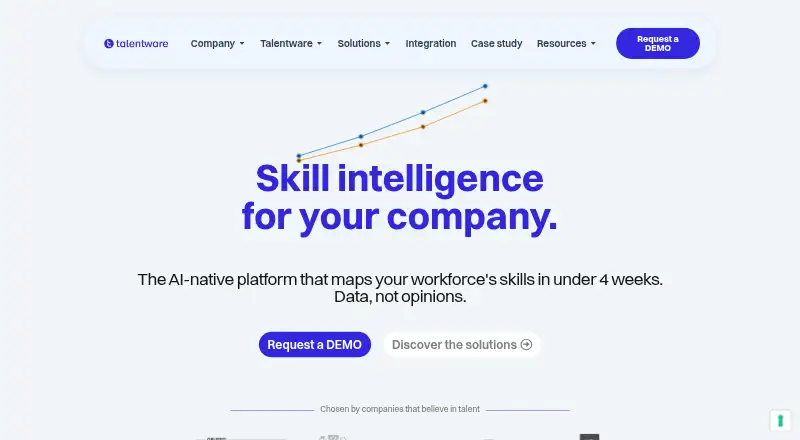
What Talentware is
Talentware is an AI-native platform for managing workforce skills, available on the web and through an API. Its Skill Intelligence module maps company skills and analyzes gaps; AI Assessment evaluates skills, including hard skills, through realistic work scenarios with standardized criteria. Six modules cover Skill Intelligence, Planning & Mobility, Development, Performance Review, Pay Transparency, and AI Assessment, and organizations can activate them over time. Talentware connects with HCM, LMS, ATS, and performance systems, and supports REST APIs, webhooks, and scheduled or live synchronization. It is designed to complement existing HR systems rather than replace an HRIS or LMS. Organizations can build a skills framework from scratch or use existing taxonomies, with configurable assessments and role-based permissions. The company says it is designed for medium- to large-sized businesses, including organizations with transformation, mobility, or succession-planning needs. Talentware was founded in 2023 within Bain & Company's Venture Studio and is headquartered in Milan, Italy. Pricing is on request.
Who it suits
Talentware is intended for medium- to large-sized businesses, particularly those working on transformation, internal mobility, or succession planning. It may suit organizations seeking to add skills management alongside existing HR systems.
What it does well
- Maps company skills and analyzes gaps
- Six modules can be activated gradually
- Connects with HCM, LMS, ATS, and performance systems
- Supports REST APIs and webhooks
- Configurable assessments and role-based permissions
What to know first
- Pricing is available on request
- It complements rather than replaces HRIS or LMS platforms
- Initial go-live depends on users, data, modules, and integrations
Getting started
- Visit the Talentware website.
- Contact the company to request pricing.
- Choose which modules to activate.
- Set up a skills framework from scratch or integrate existing taxonomies.
- Connect the platform to existing HR systems using integrations or API options.
- Arrange onboarding and go-live workshops with the Customer Success Manager.
Talentware is a skills-based talent platform for organizations that want to connect workforce capabilities to planning, development and mobility. It is best suited to medium-to-large businesses with existing HR systems and complex talent needs. Its modular scope is a strong fit for that work, but custom pricing and integration requirements call for careful planning.
Overview
Founded in 2023 within Bain & Company’s Venture Studio, Talentware is designed to complement existing HR systems rather than replace an HRIS or LMS. That makes it a skills-focused layer for organizations that want to coordinate talent decisions without moving their core HR or learning records. The platform brings skills mapping together with planning, matching, internal mobility and development.
Talentware is aimed primarily at organizations with 150 to 5,000 employees; its integration FAQ says positive ROI is possible above 50 employees. Those figures make it worth considering beyond large enterprises, but its modular scope and integration needs are more compelling for businesses with established systems and a clear skills-management agenda.
Key features
Skill Intelligence automatically maps company skills and analyzes gaps. This gives workforce planners a structured view of capabilities and shortages, while labor-market data and external benchmarking add context beyond the organization’s own workforce. Talent matching, internal mobility and workforce planning extend that view into decisions about where skills are needed and how to develop or deploy them.
The six modules—Skill Intelligence, Planning & Mobility, Development, Performance Review, Pay Transparency and AI Assessment—can be activated gradually. Phasing adoption can help organizations focus on immediate priorities, but buyers should decide which modules belong in their processes before committing to a platform priced on request.
AI Assessment evaluates skills, including hard skills, through realistic work scenarios and standardized criteria rather than self-assessment questionnaires. Configurable assessments and role-based permissions support different roles and evaluation needs. Organizations can build a skills framework from scratch or integrate an existing taxonomy, which is useful when internal job and skill definitions already matter to hiring and development decisions.
Talentware says it connects with HCM, LMS, ATS and performance systems, naming SAP SuccessFactors, Oracle, Workday, Inaz, Talentia, HiBob, Skilla, Docebo, Cornerstone and Teamtailor. Its integration options include REST APIs, webhooks, scheduled or live synchronization, and custom connections to proprietary systems, databases and specialist tools. This breadth can make it a practical companion to an existing HR stack; the number and nature of required connections will shape implementation. Initial go-live can be possible in less than a month, depending on users, data quality, modules and integrations.
The company states that it complies with GDPR and uses encryption in transit and at rest, role-based access controls, audit logging and certified cloud infrastructure. It also says it has signed the European Commission’s EU AI Pact and describes its AI as explainable and human-centered, with decisions remaining under human control. Customers receive a dedicated Customer Success Manager, onboarding and go-live workshops, direct Microsoft Teams communication, monitoring sessions and multi-level technical support.
Pricing
Talentware is paid software with custom pricing. Organizations should request a quote based on their needs and weigh the selected modules and integration requirements when assessing the commitment. The gradual module rollout can focus adoption, but there is no fixed plan price to compare before scoping the purchase.
Platforms
Talentware is available on the web and through an API. Its API and integration options are central to its role as a layer alongside existing HR systems, rather than a replacement for them.
Who it's for
Talentware is a strong candidate for medium-to-large businesses undergoing transformation or managing internal mobility and succession planning. It is particularly relevant when leaders need a view of workforce skills that can inform planning, development and talent allocation across existing HR tools. Smaller organizations seeking a standalone HRIS or LMS replacement should look elsewhere: Talentware is designed to complement those systems, not take their place.
Pros and cons
- Pros: Automatic skills mapping and gap analysis connect workforce capabilities to planning and development.
- Pros: Six gradually activated modules let organizations phase adoption around their priorities.
- Pros: Connections to common HR platforms, plus APIs and custom integrations, support use alongside an existing technology stack.
- Pros: Scenario-based assessment evaluates skills through work tasks rather than relying on self-assessment questionnaires.
- Cons: Custom pricing makes costs harder to compare before the organization scopes its modules and integrations.
- Cons: Go-live depends on data quality, user needs and integration work, so a quick initial rollout is not guaranteed.
- Cons: It complements rather than replaces HRIS and LMS systems, which limits its fit for buyers seeking a single core platform.
Alternatives
Talent Intelligence Software is a useful starting point for comparing products in the category.
Talentguide is worth considering when a team wants a free web-based evaluation sandbox: its Sandbox plan costs nothing for up to 5 seats and includes skills-gap analysis, development plans, skills evaluation and workforce planning. Talentware is the more relevant option for organizations needing its broader module set and integrations.
Eightfold Talent Intelligence is another paid option, with Android, iOS, web and API platforms. Choose between them based on platform fit and the talent capabilities your organization needs.
365Talents suits buyers who want modules priced individually, with standard connectors included and commitments of 3 to 5 years available. Talentware may suit organizations that prefer to phase its six modules, while both call for a scoped commercial discussion.
Draup is another paid option available through web and API.
Gloat Skills Foundation is a paid web option with pricing available by contacting Gloat or requesting a demo.
JobsEQ is a paid web and API subscription quoted after a scoping conversation, with pricing depending on products, organization size and type, users and data delivery needs. It does not offer a free trial.
Lightcast Labor Market Intelligence is a paid web and API option whose price depends on organizational needs and goals, with software subscriptions, consulting and data delivery options.
Reejig may suit buyers looking for a published annual price: its Work OS plan is $250,000 a year, billed every 12 months on a 12-month contract.
Verdict
Choose Talentware if your organization wants to connect skills mapping and assessment to workforce planning, development and internal mobility while keeping its existing HR systems in place. Its modular rollout, scenario-based assessment and integration options are the main reasons to shortlist it. Look elsewhere if you need a core HR or learning system replacement, or if you need straightforward pricing before defining your modules and integrations.
Verdict
Talentware brings skills mapping, assessment, planning, and development into a modular platform that connects to existing HR tools. Organizations should assess module and integration needs alongside its custom-quoted pricing.
Questions
How much does Talentware cost?
Pricing is on request.
Which platforms can I use Talentware on?
Talentware is available on web and through an API.
Does Talentware replace an HRIS or LMS?
No. It is designed to complement existing HR systems and does not replace HRIS or LMS platforms.
What systems does Talentware integrate with?
It says it integrates with HCM, LMS, ATS and performance systems, and names SAP SuccessFactors, Oracle, Workday, Inaz, Talentia, HiBob, Skilla, Docebo, Cornerstone and Teamtailor.
Who makes Talentware?
Talentware Srl says it was founded in 2023 within Bain & Company’s Venture Studio. It is headquartered in Milan, Italy.
Can companies activate modules gradually?
Yes. Talentware’s six modules can be activated gradually.
Facts from Talentware's own pages
- AI assessment
- AI Assessment evaluates skills, including hard skills, through realistic work scenarios using standardized criteria. · talentware.ai, 2 Oct 2026
- API
- The integration page describes API-driven connections, REST APIs, webhooks, scheduled or live synchronisation, and custom data-field mapping. · talentware.ai, 3 Oct 2026
- Assessments
- AI Assessment evaluates skills through realistic work scenarios using standardised criteria, rather than self-assessment questionnaires. · talentware.ai, 3 Oct 2026
- Company
- Talentware says it was founded in 2023 within Bain & Company’s Venture Studio. · talentware.ai, 2 Oct 2026
- Customization
- The skills framework, Compatibility Score criteria, assessment cycles, and role-based permissions can be configured for each organisation. · talentware.ai, 3 Oct 2026
- Founded
- 2023 · talentware.ai, 28 Sept 2026
- Headquarters
- Milan, Italy · talentware.ai, 28 Sept 2026
- Integrations
- Talentware integrates with HCM/HRIS, LMS, ATS, and performance systems; named platforms include SAP SuccessFactors, Workday, Oracle HCM, HiBob, Docebo, Cornerstone, and Teamtailor. · talentware.ai, 3 Oct 2026
- Intended users
- The FAQ says Talentware is designed for medium- to large-sized businesses, including organizations undergoing transformation and those with internal mobility or succession-planning needs. · talentware.ai, 2 Oct 2026
- Maker and founding
- Talentware Srl says it was founded in 2023 within Bain & Company's Venture Studio. · talentware.ai, 3 Oct 2026
- Modules
- Its six modules cover Skill Intelligence, Planning & Mobility, Development, Performance Review, Pay Transparency, and AI Assessment. · talentware.ai, 3 Oct 2026
- Not a system of record
- Talentware says it complements existing HR systems and does not replace HRIS or LMS platforms. · talentware.ai, 2 Oct 2026
- Organisation size
- The FAQ says Talentware is designed for medium- to large-sized businesses; its integration FAQ specifies service for organisations with 150 to 5,000 employees and positive ROI above 50 employees. · talentware.ai, 3 Oct 2026
- Product
- Talentware is an SaaS AI-native, skill-based talent management platform for mapping, assessing, developing, and activating workforce skills. · talentware.ai, 3 Oct 2026
- Responsible AI
- Talentware says it signed the European Commission's EU AI Pact and describes its AI as transparent, explainable, human-centred, and under human control. · talentware.ai, 3 Oct 2026
- Rollout
- The FAQ says initial go-live is possible in less than a month, depending on user count, data quality, selected modules, and integration needs. · talentware.ai, 3 Oct 2026
- Security
- The security page states GDPR compliance, encryption during transmission and at rest, role-based access controls, audit logging, and hosting on certified cloud infrastructure. · talentware.ai, 3 Oct 2026
- Skill mapping
- The platform combines fragmented HR data into a dynamic skill map and says it can map a workforce in under four weeks. · talentware.ai, 3 Oct 2026
- Support
- Each customer receives a dedicated Customer Success Manager, onboarding and go-live workshops, a Microsoft Teams channel, monitoring sessions, and multi-level technical support. · talentware.ai, 3 Oct 2026
- Talent modules
- The six modules are Skill Intelligence, Planning & Mobility, Development, Performance Review, Pay Transparency and AI-Assessment, which can be activated gradually. · talentware.ai, 2 Oct 2026
Where Talentware stands on Freedom251
- Talent Intelligence Software#27 of 29